6945716_make
by Charles Platt
Burn components on purpose, reason backward from the smoke, and electronics suddenly makes sense. Platt's hands-on approach turns deliberate destruction into…
In Brief
Make: Electronics (2008) teaches electronics through deliberate hands-on experimentation, starting with intentional failures that reveal how components actually behave. Charles Platt builds each concept from observed results before introducing theory, so readers gain true circuit intuition — including how to diagnose failures that software alone cannot identify.
Key Ideas
Deliberately test boundaries for true understanding
Before learning any technical skill, build a failure-tolerant environment first — then deliberately break things at the boundary. Understanding comes from observing the failure, not from avoiding it.
Show data consequences before abstract formulas
Never introduce a formula before the reader has watched its consequence. Let the data table appear first; the formula is just compression for a pattern already witnessed.
System limits specify required tools next
When a circuit (or system) hits a limit, that limit is specifying the next tool you need. Treat gaps as requirements documents.
Silent failures deserve heightened caution budgets
The most dangerous failures in any system are invisible ones: they look correct under casual inspection and reveal themselves only under magnification or unexpected load. Budget more caution for silent failures than for dramatic ones.
Simple general primitives outlast complex solutions
Simple, general primitives at the right level of abstraction outlast complex, specific solutions. The 555 timer's 40-year design stability is a more useful engineering lesson than any individual feature it enables.
Hardware knowledge diagnoses abstraction-hidden failures
Every layer of abstraction inherits the failure modes of the layer below but hides them from view. Hardware knowledge is not made obsolete by software — it becomes the diagnostic tool for failures that software cannot name.
Who Should Read This
Science-curious readers interested in Skill Acquisition and Learning who want to go beyond the headlines.
Make: Electronics
By Charles Platt
11 min read
Why does it matter? Because every technical subject is best learned backward — from the broken thing.
If electronics has always felt like a subject that requires a certain kind of brain you weren't issued, this book starts by proving that instinct wrong. Most electronics books treat mistakes the way restaurants treat health inspections — something to minimize, document, and survive. Charles Platt's first instruction is to short-circuit a battery until the fuse explodes. His second is to touch nine volts to your tongue. He explains the math afterward, once you've already seen the numbers make sense of what you felt. The one catch: five battery chemistries — lithium cells, lead-acid, and a few others that can catch fire or explode — you must never short-circuit this way. By the time he tells you that, you already understand why, which is the whole method in miniature. By the end, you'll have a mental model of voltage, current, and switching clear enough to reason about any circuit without reaching for a reference: not because you memorized theory, but because you destroyed enough things to know exactly where the limits are.
The Safest Way to Learn Electronics Is to Break Things on Purpose
Destroying components is not a side effect of learning electronics — it is the method. Charles Platt opens his workbench guide by telling you, without apology, to burn things out and mess things up. Most introductory books treat this as a disaster to prevent. Platt treats it as the fastest path to understanding.
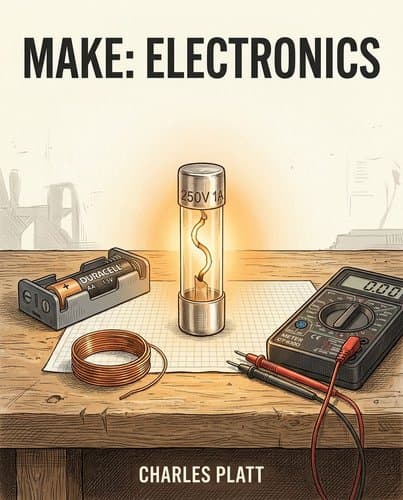
The setup that makes this viable is precise. In the second experiment, you're instructed to short-circuit a battery, connecting both terminals directly so electricity has nowhere to go but through the wire. The wires get hot. The battery gets hot. Then you attach a 3-amp fuse and watch a tiny S-shaped sliver of metal inside it melt nearly instantaneously. This is deliberate destruction, and you come away knowing exactly what a fuse does and why: it sacrifices itself to protect everything downstream.
But this only works within limits Platt names explicitly. A car battery shorted the same way can explode, spraying acid. A wall outlet produces a flash, molten metal, and particles that can blind you. The safe experiment uses one alkaline AA cell, 1.5 volts, in a holder with thin insulated wires. Every element of that constraint is load-bearing.
The payoff comes when you do the math afterward. Touch a 9-volt battery to your moist tongue and you feel a tingle: no heat, just a sharp electric fizz. Short a 1.5-volt AA through a wire and the wire gets hot enough to notice within a minute. How can lower voltage produce more heat? Your tongue has roughly 50,000 ohms of resistance, so 9 volts pushes only about 0.18 milliamps through it. The wire's resistance is near zero (maybe 0.1 ohms), so even 1.5 volts drives roughly 15 amps. A hundred thousand times more current. You didn't learn this from a formula. You felt both outcomes first, then the math arrived to explain what your body had already registered.
Ohm's Law Isn't a Starting Point — It's a Name for Something You Already Observed
You're sitting at a workbench with a knob in your hand. It's attached to a potentiometer — a coil of resistive wire with a wiper that slides along the wire when you turn the shaft. You've wired it into a circuit with a battery pack and a resistor, and your multimeter is clipped in to measure current. Turn the knob clockwise: resistance drops, the meter climbs. Turn it back: resistance rises, the reading falls.
Platt has you write down three data points. At 3,000 ohms, the current is 2 milliamps. At 2,000 ohms, it's 3. At 1,000 ohms, it's 6. Stare at those three rows. Something is suspiciously consistent: multiply each resistance by its current and you get 6 every single time. Six is also the voltage your battery pack supplies.
Think about water moving through a pipe. Voltage is pressure — how hard it pushes at the source. Current is flow rate — how much water moves per second. Resistance is a narrowing: squeeze the pipe tighter and flow drops; widen it and flow surges, as long as the pressure stays the same. You've been watching that relationship play out on a meter this whole time, just in volts, milliamps, and ohms instead of PSI and gallons.
That pattern has a name: Ohm's Law. Voltage equals current times resistance, V = I × R. But you didn't get the law from a definition. You got it from three rows of data you made yourself, and the formula is compression — shorthand for something you already watched happen.
The formula earns its place fast. Say you want to light an LED: you have a 6-volt battery and an LED that will burn out above 20 milliamps. The data sheet says its forward voltage is about 2.5 volts, meaning your resistor has to absorb the remaining 3.5 volts while keeping current at or below 20 milliamps. Rearrange: R = V ÷ I = 3.5 ÷ 0.02 = 175 ohms. Round up to 180. The LED lights up and nothing burns out — because the formula told you exactly what to use before you touched anything.
You Don't Learn What a Transistor Does Until a Relay Fails to Do It
Think of the moment you discover you need reading glasses — not from an optometrist telling you, but from a menu you can't quite bring into focus. The need precedes the solution, and the solution lands because the frustration already created space for it. Platt's chapter on switching works exactly this way. He doesn't introduce components in any logical order. He introduces them at the exact moment the previous circuit breaks.
The relay-as-oscillator experiment makes this visible. Wire a relay so its own contacts control its own coil: when the contacts close, power reaches the coil; the coil pulls the contacts open; power cuts; the contacts spring back. The relay buzzes at roughly 50 cycles per second. You can feel it vibrating. But at that speed, sparking erodes the contacts in minutes. The circuit is destroying itself, and you need something to slow it down before you even know what slowing-down looks like.
A capacitor does it. Dropped in parallel with the coil, it charges almost instantly when the contacts close, then releases that charge slowly, holding the coil energized for about a second after the contacts open. The relay drops from fifty buzzes per second to one deliberate click. How long the pause lasts depends on TC = R × C, the time constant, calculated by multiplying resistance in ohms by capacitance in farads. A 1,000-ohm resistor with a 1,000-microfarad capacitor gives TC = 1 second, meaning the capacitor reaches 63% of supply voltage in one second, then 63% of what remains in the next, then again, like someone who always eats 63% of whatever cake is still on the plate and therefore never quite finishes, but is effectively done after five bites. The capacitor didn't arrive because it was next in a syllabus. It arrived because the relay's failure created an exact shape of need.
The transistor arrives the same way. At this point in the book, the oscillating relay is already driving a simple alarm circuit, clicking it on and off at a steady rate. But a click isn't volume. Once you want the signal loud enough to drive a real output, the relay has nothing left to offer. It is a mechanical thing with moving parts, limited switching speed, and contacts that wear out. A transistor has no moving parts at all. Its internal resistance varies continuously depending on how much current you push into its base: at 0.01 milliamps in, roughly 1.9 milliamps come out the emitter, a ratio of about 240 to 1. That ratio is the transistor's amplifying power. String two together and the amplification becomes 240 × 240, roughly 50,000 to one — enough to drive a loudspeaker through a real circuit.
You don't learn that by reading about transistors in the abstract. You learn it because the relay just demonstrated that mechanical switching has a ceiling, and you already want something that doesn't.
The Capacitor That Exploded Was Not the Worst Failure — The Gap You Couldn't See Was
Not all of Platt's failures are planned.
Platt is staring at a circuit that is not working, trying to figure out why, when the capacitor bursts. It scatters small flaming fragments across his workbench in a three-inch radius — pieces hot enough to melt pits into the breadboard plastic beneath them. He had connected a tantalum capacitor backwards, a simple polarity error, and a power supply capable of delivering serious current had done the rest. He tells this story on himself, with something approaching good humor. At least he knew exactly what had happened.
The visible disaster is, in a strange way, a gift. Something is wrong, here is where, here is why: the circuit communicates through destruction rather than silence. The flaming fragment taught him the polarity rule in a way no diagram could, and taught it permanently.
The joint he found months later under a magnifying glass was a different kind of lesson.
After soldering the perfboard version of the alarm circuit, Platt applied power. The relay clicked. The loudspeaker produced no sound. Everything had worked on the breadboard the week before. He went through the checks: component placement, correct. He anchored the negative probe of his meter to the power supply ground and walked the positive probe through the circuit from stage to stage. Voltage was present at every node until the output of the second transistor: dead. Then he gently flexed the board while it was live. The loudspeaker produced a single, brief beep.
That beep is the diagnostic signature of a cracked solder joint. The flex was opening and closing a gap barely large enough to interrupt current. Under magnification, Platt found it: solder had flowed around one of the transistor's leads without bonding to it. The gap was under a thousandth of an inch. Under normal light, the joint had looked complete — a small rounded silver bead, exactly as a good joint should appear. It had passed the visual inspection that most beginners treat as final.
The dramatic failures obscure this one. A capacitor that explodes teaches you polarity and moves you along. A joint that looks correct but isn't teaches you that visual inspection is not inspection: the only honest check is a magnifying glass, probe pressure, and patience. One lesson ends when you learn the rule. The other requires a permanent change in how you work.
The book's method rewards a particular kind of energy: swap the resistor, try a different value, move on when it works. Breadboards exist for this. They're rearrangeable, forgiving, with no permanent joints. Platt's implicit rule — taught mostly by example — is that a breadboard circuit is a hypothesis, not a finished thing. The transition to perfboard is where that habit becomes a liability. A breadboard forgives sloppy contact because nothing is permanent. Solder doesn't forgive anything. The circuit that worked all week and fails on perfboard isn't broken; it just hasn't been looked at closely enough yet.
A Man Scribing Circuits into Plastic with an X-Acto Knife Built the Chip That Still Runs Everything
Every discrete component you've been burning through descends from one man's decision to build a chip alone.
In 1970, Signetics gave an engineer named Hans Camenzind a problem: build a programmable timer cheap enough to sell for less than a dollar. Camenzind did something that would be career-ending at any modern semiconductor company. He worked alone.
He built his first version on a breadboard using transistors, resistors, and diodes you could order from a catalog. Twenty-three transistors in total. He verified it worked, then started substituting different values, looking for failure modes, making sure the design would survive manufacturing variation and temperature shifts. He built about ten versions before he was satisfied.
Then came the fabrication work, which he did by hand. Camenzind sat at a drafting table and used an X-Acto knife to scribe his circuit into a large sheet of plastic — the pattern that would eventually become a chip. Signetics photographed his artwork and reduced it roughly 300 to 1, then etched the result into slices of silicon and encased each one in a small rectangle of black plastic. The 555 timer was born.
It has since sold in the tens of billions. Its design has not changed in nearly forty years.
What kept it alive is the interface. You control the output pulse with two components: a resistor and a capacitor. The trigger pin is digital: pull it low, the timer starts. The reset pin is digital: pull it low, it stops. That's it. You don't need to know how the internal flip-flop is wired. You don't need to care. A kitchen timer and a missile guidance system can both use the 555 for the same reason: the direct connection between an external resistor, a capacitor, and the output pulse duration is right there in front of you, legible without a datasheet. The chip chains to other chips, powers speakers and relays, drives logic inputs — not because it's clever but because its interface is correct.
When Camenzind scribed that circuit into plastic with a knife, he wasn't just solving Signetics' cost problem. He was finding the primitive that would still be shipping forty years later. The primitive itself was the invention, not the manufacturing process that produced it.
The Chip That Said 200 + 60 = 4 Is Why You Needed to Learn All of This
Near the end of the book, Platt wires a chip the size of a 555 timer into the combination lock circuit from an earlier project. The chip is a PICAXE, a tiny programmable computer for under five dollars. Same relay, same keypad as before, but now the three-digit code lives in a file on your computer. You change it by editing three characters and clicking download. No soldering iron. No modified circuit traces.
For thirty-five experiments you have burned out fuses, traced hairline cracks in solder joints under magnification, and watched capacitors scatter burning fragments across the workbench. Now the chip handles all the logic. You open the Programming Editor and the relay clicks on the first try. You can change the combination again tomorrow without touching a wire. The work feels like it's finally paying off. You think the frustrating part is behind you.
Then Platt shows you what happens when a byte variable overflows.
A variable named b1 holds 200. Another named b2 holds 60. The program adds them and stores the result. The answer should be 260. Byte-size variables hold a maximum of 255 — eight binary digits, a ceiling fixed at the hardware level. Without any warning, without any error message, without any flag in the simulation, the variable receives the value 4. The code has no syntax errors. There are none to find. The simulation passes, because you tested it with values that stay below the limit. Weeks later, in deployment, an unexpected input produces a number large enough to cross the boundary. The chip silently computes 4, and something stops working in a way that nothing in the software layer can explain.
The silence is the point. Hardware fails loudly: the capacitor that scatters flaming fragments, the relay that buzzes and erodes its own contacts, the solder joint that reveals itself only when you flex the board. Software failures are patient. They wait in some edge case, dormant, until the exact wrong combination of inputs arrives.
The only tool that reaches that boundary is the knowledge underneath it. You know what a byte is (eight physical bits, each representing a power of two, summing to a maximum of 255) because you built circuits before you wrote code. That knowledge didn't come from the Programming Editor. It came from thirty-five experiments conducted before the chip appeared.
Platt notes the tradeoff without elaborating. He's already shown you both sides.
What You Were Really Learning to Debug
The byte overflow doesn't announce itself. It assigns 4 where 260 should be, the code compiles clean, the simulation passes. The failure waits in production until exactly the wrong input arrives, then fails in silence — no smoke, no melted fuse, nothing to point at.
Every layer of abstraction hides the failure modes of the layer below it while inheriting them completely. The PICAXE byte overflow is the hardware layer leaking through the software layer, undetected: an 8-bit register can't hold 260, but your code never knew that, because nothing told it to ask. The bug isn't in your logic. It's in the assumption that your logic runs on nothing.
That's what this is really about. Not whether you can solder, but whether you've built the habit of asking what the layer below is hiding — and learned, from experience, that something always is.
Notable Quotes
“should actually be. I think it should be another logic gate. It should say,”
“That sounds like a NAND gate, but before I start choosing chips, I have to decide what the latch will be. I can buy an off-the-shelf flip-flop, which flips”
“if it gets one signal and”
Frequently Asked Questions
- What is Make: Electronics about?
- Make: Electronics (2008) teaches electronics through deliberate hands-on experimentation, focusing on learning from intentional failures that reveal how components behave. Charles Platt builds each concept from observed results before introducing theory, so readers gain true circuit intuition—including how to diagnose failures that software alone cannot identify. Rather than starting with formulas and abstract theory, the book prioritizes observing actual behavior, understanding why things work or fail, and developing practical diagnostic skills. Readers learn to think like engineers through experimentation, not memorization.
- How does Make: Electronics teach circuit design differently than traditional textbooks?
- Make: Electronics rejects the traditional formula-first approach. Instead, it introduces observed data before formulas, allowing patterns to emerge naturally from experimental results. Platt's method creates failure-tolerant environments where readers deliberately break things to understand limits and failure modes. This hands-on strategy builds genuine intuition: readers observe consequences before learning theory, creating stronger mental models than memorization. By treating failed experiments as learning opportunities rather than obstacles, the book develops practical diagnostic thinking—crucial skills for identifying silent failures that aren't visibly obvious but compound over time.
- What are the key learning principles in Make: Electronics?
- Make: Electronics emphasizes several core principles: understanding failures comes from observation, not avoidance. Readers should witness failure consequences before encountering formulas—data precedes abstraction. Treating system limits as diagnostic tools reveals what you need to learn next. The book warns against invisible failures: the most dangerous breakdowns look correct superficially but only appear under magnification or stress. Simple, proven primitives like the 555 timer chip—unchanged for 40 years—teach better lessons than feature-rich solutions. Finally, Platt stresses that hardware knowledge isn't obsolete despite software advances; it's the diagnostic tool for failures software cannot name.
- Why is learning through failure important in electronics?
- Learning through deliberate failure builds robust intuition unavailable through theory alone. When circuits fail, they reveal how components actually behave—information no textbook formula can replicate. Silent failures, which look correct but break under stress or magnification, teach the most valuable lessons because they expose hidden assumptions. By systematically breaking things in controlled environments, readers discover the boundary conditions that tools and theories address. This approach creates failure-tolerant thinking: understanding not just how systems should work, but why they fail when limits are exceeded. Mastering failure diagnostics becomes the engineer's most practical skill.
Related Book Summaries


Read the full summary of 6945716_make on InShort