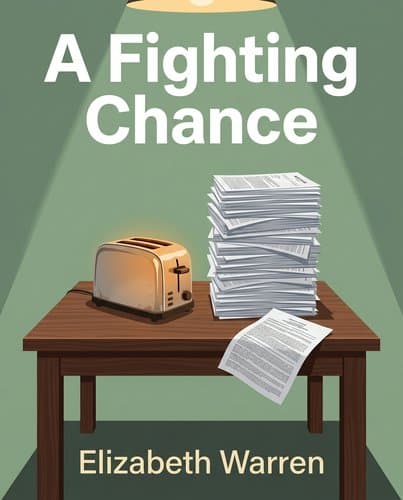
18779662_a-fighting-chance
by Elizabeth Warren
Elizabeth Warren's decades of bankruptcy research proved the middle class isn't failing through personal weakness—they're being squeezed by deliberate policy…
In Brief
Elizabeth Warren's decades of bankruptcy research proved the middle class isn't failing through personal weakness—they're being squeezed by deliberate policy backed by industries spending millions daily to keep it that way. Her memoir maps the brutal gap between having the right data and actually winning the fight.
Key Ideas
Bankruptcy myth hides actual family crises
The 'deadbeat borrower' narrative is statistically false: Warren's research showed 90% of bankruptcy filers were middle-class families hit by job loss, medical crisis, or divorce — not reckless spenders. Policy built on the wrong diagnosis produces the wrong solutions.
Products disguised as contracts escaped regulation
Financial products were deliberately classified as 'contracts' rather than 'products' to exempt them from consumer safety law. The CFPB changed that classification — which is why the banking industry spent $1 million a day to stop it.
Money defeats data and powerful allies
Having the right data and powerful allies is necessary but not sufficient: the bankruptcy reform fight had two presidential vetoes, Kennedy, Wellstone, and Durbin — and the banks still won. Understanding why requires looking at who funds campaigns, not who has the better argument.
Unspoken loyalty code protects insider power
The Larry Summers rule — insiders don't criticize other insiders — is the operating system of Washington. It's not corruption in the legal sense; it's a social contract that functions to insulate decision-makers from accountability. Recognizing it is the first step to not being bound by it.
Clear forms reveal what complexity obscures
Transparency is a tool with teeth: the CFPB's one-page mortgage form, tested behind a one-way mirror in Baltimore, let a consumer named Mr. Harris see in minutes what 30 pages of fine print obscured. Complexity in financial products is often a feature, not a bug — it hides the actual cost.
Personal relationships drive structural policy victories
Systemic change and individual relationships keep trading places: the CFPB passed because of a kitchen-table conversation with Barney Frank and a 90-minute meeting with Ted Kennedy. Warren's structural argument about collective investment coexists uneasily with how much her victories depended on specific people in specific rooms.
Who Should Read This
Readers who connect with first-person stories about Memoir and Political Figures and want to see the world through someone else's eyes.
A Fighting Chance
By Elizabeth Warren
14 min read
Why does it matter? Because the middle class isn't struggling — it's being taken apart on purpose.
Most of us carry a quiet assumption that economic struggle is essentially weather — impersonal, systemic, nobody's fault. Jobs disappear because of globalization. Families go broke because they overspent. The middle class shrinks because that's what happens in a complicated world. Elizabeth Warren spent decades as a bankruptcy researcher believing something far more unsettling: the weather was engineered. Specific people, in specific rooms, made specific decisions that transferred risk downward and reward upward — and left behind paperwork you could actually read. She proved it — court records, census data, a decade of bankruptcy filings — until the numbers were too large to dismiss. Then she discovered the thing that academic proof cannot do: change anything on its own. This book is about what comes after you're right — the messier, more humbling education of learning that fighting the powerful requires becoming something she never planned to be.
The Moment You Stop Being a Child Is the Moment You See What the System Actually Costs
There is a specific afternoon in Oklahoma City — probably 1961 — that Elizabeth Warren spent watching her fifty-year-old mother try to zip herself into the black dress she kept for funerals and graduations. Warren's father had recently suffered a heart attack that cost him his salaried carpet-selling job at Montgomery Ward; the family station wagon had already been repossessed. Her mother was interviewing at Sears, where she would walk the floor and earn minimum wage. The dress, stiff and short-sleeved, had not fit this version of her mother's body in years. Tears dropped off her mother's chin while she worked the zipper. When it finally closed — pulling, puckering, looking like it might split at any moment — she turned to twelve-year-old Betsy and asked: 'How do I look? Is it too tight?'
Warren knew there was no other dress in the closet. She looked her mother in the eye and said, 'You look great. Really.' She calls this the moment she stopped being a child.
What makes this scene the right opening to Warren's entire story is what she would spend the next three decades proving in courtrooms and databases: her family's crisis was not particular to them. When Warren began teaching bankruptcy law in the early 1980s, the prevailing expert wisdom held that people who filed were economic margins-dwellers — day laborers, housemaids, chronic poor decision-makers. A famous legal scholar told her bankruptcy class as much, and when Warren pressed him on his evidence, he said simply that everyone knew it. Warren found this answer intolerable, and she set out to get actual numbers.
Working with a sociologist and a practicing bankruptcy attorney, she collected hard data from courts across the country. What the numbers showed was that roughly ninety percent of people filing for bankruptcy were middle-class families undone by one of three events: a job loss, a serious medical problem, or a divorce. Not recklessness — disruption. The kind that had hit her father when a heart attack took away his salary and left him selling on commission, her father who had never been a natural salesman now having to be one, watching the station wagon disappear.
The families Warren found in those court records had done everything the deal promised: college, steady jobs, marriages, mortgages. They had just encountered a version of what her parents encountered, and in doing so they had crossed from security to freefall faster than anyone expected. What her childhood had taught her emotionally, her research confirmed statistically. The middle class was not insulated from catastrophe — it was one bad event away from it, and the cushion between one bad year and financial freefall was thinner than anyone wanted to admit.
The Banks Wrote the Law, Then Called It Reform
The banking industry didn't wait to see what a neutral review commission would recommend. It wrote its own bankruptcy bill, introduced it in Congress a month before the commission's deadline, and then spent the next eight years and tens of millions of dollars making sure that bill became law.
That sequence matters. By arriving first, the banks controlled the frame. In their telling, Congress faced a simple moral choice: stand with people who honor their debts, or enable people who skip out on them. Nowhere in that frame was there room for a laid-off autoworker, a woman leaving an abusive marriage with a stack of unpaid bills, or a family that had exhausted its savings paying for chemotherapy. The banks didn't need to win the argument on the merits. They just needed to make the merits invisible.
When the argument started slipping away from them, they bought new facts. The industry commissioned studies — promoted as independent — that calculated a '$550 hidden tax' supposedly paid by every responsible American family because of bankruptcy filings. The number was fabricated. But it circulated in congressional briefings and newspaper stories for years, repeated so often it hardened into received wisdom. Warren had spent nearly two decades agonizing over sample sizes and statistical significance, double-checking every finding before publishing. The banks wrote a check and got their own reality.
Warren recruited real allies. Ted Kennedy, after a ninety-minute meeting in his Boston office, agreed not just to vote against the bill but to lead the Senate opposition — a meaningful distinction, the difference between attending a fight and starting one. A coalition of Senate Democrats joined him. President Clinton vetoed the industry bill twice, the second time at his wife's urging. A procedural standoff over an unrelated abortion-rights amendment killed it a third time. For nearly a decade, the sandbags held.
Then George W. Bush won the White House. MBNA, then the country's largest credit card lender, had been his single biggest donor in 2000 and stepped up again in 2004. In 2005, the bill passed the Senate 74 to 25. The final margin wasn't even close.
What the law actually did was specific and deliberate. Filing became more expensive and more complicated. Single mothers found it harder to collect back child support from bankrupt ex-husbands — the credit card companies had successfully elbowed ahead of them in line. Debt collectors reportedly spread the rumor that bankruptcy was now illegal. Many families who qualified for relief never sought it. The banks had achieved something more durable than a legislative win: they had convinced millions of drowning people that the lifeline no longer existed.
Washington Has One Unbreakable Rule, and It Has Nothing to Do With the Law
By 2008, Warren was chairing the Congressional Oversight Panel (COP) monitoring the bank bailout — and the Indian restaurant near the White House was quiet and softly lit, the kind of place where powerful people go to talk honestly because no one will hear them. Larry Summers, who was advising President Obama on the economy, ordered a Diet Coke when he sat down and launched into a long, substantive back-and-forth with Warren about deregulation and the bailout. She found him genuinely engaging, willing to argue. Then, late in the meal, he leaned back and offered what he framed as friendly advice.
He told her she had a choice. Outsiders can say whatever they want, but the people in power don't listen to them. Insiders get access, get heard, get a real shot at shaping decisions. But there is one rule for insiders, non-negotiable and unspoken until that moment: they do not criticize other insiders.
Warren had already been doing exactly that. The Congressional Oversight Panel had gone just as hard on the Obama Treasury Department as on its predecessor. She had published a report showing that for every hundred dollars the Treasury handed to the ten biggest banks during the bailout, it received back assets worth sixty-six dollars — a seventy-eight billion dollar subsidy dressed up as a transaction at fair value. Secretary Paulson had told the public otherwise. The report called that out in plain English.
She had also sat across a massive historic table from Treasury Secretary Tim Geithner while he explained his approach to the foreclosure crisis, which was consuming hundreds of thousands of families a month. When she pressed him on why the relief program was so small and so slow, he said the goal was to spread out the pace of foreclosures so the banks wouldn't be overwhelmed. The program, he said, would 'foam the runway' for them. The homeowners losing their houses weren't the passengers. They were the foam.
The insider code Summers described isn't just about self-protection or careerism. It is structurally load-bearing. It is what allowed Treasury officials to mislead the oversight panel about the Citibank deal while it was being negotiated down the hall. It is what made the 'stress tests' on the largest banks a closed-door exercise the panel couldn't access. It is what kept senior banking executives from facing any serious criminal investigation even after their institutions required tens of billions in emergency taxpayer funds to survive. Everyone in the room knew the rules. Warren didn't follow them. Which is why, at a private farewell party for Secretary Paulson — as Warren herself recounts it — someone looked around the table, noted there were no women present, and said of her: 'She just doesn't get it.' Everyone nodded.
She got it perfectly. She just refused to play.
A Toaster Has More Legal Protection Than Your Mortgage
Here is a thought experiment: if a manufacturer tried to sell you a toaster with a one-in-five chance of setting your kitchen on fire, a federal agency would pull it from shelves before it reached your home. This is not controversial. It is just how products work. But in 2007, lenders were selling mortgages with roughly those same odds of stripping a family of its home — and no agency had the power to stop them. The difference wasn't risk. It was classification. Toasters are products. Mortgages, legally speaking, are contracts. Two supposedly equal parties negotiate and agree. Whatever they settle on, that's the deal. Never mind that one party has a roomful of lawyers and thirty pages of fine print, and the other is just trying to buy a house.
Warren's insight — and the entire logic of what became the Consumer Financial Protection Bureau — was that this classification was a choice, not a given. Change the category, and you change who bears responsibility for the risks hidden inside.
The political journey from insight to law was improbable enough that describing it feels like embellishing. Warren pitched the idea in February 2009 to a room of labor leaders at AFL-CIO headquarters. John Sweeney, the federation's president, urged the room to make the response to the financial crisis historic. They got behind her. Congressman Barney Frank, the sharp and ferocious chairman of the House Financial Services Committee, came around after Warren squeezed herself next to his refrigerator in his Newton apartment and argued that you win public trust by fixing something people can actually see — a crooked mortgage, a credit card rate that triples in the fine print — before asking them to believe you've fixed the machinery they can't. Frank's response: 'I get it. Let's do it.'
The banking industry spent what was reported as more than a million dollars a day lobbying against the agency. Then, in January 2010, the whole effort nearly died quietly — no floor vote, no public drama, just a rumor that Senator Chris Dodd would drop the agency to save the rest of the financial reform bill. Warren's response to the Huffington Post was unambiguous: her second choice, after a strong agency, was no agency at all — with, as she put it, plenty of blood and teeth on the floor. A 'mouthful of mush' wasn't on the list.
Dodd ultimately delivered a strong bill. The Dodd-Frank Act was signed on July 21, 2010. The banking lobby had spent over five hundred million dollars trying to prevent this outcome. A few weeks later, Warren received in the mail one of the pens the president had used to sign it.
They'll Let You Build the Agency as Long as You Don't Get to Run It
What does it mean to build something you're not allowed to run? The summer after the Dodd-Frank signing, 140,000 people signed a petition asking Obama to make Warren the CFPB's first director. An actual rap video circulated — a cowboy with a lasso rapping 'Sheriff Warren, she's what we need, yo.' And still, when she sat across from the president in the Oval Office, he held her hands, looked her in the eye, and said the same sentence twice, almost apologetically: 'You make them very nervous.' The banks, the Republican senators who'd filibuster any vote on her name, the advisors who preferred not to pick a fight — all of them were nervous. So instead of the directorship, he offered her a subordinate advisory role reporting to Tim Geithner, the same Treasury Secretary whose foreclosure strategy she'd described as sacrificing homeowners to cushion the banks' landing. One of the president's advisors had floated an even more direct proposal: let someone else run the agency while Warren served as its public cheerleader. Her response: 'I did not rush out to buy pom-poms.'
She took the job anyway — 'special advisor,' a title that carried real authority only because Obama attached 'assistant to the president' alongside it as a signal he would back her up. She brought in Rich Cordray to run enforcement. She pushed through a consumer complaint database that the banks loathed because it would make their worst customer service visible to the public. And in a testing lab outside Baltimore, behind a one-way mirror, a staffer named Pat McCoy watched a middle-aged man named Mr. Harris read the single-page mortgage disclosure the agency had designed to replace thirty pages of fine print. Partway through, he stopped. He did the arithmetic on what happened to the monthly payment if interest rates rose. Then he pushed the paper back across the table and said he couldn't afford that loan. The form had done, in sixty seconds, what the old paperwork was engineered to prevent.
None of it was enough to keep her. When it became clear Senate Republicans would filibuster her nomination regardless of her record, Obama nominated Cordray instead, on the theory that a different tough director might actually get confirmed. He didn't — the Republicans announced his candidacy was dead on arrival before the day was out. There was no deal. Warren packed up her Washington apartment, gave away her furniture to young agency staffers, and left. The slingshot she'd built was real. She just wasn't allowed to hold it — which, it turns out, was always the condition of her being allowed to build it at all.
Nobody Gets Rich Alone — But Nobody Changes Anything Alone Either
An auditorium at Framingham State University, a Tuesday night in October 2011, one month into Warren's Senate campaign. She had just made a fool of herself in the Daily Beast, accidentally claiming credit for Occupy Wall Street. She expected a thin crowd, maybe enough people to fill the first few rows. Instead, she turned around from the door and found every seat taken, overflow standing along the walls — several hundred people who had showed up on a cold weeknight, most of them saying some version of the same thing: I've never done this before. This is my first time.
That same week, a clip from an Andover house party had gone viral. Someone with a camera caught Warren answering a question about the deficit, and she'd gotten wound up. Her point was simple: the wealthy don't build alone. Roads, schools, courts — those are collective investments. Keep a big share of what you earn, she said, but pay it forward for the next kid. Rush Limbaugh called her a parasite. MoveOn called it the quote every American needed to see. A million views in a week.
Both moments — the overflowing auditorium and the viral clip — revealed the same thing. Warren's argument about collective investment wasn't just a policy position. It was also, quietly, a description of what a campaign actually is. Marcus Webb, a young man from Worcester who told her about this at a T stop one Saturday night, had done everything right: good grades, good university, graduated on time. He counted the accomplishments off on his fingers. He'd gotten nothing in return, and he knew exactly why — the deal had broken down on one side only. He was sending her money out of his part-time wages anyway. This is my fight too, he said.
She won in November 2012, 54 to 46, with the highest voter turnout in Massachusetts history. More than eighty percent of her donations came in at fifty dollars or less. Her first Senate office was a trailer — marble hallways, a sharp turn onto a plywood ramp, prefab walls, a fake window hiding electrical cable. The CFPB she'd built was still standing, though she hadn't been allowed to run it. The student loan bill she introduced didn't pass. The fight, she discovered, does not resolve into victory. It just continues, with better tools and more company — which turns out, if you look at what actually changed, to be enough of a reason to keep going.
The Trailer Office at the End of the Marble Hallway
Here is what the book finally asks you to sit with: the wins are real, and they're not enough, and both of those things are true at the same time. A one-page mortgage form that let Mr. Harris see what thirty pages hid. An agency that exists and has teeth. A senator who got there on fifty-dollar donations from people who'd never given before. All of that happened. And Warren is still walking marble hallways to a trailer with a fake window, about to introduce a bill on behalf of a young man in Worcester who did everything right and got nothing back. The distance between knowing exactly what's broken and actually fixing it turns out to be measured in decades, not arguments. She knew that when she walked up the plywood ramp. She showed up anyway.
Notable Quotes
“They think he’s going to die.”
“How do I look? Is it too tight?”
“Send us another $100 immediately or else your toaster will stop toasting your English muffins!”
Frequently Asked Questions
- What does Elizabeth Warren's research reveal about who files for bankruptcy?
- Warren's bankruptcy research demonstrates that the conventional narrative about debtors is deeply flawed. Her findings show "90% of bankruptcy filers were middle-class families hit by job loss, medical crisis, or divorce — not reckless spenders." This evidence exposes how the "'deadbeat borrower' narrative is statistically false." By establishing the true causes of bankruptcy, Warren reveals why "policy built on the wrong diagnosis produces the wrong solutions." Understanding real bankruptcy patterns is essential for developing regulations that actually protect middle-class families from genuine financial shocks.
- Why did the banking industry spend $1 million a day opposing the CFPB?
- The financial industry's massive opposition to the CFPB stemmed from a fundamental classification issue. "Financial products were deliberately classified as 'contracts' rather than 'products' to exempt them from consumer safety law. The CFPB changed that classification — which is why the banking industry spent $1 million a day to stop it." This regulatory loophole had allowed banks to avoid accountability to consumer safety standards. By reclassifying financial products, the CFPB threatened this long-standing exemption, explaining the industry's aggressive spending to protect this advantage.
- How does insider culture prevent financial reform?
- Warren identifies "the Larry Summers rule — insiders don't criticize other insiders" as the fundamental operating system of Washington. This unwritten social contract silently protects decision-makers from scrutiny. "It's not corruption in the legal sense; it's a social contract that functions to insulate decision-makers from accountability." By discouraging insiders from questioning each other's decisions, the rule perpetuates policies favorable to financial insiders despite public evidence of harm. Warren argues that "recognizing it is the first step to not being bound by it," helping explain persistent barriers to financial reform.
- How does the CFPB's mortgage form demonstrate the power of transparency?
- Warren illustrates transparency's transformative power through the CFPB's mortgage redesign. "The CFPB's one-page mortgage form, tested behind a one-way mirror in Baltimore, let a consumer named Mr. Harris see in minutes what 30 pages of fine print obscured." This reveals a critical truth: "Complexity in financial products is often a feature, not a bug — it hides the actual cost." Banks deliberately obscure pricing through dense documents. Simplifying disclosure gave consumers real power to understand financial commitments, demonstrating how regulatory design directly empowers consumers against deliberately obfuscated information.
Related Book Summaries

Read the full summary of 18779662_a-fighting-chance on InShort