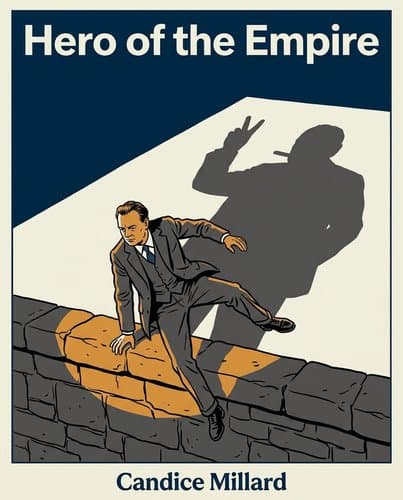
26891468_hero-of-the-empire
by Candice Millard
Churchill manufactured his own legend before anyone believed in it—treating courage as deliberate strategy and destiny as settled fact.
In Brief
Churchill manufactured his own legend before anyone believed in it—treating courage as deliberate strategy and destiny as settled fact. His audacious escape from a Boer prisoner-of-war camp in 1899 reveals how self-belief that precedes evidence can, through sheer audacity, create the evidence.
Key Ideas
Courage cultivated through strategic risk accumulation
Courage can be cultivated as a deliberate strategy — Churchill built his reputation for bravery through calculated risk-taking (the gray horse, the correspondent contract, the Cuba posting), treating courage as social capital he was consciously accumulating rather than a trait he happened to have.
Self-belief creates evidence through consistent action
Self-belief that precedes evidence isn't delusion if you act on it consistently enough to create the evidence — Churchill's conviction in his own destiny drove him into situations where the prophecy could prove itself, turning a psychological stance into a historical force.
Contingency shapes life's most consequential moments
The most consequential moments in a life often hinge on contingency — a lost revolver, a coalmine in the dark, a stranger who happened to be English — preparation and audacity matter, but so does the luck of what you find on the other side of the fence.
Heroic triumph casts shadow on others
Heroic narratives have shadows that the individual story can't contain — the same events that launch one person's legend can be catastrophic for others in the same frame; the Boer War that made Churchill also produced Kitchener's concentration camps, and Gandhi was on the same battlefield.
Character revealed in moments of genuine uncertainty
Look for the formative episode before the famous achievement — what people do when the outcome is genuinely uncertain reveals character in ways their greatest triumphs cannot, because by the time history remembers those triumphs, the contingency has been edited out.
Who Should Read This
History readers interested in Political Figures and Military History who want a deeper understanding of how we got here.
Hero of the Empire
By Candice Millard
10 min read
Why does it matter? Because the man who held the line against Hitler spent his twenties manufacturing his own legend.
The easy version of Churchill is that greatness was always there — baked into the bloodline, confirmed by history, just waiting to be called upon. But that story starts too late and too clean. In 1899, Winston Churchill was 25, freshly beaten in a parliamentary election, carrying the complicated legacy of a father who'd blazed brilliantly and then simply stopped, and so convinced of his own extraordinary destiny that he'd spent the better part of his twenties engineering situations that might prove it true. He went to South Africa as a war correspondent not because he was already a hero, but because he needed to become one, and he was running out of time. What followed was a train ambush, a midnight vault over a prison fence with no map and no plan, and a desperate crawl into a hole between a boxcar wall and a bale of wool. Candice Millard makes you understand that this wasn't destiny unfolding. It was a man who'd already decided he was indestructible — finally getting his proof.
At 25, Churchill Was a Failed Parliamentary Candidate With a Speech Impediment and a Desperate Need to Prove Something
Lord Randolph Churchill was exactly the kind of father who haunts a son's ambitions rather than settling them. He'd rocketed to Chancellor of the Exchequer at 37, the youngest in a generation, and then in December 1886, gambling that he was indispensable, submitted his resignation to Salisbury expecting the Prime Minister to blink. Salisbury accepted it. Lord Randolph never held office again. His health collapsed, his speeches in the Commons grew rambling and incoherent, and he was dead at 45. Winston wasn't close to him, but he idolized him, and that arc left him with two things at once: a template for what was possible and proof of how thoroughly it could be squandered.
The Churchill name opened doors, but it didn't come with much cash, and the famous connections were attached to that wreckage. What drove Churchill wasn't privilege — it was anxiety, and it ran deep. His father's fall wasn't a private tragedy; it was evidence that even brilliant men could burn through their moment if they weren't fast enough. Churchill graduated from Sandhurst in 1894 and immediately began engineering situations where he could prove himself: finagling his way to Cuba as a military observer, attaching himself to campaigns in India and Sudan, fighting in conflicts where he had no official standing. He was compulsive about it — always another front, another dispatch, another chance to get his name in print before time ran out. When he ran for Parliament in 1899 and lost, despite speeches he'd drilled word by word to disguise a genuine stutter, he didn't retreat. He converted his writing into a war correspondent contract in South Africa, becoming the best-paid correspondent in England, filing dispatches from the front lines.
Before he'd done much to justify it, he wrote in a letter: "I do not believe the Gods would create so potent a being as myself for so prosaic an ending." That sounds like aristocratic entitlement. It wasn't — it was the voice of a man who understood, somewhere under the bravado, exactly how fast a brilliant man's flame could go out.
He Bought a Gray Horse Specifically to Be Shot At — Courage Was His Career Strategy
Somewhere in the Hindu Kush in 1897, with Pashtun riflemen capable of dropping a man at several hundred yards hidden in hills that looked empty, Winston Churchill went shopping for a horse. He came back with a gray one — the kind that catches the eye at distance.
He knew exactly what he was doing. The Pashtun fighters were not going to miss a conspicuous target. Churchill bought conspicuous anyway.
Buying gray wasn't a death wish. It was an investment. After that campaign, Churchill wrote that "there is no ambition I cherish so keenly as to gain a reputation for personal courage." He wasn't describing a feeling; he was describing a strategy. Courage in the British Empire of 1897 wasn't merely admirable. It was the currency that bought everything else: commissions, newspaper columns, parliamentary seats. His father had risen to Chancellor of the Exchequer on political brilliance and a famous name. Winston had the name. He needed the rest, and he understood that "brave under fire" was something you could accumulate, provided you survived the accumulating.
What looks like recklessness was actually a portfolio. Each deployment was a deliberate deposit: Cuba as a military observer, Malakand, the Sudan, where he charged at Omdurman and then wrote a widely praised book about it. When he resigned his army commission in 1899 and his first parliamentary run failed, he didn't abandon the plan; he found another vehicle. The Morning Post handed him the best-paid war correspondent contract in England to cover South Africa. The hypothesis finally faced conditions that weren't staged, and he ran toward them anyway.
The gray horse is the detail to hold onto. Most people, aware they're in the crosshairs, try to be less visible. Churchill went the other direction. That choice tells you everything about how differently he calculated risk — and what happens next in South Africa feels less like accident than like the bill coming due on a very deliberate wager.
The Real Heroism Happened Before the Escape — and the Capture Was a Fluke
The armored train was an absurd piece of machinery: a regular locomotive with boilerplates bolted on, running back and forth on a single track the Boers knew as well as their own farms. Boer general Louis Botha, 37 years old and already the most dangerous commander on either side, had 3,000 men and four field guns waiting in the hills, with a pile of stones stacked on the rail line to derail the train on its return leg.
Churchill was on board as a newspaper correspondent. He had no military commission, no orders, no obligation beyond surviving and filing a story.
When the derailment happened and Boer artillery opened up on the stopped train, Churchill went forward to see what could be done. The engine was blocked by an overturned armored car. He got the driver to ram it clear (a decision made in about thirty seconds), then spent the next hour doing the work of several people at once: cajoling the driver who wanted to abandon the engine and run, ferrying information back to British officer Captain Haldane coordinating the defense, and loading wounded men onto the locomotive, all while Boer marksmen kept up heavy, accurate fire on British soldiers pinned with nowhere to go. He carried only a pistol, useless at that range. His contribution was entirely organizational. A civilian in the middle of a military disaster, willing the thing not to collapse.
The escape narrative tends to swallow this part of the story. The Pretoria breakout (the fence, the coal bale, the bribed border officials) is a better yarn. But Millard is tracking something different: the first moment Churchill's belief in his own exceptionalism wasn't an untested claim. Back in India he'd bought a gray horse specifically to be visible on the battlefield. That was strategy at a safe remove. The train ambush was when the working hypothesis met conditions he didn't choose and couldn't stage, and he ran toward them anyway.
He was captured only because he had lost his revolver somewhere in the chaos. When Boers surrounded him as he made his way back to find Haldane, he reached for the gun and found nothing. It wasn't a decision to surrender — it was a disarmed man who had run out of options. His captors separated him from the other prisoners the moment they recognized his name.
He left them a note when he eventually escaped. It praised Boer hospitality and signed off with the postscript "PPC" — pour prendre congé, the French phrase for taking one's leave. The Boers issued wanted posters. But the note says something true about Churchill: even running for his life, he couldn't resist writing the ending.
He Vaulted the Fence Alone — No Compass, No Map, No Plan, Just the Unshakeable Certainty That He Couldn't Die Here
On the evening of December 12, 1899, Churchill walked to the wall and checked the guard. The plan called for three men to go together: himself, Captain Haldane, and Brockie, who spoke Dutch and knew the terrain. The guard stepped away briefly. Churchill pulled himself over the fence and dropped into the garden of a private house on the other side. He waited. The guard came back. Haldane, watching from inside, couldn't move without being spotted.
An hour passed. Through the fence, in a whisper, Haldane told Churchill he couldn't get out.
Churchill had no compass, no map, no food beyond some bread and chocolate. He didn't know which direction Portuguese East Africa lay. East, roughly, by the horizon. The most recognizable British subject in the Transvaal, with no plan beyond his own momentum, he told Haldane he was going anyway.
What followed was a series of near-failures held together by audacity and luck. Churchill walked straight through Pretoria, apparently on the theory that confidence was better camouflage than anything else. He flung himself into a boxcar when a train appeared, fell asleep, leapt off somewhere in the dark, and determined from the direction of sunrise whether he was heading the right way.
He was 70 miles from Pretoria, with 200 miles still to go to the border. The Boers had shut down night rail service after his escape. Running out of food and moving only in darkness, he was near his limit when he spotted distant fires and walked toward them.
The fires belonged to a coalmine run by John Howard, one of the few British subjects the Boers had allowed to stay in the Transvaal (they needed his expertise to keep the operation running). Churchill knocked, concocted a cover story on the spot, then dropped it when Howard didn't believe it. The man who answered was English and, against considerable odds, willing to help.
Howard hid him in the underground stable where ponies pulled the mine carts. Workers moved through the mine, and Boer patrols had already searched the area. His solution: tell the workers the area was haunted by a Tokoloshe (a small, malevolent spirit from Zulu myth). They stayed away. The most wanted man in South Africa was safe because a British mine manager had weaponized an African ghost story.
Howard arranged the rest. His contact Charles Burnham, a local wool merchant who knew which officials could be bought, bribed railway workers at stop after stop while Churchill lay crammed in a hole between a boxcar wall and a bale of wool. At one station, a rumor circulated that Churchill had already passed through disguised as a Catholic priest — by then he was the kind of fugitive people invented stories about. When Portuguese uniforms appeared through a crack in the wood, Churchill screamed and fired his pistol in the air. He had no other way to express what it had taken to get there.
The Same War That Made Churchill a Hero Killed 46,000 Civilians — and Gandhi Was on the Same Battlefield
The Boer War ended with General Kitchener burning farms, rounding up Boer families into camps where poor sanitation killed 26,000 civilians — and 20,000 Africans on top of that. Churchill was already home by then, parliamentary seat won, eight gold watches sent to John Howard in thanks once he reached safety. The individual story had resolved cleanly. The historical one had not.
But Millard surfaces a detail that does more work than the casualty figures: Mohandas Gandhi was on the same battlefield. He organized a stretcher corps for the British Army and personally carried the wounded out of the firing line. The young man who would spend the next half-century dismantling the British Empire spent 1899 serving it — rescuing its soldiers under the same Boer fire that had nearly killed Churchill.
Two men who would spend the next fifty years defining and dismantling British imperial power, one defending it with a pistol on an armored train, one rescuing its casualties with a stretcher, were on the same side, in the same war, in the same country, without crossing paths. Neither saw anything contradictory in this. The Empire was simply the world they lived in, and both were finding their place inside it.
Millard offers the Gandhi detail as a footnote. But it's really an epilogue to everything the book has traced: Churchill's audacity, the Boers' doomed courage, the tidiness of the triumphant individual narrative. Gandhi survived the war too. He also had plans.
The Escape Didn't Create Churchill's Belief in His Destiny — It Was the First Time the World Agreed With Him
The Boer War escape didn't give Churchill his sense of destiny. He arrived in South Africa already carrying it. The escape was the first time the world confirmed what he'd privately decided years before anything justified the decision.
Before Cuba, before the gray horse, before any evidence was in, Churchill had already committed his operating assumption to paper: that the Gods would not create so potent a being as himself for so prosaic an ending. It reads as comic overreach until you understand it was a working hypothesis, not a boast — a claim he intended to test by placing himself in harm's way. The gray horse in the Hindu Kush wasn't bravado. It was evidence-gathering, him running the experiment under conditions that had killed men far more decorated.
What's striking is how far back the evidence goes. More than forty years before 1940, the certainty was already there — arriving like the first outlines on a Polaroid, faint then unmistakable. The self-certainty wasn't created by the war. It was already fully formed. The war made it legible to everyone else.
The escape was the moment the private prophecy became public record. Churchill vaulted a fence alone, with no map, walked through an occupied city on nerve, hid in a mine shaft for three days, and crossed three hundred miles of hostile territory to freedom. The British Empire, watching, concluded exactly what he'd always claimed: that he was exceptional. He was elected to Parliament within months. The loop had closed.
Everything he became afterward ran on the same fuel: the refusal to negotiate with Hitler, the speeches that held a country together when arithmetic said surrender. He'd decided what he was before the world weighed in. South Africa was just when the world caught up.
What a Self-Fulfilling Prophecy Actually Requires
Here's what Millard leaves you with: the escape didn't forge Churchill's conviction — it just gave it a return address. He was already running the experiment, already leaving "PPC" on a calling card for his captors. South Africa confirmed what he'd pre-decided, and that confirmation is what carried him through 1940, when the arithmetic genuinely favored surrender. He'd already done this once.
The question you can't quite shake: how many others believed just as fiercely, calculated just as shrewdly, and simply knocked on the wrong door in the dark? Churchill found John Howard. Someone else found no one. The prophecy didn't fail — the door did.
Notable Quotes
“The Boers were not amused, and issued wanted posters—”
“'There is no ambition I cherish so keenly, as to gain a reputation for personal courage.'”
“'I do not believe the Gods would create so potent a being as myself for so prosaic an ending.'”
Frequently Asked Questions
- What does Hero of the Empire reveal about how courage actually works?
- Courage can be deliberately cultivated as a strategy rather than inherited as a trait. In Hero of the Empire, Candace Millard shows how Churchill built his reputation for bravery through calculated risk-taking—the gray horse, the correspondent contract, the Cuba posting—treating courage as social capital he consciously accumulated. Each calculated risk was a deliberate investment in his public image, proof that he wasn't naturally fearless but strategically audacious. This reveals that reputation for courage is often constructed through intentional exposure to danger, not spontaneous heroism. Churchill's method shows how ambitious people can engineer circumstances that demonstrate the qualities they need to advance.
- How does self-belief actually create destiny according to Hero of the Empire?
- Self-belief that precedes evidence becomes self-fulfilling when you act on it consistently enough to create the evidence. Churchill's conviction in his own destiny didn't make him delusional—it drove him into situations where he could actually prove his prophecy true. Millard reveals how Churchill's psychological stance became a historical force through deliberate action. He didn't just believe he was destined for greatness; he positioned himself in dangerous circumstances where that belief could materialize. This shows the paradox: unwavering self-conviction alone is meaningless, but self-conviction paired with the audacity to test it becomes consequential, turning internal conviction into external reality.
- What does Hero of the Empire reveal about luck in historical moments?
- The most consequential moments in a life often hinge on contingencies beyond anyone's control. Millard shows that Churchill's escape and rise depended on preparation and audacity, but equally on luck—a lost revolver, a coalmine in the dark, a stranger who happened to be English. These uncontrollable factors shaped his legend as much as his choices did. By the time history remembers great triumphs, the contingency gets edited out. Hero of the Empire restores the role of chance, showing that even carefully constructed reputations depend on finding the right break at the right moment. This reframes how we understand historical achievement.
- What does Hero of the Empire reveal about the shadow side of heroic narratives?
- Heroic narratives contain shadows that individual stories can't capture, and Hero of the Empire illustrates this through the Boer War context. The same events that launched Churchill's legend—his daring escape, his courage under fire—occurred within a larger frame where others experienced catastrophe. Kitchener's concentration camps operated during Churchill's rise; Gandhi fought on the same battlefield but didn't gain the same platform. Millard reveals that Churchill's heroic myth was constructed within a specific historical moment that produced different outcomes for different people. The book shows how singular legendary narratives obscure the complexity of shared historical moments where some rise while others suffer.
Related Book Summaries
Read the full summary of 26891468_hero-of-the-empire on InShort