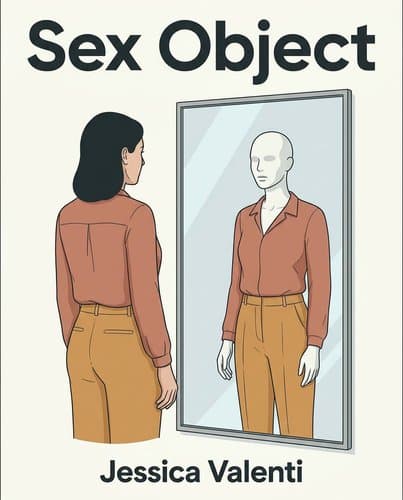
26795372_sex-object
by Jessica Valenti
Objectification doesn't just happen to women—it colonizes them, eroding the sense of being a person until violation feels like weather and love feels…
In Brief
Sex Object (June) is Jessica Valenti's memoir-essay examining how sexual objectification accumulates into a nameless psychological injury that shapes how women experience themselves, their bodies, and their capacity for intimacy.
Key Ideas
Unnamed harm accumulates without clinical recognition
Objectification accumulates into injury that has no clinical name — the harm is real even when medicine offers no diagnosis, which means women are left to carry it as ambient weather rather than wound.
Coping mechanisms perpetuate rather than escape compliance
The coping strategies that keep women functional — humor, nonchalance, the cool-girl shrug — demand the same suppression of pain that caused the injury, and they are not alternatives to compliance, they are a form of it.
Objectification erases women's sense of violation
Not naming a violation isn't always denial or cowardice. Sometimes it means objectification has worked so completely that a woman no longer experiences herself as the kind of person to whom violations matter enough to say out loud.
Depersonalization prevents feeling of deserved love
The gap between loving someone and being able to feel that love is not a personal failure — it is a predictable outcome of years of trained depersonalization, and calling it a failure compounds the original injury.
Culture systematically trains accepting mistreatment
When evaluating why women don't report, leave, or name what happened to them, the question is not 'why didn't she do more?' — it is 'what does a culture have to do to a person, consistently, from the age of twelve, to make her not believe she deserves more?'
Who Should Read This
Readers who connect with first-person stories about Memoir and Social Issues and want to see the world through someone else's eyes.
Sex Object
By Jessica Valenti
9 min read
Why does it matter? Because the damage sexism does doesn't stay outside — it colonizes the self.
Jessica Valenti has spent her career naming what happens to women. She knows the vocabulary, the mechanism, the politics. Then a man penetrates her while she's unconscious, and she doesn't call it rape — not because she lacks the word, but because she doesn't quite believe she's the kind of person the word belongs to. That failure isn't a contradiction of her feminism. It's the clearest proof of her argument. Sex Object tracks how objectification works from the inside: not as dramatic violation but as slow replacement — the self gradually exchanged for a surface, until violation registers as weather and even a woman who has made a career of naming this exact thing cannot apply the name to herself. By the end, you'll understand why women don't report, don't leave, don't claim — not for lack of courage, but because the mechanism works.
Women's Suffering Runs in a Line, Not a Cycle — and No One Has a Name for What Causes It
On a twin bed in a room covered with glow-in-the-dark stars, Valenti's mother sat her down for the "bad touch" talk, and made it personal. She was eight when a family friend arrived at the house with ice cream. Her own mother was cooking dinner in the kitchen. The man told her to come sit in his lap if she wanted some. She doesn't remember what happened next, only that something did, and that she said nothing after. A while later, a neighborhood barber offered a free haircut if the girl would fold some towels. Her mother stepped out to let her work. He took her to the back room.
That girl grew up to be the woman on the twin bed. Her mother, Valenti's grandmother, had her own story. Orphaned at ten when her father died of alcoholism, she went to live with an uncle. At eleven, he raped her. She told her aunt. The next day she was sent to St. Joseph's Orphanage in Brooklyn.
Valenti describes this not as a cycle but as a line. Cycles imply return, recurrence, something spinning back to its starting point. A line goes forward. The harm travels through generations like a birthright, losing pressure — rape became molestation became subway assault — but never stopping.
The absence surrounding it is what makes this more than a family tragedy. Society has built shelters for domestic violence. It has documented the PTSD that develops in children who grow up in violent neighborhoods. It knows that sustained bullying reshapes the brain. Yet for the tremor in your hands after a stranger whispers something obscene in your ear on the way to work, for the low-grade vigilance that has you checking whether the cab is actually taking you home, there is no diagnosis, no clinical name, no treatment protocol. The individual incidents have names. The cumulative injury, the slow erosion of the sense that you are a person and not a target, carries nothing.
No one forgot to name it. A culture that has no word for something has decided it is weather — not wound, not cause.
There Is No Posture Innocent Enough: The Female Body as Permanently Public Text
The female body in public space is public text. It doesn't matter what the woman wrote on it, or whether she consented to the reading.
In 2006, Valenti stood in a group photo with a former president and several other bloggers. She was there because she ran a prominent feminist website. The photo was taken, and a law professor with a blog looked at it and decided the focal point was Valenti's posture, her arch, her chest — that she had positioned herself to be noticed, that her clothing announced intent. What followed was months of harassment: limericks about oral sex with the president, speculation that she had been placed in the room to seduce him, phone calls with breathing and laughter. When Politico covered the story as a "dust-up," a reporter explained his interest by citing the title of her book, as if the name of a book about feminism confirmed that her body had been the point all along.
When Valenti first told her parents she'd been invited to meet the president, they wept. They told family, customers, strangers who wandered into their store. They tacked the photo behind the cash register. Then the photo became a joke about interns and blow jobs, and Valenti sat in her parents' living room reading through comment after comment, crying. Her mother looked up flights to Wisconsin to go find the blogger.
The book maps the gap between what a woman is doing and what is being seen. She is standing in a photo. She is boarding a subway car. She is walking to school. None of these acts contains an invitation. The invitation is supplied by the onlooker, then attributed to the body.
The Google related-search that appeared when you typed Valenti's name in 2006 — "JESSICA VALENTI BREAST" — is not an aberration. It's an accurate transcript of how public space receives a woman: whatever else she brings, the body arrives first and stays longest. The algorithm will suggest you might also be looking for her tits.
The Cool-Girl Shrug Is Still a Performance — and It's the One That Costs the Most
The neighborhood men who exposed themselves from windows or on the street had a standing policy in Valenti's family: point and laugh. The cops had already explained that a man could do whatever he wanted inside his own house, so laughter was the available tool — mock them, and usually they'd scatter. It worked often enough to become doctrine, handed down as practical advice.
By the time Valenti was managing a decade of daily harassment online (the inbox flooding with slurs, the death threats that moved her and her infant daughter out of their home for weeks), she had carried the same strategy forward. Answer an abusive tweet with a Jennifer Lawrence GIF. Mock the misspellings. Perform unruffled wit. The harassers still look ridiculous. The audience sees a woman who cannot be touched.
What neither generation named was the demand embedded in that strategy: convert your pain into entertainment, as a condition of being allowed to stay in public. Not just for the harassers. For everyone watching, who prefers composure to distress. The woman who gives as good as she gets is still doing the thing women have always been asked to do: make everyone around her comfortable, swallow what she actually feels.
This is what the performance costs. Valenti is clear about it: the unwillingness to show damage, to admit you are injured even when you plainly are, doesn't protect you. It buries the evidence. You become the most efficient enforcer of your own erasure, performing your way through wounds that, without a name, cannot be treated. The cool-girl shrug isn't defiance; it's pleasantness updated for a new century, packaged as agency instead of submission.
The Feminist Who Built Her Career on Naming Couldn't Name Her Own Assault
Objectification takes something more fundamental than safety or dignity. It takes the sense that you are a person to whom things happen in a way that counts.
Valenti woke up at two in the afternoon in the Manhattan apartment of a man named Carl, naked, with ten missed calls from her parents. She knew immediately what the night had contained. She is a feminist writer who has spent her career urging women to name what was done to them, to lay violations bare so they become impossible to argue with. She has written plainly about what rape is. What happened in that apartment fits her own definition. She never called it that. She adds, "I don't know why."
She explains that the assault registered lower on her scale of damage than the time a stranger ejaculated on the back of her jeans on a subway. Not as provocation. Just as fact. And then the reason, stated with the flatness of a finding: she had barely been registering herself as a person. She was moving through her early twenties the way water moves — through bars, jobs, relationships, friendships — and she remembers riding the subway narrating herself from the outside, as if watching a movie about a girl with headphones walking through tunnels. The self who would need to be harmed in order for harm to register had already vacated.
The book's central argument arrives not through theory but through what Carl left her: a grilled cheese sandwich and cab fare home. The tools she built her public work around — language, naming, the insistence that stories told aloud become inescapable — fail at the exact moment they're needed most. The failure wasn't about courage, or fear of Carl, or judgment. The naming failed because there was no one home to receive it. A woman who has internalized her own object-status cannot experience herself as the subject of a crime. She can eat the food, take the money, cry on the subway home, and still find that the word "assault" has nowhere to land.
Love Without Power: A Metal Pipe and a Bag of Cherries Still Isn't Enough
This is what the damage looked like before it had a name, and what it asked of the people who loved her.
After Valenti was flashed on the 39th Avenue subway platform on her way to junior high — a man walking toward her with his penis out, stopping only when a train pulled in — her father, Phil, started walking her to the platform every morning. He explained what had happened to the token booth worker, who let him through the turnstile without paying; Phil thanked him each week with a bag of cherries from their yard. One morning Valenti noticed a strange shape under her father's jacket. When she pressed him, he lifted his shirt. A metal pipe was tucked into his waistband. He told her no cop would arrest a man for beating someone who flashed children. He knew, he'd later admit, that was a lie. He brought the pipe anyway.
A Queens father with a metal pipe and a weekly bag of cherries: that's the whole argument. Phil's love for his daughter is total and genuine. The pipe is not theater; it is the maximum available response to a structural problem. Public space is hostile to his daughter in ways that no individual man, however devoted, can fix. The token booth worker's goodwill costs a bag of cherries and lasts exactly as long as Phil stands there. The pipe is illegal, invisible to every man except the one Phil would like to find. It is the most his love can do, and it is nothing.
Years later, when Valenti calls her father from Tulane after a fraternity's campaign to humiliate her — a condom taped to her door, a slur on her dry-erase board, a man she'd never met blocking her path on campus to describe what he'd like to do to her — Phil's version of the pipe is a sentence: it could have been a lot worse, when boys get to that place they're capable of real violence, you were lucky. He means it. He is right. "You were lucky" is not comfort. It is the most honest protection speech available: the harm was real, the protection was nothing, and this time the harm stopped where it did.
There Is a Difference Between Loving Someone and Being Able to Feel It
Layla arrived at two pounds, her IV arm braced with Popsicle sticks and tape to keep her from pulling out the central line. The lights above her incubator glowed blue, for jaundice. Valenti reached the NICU by gurney a full day after the C-section. Even then, she had to monitor the baby's head angle constantly: too far back and Layla stopped breathing, too far forward and the airway closed off. The nurses had to scoop her away more than once, tapping her feet until the color came back. Valenti writes that she mostly dreaded holding her daughter.
What she couldn't say was that she also couldn't feel love for her — not its absence, but its inaccessibility. When her editor noticed that Valenti never used Layla's name in conversation, only "the baby" or "her," Valenti took this as diagnostic rather than stylistic. A woman who had built a career on the argument that naming things is the prerequisite to addressing them had lost the ability to name her own child.
She draws the distinction precisely: knowing you love someone is not the same as having access to that feeling. The failure to access what culture insists is a woman's most essential emotion, for an infant who needs you to survive, reads as the worst possible verdict on your character. She does not experience this as a symptom of what was done to her. She experiences it as evidence of what she is.
But the book has been accumulating exactly this evidence. What happens to a woman who spends decades being perceived rather than known, entered rather than consulted, her body read as public text before anyone hears her name? The interior eventually quiets. Not in any single collapse but by degrees, the self receding until the gap between knowing you love someone and feeling it becomes something you fall into. The mind does what it needs to do to survive it. What Valenti describes is a woman so thoroughly trained not to count that she eventually loses the ability to count herself as someone capable of loving — and calls this, with full conviction, her fault.
Layla Whispers 'Ice Cream' — and Then Come the Endnotes
A California restaurant, Thanksgiving week. Layla is on her mother's lap, going over the script one more time: the waitress will approach, Valenti will set up the question, and Layla has to say two words — "ice cream" — out loud, to a stranger. This is the therapist's prescription: exposure, one small increment at a time. Layla has selective mutism, an anxiety disorder that seals her voice shut the moment another child enters her orbit. She has a sign language with her best friend (point at yourself, make a heart, point at the other person) but she hasn't spoken to a peer in years. Now she's being asked to speak to an adult she has never met.
The waitress arrives. Layla's mouth moves. Nothing comes out. Told to speak louder, she produces a whisper too quiet to carry, and on the second try something breaks loose: words and a choke of a cry at once, and she's weeping and smiling into her father's shoulder as the woman in the black-and-white uniform turns to bring the chocolate ice cream.
The chapter ends there. Then the ENDNOTES (2008–2015) begin.
Seven years of emails and tweets and Facebook comment threads, uninterrupted, without explanation. Someone wishing rape on Valenti's daughter. A Breitbart piece speculating whether feminism makes women ugly. A Facebook thread of men rating her appearance, one noting he would only sleep with her in a dumpster and make her call him daddy. ReturnofKings placing her among "The Nine Ugliest Feminists in America." All of it presented the same way Valenti has presented everything in this book: flat, named, dated, sourced.
She doesn't write a sentence connecting the two halves. The structure is the argument. A mother who knows what it cost her daughter to produce two words, placed immediately next to the seven-year record of what women receive for using theirs. Here is what finding your voice looks like. Here is what it's for.
The Pig Who Wouldn't Play the Part
What the book gives you is not a way out. That's Valenti's argument in its final form: here is what finding your voice costs, here is the ledger that will never close. The lineage doesn't stop because someone decided to refuse it. What stops it — if anything does — is the ability to name the mechanism precisely enough to see it working. That's what this book is. Not a cure. A set of eyes.
Notable Quotes
“That usually sends them running.”
“is such a terrible idea. Recognizing suffering is not giving up and it's not weak.”
“Someone did something bad to me.”
Frequently Asked Questions
- What is Sex Object about?
- Sex Object is Jessica Valenti's memoir-essay that explores how sexual objectification accumulates into psychological harm for women. The book examines how culture trains women to absorb violation as ordinary and provides a framework for recognizing this damage, understanding its roots, and recognizing why naming it is so difficult. Valenti maps the mechanisms through which objectification becomes embedded in how women experience themselves, their bodies, and their capacity for intimacy, illustrating how cumulative harm shapes women's sense of self and their relationships.
- What is the main argument about objectification in Sex Object?
- A central argument is that "Objectification accumulates into injury that has no clinical name — the harm is real even when medicine offers no diagnosis, which means women are left to carry it as ambient weather rather than wound." Valenti explains that this unnamed harm operates insidiously because it lacks clinical recognition. Women experience tangible psychological and emotional damage from objectification, yet without medical diagnosis or language, they internalize it as a normal condition of existence rather than a wound requiring acknowledgment or healing. This framework reframes individual struggles as systemic outcomes of cultural conditioning.
- What does Valenti say about humor and nonchalance as coping strategies?
- Valenti argues that "The coping strategies that keep women functional — humor, nonchalance, the cool-girl shrug — demand the same suppression of pain that caused the injury, and they are not alternatives to compliance, they are a form of it." Rather than enabling escape or healing, these mechanisms perpetuate the original damage by requiring ongoing denial. Women use these strategies to survive in a culture that devalues their pain, but in doing so, they reinforce the suppression that objectification initially demanded. This paradox shows how survival tactics become complicity.
- How does Sex Object explain why women don't report violations?
- Valenti shifts the framework for understanding silence around violations, arguing: "When evaluating why women don't report, leave, or name what happened to them, the question is not 'why didn't she do more?' — it is 'what does a culture have to do to a person, consistently, from the age of twelve, to make her not believe she deserves more?'" This perspective reframes women's silence not as individual failure but as evidence of systematic cultural conditioning. Women's inability to report or name harm reflects accumulated training in depersonalization and unworthiness, illustrating how societal messages become internalized as self-belief.
Related Book Summaries



Read the full summary of 26795372_sex-object on InShort