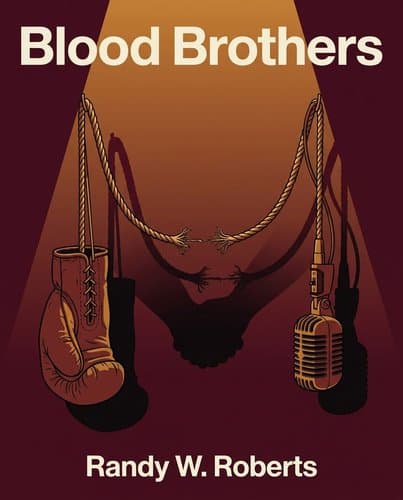
26240780_blood-brothers
by Randy W. Roberts
Malcolm X and Muhammad Ali shared one of history's great friendships—until survival required each man to choose power over loyalty.
In Brief
Malcolm X and Muhammad Ali shared one of history's great friendships—until survival required each man to choose power over loyalty. Their story reveals how institutions weaponize belonging, forcing even those who love each other to become instruments of each other's destruction.
Key Ideas
Publishing motives shape narrative silence
Before trusting any 'definitive' historical account, ask what the storyteller had to gain — Haley needed a clean morality play to sell the Autobiography, and that need shaped what he published and what he left in his notes. The index card he kept private is the most revealing document in the book.
Genuine affection coexists with strategy
The most powerful alliances often combine genuine love with strategic calculation — Malcolm loved Clay and used him as a human shield simultaneously. Recognizing both truths doesn't diminish the love; it makes it more honest.
Survival instinct masks personal betrayal
Choosing institutional safety over personal loyalty rarely feels like betrayal in the moment. It feels like survival. Ali's Louisville whisper — 'They'd shoot me, too' — is what that calculation looks like from the inside, a decade later.
Real freedom depends on institutions
A declaration of freedom is only as real as the institution that will let you keep it. 'I don't have to be what you want me to be' meant something very different the morning after the Liston fight than it did the night Ali drove past Elijah's mansion at fifty miles per hour with George Plimpton ducking in the passenger seat.
The refused path becomes your own
The person whose path you refuse to follow often turns out to be mapping your own destination — Ali arrived at Malcolm's universalism, his rejection of race theology, his insistence that being born in America doesn't make you an American. He just arrived there alone, years after the man who showed him the way was buried at Ferncliff.
Who Should Read This
History readers interested in Political Figures and World History who want a deeper understanding of how we got here.
Blood Brothers
By Randy W. Roberts & Johnny Smith
12 min read
Why does it matter? Because the story you know about Muhammad Ali and Malcolm X was designed to be comfortable — and the real one is far more human.
The accepted story: the moment Elijah Muhammad renamed Cassius Clay, Malcolm X was finished — discarded cleanly, without grief, by a man who chose power over loyalty. Satisfying moral fable. Also largely fabricated.
The man who gave us that version was Alex Haley. What Haley buried — in his own files, never published — was evidence that the comfortable story was the one he'd manufactured.
Blood Brothers follows the evidence rather than the fable: two men who used each other as shields, who genuinely loved each other, and whose split was engineered by an organization that needed one of them dead. The story you think you know is the cover story.
The Cold Betrayal Story You Know About Ali and Malcolm X Was Manufactured — and We Can Prove It
The most quoted line about Ali's rejection of Malcolm X was almost certainly borrowed from somewhere else, placed in a conversation that couldn't have happened when Haley said it did, and contradicted by evidence Haley kept in his own files.
Here's how the accepted story goes: the moment Elijah Muhammad renamed Cassius Clay as Muhammad Ali in March 1964, the new champion coldly cut off his mentor. The key evidence is a quote Ali supposedly gave Alex Haley during a private interview in Harlem that week: "You just don't buck Mr. Muhammad and get away with it. I don't want to talk about [Malcolm] no more." Haley published it in the epilogue of The Autobiography of Malcolm X, and generations of biographers accepted it as the definitive moment of rupture.
Two problems. First, that line appears nearly word-for-word in an Ebony interview Ali gave in September 1964. Haley was almost certainly working from that published interview when he wrote the epilogue and transplanted the quote into a scene he constructed. Second, Ali was not in Harlem during the week of March 6, 1964. The conversation Haley described could not have taken place when he said it did.
But the deepest crack in the story comes from Haley's own desk. During the actual Playboy interview — conducted after Ali returned from Africa in late June 1964, months after the renaming — Haley scribbled something on an index card. Ali had said that despite following Elijah Muhammad, Malcolm was "still my brother, and my friend." Haley held onto the card. Then, not long after, he happened to mention to Malcolm that he'd spoken with Ali. Malcolm asked what Ali had said. Haley pulled out the card and handed it over.
Malcolm stared at it. Then he looked out the window. When he finally spoke, his voice gave him away. "I felt like a blood big brother to him," he said. He breathed and added: "I'm not against him now. He's a fine young man. Smart. He's just let himself be used, led astray."
So what did Haley do with this? He published the opposite: a clean, cold betrayal, with Ali saying he had nothing more to say about Malcolm. The index card stayed in his files. The broken voice stayed off the page.
Haley was under serious financial pressure to make the Autobiography a commercial success, and a tragic rupture between two giants sold better than a more complicated grief. That's not accusation — it's the logic of the evidence. But the effect was to bury a story that had nothing clean about it. It was about two men who still called each other brothers while the world was being told otherwise.
Their Bond Started With a Wound Neither Had Words For
On the night of August 8, 1957, Officer Kalbfleisch answered a domestic disturbance call at a house in Louisville's West End. When he arrived, the father had already bolted into the darkness. A mother stood crying. Two boys huddled close to her. One of the teenagers was bleeding from a wound in his thigh. When Kalbfleisch asked about it, the boy said he'd cut himself on a milk bottle. The officer knew better — the father had fled, the story didn't hold — but he let it go. The report he filed was three lines: a cutting investigation, no arrest. The teenager who gave the unlikely explanation identified himself: Cassius Clay.
The wound was real. So was the lie that covered it. Clay grew up in a house where his father's racial fury had nowhere to go except inward. Cassius Clay Sr. was a sign painter and muralist who believed white America had robbed him of everything he might have been, and he wasn't wrong. That knowledge didn't liberate him. It curdled. He beat his wife. He told his sons the color of their skin was why they would never be rich. He warned them constantly about white men — don't look at them, don't contradict them, don't get arrested — and then confirmed, again and again, that there was no escape from a world that had already decided what they were.
Malcolm's father was found on the streetcar tracks in Lansing with his skull fractured. The official ruling was accidental. Earl Little had been a Black minister who organized for Marcus Garvey; he'd been receiving death threats for years. Malcolm was six. Before that, the family's house had been set on fire in the night while everyone was inside. They got out. The neighbors who lit it called themselves good Christians. That report filed too: no arrests. When journalists later asked Malcolm when he first experienced racial inequality, he didn't reach for a story. He said: when I was born.
When Clay met Malcolm in Detroit in June 1962, what struck him had nothing to do with theology or politics. He watched a Black man denounce the American government in front of thousands of people — loudly, without flinching, without running — and Clay's first thought was that only God could be protecting someone willing to do that. "He was fearless," Clay said later. "That really attracted me."
That's the thing about two people who carry the same wound: they don't see a mentor in each other. They see evidence that what broke the father doesn't have to break the son. Someone who took what broke their father and didn't break.
They Loved Each Other Because They Needed Each Other — and That's Not a Contradiction
Does it diminish something to discover that both men were using each other?
That's the question the book won't let you dodge. Malcolm saw in Clay a political force who could unify young, disenfranchised Black Americans: someone whose fame could reach an audience no movement outside the Nation of Islam could otherwise touch. Clay saw in Malcolm a man who stood in front of thousands and said things that should have gotten him killed, proof that the fear his father spent a lifetime trying to manage wasn't inevitable.
Then came January 1964, and the calculation became explicit in a way that's hard to romanticize. Malcolm was pacing a hotel room at JFK Airport for seven hours with Alex Haley, unable to sit still, his mind somewhere else entirely. Elijah Muhammad had suspended him indefinitely. Someone at his own mosque had told the congregation that if they knew what he'd done, they'd want to kill him themselves. He had no savings, no property, no home of his own. He'd signed his book royalties over to the Nation of Islam. The only fixed point was Cassius Clay.
What took shape in that hotel room was survival arithmetic. If Malcolm went to Miami and made his friendship with Clay as visible as possible — photographs, public appearances, press interviews — he could force Elijah into a corner. Either Elijah would reinstate him to protect Clay's title shot, or he'd punish Clay for associating with a suspended minister. Either way, Malcolm's bond with the boxer tightened. And none of Elijah's followers would move against him while he was standing next to the man about to fight for the heavyweight title. Clay was the only cover Malcolm had left.
Here's what makes this complicated: Malcolm went to Miami and played with Clay's daughters. He laughed watching Cassius clown for his camera. When his wife Betty said Malcolm loved the boxer like a younger brother, she wasn't describing a performance. The calculation and the love occupied the same person at the same time.
Clay was just as deliberate, and just as genuine. He used Malcolm's fearlessness the way a student uses a proof: evidence that standing in the open and refusing to flinch was actually possible. When promoter Bill MacDonald threatened to cancel the Liston fight over Malcolm's presence in camp, Clay's answer came without hesitation: "My religion is more important to me than the fight." That's a man who has already decided who he is.
The Real Fight Was Never Clay vs. Liston — It Was Elijah vs. Malcolm for Ali's Soul
Malcolm was driving when Elijah Muhammad's voice came through the car radio. It was early March 1964, and Elijah had commandeered a nationwide broadcast on WWRL, a Harlem radio station, to announce that the heavyweight champion of the world would carry a new name, Muhammad Ali, a name the Messenger himself was bestowing as a mark of divine favor. Malcolm erupted at the wheel. He told the man beside him that this was a political move, timed precisely to seal Clay's loyalty before Malcolm could claim it.
He was right. Elijah had told Malcolm the Liston fight was unwinnable and forbidden the Nation's newspaper from covering it. When Clay won anyway, Elijah rewrote history: he and Allah had assured the victory, no one else. Now, three weeks later, he was using national radio to claim the champion's very identity before Malcolm could establish himself as the man who'd made Clay's faith possible. Both men understood what the broadcast meant. Elijah had moved his queen.
What neither said aloud, what the book reconstructs through the people who were in the room, was that Clay had already decided. At the Hampton House, a Black-owned Miami hotel where Ali's entourage had gathered after the fight, he told the football star Jim Brown that he loved Malcolm but could not follow him. Elijah had power. And power, for Ali, had always worn the face of a father.
The name-change alone doesn't explain this. Ali spent his career ceding authority to older men: his trainer Angelo Dundee, the wealthy Louisville syndicate that controlled his purses, and now Elijah. Malcolm had spent two years building Elijah's image as an all-knowing messenger, and Ali absorbed it so completely that when Malcolm tried to dismantle it, calling Elijah a false prophet and triggering a physical struggle when Ali's brother Rudy tackled him for the blasphemy, it backfired. Clay ended up suspicious of Malcolm's motives, not Elijah's conduct. Jerry Izenberg put it plainly: the Nation became Ali's family, he said, and Elijah became his father. Malcolm could offer a political vision and a global stage. He could not offer a patriarch.
What Ali needed, at twenty-two, with every institution in American sports trying to strip his title and half the country refusing to say his name, was the certainty that someone powerful was unconditionally on his side. Malcolm offered something more demanding: a peer who expected him to carry his convictions outside the ring, into sit-ins and confrontations that genuinely frightened him. He'd said more than once that he was afraid of what would happen if he joined a demonstration. The Nation asked him to be a boxer. Malcolm asked him to be brave in a way that boxing didn't cover.
When Elijah's men told Malcolm that Clay was no longer taking calls, Malcolm rang the hotel suite eight times in a single day. No one picked up. The man he had introduced to African ambassadors, coached through speeches, and boasted about to Alex Haley like a proud older brother — had chosen. Elijah had been watching from Chicago the whole time, and he had won.
Ali Spent a Decade Terrified of Becoming Malcolm X — Then Became Exactly That
In November 1974, Muhammad Ali returned to Louisville as heavyweight champion, having just beaten George Foreman in Zaire. At a reception, two Nation of Islam security men appeared at his elbow and told him it was time to leave. Ali pushed back. "These are my Louisville men, they can stay as long as they want." He sent them off, then turned to reporter Dave Kindred and dropped his voice. "I would have gotten out of this a long time ago," he said. "But you saw what they did to Malcolm X. I ain't gonna end up like Malcolm X." And then: "I can't leave the Muslims. They'd shoot me, too."
That confession reorganizes the decade that preceded it. The draft refusal in April 1967, the act that cost Ali his title, his income, and three years in the prime of his career, looks from the outside like pure conscience. It was that. But it was also the decision of a man who, at two in the morning before the Zora Folley fight, wept to Sugar Ray Robinson and admitted he was afraid. Robinson pressed him: afraid of jail? Ali went silent. Robinson concluded it wasn't jail. It was what the Nation would do to him if he chose the government over Elijah. He refused induction because Elijah ordered it, and stayed for a decade because he knew what happened to men who left.
Elijah eventually answered that question himself. In 1969, after Ali admitted on national television that he might return to boxing for money, Elijah suspended him — returned his "slave name," barred him from meetings — for the same offense that had ended Malcolm: placing something above the Messenger's authority. A decade of speeches denouncing Malcolm purchased no immunity. When Ali could no longer generate publicity, Elijah discarded him the same way.
Ali lived to see what came next. Elijah died in 1975. His son Wallace dismantled the race theology and renamed Harlem's Mosque No. 7 in Malcolm's honor, a formal acknowledgment that Malcolm had been right. Ali arrived at the same place, slowly: "I don't hate whites. The devil is in the mind and heart, not the skin."
He said later that he wished he could have told Malcolm he was sorry, that Malcolm was right, that he never would have become Muhammad Ali without him. Malcolm had drawn that road in 1964: orthodox Islam, universalism, a politics of human dignity over racial separatism. It was exactly where Ali ended up. He just walked it alone, a decade late, with no way to say any of it to the man who drew the map.
The Ghost of a Brother Who Was Always Right
What the book leaves you with isn't a verdict. It's an accounting. Two men who genuinely loved each other, who each used the other as cover at their most desperate moment, separated not by diverging beliefs but by the instant one man's institutional loyalty ran out and took the other man's protection with it. Malcolm died having lost the only shield that might have saved him. Ali spent a decade knowing the price of that and paying none of the bill.
Eventually Ali arrived at every position Malcolm had mapped — universalism, orthodox faith, the refusal to mistake race for theology — with no one left to apologize to.
Notable Quotes
“Malcolm slowly climbed the stairs up to the main ballroom, taking long, heavy steps. By the time he reached the second floor, he looked exhausted,”
“Restless, he bounded from the chair and began pacing, occasionally peeking out at the audience.”
“Benjamin 2X remembered. Without an official platform or a guest speaker, he sent Benjamin to give the introduction.”
Frequently Asked Questions
- What is Blood Brothers about?
- Blood Brothers chronicles the intertwined lives of Malcolm X and Muhammad Ali, examining how their bond—built on genuine love and mutual recognition—was torn apart by institutional loyalty, political calculation, and the price of survival. The book draws on private documents including Alex Haley's unpublished notes to explore how power, betrayal, and self-preservation shape even the most personal relationships. It provides a framework for understanding the complex intersection of friendship, ideology, and institutional pressure in two of modern America's most influential figures.
- What was the relationship between Malcolm X and Muhammad Ali according to Blood Brothers?
- Blood Brothers reveals that Malcolm X and Muhammad Ali shared a powerful bond built on genuine love and mutual recognition. The most powerful alliances often combine genuine love with strategic calculation—Malcolm loved Clay and used him as a human shield simultaneously, and recognizing both truths makes it more honest. This relationship was eventually torn apart by institutional loyalty and political calculation. Through unpublished notes, the authors demonstrate how survival instincts led both men to prioritize institutional safety over personal loyalty, with Ali later arriving at Malcolm's universalism years after Malcolm's death.
- What sources does Blood Brothers use to tell this story?
- Blood Brothers draws extensively on private documents, notably Alex Haley's unpublished notes from the Malcolm X Autobiography. Before trusting any 'definitive' historical account, ask what the storyteller had to gain—Haley needed a clean morality play to sell the Autobiography, and that need shaped what he published and what he left in his notes. The index card he kept private is highlighted as "the most revealing document in the book," offering crucial insights into Malcolm and Ali's relationship that weren't included in the published autobiography.
- What are the main lessons from Blood Brothers about power, loyalty, and freedom?
- Blood Brothers teaches that choosing institutional safety over personal loyalty rarely feels like betrayal; it feels like survival. Ali's reflection encapsulates this: 'They'd shoot me, too.' The book shows that a declaration of freedom is only as real as the institution that will let you keep it. Finally, the person whose path you refuse to follow often turns out to be mapping your own destination—Ali eventually arrived at Malcolm's universalism, his rejection of race theology, and his insistence that being born in America doesn't make you an American, just as Malcolm had envisioned.
Related Book Summaries
Read the full summary of 26240780_blood-brothers on InShort