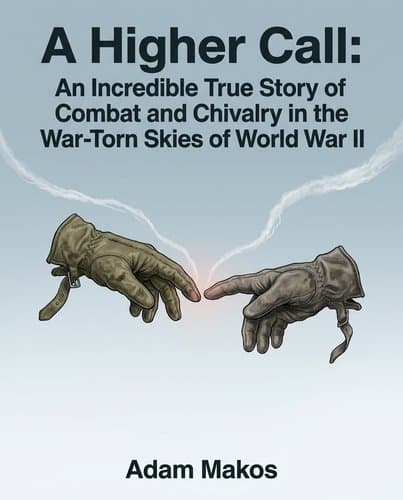
15808816_a-higher-call
by Adam Makos, Larry Alexander
In 1943, a German fighter pilot chose to escort a crippled American bomber to safety instead of shooting it down—then spent 47 years wondering if the crew…
In Brief
In 1943, a German fighter pilot chose to escort a crippled American bomber to safety instead of shooting it down—then spent 47 years wondering if the crew survived. This true WWII story proves that personal honor can survive totalizing evil, and that one act of mercy can outlast empires.
Key Ideas
Pressure Reveals Character Built Through Training
The rules you follow under pressure reveal who you are, not the ones you follow when it's easy — Franz's restraint over Germany wasn't improvised in the moment; it was the direct output of a code he had been handed and tested for fifteen years before that flight.
Logic Explains Institutional Choices Better Than Judgment
Institutions suppress moral events not out of malice but out of logic: the 8th Air Force's suppression of the Stigler story was coldly rational — 'if other gunners hesitate before shooting a nice German, more Americans die.' Understanding this is more useful than finding it villainous.
Ethics Preserves Your Identity, Not Theirs
'You follow the rules of war for you, not for your enemy' — Commander Roedel's instruction to Franz reframes ethical behavior as self-preservation of a different kind. The rules aren't about the other person; they're about who you remain after the fight is over.
Precision Persistence Bridges Impossible Time Gaps
The search for Franz took Charlie four years and required specific, unpublished details as verification tests — meaning the reunion only happened because Charlie pursued it with the same precision he flew his missions. Passive hope doesn't close a 47-year gap.
Moral Ambiguity Within Corrupt Systems
Honor inside a corrupt system isn't the same as endorsing that system — but the book insists you sit with the discomfort of where that distinction blurs. The pilots of JV-44 kept flying after they knew about Buchenwald. That fact belongs in the story alongside their courage.
Who Should Read This
History readers interested in Military History and World History who want a deeper understanding of how we got here.
A Higher Call: An Incredible True Story of Combat and Chivalry in the War-Torn Skies of World War II
By Adam Makos & Larry Alexander
11 min read
Why does it matter? Because the clearest moral story we think we know is the one most worth questioning.
Most people think they know what World War II was. The clearest moral story the modern world has — good side, evil side, no squinting required. Then consider this: March 1946, a bombed-out Bavarian city, and a decorated Luftwaffe ace in his dead father's moth-eaten coat is being turned away from a brickyard job by the very civilians he spent four years bleeding over. They call him a Nazi. He is a man whose personal code of honor survived 487 combat missions and a regime his own family voted against — a man who once made a decision over the North Sea that should have gotten him executed, and instead became the most important thing he ever did. This is the story Adam Makos spent eight years reconstructing, and it will quietly dismantle everything you assumed was settled about what it means to be on the wrong side of a just war.
The Man You Were Before Anyone Was Watching
The glider hits the dirt nose-first, and twelve-year-old Franz Stigler flops backward, still strapped to his seat, groggy but alive. His father pulls him free, holds him, cries. Then, once the tears are done, the repair work begins — and this is where the real lesson happens.
While patching the damaged glider, Franz tries to smooth over a section of sloppy gluework before covering it with fabric, where no one would ever see it. His father stops him. Fix it anyway, he says. Because you'll know it's there. Not because someone might inspect it. Not because there are consequences. Because the man you are when no one is watching is the only man you actually are.
That sentence — or the spirit of it — is the whole architecture of what Franz Stigler will become. Ten years later, climbing into a Messerschmitt 109 over the North African desert, he carries it without knowing he carries it.
His first combat mission ends in a rout. His commander, Lieutenant Gustav Roedel, one of the Luftwaffe's most decorated aces, leads Franz straight at a formation of British P-40s. The P-40s open fire — twenty-four combined machine guns — and Franz panics, hauls back on the stick, and runs for altitude. He lands shaking, discovers he's wet his flight suit, and waits for Roedel's contempt. Instead, Roedel sits down on the tire of Franz's plane and calls it a success: you survived, you came home, and you'll never be that frightened again. Then he adds something else — about rules, about what a pilot owes himself in the air, about the line between a soldier and something worse. Franz listens.
Two lessons, years apart, from two different men. Both say the same thing in different registers: who you are is measured in private acts, not public ones. Fix the glue nobody can see. Follow the rules no one would punish you for breaking.
December 20, 1943 — when Franz pulls his fighter alongside a shattered American bomber and refuses to fire — is still two years away. The test of all of it hasn't come yet.
The Enemy Who Taught Franz What Victory Was For
The most celebrated German pilot of the North African campaign measured his greatest moments by how bad they made him feel. Hans-Joachim Marseille, twenty-two years old and already credited with more than fifty aerial victories, sits in his tent with prohibited American jazz on the phonograph, Oriental rugs underfoot, and a Black South African prisoner named Matthias across the chess board — a friendship German racial law explicitly forbade and that nobody at JG-27 thought to enforce. When Franz finally meets this legend, he expects swagger. What he gets is a glass of cognac and a quiet confession: that his first victory left him sick with sorrow. 'There's no reason to apologize for never having killed a man,' Marseille tells him. 'Once a person enjoys killing, he is lost.' This from the man German newspapers called the Star of Africa.
He meant it literally. Marseille had twice flown his fighter through British anti-aircraft fire — defying a direct order from Goering — to drop notes over enemy airfields confirming that a downed Allied pilot had survived. He wasn't performing chivalry. He was someone for whom the enemy pilot's mother was a real consideration that outweighed institutional authority.
Franz files this alongside what he already knows from Roedel: that the rules of war exist for the soldier who follows them. Two senior men, the best at what they do, saying the same thing in different registers. Victory is a means, not the point. The point is what kind of person you remain while pursuing it.
The image that stays is the chess board. Matthias on one side, Marseille on the other, jazz playing in a desert tent. The Star of Africa, having confessed that killing made him feel terrible, waiting for his opponent's next move.
Charlie Brown Wasn't Supposed to Be Here — And He Knew It
Charlie Brown dives a B-17 Flying Fortress to just above the surface of the West Fork River, four throttles full forward, 250 miles per hour, fishermen throwing themselves flat in their canoes as the blast wave rolls over the banks and billows dust down the main street of Weston, West Virginia. He barely clears a bridge. He almost doesn't clear the mountains. And somewhere in that terrifying low pass is the whole reason he's there: his father is standing on the sidewalk in his judge's robes, waiting, and Charlie needs him to see.
He grew up without electricity, milked cows before school, and spent his evenings scrubbing toilets as the elementary school janitor. He enlisted as a private, got knocked out in the first round of a base boxing tournament by a gray-haired old pro who then leaned over his stool and told him he was too decent a kid for the infantry — check out the Air Corps. He did. By twenty years old he was a B-17 pilot, lying about his age to his own crew (telling them he was twenty-four so they wouldn't panic at who held their lives) and flying the most advanced bomber in the world over the town where he used to clean other people's floors. The buzz of Weston isn't recklessness. It's a specific, human hunger: to be seen as something other than the boy who came from nothing.
He understood the cost of that hunger precisely. On the train east toward deployment, his crew learns about Black Thursday — October 14, 1943, sixty bombers and six hundred men gone over Schweinfurt in a single afternoon. Then comes the information that his rookie crew will fly Purple Heart Corner: the lowest, outermost position in the formation, the spot German fighters hit first. Charlie doesn't write home that night. He goes and finds his crew. Twenty years old, farm-raised, responsible for nine men — he hears all of this and climbs aboard anyway. Not because the odds look good. Because he already knows what he wants badly enough to die for it, and that kind of hunger doesn't turn the plane around.
The Thirty Seconds That Changed Everything
Franz Stigler pulls his refueled 109 back into the cold air above Jever and finds the bomber almost immediately — a lone B-17 staggering westward, trailing smoke, losing altitude. He needs one more kill for the Knight's Cross. This is the moment he's been building toward since Africa.
He swings in from behind and throttles back to match the bomber's wounded speed. Standard approach. He settles his gun sight on the tail position and waits for the tail gunner to open fire — that exchange would determine who lived. But the guns don't move. Franz edges closer. Still nothing. At perhaps a hundred yards, close enough to count rivets, he finally sees why: the tail gun compartment has been hacked open by cannon shells, the glass gone, the metal peeled back to the sky. The tail gunner's fleece collar is soaked red, and the blood has frozen in thin lines down the length of the gun barrels. Franz lifts his finger from the trigger.
What happens next is the whole book in a single motion. Franz doesn't turn for home. He flies the full length of the fuselage, slow and deliberate, scanning for weapons that could still be turned on him. The waist gun has been blasted from its mount. The radio room is destroyed. Through gaps in the bomber's skin — sections of aluminum stripped entirely away — he can see the surviving crew members crouched over their wounded in the cold interior. He pulls up to the right wingtip and holds position there, matching the bomber's airspeed, and begins flying them toward the sea.
This is the part that should be impossible, and here's why it happened anyway: Franz had been told, twice, by the two best pilots he ever knew, that the quality of a soldier is measured in the acts no one can enforce. Roedel told him never to shoot a man in a parachute — not as a courtesy to the enemy, but to keep something intact in himself. Marseille told him that a pilot who starts to enjoy the killing is already lost. On December 20, 1943, Franz looks through his gun sight at frozen blood on spent gun barrels and decides, without anyone watching, without any consequence for pulling the trigger, that this is not a kill. Not pulling the trigger is the same logic as fixing the glue nobody sees — the thing you do because of who you are, not because anyone will know.
Inside the cockpit, Charlie Brown and his copilot Pinky stare at the German fighter sitting ten feet off their wingtip and conclude the only logical thing: he's toying with them, waiting for the moment he wants. Franz mouths a word and points north — Sweden, neutral territory, thirty minutes away, survival nearly guaranteed. Charlie can't read it. He orders his one working turret to track the 109. Franz sees the guns rotate toward him, understands he has done everything he can do, and offers a slow salute before banking away and disappearing into the overcast. He leaves the crippled bomber to make the two-hour crossing over the North Sea on three damaged engines with a dead tail gunner, a man bleeding out in the waist, and a nose open to the sky.
Charlie makes it. But that comes later. What matters here is the salute — one man acknowledging another at the precise moment he forfeits everything he came for, because the man he'd always been left him no other option.
Honor Is Dangerous — The Institution Made Sure of It
When Charlie Brown sat across from intelligence officer Lieutenant Bob Harper at Seething airfield and described the German pilot who had flown alongside their ruined bomber and saluted them out over the sea, Harper leaned across his desk in genuine disbelief. Then he went and made his calls to 8th Air Force headquarters. By the time Charlie's replacement ride to Kimbolton was ready, the orders were waiting: tell your crew to say nothing to anyone, and forget about the medals. The Distinguished Flying Cross Charlie had requested for each man — a decoration routinely handed out for completing a standard tour — was denied.
The reasoning was cold and, if you follow it, hard to argue with. Award the crew, and people ask why. The crew tells the story, and somewhere out there another shot-up bomber gets a 109 on its wing, and the gunners remember what they heard and hesitate. Maybe that German pilot isn't Franz Stigler. Maybe he finishes the job. The 8th Air Force couldn't afford a story that made the enemy legible as a person, because legibility costs fractions of a second, and fractions of a second cost lives. So the story was filed away under silence, and the crew who had just survived the unsurvivable flew home with orders to pretend their day had been ordinary.
On the German side, Franz never filed a report claiming the kill. He had watched the bomber disappear toward England already certain it would go down in the North Sea, convinced the crew was doomed regardless of what he'd done. But he also knew exactly what silence meant for his own standing: the Knight's Cross he had chased since Africa, the decoration that had defined his ambition for years, was gone the moment he banked away and saluted.
Harper never asked Charlie to invent a cover story. He didn't need to. The institutional logic handled it quietly, on both sides, without anyone having to say the ugly part out loud. The two most decent things that happened in the skies over Germany on December 20, 1943, were buried — one by order, one by omission — and the machinery rolled on.
What the Best Men in the Luftwaffe Finally Admitted to Themselves
Trautloft walked into the room and told them what he'd found at Buchenwald: 160 Allied airmen designated as 'terror fliers' by the SS, scheduled for execution, being held alongside crematoriums and starving inmates. He had intervened personally to transfer them to a Luftwaffe prisoner camp before the SS could act. When he told this to the assembled pilots of JV-44 — men who had flown for Germany since before the fall of France — the effect wasn't revelation so much as confirmation. These weren't naive boys. They already suspected the shape of what they were serving. Trautloft gave them the specifics.
And they kept flying.
There's no clean resolution here. What these men told themselves — and what the evidence loosely supports — is that they were flying for each other, not for the Reich. The cause had been privately abandoned; the brotherhood hadn't. Franz's code, the same one that produced the mercy over Bremen in 1943, demanded that you don't walk away from men who depend on you. The problem is that this logic, honorable at the scale of a squadron, provided functional cover for a genocidal state at the scale of a war. The same moral seriousness that made Franz Stigler incapable of shooting a wounded man also made him incapable of leaving the men beside him. There's no clean answer for which of those facts cancels the other out — and there isn't supposed to be.
Forty-Seven Years Is How Long It Takes to Finish a War
Think of a debt that accumulates interest for forty-seven years. Not a financial one — a moral one. One decision, made alone at altitude in December 1943, begins compounding the moment Franz Stigler banks away and offers his salute. The two men it binds together go their separate ways without knowing the other survived, carry the memory like an unhealed wound, and spend the next five decades on opposite sides of the world, both haunted by the same ten minutes.
The verification call, when it finally comes in 1990, is the part that should be impossible — and it happened anyway. Charlie Brown had spent four years working through military archives, writing letters, getting nowhere, until a German fighter pilot's association journal called Jaegerblatt agreed to publish his appeal. His ad was deliberately sparse: he described the encounter but withheld three specific details — the bomber's missing stabilizer, the shattered tail gun compartment, the long flight out over open water before Franz finally peeled away. These were his tests. Any imposter would fail them for lack of knowing.
Franz read the ad and recognized the day immediately. On the phone, he described the battle damage without being asked: the missing stabilizer, the destroyed tail position, the blood frozen to the gun barrels. Then he said that when he finally turned back from the bomber, he had assumed they would never survive the crossing over the sea. Charlie hadn't mentioned the sea. That was the last test. 'My God, it is you,' Charlie said, and wept into the phone.
Six months later in a Seattle hotel lobby, Franz crossed the atrium at something close to a run and wrapped his arms around an old man in a bolo tie, and told him plainly: 'I love you, Charlie.' What he meant, and what he said explicitly in the days that followed, was that the brother he'd lost early in the war — his brother August, dead over Malta — had somehow been returned to him in this form. One mercy, extended to a stranger over Germany, eventually produced a brother in his old age.
The reckoning that followed was both personal and institutional. The U.S. Air Force, sixty-four years after ordering Charlie's crew to stay silent, formally acknowledged the mistake. In April 2008 — the same month Franz was dying — Charlie stood at the Florida State Capitol and received the Air Force Cross, the nation's second-highest decoration for valor. The rest of the crew, living and dead, received Silver Stars. The men the Air Force had once ordered into silence became, collectively, among the most decorated bomber crews of the war.
Franz never received the Knight's Cross. He'd been three kills short when he flew alongside a wounded bomber instead of finishing it. For the rest of his life he said, with no apparent bitterness, that he'd gotten something better. By the time both men died in 2008 — Franz in March, Charlie eight months later — twenty-five descendants of that crew existed in the world: children, grandchildren, lives that ran forward from one decision made at 27,000 feet when nobody was watching and no one would have blamed him for the other choice. That's what the debt compounded into.
The Knight's Cross He Never Got
Franz Stigler flew 487 missions, took a bullet through the forehead, and never received the decoration he spent years earning. What he did on December 20, 1943, produced no citation and was witnessed only by men ordered to forget it. And yet: 25 people are alive because of it. A brother found in old age because of it. A phone call in 1990 where an old man wept and said my God, it is you — because of it. The record took 47 years to catch up to the man, and when it did, the man had already known for 47 years exactly what he'd done and why. His father taught him that in a woodshed in Bavaria. The glue nobody sees still has to hold.
Notable Quotes
“Let me know when they start their attack!”
“How are you still flying?”
“Then the last 109 parked on our wingtip,”
Frequently Asked Questions
- What is A Higher Call about?
- A Higher Call reconstructs the true story of a German fighter pilot who chose to spare a crippled American bomber crew over Germany in 1943, and the 47-year search that eventually reunited the two men. Drawing on both pilots' accounts, the book examines how personal codes of honor operate inside corrupt institutions and what it costs to act on them. The narrative explores the ethical complexities of wartime decisions and the bonds that can form between enemies. It challenges readers to consider how individuals maintain their integrity when institutions and warfare demand compromise.
- What are the key takeaways from A Higher Call?
- The book demonstrates that the rules you follow under pressure reveal who you are, not the ones you follow when it's easy. Franz's restraint over Germany wasn't improvised in the moment; it was the direct output of a code he had been handed and tested for fifteen years before that flight. The narrative also reveals how institutions suppress moral events not out of malice but out of logic: the 8th Air Force's suppression of the story was "coldly rational." Finally, "You follow the rules of war for you, not for your enemy" reframes ethical behavior as a form of self-preservation about who you remain after the fight.
- How did the American bomber crew and German pilot reunite after 47 years?
- The reunion between Charlie Brown and Franz Stigler came only after Brown spent four years conducting a precision search for his former enemy, requiring specific, unpublished details as verification tests. The book emphasizes that passive hope doesn't close a 47-year gap—instead, Brown pursued the search with the same precision he flew his missions. Through methodical detective work and the discovery of verifiable details only the real Franz would know, Brown eventually located Stigler, and the two pilots reunited decades later. The story underscores that extraordinary reunions require extraordinary effort and determination, not coincidence.
- What does A Higher Call reveal about honor in wartime and corrupt systems?
- The book insists that honor inside a corrupt system isn't the same as endorsing that system, but encourages readers to sit with the discomfort of where that distinction blurs. The pilots of JV-44 kept flying after they knew about Buchenwald, a fact the narrative includes alongside their courage. This creates a complex portrait: individuals can demonstrate extraordinary humanity and moral courage in specific moments while operating within fundamentally compromised institutions. The work challenges the notion of clean heroism, instead presenting the nuanced reality of maintaining a personal code of honor while trapped in circumstances that demand moral compromise.
Related Book Summaries



Read the full summary of 15808816_a-higher-call on InShort