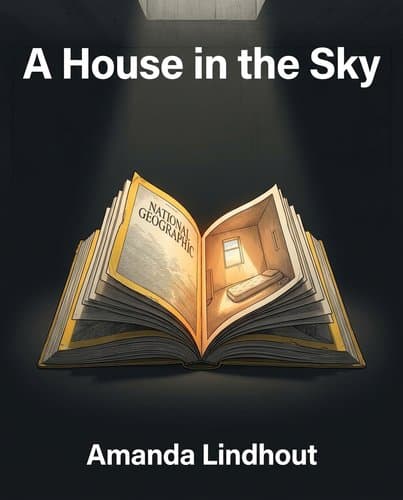
18039963_a-house-in-the-sky
by Amanda Lindhout, Sara Corbett
A woman who escaped childhood poverty through dreams of travel eventually finds herself chained in a Somali cell for 460 days—where the only remaining escape…
In Brief
A woman who escaped childhood poverty through dreams of travel eventually finds herself chained in a Somali cell for 460 days—where the only remaining escape route leads inward. Amanda Lindhout's harrowing memoir reveals how the mind architects its own refuge when every external freedom is stripped away.
Key Ideas
Survival Mechanisms Don't Update With Environment
The psychological tools that help a child survive a dangerous environment — using imagination to escape, interpreting danger as proof of resilience, equating movement with safety — don't automatically update when the environment changes; they keep running the same logic until something forces a reckoning
Proximity Deceives Us Into Greater Risk
'The rule of proximity' is seductive in any domain: reaching one difficult thing makes the next harder thing feel like a natural hop rather than a new risk calculation. The memoir is a case study in what happens when that logic is never stress-tested against its own limits
Memory Scraps Build Unshakeable Interior Sanctuaries
Survival under extreme duress is not primarily physical endurance — it is architectural. The mind, deprived of every external resource, will build interior spaces from whatever scraps are available: a passport photo, a remembered taste, a sparrow in a doorway. What you have built inwardly before crisis matters enormously
Compassion And Clarity Coexist Without Contradiction
Compassion for someone who is harming you is not the same as excusing the harm. Amanda's 'seedling of compassion' for Abdullah was a survival technology, not a moral verdict — she held the clarity that what he was doing was absolutely wrong while also seeing the child trauma that produced him, and used the latter to keep the former from consuming her
Forgiveness Lived As Practice Not Achievement
Forgiveness, as the Epilogue describes it, is not a state you arrive at and stay in. It is a direction you choose to walk toward on the days you can, and acknowledge you didn't reach on the days you can't — a practice rather than an achievement
Power Determines If Belief Protects Or Harms
The same text, the same system of belief, the same framework can be used to justify harm and to survive it — which means the question of whether a belief system is protective or damaging cannot be separated from the question of who holds power in the room where it is applied
Who Should Read This
Readers who connect with first-person stories about Memoir and Resilience and want to see the world through someone else's eyes.
A House in the Sky
By Amanda Lindhout & Sara Corbett
13 min read
Why does it matter? Because the hunger that saves a child can become the hunger that destroys an adult.
The girl who survived her childhood by disappearing into other people's geographies — the Hungarian cowboys, the Sistine angels, the impossible blue of some faraway ocean — never stopped running toward the horizon. That's the thing this book understands that most survival stories don't: Amanda Lindhout's compulsion wasn't recklessness. It was the only tool that worked. You build what saves you from the inside out, and then you carry it everywhere, even into places it can't protect you. Especially there. What A House in the Sky maps is the precise moment that tool fails — a Somali road, a blue Suzuki, twelve men with guns — and what a person constructs in its absence when the body is chained and the room is dark and the only territory left unclaimed is the mind itself. It turns out that's enough. Barely. Enough.
The Girl Who Escaped Into Pictures Built Her Entire Identity Around Escape
A nine-year-old girl climbs into a municipal dumpster behind a white stucco fourplex in Sylvan Lake, Alberta, and starts sorting through other people's garbage. She and her older brother Mark are hunting for sixty-ounce liquor bottles — sixty-pounders in their household vocabulary — worth two dollars each at the depot down the road. The money Amanda earns goes to a thrift store by the lake, where she buys back issues of National Geographic for twenty-five cents apiece. She stacks them on her nightstand, within reach from the top bunk. In the next room, a man named Russell drinks rye from a plastic cup and watches television until something on the screen trips a wire in him and the apartment fills with a specific kind of electricity everyone in that household has learned to read. By night, Russell threatens to cut out her mother's eyes. By day, Amanda reads about Hungarian cowboys and Sistine Chapel angels. The magazines were not a hobby. They were the only exit that reliably worked.
Years later, at nineteen, she is stashing thousand-dollar tip nights in her freezer at a Calgary nightclub called The Drink. Oil money is flowing through the city and she is good at her job — good at the heels and the smile and the management of wealthy men's attention. But she watches the suited corporate drinkers collapse into leather chairs after their twelve-hour days and feels something close to pity. She is already gone in the way that matters. One afternoon she sits on the floor of a used bookstore, flipping through old National Geographics, and selects an entire continent to travel to based on nothing more rigorous than the sound of the names. Madidi. Venezuela. Paraguay. The words dissolve the flat syllables of Alberta the way the magazines once dissolved the damp smell of the basement carpet. She just found larger and larger worlds to escape into.
Each Near-Miss Felt Like Confirmation, Not Warning
Amanda Lindhout knew danger when it found her. That is the uncomfortable truth the early chapters force you to sit with. She was not sleepwalking through hazardous places — she was awake, alert, genuinely skilled at reading a room. The problem was what she did with the information once she had it.
In Dhaka in 2005, an auto-rickshaw driver takes a young foreign woman away from the lit streets and into the darkening outskirts of the city. Her neck begins to tingle. She understands, with the body-level certainty that precedes conscious thought, that something is wrong. What she does next — lunging forward from the back seat and driving her fist into the side of the driver's head hard enough to open a cut above his cheekbone — is not the interesting part. The interesting part is what she concludes afterward. Standing on the corner near her hotel, flooded with equal parts anger and relief, she does not register the near-miss as a near-miss. She files it under capability: evidence that she has found what she calls a more aggressive way of using her own power. The rhinestone rings from a Thai beach market, the blood on the driver's face, her own throbbing knuckles — all of it becomes proof that she can handle whatever the world puts in front of her. A warning gets reclassified as a credential.
What follows from that reclassification is not a failure of perception. It is a triumph of a particular logic, one she had been building since childhood, when reading the room accurately and surviving it were the same skill. A girl who learned to navigate genuine unpredictability at close range — Russell's moods, the tilt of the apartment's emotional atmosphere at eleven o'clock on a Tuesday — develops an intimate relationship with her own ability to get through things. Bangladesh confirms it. Pakistan confirms it. Then Kabul, where a gunman shoves a pistol between her ribs in a crowded market and takes three hundred dollars and half her remaining sense of invulnerability. She weeps in the street like a child and misses her mother and catches a bus back to Pakistan and eventually flies home. But even the bruise the gun leaves below her ribs, star-shaped and slow to fade, does not extinguish what she describes as the pilot light still burning underneath everything — the part that says, after all of it, yes, do.
That light was not irrational. It was the most rational thing she had, given what had built it. Every near-miss had, so far, resolved in her favor. The system worked. It just had no mechanism for recognizing when the odds had finally shifted.
Somalia Wasn't a Destination — It Was the Only Story She Knew How to Tell Herself
What drove Amanda Lindhout to Somalia? The obvious answer is ambition — a young freelancer chasing the kind of story that makes careers. The real answer is shame, and a logic she had been building her entire life: the only way out of humiliation was through a door marked danger.
The Baghdad embarrassment had been total. A YouTube clip surfaced of her telling an Iranian anchor, on live television, that mainstream Western journalists were hiding in the Green Zone while she alone was out in the real city. She had been wrong. There were plenty of reporters working the streets of Baghdad. She had arrived two months earlier, seen almost nothing, and awarded herself the moral high ground — and now it was permanent, public, searchable. She described carrying that shame the way a body carries an iron lung: the thing keeping her alive was also the thing she couldn't move inside. The journalists at her hotel, the ones she had wanted so badly to impress, had watched it. Every conversation at the poolside bar was colored by it.
Somalia is where the pattern from earlier chapters tightens into something that can no longer save her. The rickshaw driver in Dhaka, the gunman in Kabul — each close call had written the same lesson into her nervous system: you got through it, which means you can get through the next one. Baghdad added a new variable. The threat was no longer physical; it was professional and social. And the system she had always used — move toward the hard thing, come out the other side — had only one available response. She needed a story significant enough to bury the clip. She named it herself, reaching for the legend of a young Dan Rather lashing himself to a flagpole in a Texas hurricane while other reporters retreated inland, surviving the storm, and making his career in a single broadcast. Somalia would be her hurricane.
The Italian aid worker on the flight into Mogadishu tapped his own temple and told her that her head was worth half a million dollars to the right buyer. She knew exactly what he meant. She just didn't want to hear it — and somewhere past that sentence, the door she had always found on the other side of danger stops being a door.
When the Body Has No Options Left, the Mind Begins to Build
Think of a plant sealed in a dark room — how it sends tendrils toward any crack where light might enter, twisting through impossibility, altering its own architecture in response to the void. Amanda Lindhout, chained in a concrete room in Mogadishu with no light and no calendar and a razor blade kept in a paper sheath near her mattress, did something structurally similar.
By the time she arrived in that darkness, she had already tried every external lever available. On the eleventh day of captivity, she engineered a conversion to Islam — reciting the Arabic declaration of faith in slightly uneven unison with Nigel while a guard named Ali dropped to his knees and shouted 'God is great' three times, treating her capitulation as his personal victory. She described the move herself in the clearest possible terms: a chess piece advanced two squares forward and one to the side. Not faith, not surrender — a bid to reposition herself on a board where the rules were written in a language she was still learning to read. It bought small things: soap that smelled like detergent, a new name, Amina. It did not buy safety.
When a guard named Abdullah began using the afternoon quiet hours to enter her room, the external architecture of survival collapsed entirely. There was no lever left. What grew in its place was interior and, by the book's own insistence, not a symptom of breaking down but a method of staying whole.
During the assaults, Amanda built. She constructed stairways in her mind that opened onto high rooms with cross-breezes, hallways connecting to more hallways, until she had assembled an entire coastal city — something like Vancouver, luminous and cold, with a running path along a jewel-green harbor. She ate imaginary pancakes. She read imaginary books. She was specific about what she was doing: this was not longing, and it was not madness. It was relief. The distinction matters. Longing keeps one foot in the ruined room. What she was doing was full relocation — moving the self into a structure her captors could not enter because they did not know it existed.
The Christmas exchange with Nigel captures the same principle at smaller scale. Working through walls and bathroom-ledge drops and taps on pipes, each of them built gifts from the literal debris of captivity: a doll fashioned from a cough syrup bottle dressed in a black sock, a bracelet threaded from tuna-can pop-tops with knots the size of poppy seeds. The objects weren't symbols of resourcefulness. They were proof that value could be generated from nothing external — that care, expressed through weeks of fingertip labor in a dark room, produced something better than anything you'd find at Tiffany's.
The mind, stripped of every external resource, does not go quiet. It builds. That is what this section of the book documents: not endurance in the sense of gritting through, but construction — rooms, cities, bracelets, a whole inner world assembled from whatever the darkness hadn't yet taken.
The Ransom Call Is the Most Formally Devastating Passage in the Book for a Reason
A document begins with the clean efficiency of a law enforcement header. Case ID: Lindhout. Line ID: a phone number in Sylvan Lake, Alberta. Start time: 12:04:24 MST. Direction: Incoming. The formatting is the same formatting used for parking violations and insurance disputes. Then Amanda's voice appears in the transcript, rendered in stage directions the way a playwright might note a character's emotional state: (Crying). (Sobs). The collision between those two registers — the bureaucratic precision of the header and the raw human noise of those parentheses — is where the book does something no summary can fully capture. It removes the narrator's hindsight. There is no one standing outside the moment, shaping it with the survivor's understanding of what comes next. There is only the real-time transcript, Adam's flat command to not waste his time, and a daughter sobbing 'Momma?' into a phone held by the man who just finished pressing a serrated knife to her jugular.
The call follows the desert. Hours before the transcript begins, Amanda had been driven through bonfires and armed clusters of young men to a clearing around a gnarled acacia tree, forced to her knees in sand still radiating the previous day's heat, and held with a knife at her throat while her captors staged what they intended her to experience as her own murder. On her knees in the dirt, she found herself making an argument she had never once consciously formulated: that she could not die because she had not yet had children. The specificity of it — not 'I want to live' but that precise, unfamiliar thought surfacing from somewhere underneath deliberate thought — suggests that extremity finds the life a person was going to live, not the one they have been living.
She survived it because a negotiator named Donald intervened, then handed her a phone and called it a reprieve. One week. One million dollars. The government, her mother explains across the connection, won't pay. The family has gone back to the bank.
That detail — 'we've gone back to the bank' — lands harder than any description of the knife. The RCMP agents coaching Lorinda Stewart in Sylvan Lake have already explained the logic to her: Amanda and Nigel are investments the captors cannot afford to destroy. The call disconnects mid-sentence, before anything is resolved, and the chapter simply ends. The RCMP report offers no follow-up notation. The bureaucratic container holds the scream and then closes around it, and that is the most formally devastating moment in the book: not a sentence at all, just a stage direction. (Call is disconnected.)
Compassion Wasn't a Moral Achievement — It Was a Survival Technology
Here is what survival actually required: not the white heat of hatred held as fuel, but something colder, stranger, and harder to admire. Compassion. Not as a moral stance, but as the one tool that hatred couldn't burn down.
The moment arrives during a rape. Amanda is on her back, enduring what has become a recurring event in the Dark House, her captor Abdullah moving over her. She pushes her hands against his chest — less resistance than reflex, the body trying to manufacture distance where none exists. And then something breaks open. She describes it as a blast of heat through her palms, followed by her own consciousness dissolving into something wider. What floods in is his life, not hers. She sees him as a small boy running toward an explosion that has just killed his aunt, carrying home the only piece of her he can find — a fragment of a leg — because he doesn't know what else to do. She sees him, years later, hiding behind a truck while gunmen work through the houses on his street. The images are involuntary and precise, assembled from stories he had told her months earlier, now arriving with a clarity she can neither control nor dismiss. For one suspended moment, she understands that his suffering runs deeper than hers. His sadness, she realizes, trenches beneath her own.
This is not forgiveness. Her body hurts exactly the same way it always does when he leaves. What has changed is the geometry of her rage. Rage, she has been learning through these months of total darkness, functions like a lava pit — you cannot swim in it and survive. The daily ritual she has built against the void makes this plain in smaller increments: forcing herself to note that one guard set her food on the floor instead of throwing it, that another smiled when he brought half a papaya and held his arm next to hers to say, without shared language, that their difference was no problem. These were not moments of warmth. They were acts of radical self-preservation — Amanda choosing, deliberately and against every instinct, to find the human inside the person destroying her, because the alternative was a fury that would have consumed her faster than they could.
The Same Text That Was Used to Justify Abuse Was the One She Used to Survive
Donald settled cross-legged on Amanda's floor, opened her Koran to Chapter 23, and began explaining. He had the practiced calm of a man who believes he is teaching. The relevant verses were about self-control and modesty — believers who 'guard their private parts' — except, the passage continued, with those whom their right hands possess. Donald steepled his fingers. Not forbidden, he explained. Not even blameworthy. He had used her own copy of the book she'd been studying as a chess manual to codify her status as property. The same text. The same pages she'd been turning for weeks looking for leverage.
And yet. The Koranic vision of paradise — cool valleys, rivers, fruit that never rots, a body held perpetually at thirty-three — is precisely what she dismantled and rebuilt during the rapes that followed. Not as theology, but as architecture. She placed herself in a city like Vancouver, running along a jewel-green harbor, eating syrup-drizzled pancakes, watching light fall through trees. The book's language of transcendence — a life beyond the suffering body, accessible through directed imagination — had become her escape hatch. It transferred, even without her consent.
Later, in Positive House, she developed what she called an incantation: 'My digestive system is healthy. My skin is healed. My ovaries still work.' Stated in the present tense, asserted as already true, repeated daily. This is the structure of Islamic du'a — personal supplication offered as petition and affirmation at once. She had entered the religion as a chess player. But the vocabulary of the game had gotten inside her, and the Epilogue's hard-won philosophy — forgiveness as a horizon you point your feet toward, some days reaching it and some days not — carries the same grammar as the Koranic concept of mercy extended not because it is deserved but because the one who extends it needs to. It just leaves Donald's steepled hands in the same frame as her imagined harbor, and you are left in the space between them.
Survival Didn't End at the Door — It Just Changed Shape
She is standing in a hotel bathroom in Mogadishu, the first night of her freedom, looking at a stranger. Bones pushing against waxen skin. Hair coming out in clumps. Ankles circled with bruises the color of old plums where the shackles had been. She runs the shower as hot as it will go and scrubs herself with both hands, convinced the hot water will be taken away any moment — and while she scrubs, a small argument runs on a loop in her mind: slow down, you're safe; no, I'm not; yes, really, you are. The door is open. Her captors are gone. And her nervous system, which spent fifteen months learning that safety was always a trick, simply cannot update.
The lecture hall is where you understand the scale of what she carries. A classmate peels a banana in a Nova Scotia classroom, drops the skin on a desk nearby, and the smell reaches her before the thought does. What opens is not a memory but a relapse into sensation — starvation-hunger so acute she once ate a rotten peel off the floor of the Dark House, and her body apparently filed that experience somewhere forgetting couldn't reach. She runs from the room, locks herself in a stall, unsure for a moment whether her freedom is the dream and the Dark House the reality. The world, she comes to understand, is loaded with these peels — mundane triggers that collapse the distance between then and now without warning, no matter how far she has traveled.
What she builds against this is not resolution. It is direction. She founds a school for Somali refugee women in a run-down corner of Nairobi called Little Mogadishu, naming it Rajo — the Somali word for hope — after the anonymous woman who threw her own body over Amanda's during the failed mosque escape. She describes forgiveness the same way: not an arrival but a point on the horizon she points her feet toward, reaching it some days and not others. The school gets its name, the chalk circle goes around it, and the book ends there — not because the nightmare is over, but because hope, practiced daily, is what you build when the door opens and the architecture you survived in is the only one you have left.
The House Was Always the Point
What she built in the dark was not a coping mechanism. It was a home — assembled from imagined harbors and remembered tastes and the specific weight of a tuna-can bracelet finished over weeks of careful knotting in a lightless room. The nine-year-old in Sylvan Lake was already an architect; she just didn't have the materials yet. She didn't find herself in captivity. She built herself there, the only place she'd never been able to flee from. So the school called Rajo, the forgiveness described as a horizon she reaches on some days and doesn't on others — that's just what the work looks like once the walls come down and the building has to hold weight in ordinary light.
Notable Quotes
“Be very careful in Mogadishu,”
“is worth a half million dollars there. And that’s just for your head.”
“They’re saying the war has broken out at the airport in Mogadishu,”
Frequently Asked Questions
- What is A House in the Sky about?
- A House in the Sky is a 2013 memoir by Amanda Lindhout that recounts her fifteen-month kidnapping in Somalia and the psychological survival strategies she employed during captivity. The narrative explores how the mind constructs interior refuge under extreme duress, demonstrating that survival is fundamentally architectural rather than physical. Through her account, Lindhout reveals how imagination, compassion, and interior mental spaces become critical tools when external resources are depleted. The memoir examines how individuals build inwardly before crisis to sustain themselves through unimaginable circumstances, and how forgiveness operates as an ongoing practice rather than a fixed destination.
- What psychological strategies does Amanda Lindhout use to survive her kidnapping?
- Lindhout relies on constructing interior spaces from available mental resources. "Survival under extreme duress is not primarily physical endurance — it is architectural. The mind, deprived of every external resource, will build interior spaces from whatever scraps are available: a passport photo, a remembered taste, a sparrow in a doorway." What a person has built inwardly before crisis matters enormously. Additionally, Lindhout employs compassion as a survival technology—holding the capacity to see her captor Abdullah's childhood trauma while maintaining clarity that his actions were absolutely wrong. This dual awareness prevents her from being consumed by rage while preserving her psychological integrity.
- How does Amanda Lindhout approach forgiveness in her memoir?
- According to the memoir, forgiveness is not a permanent state but an ongoing directional choice. "Forgiveness, as the Epilogue describes it, is not a state you arrive at and stay in. It is a direction you choose to walk toward on the days you can, and acknowledge you didn't reach on the days you can't — a practice rather than an achievement." Lindhout reframes forgiveness as sustainable practice rather than an impossible achievement. This perspective acknowledges the complex emotional reality of recovering from traumatic harm—that some days moving toward forgiveness feels possible while other days require honest acknowledgment of not being able to take that step.
- What does A House in the Sky reveal about childhood survival strategies in adulthood?
- The memoir demonstrates that psychological tools developed in childhood to survive danger persist into adulthood without automatic updating. The mechanisms that help a child use imagination as escape and equate movement with safety continue operating with identical logic until something forces a reckoning. Additionally, 'the rule of proximity' is seductive: reaching one difficult thing makes the next harder challenge feel natural rather than a new risk calculation. Lindhout's experience illustrates what happens when this logic is never stress-tested against its own limits, revealing how early survival strategies can inadvertently increase vulnerability in different contexts.
Related Book Summaries

Read the full summary of 18039963_a-house-in-the-sky on InShort