27917674_when-we-rise
by Cleve Jones
Visibility wasn't just courage—it was strategy. Cleve Jones's firsthand account of the LGBTQ movement reveals how writing dead friends' names on poster board…
In Brief
Visibility wasn't just courage—it was strategy. Cleve Jones's firsthand account of the LGBTQ movement reveals how writing dead friends' names on poster board outside federal buildings became the blueprint for turning private grief into political power that statistics alone could never create.
Key Ideas
Visibility transforms opponents into known neighbors
Visibility is a political mechanism, not just a personal value. Harvey Milk's electoral theory rested on a specific insight: when voters actually know gay people as neighbors, coworkers, and family members — not as abstractions — fear-based opposition collapses. Mass coming-out was the strategy, not just the byproduct.
Specific names outweigh aggregate statistics
Public grief is more politically potent than private sorrow — but only when it's specific. Jones discovered this when he handed out poster board and asked a crowd to write names on a federal building: actual names of actual people create moral pressure that statistics cannot. The unit of witness is the individual, not the aggregate.
Multiple tactics reinforce movement strategic power
Movements need multiple theories of change running simultaneously. Electoral strategy, direct action, and collective witness served different functions and reinforced each other throughout this history. Treating them as alternatives — the Quilt vs. ACT UP, lobbying vs. marching — is how movements stall. The disagreement about tactics was generative, not fatal.
Inclusion boundaries determine achievable political outcomes
The 'who belongs in we?' question inside a movement is as consequential as the 'what do we want?' question. Jones names the fractures honestly: lesbians sidelined in gay organizations, trans women excluded from women's spaces, ACT UP's overwhelmingly white male membership, the near-invisibility of people of color in the movement's major institutions. These weren't side issues — they shaped what the movement could and couldn't achieve.
Movements cannot restore traumatic loss
Legal and political victories don't undo the specific psychic damage of watching a generation die while institutions refused to act. Movements that mistake triumph for restoration — that expect a Supreme Court ruling to heal what a decade of mass death cost — misunderstand what survivors are carrying. The Safeway exchange isn't pessimism; it's honesty about what movements can and cannot give back.
Who Should Read This
Readers who connect with first-person stories about Memoir and Social Issues and want to see the world through someone else's eyes.
When We Rise: My Life in the Movement
By Cleve Jones
9 min read
Why does it matter? Because the movement wasn't built from hope — it was built from the refusal to disappear.
Most accounts of civil rights movements begin with a dream — some vision of the future bright enough to pull people toward it. Cleve Jones's story begins with a pill stash hidden under a mattress. A teenager in Phoenix, quietly planning an exit, stumbles across a photograph of men marching openly through American streets. What reaches through the page to stop him isn't hope. It's proof that other people like him exist.
That logic never leaves the book. From that Phoenix library to a quilt laid across the National Mall, When We Rise makes one stubborn, urgent argument: visibility isn't a symbol — it's the mechanism itself. The way you force a society to see you as real is to become impossible to ignore. Again. And again. Until they have no choice.
Before the Movement Existed, a Suicide Plan Was the Only Logical Contingency
A teenage boy sits in his high school library in Scottsdale, Arizona, occasionally remembering to cough. He should be in gym class. He has convinced the family doctor that a mysterious respiratory condition makes physical education medically dangerous, and he spends that hour in the library. Gym is where he gets beaten, or where the threat of it hangs over him like weather.
One afternoon in 1971, he's flipping through Life magazine when something catches his eye: "Homosexuals in Revolt!" Photographs follow — young men marching through Greenwich Village, fists raised, hair long. A caption mentions Gay Liberation Arizona Desert, a small activist group holding meetings at Arizona State University — the campus where both his parents teach, where he'll enroll after graduation, somewhere he could actually go. He is fourteen. The movement is not in New York or San Francisco. It is in the next city over.
Cleve Jones would later write that this was probably the exact moment he stopped planning to kill himself. The line lands like a door falling open, because planning to kill himself was exactly what he had been doing — not vaguely but with the practical focus of someone who has thought through a logistics problem. At twelve, he'd looked up "homosexual" in his father's clinical psychology library. The books said he was sick, psychologically damaged. His father was a professor of psychology. The verdict carried professional weight. His response was immediate and tactical: keep the secret completely, and if discovered, use the pills he'd already begun hoarding.
This was not despair. It was reasoning. Before the movement existed, a boy who understood what he was could turn to law, medicine, church, or family and find no version of survival that included being known. Homosexual conduct was a felony in nearly every state. The only books that acknowledged people like him treated them as pathological. The suicide plan wasn't weakness. It was the contingency a careful person makes when every authority confirms there is no other.
The Life article didn't change any of those facts. It introduced one new one: other people existed. And somewhere close enough to reach.
The Movement Had Something to Protect Long Before It Had Anything to Demand
Cleve Jones crossed the Bay Bridge for the first time in 1972, windows down, the cold air carrying sea and smoke and coffee and fog. The city was laid out before him. "It was the most beautiful thing I had ever seen," he later said. He went back to Phoenix and flushed the pills he'd been hoarding.
A year later he was in San Francisco for good — a stranger's address in his pocket, almost no money — and within months he was living in a communal Victorian flat near Buena Vista Park with half a dozen young men, all of them refugees from families and hometowns and churches that had no room for who they were. Late at night in the kitchen, he and a housemate named Silas talked through what they might become: We need to think of ourselves as a people. We're more than a subculture. Or we could be.
In the fog-thick park one afternoon, a friend named Bobby Kent led him through dense undergrowth to a tree house thirty feet up: a wooden box, a leather-bound journal, eighteen months of poems and love notes from strangers. When Bobby emptied the box — it held hashish — he replaced it with an amethyst crystal, then explained the rules: keep this place secret, and always leave a gift for the next person.
No organization had built the tree house. No movement had decided it should exist. Someone had simply understood — the way you understand things you've never been taught — that a refuge requires upkeep, and whoever comes next deserves to find something there.
The movement spent the next decade fighting to protect this: not an abstraction but a specific texture of life that already existed in a few square miles of San Francisco. Young men who'd spent their entire childhoods certain they were the only person on earth who felt what they felt, arriving here and discovering not just tolerance but a world built to human scale around people like them. Jones's word for this period isn't freedom or rights. It's we.
Harvey Milk's Theory: Mass Coming-Out Isn't Personal Bravery — It's the Whole Strategy
Harvey Milk's theory of change was about information, not inspiration. Mass coming-out would win the Briggs Initiative, and every fight that followed, because it would change the basic social facts voters carried into the booth.
The argument landed just after his election to the San Francisco Board of Supervisors in November 1977. At a victory party, Milk pulled Jones into a corner and laid out what was coming. A state senator from Orange County named John Briggs was advancing a ballot initiative, Proposition 6, to ban gay people and their supporters from every California public school. The polls were ugly. Milk could see they couldn't win in Florida, barely anywhere else. California was different, but only if they moved fast and got the mechanism right.
"Even if we lose, having the debate moves us forward," he told Jones — but that wasn't the main bet. The main bet was that if enough gay people came out simultaneously, the election math would flip. Once voters understood they already had gay friends, gay family, gay neighbors, the abstract fear driving the Briggs campaign would have nobody to land on. You can't easily vote against your sister.
Most people already know gay people, whether they realize it or not. Mass coming-out converts that private social fact into public political reality. The argument doesn't ask voters to accept a new culture or a radical program. It asks them to notice what they already knew. The strategy works precisely because it requires no ideology from the people being persuaded.
He handed Jones his orders on the spot: organize every campus in California, start immediately, don't wait for the initiative to qualify. Jones was twenty-three. He'd been out of the closet for five years. Milk was asking every other gay person to do what Jones had already done, not for their own peace of mind but because the math only worked if enough people did it at once.
The movement had spent years building something worth protecting. Proposition 6 went down in November 1978. Now it had proof that protection worked.
A Virus Was the Disease. Government Silence Was the Policy.
On June 5, 1981, Cleve Jones returned to his office and found a new issue of the CDC's Morbidity and Mortality Weekly Report in his reading stack. He subscribed to it for his health policy work; grim reading, but he'd learned to parse it. The headline read "Pneumocystis Pneumonia — Los Angeles." He read it once, then again. Then he reached for scissors, clipped the article out, wrote a few words in the margin about the timing of things, and tacked it to the corkboard above his desk.
That clipping is the memoir's hinge. Before it, a decade of building something real — a neighborhood, a political power base, a world arranged around people like him. After it, everything that followed. The people paying close attention already knew what it meant.
Within weeks Jones was at dinner at Zuni Café with Dr. Marcus Conant, a UCSF dermatologist who had already written to Jones's boss, Art Agnos (the state assemblyman who would later become San Francisco's mayor), asking for help. Conant leaned across the table and told Jones what he believed was happening: a new virus, unknown to medicine, probably sexually transmitted, that destroyed the body's immune system from the inside. He thought it killed most, possibly all, of those it infected. Jones said the only logical thing: that they were all going to die. Conant did not dispute it.
After dinner, Conant took him up to UCSF Medical Center to visit Simon Guzman, a young man Jones had known from the Castro. Jones had already seen what the disease looked like at its beginning: small blue-grey spots on the foot of a friend named Bobbi Campbell, who'd described them as bruises from a hike. On Guzman's body, the same lesions were large and raised and everywhere, while his lungs worked in small, effortful jerks among the tubes and wires.
A government document had noticed this. That was the extent of official action. Conant knew what was coming; Jones knew; the community would soon know. What the Reagan administration chose not to do — fund research, warn the public, treat an epidemic as a national emergency — was not confusion or ignorance. It was the same indifference that had always classified gay lives as expendable, now operating at viral scale. The CDC was counting. The White House was silent. It would stay silent for years.
Grief Becomes Political the Moment You Make It Impossible to Ignore
By autumn 1985, roughly one thousand San Franciscans had died of AIDS. Jones and his friend Joseph Durant were outside Marcello's pizza on Market and Castro Street, reading that number in a Chronicle headline, when it landed on them. They listed aloud the names of everyone they personally knew who was gone. Almost every one of those thousand people had lived and died within half a mile of where they stood. The fog moved down from Twin Peaks the way it always did. The buses ran.
Jones told Durant that if he had a bulldozer he'd level the painted Victorian buildings around them, and that if the neighborhood were a meadow of rotting corpses, people might finally understand and respond. A statistic sits on a page, gets filed, becomes something a government can acknowledge and not act on. A name belongs to someone with a face, an apartment, people who ate dinner with them.
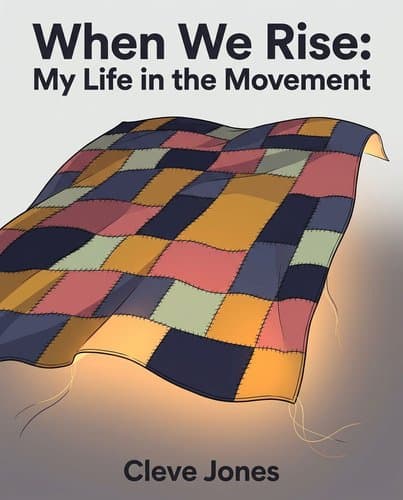
On November 27 that year, at the annual Milk/Moscone memorial march, Jones arrived with Harvey Milk's old bullhorn and a stack of poster board. He asked the crowd how many knew someone killed by AIDS. Almost every hand went up. Someone called out that their lover had died that morning; another that both roommates were gone. Jones told them to write the names. Hundreds of panels got filled. The march moved silently down Market Street to City Hall, then east to the old Federal Building, where volunteers climbed ladders and taped the name-covered cardboard to the stone facade in light rain. Thousands stood in the drizzle reading. Jones walked to the edge of the crowd and looked back. The patchwork of names on the wall looked like a quilt.
That image consumed him for the next two years. The idea: the National Mall covered in fabric from the Capitol to the Washington Monument. A quilt because the word held the right weight — pioneer women, enslaved people stitching scraps, cast-off things made into something warm. Each panel sized to approximate a grave. The NAMES Project AIDS Memorial Quilt was therapy for a grieving community and a media tool, but Jones was clear about its third purpose: a weapon, to shame a government that had looked away.
When ACT UP, a direct-action group newly launched in New York, called the Quilt a "death tarp," Jones understood the critique without accepting it. He admired the direct action, the science advocacy, the civil disobedience. But he kept thinking about his grandmothers — who loved him, who weren't going to storm the FDA in bomber jackets. A movement with no room for them had left something important out.
The Movement Won. The Decade of Mass Death Cannot Be Undone.
The political victories are genuine — Milk elected, Briggs defeated, Obergefell decided. Jones doesn't hedge any of them. He won't let them stand as resolution for something that can't be resolved.
In a Safeway produce aisle in Guerneville, he ran into Jeff — both patients of the same UCSF doctor, both in the early combination therapy trial that had recently pulled Jones back from below fifty T-cells and Pneumocystis pneumonia. Jeff still looked gaunt but better, and Jones said so. They agreed they probably weren't going to die, were probably going to live. Jeff loaded some vegetables into his cart. Then he said he supposed they'd never be happy again. Jones supposed the same.
Both men had survived something the people two aisles over couldn't imagine: a decade of mass death so relentless that the Thursday newspaper's obituary section ran three full pages weekly, a thousand names a year in San Francisco alone for more than ten years. No drug could undo what that decade had done to the people who lived through it.
Twenty years later, when the Supreme Court ruled that same-sex couples had a constitutional right to marry, Jones woke early, read the majority opinion until he couldn't see through tears, and watched the White House lit in rainbow colors from a barstool while a bartender poured without being asked. The decision was real. The people who didn't survive to read it cannot be returned.
The memoir ends with Jones sleeping alone most nights, the bed filling with ghosts when his eyes close — and he welcomes them. He writes that the movement saved his life twice: once from the pill stash under the mattress in 1971, once from the epidemic in 1994 when activists stormed the FDA. It's a reckoning with what he owes the dead, not evidence the debt can be paid. Hope, in this book, is not the end of catastrophe. It is the refusal to look away.
The Bed Crowded with Ghosts
The bed fills with ghosts and he lets them in. That's where the book leaves you — not at the Supreme Court steps, not at a rally, but in a quiet room where a man who once hoarded pills against discovery now sleeps surrounded by everyone the movement couldn't save. The victories are real. So are the dead. Jones never asks you to choose which matters more, because the question is wrong. What he built — what he kept building, from a library in Scottsdale to a quilt on the National Mall — was never about erasing loss. It was about refusing to let loss stay invisible. That refusal turns out to be the only thing that actually transfers. The movement gave it to him. In the dark, he lets them in.
Notable Quotes
“Take your time, I hear Local 2 is picketing the Patio Café. Say hi to them, get some lunch, and I'll see you this afternoon.”
“Cleve, it's on the radio, they shot Mayor Moscone.”
“Who do you think you are, Mr. Milk? Dr. King? Malcolm X? I don't think you're important enough to be assassinated.”
Frequently Asked Questions
- What is 'When We Rise' about?
- "When We Rise: My Life in the Movement" chronicles Cleve Jones's four decades of civil rights activism, spanning from Harvey Milk's San Francisco to the AIDS crisis and ultimately marriage equality. The memoir reveals how visibility, public witness, and overlapping activist strategies built one of modern history's most significant civil rights movements. Rather than presenting a triumphalist narrative, Jones shows readers the actual mechanics of movement-building: the internal disagreements, tactical fractures, and lasting psychological costs that persist even after legal victories. It's a concrete guide to how social movements operate.
- What role does visibility play according to 'When We Rise'?
- "Visibility is a political mechanism, not just a personal value," Jones argues. Harvey Milk's electoral theory rested on a specific insight: "when voters actually know gay people as neighbors, coworkers, and family members — not as abstractions — fear-based opposition collapses." "Mass coming-out was the strategy, not just the byproduct." By orchestrating visibility as deliberate collective action rather than spontaneous individual identity expression, the movement strategically transformed how voters perceived LGBTQ+ people and systematically dismantled political opposition rooted in fear and abstraction.
- How did different activist tactics work together in this movement?
- Jones identifies three concurrent theories of change: electoral politics, direct action, and collective witness. Electoral strategy targeted power through voting; direct action (like ACT UP) applied pressure through disruption; collective witness (like the AIDS quilt) created moral pressure through testimony. "Movements need multiple theories of change running simultaneously...treating them as alternatives—the Quilt vs. ACT UP, lobbying vs. marching—is how movements stall. The disagreement about tactics was generative, not fatal." Rather than competing, these approaches reinforced each other, allowing the movement to advance on multiple fronts simultaneously.
- What does the book reveal about inclusion and representation in the movement?
- The book directly names internal exclusions that shaped movement capacity. "Lesbians sidelined in gay organizations, trans women excluded from women's spaces, ACT UP's overwhelmingly white male membership, the near-invisibility of people of color in the movement's major institutions." Jones emphasizes that these weren't peripheral concerns but fundamental constraints on what the movement could achieve. The "who belongs in we?" question is as consequential as "what do we want?"—both determine what a movement can accomplish and whose experiences receive visibility within broader social change efforts.
Related Book Summaries
Read the full summary of 27917674_when-we-rise on InShort