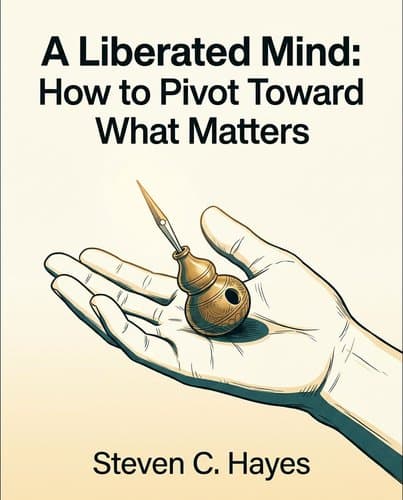
43330899_a-liberated-mind
by Steven C. Hayes
The same mental machinery that built civilization is actively worsening your anxiety and pain every time you try to think your way out of it.
In Brief
The same mental machinery that built civilization is actively worsening your anxiety and pain every time you try to think your way out of it. Hayes reveals how to step outside your mind's authority entirely and redirect that energy toward a life defined by your deepest values.
Key Ideas
Name your thoughts, create distance
When you notice the urge to suppress, argue with, or escape a painful thought, pause and name the process: 'I notice my mind is telling me [exact thought].' This single verbal move creates the observer distance that defusion requires — you're watching the thought rather than being it.
Repeat harsh words, lose grip
Try Titchener's word-repetition technique on your harshest self-label: say it aloud once per second for thirty seconds. Meaning doesn't disappear, but its grip loosens — you hear a sound, not a verdict. The technique works best when the label feels most real.
Pain points toward your values
When painful emotion surfaces, ask: 'What would I have to not care about for this not to hurt?' The answer maps directly to what you value. Pain isn't an obstacle to the life you want — it's often a navigational signal pointing toward it.
Write values into changed behavior
Write for ten minutes about the qualities of how you want to act in one specific life domain (lovingly, curiously, persistently) — not goals you want to reach, but ways of being you want to embody. Research shows this alone produces measurable behavior change over the following weeks, with no other intervention.
Lapse triggers recommit or quit
After any lapse on a commitment, you face exactly two patterns available: commit-slip-commit, or commit-slip-quit. Choosing the first requires only that you recommit — not that you feel good about the lapse, not that you understand why it happened, not that it won't happen again.
Posture shift opens mental flexibility
Notice the posture your body takes when you imagine yourself at your worst in a difficult situation, then at your best. The contrast is immediate and physical: closed and defended versus open and upright. Your body already knows the difference — and accessing that open posture is a genuine entry point into the flexibility state, not just a metaphor for it.
Who Should Read This
Curious readers interested in Mental Health and Mindfulness and the science of how the mind actually works.
A Liberated Mind: How to Pivot Toward What Matters
By Steven C. Hayes
9 min read
Why does it matter? Because the tool you're using to fix your suffering is the one making it worse.
We have never been physically safer. Cancers that routinely killed children now mostly don't. Maternal mortality has dropped by nearly half. The ancient dangers — infection, famine, the sheer grinding violence of ordinary life — have retreated farther than any previous generation could have imagined. And yet depression has climbed, in thirty years, from the fourth leading cause of disability in the world to the first. Something is getting worse that surgery cannot reach.
The answer this book proposes is genuinely difficult to sit with: every strategy most of us use to manage psychological pain — suppressing an unwanted thought, replacing it with a better one, avoiding the memory or the situation that triggers it — shares a hidden flaw. Not a design flaw in the user. A flaw in the approach itself. The harder you fight, the tighter the grip. Hayes spent years building the most careful cage he could imagine to keep his anxiety out — and learned, too late and then just in time, that every bar he added made it smaller.
The Harder You Fight Your Own Mind, the Tighter the Trap
Fall 1978. Steven Hayes, a young psychology professor, sits in a faculty meeting watching his senior colleagues argue. He raises his hand to speak, then lowers it, not because he's giving up but because he thinks he might pass out. His heart is hammering too fast to count. When the room finally goes quiet and everyone turns to look at him, he opens his mouth and nothing comes out. He sits there, lips moving silently, until the meeting rolls on without him.
He walked out convinced something had broken, and his mind immediately got to work: never let this happen again. Over the following years, he constructed an elaborate system of protection: always positioning himself near exits, discreetly counting his pulse in meetings, replacing lectures with film screenings on bad days to avoid threading a projector while panicking, keeping a trusted person visible in every room, drinking before stressful events. Each tactic felt reasonable. Each one worked, briefly. And each one shared the same hidden assumption: anxiety was an enemy to be defeated.
Every precaution confirmed the same story: that anxiety was dangerous, that its arrival signaled something was wrong, that prevention was the only rational response. The tactics didn't shrink the threat. They fed it. The zones where panic might strike kept expanding. Within two years, his careful precautions had consumed 80 to 90 percent of his waking hours — and with every step, the danger grew.
He came to understand what had happened through a West African hunting trap: a hollowed gourd with a hole just wide enough for an open hand but not a closed fist. The animal reaches in, seizes the food, and holds itself captive simply by refusing to let go of what seemed, a moment ago, completely reasonable to want.
Hayes had been gripping the vision of a life without anxiety. Of course he had — who wouldn't? But that grip was the trap itself. The more he fought, the more the anxiety grew, not because he was weak but because fighting internal experience is structurally guaranteed to strengthen it. You cannot scan a room for exits without voting, again, that something dangerous is coming. Every precaution renewed the threat it was meant to prevent.
Recovery didn't begin with a better technique. It began when he let go of the food.
Your Brain Builds Thought Networks That Cannot Be Deleted — Only Defused
Imagine you've been bitten by a dog and decide to overcome the fear by repeating to yourself, "Dogs are safe, dogs are safe," every time you feel anxious near one. Over months, you say it thousands of times. Then a dog snarls at you from behind a fence. What happens? The phrase "dogs are safe" cues the anxiety it was meant to counter, because your mind has learned them together.
That's language doing exactly what it was built to do.
Around the age of twelve months, children do something no other animal does: they discover that words and their meanings form two-way connections. Hearing "apple" produces the image; the image also calls up the word. From there, the mind starts linking everything through abstract relationships. Hayes's research showed that just eight items and their names yield over four thousand possible relations — things like bigger than, caused by, opposite of — which is why a single thought can pull an entire emotional ecosystem in its wake. The resulting network is sprawling, inconsistent, and permanent. Extinction research makes this concrete: when food was withheld after a bell, Pavlov's dogs stopped salivating. But the learned connection only went underground. Present food again and salivation returned instantly; the original learning had been waiting the whole time.
Hayes found out what this means in practice by accident. During his years of panic, he repeated "calm and relaxed" so persistently as a countermeasure that the phrase and the anxiety state fused in his mind. One afternoon, feeling genuinely relaxed, he noticed it and thought: calm and relaxed. His heart skipped. He thought it again, harder. His heart raced faster. Within seconds he was in full panic. The cure had become the trigger.
That realization changed the whole target: not what thoughts say, but what they cause you to do.
Defusion: You Can Watch Your Thoughts Without Obeying Them
Forty-five minutes after forming his hand into a gun and telling a substance abuse group that the gun does the talking, the same tattooed man is on his feet weeping. What he most wants, he says, is to be a good father to his children.
No breakthrough revelation, no therapy technique, no digging into the past. What happened between those two moments was thirty seconds of saying the word "loser" aloud, once per second, with the rest of the group.
The technique traces back to Edward Titchener, who noticed a century ago that rapid repetition strips words of their meaning. Hayes's team found that saying "fish" once per second for thirty seconds dissolves the sensory experience the word conjures: smell, taste, texture. The word becomes sound. Not because you've forgotten what fish is, but because you've separated the label from its grip.
That separation is what Hayes calls defusion. It clarifies something counterintuitive: a judgment feels like a verdict not because it is one, but because language gives thought-events the texture of reality. "I am a loser" and "I am standing in front of a fire" feel like the same kind of statement, one that describes what's actually there. Defusion doesn't argue the case. It shifts the sentence from verdict to observation: my mind is producing the word "loser," and I can watch that happen.
The goal is not to quiet the Dictator — Hayes's name for the mind's relentlessly judging inner voice. He's explicit: the critical voice doesn't disappear after defusion. What changes is its authority. Thoughts become more like an advisor's commentary than a general's orders. The tattooed man still had his history with that word. He hadn't resolved it. He had learned, in thirty seconds, to stop letting it run him.
That shift is not semantic. Researchers at an Irish university measured it physically: people who spent a few moments saying "I cannot walk around this room" while walking around it held their hands on a very hot plate 40 percent longer than controls. The smallest demonstration that the mind's authority is an illusion produces measurable room to move.
Acceptance Isn't Resignation — It's Finally Hearing What Your Pain Has Been Trying to Say
Twice in a row, while teaching ACT workshops, Hayes felt an inexplicable wave of emotion, an urge to cry that appeared from nowhere and vanished just as fast. The second time, he noticed something stranger: he felt eight or nine years old. That evening, he deliberately pulled back a memory that had lain dormant for decades.
He is under his bed. His parents are screaming. His father, home late and drunk, is hurling threats at his mother while she sharpens them with her tongue. Then a crash — a coffee table thrown across the room, his mother screaming — and the boy on the floor thinks, with total clarity: I'm going to do something. He almost does. He nearly pulls himself up and walks into the next room to make it stop. But a month before, he had watched his older brother try to intervene in a similar fight and nearly take a fist to the face. He scoots farther under the bed instead, hugs himself, and cries.
What Hayes found in that memory was not just old pain. It was information: specific, sealed off completely by years of fighting anxiety into silence. The boy under the bed had desperately wanted to do something about suffering. That desire, fused with the terror of not being up to the task, was the engine his anxiety had been running on all along. The feuding colleagues in his psychology department had triggered it. His years of chasing professional credentials (which had felt like progress) turned out to be avoidance wearing ambition as a costume.
By insisting his anxiety was invalid, he had been telling that child to shut up. And that child was the entire reason he had become a psychologist.
He noticed one more thing: the memory had resurfaced precisely when he became willing to receive it. The message had been waiting for someone ready to hear it.
That's what makes acceptance different from tolerance. Tolerance is gritting your teeth while the pain continues. Acceptance is treating pain as a dispatch from yourself, something that arrived carrying a reason, containing a question. What you've been fighting may not be evidence that something broke. It may be the most coherent signal your inner life has ever sent.
The Best Relationships in Your Life Already Did This to You
What if you already know exactly what psychological flexibility feels like — because someone did it to you?
Hayes asks readers to call to mind the most empowering relationship of their life: a teacher, a spouse, a friend, anyone who carried them forward. Then six questions: Did they accept you as you were? Was their judgment soft or absent? Were they genuinely present, not half-distracted? Did they see you deeply? Did what mattered to you matter to them? Did they meet you in different ways depending on what the situation needed?
Each question maps onto one of the six skills in Hayes's framework, including everything we've covered above. If your answers are what Hayes suspects (yes to all six), then you've already experienced psychological flexibility from the inside. You know its texture. The work isn't importing something alien; it's learning to generate what your best relationship already gave you.
The same recognition lives in muscle memory. Think of a painful psychological problem. Embody your worst with it, then your best. Across thousands of workshop participants in the United States, Canada, and Iran, the pattern is identical: worst is contracted — tucked arms, downcast eyes, braced or curled. Best is open: head lifted, arms free, ready to engage. No instruction required. Your body showed you the difference in thirty seconds.
You didn't have to be taught what liberation feels like. It's already been given to you, held in your best memories of being known, and encoded in the way your body moves when you finally stop fighting.
Values Are a Compass, Not a Checklist — and That One Distinction Changes How You Live
Suppose you decide to travel west. You point your car toward the setting sun and drive. There's no moment when you arrive at "west": no destination, no box to check, no sense of finally having gotten there. West is a direction, not a place. That gap — between a direction and a destination — is what separates values from goals, and Hayes argues it changes everything about how you live.
Goals are destinations: the degree, the promotion, the relationship that will finally make things right. Every goal also names where you aren't yet, which is why a life organized around them tends to feel insufficient no matter what gets accomplished. Values work differently. Qualities like learning with genuine curiosity, or showing up for people honestly, don't wait to be achieved; they're available right now, in whatever you're already doing. You can't complete them. You can only move toward them or away.
Hayes tested whether this distinction, once grasped, actually changes behavior. In a study of 579 college students, 132 who volunteered were split into three groups: a control group left alone, a group trained in concrete goal-setting, and a group that spent fifteen minutes writing about their genuine values around education: not what grades they wanted, but what qualities of engagement mattered to them in the act of learning itself. Over the following semester, the control group's performance held flat. So did the goal-setting group's. Structure without meaning moved nothing. The values group's grade-point averages rose by roughly a fifth of a GPA point — the difference between a B and a B+, sustained across an entire semester. When the researchers later gave the control group the same writing exercise, the same jump appeared again.
Fifteen minutes of writing. Not a new study plan, not better time management. Just locating the compass direction.
That's where all of this lands: not as a therapy program to complete before life resumes, but as a direction you can turn toward in the very next thing you do.
The Evidence Is Harder to Ignore Than You'd Expect
Four hours of sessions should not be enough to change the trajectory of someone's life. The Swedish data from 2004 suggests otherwise.
High-risk public health workers — nurses, elder-care aides, daycare staff — were averaging more than two months of missed work every year due to chronic pain and stress. The government had flagged them because the statistics predicted their destination: permanent disability, never working again. Half received standard medical care. The other half received four individual one-hour ACT sessions. Six months later, the medical group had missed fifty-six working days, nearly half the follow-up period. The ACT group had missed an average of half a day. Pain and stress fell equally in both groups, but only the ACT group achieved this while still showing up for work.
The asymmetry matters. The medical group reduced their pain by staying home. The ACT group reduced their pain by going to work, which means the flexibility skills had changed something about the experience of pain itself, not just their exposure to it.
The durability numbers are stranger still. In a separate study, fifty-seven people in clinical depression received four ACT sessions and were followed for five years. At session end, 39 percent were depression-free. At five years, 57 percent. The number kept climbing. Two-thirds were still actively using the skills half a decade later. Antidepressant use had fallen from roughly 30 percent to 6 percent.
The pivots don't require maintenance so much as continuation — the same direction, walked further. You already know what that direction feels like. Your body showed you, and your best relationships confirmed it. The only remaining question is whether you'll keep walking.
Life Keeps Asking the Same Question
Hayes closes with something that sounds less like a therapy prescription and more like a vow. Are you willing to experience what you're experiencing? To carry it without building walls around it? To let what you care about point you somewhere, however incrementally? Life keeps asking this question — not once, not at a dramatic turning point, but continuously, in the next meeting, the next conversation, the next morning you wake up dreading something. Each yes is small and real. Each no is also small, but it compounds. The Swedish nurses didn't need a revolution. Four hours of practice and their sick days dropped from fifty-six to half a day — not because the pain left, but because they stopped waiting for it to. You don't have to feel ready. You don't have to silence the voice telling you this won't work. You just have to take one step, in the direction you actually want to go, whether that voice approves or not.
Notable Quotes
“he intoned over a growing smirk.”
“—he paused and then breathed in for effect—”
“who was watching was beyond those ego-based stories, good, bad, or indifferent. The”
Frequently Asked Questions
- What is A Liberated Mind about?
- A Liberated Mind: How to Pivot Toward What Matters presents Acceptance and Commitment Therapy (ACT), a research-backed psychological framework for addressing mental suffering. The book, written by psychologist Steven C. Hayes, explains why suppressing or arguing with painful thoughts amplifies suffering, and teaches practical techniques to redirect your energy toward values that matter. Rather than eliminating difficult thoughts, the framework teaches you to observe them with distance and defuse their emotional grip. Through specific exercises like word repetition and values clarification, Hayes shows how you can align your actions with what truly matters to you, transforming your relationship with pain and building a more meaningful life.
- What techniques does Hayes teach for handling painful thoughts?
- Hayes teaches thought defusion as the key technique for painful thoughts. "When you notice the urge to suppress, argue with, or escape a painful thought, pause and name the process: 'I notice my mind is telling me [exact thought].' This single verbal move creates the observer distance that defusion requires — you're watching the thought rather than being it." He also recommends Titchener's word-repetition technique: say your harshest self-label aloud once per second for thirty seconds. "The meaning doesn't disappear, but its grip loosens — you hear a sound, not a verdict." These defusion techniques free mental energy to redirect toward your actual values.
- How does the book connect pain to personal values?
- Hayes presents a powerful reframing: pain reveals your values. He teaches asking: "What would I have to not care about for this not to hurt?" Your answer maps directly to what you value. This shifts pain from an obstacle into a navigational signal pointing toward meaningful living. The book provides a practical exercise: write for ten minutes about qualities describing how you want to act in a specific domain—lovingly, curiously, persistently—not goals to reach but ways of being to embody. Research shows this writing exercise alone produces measurable behavior change over subsequent weeks, demonstrating that aligning with values transforms both mindset and action.
- What does the book say about lapses and commitment?
- Hayes clarifies how to handle commitment lapses: "After any lapse on a commitment, you face exactly two patterns available: commit-slip-commit, or commit-slip-quit. Choosing the first requires only that you recommit — not that you feel good about the lapse, not that you understand why it happened, not that it won't happen again." This removes common barriers. The book also teaches using body posture as an entry point to flexibility. "Notice the posture your body takes when you imagine yourself at your worst in a difficult situation, then at your best. The contrast is immediate and physical: closed and defended versus open and upright." Your body knows the difference—accessing open posture facilitates the flexibility state.
Related Book Summaries
Read the full summary of 43330899_a-liberated-mind on InShort