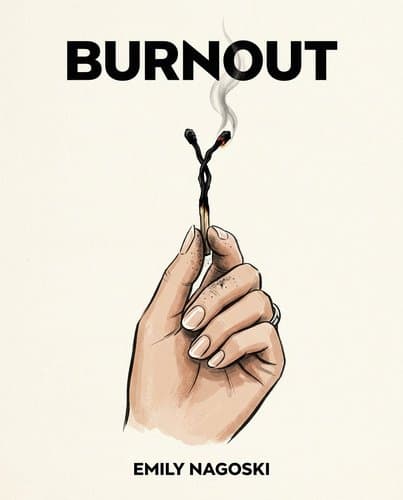
42397849_burnout
by Emily Nagoski
Stress and stressors are two separate biological problems—and managing your situation without completing the stress cycle is why exhaustion never fully lifts.
In Brief
Stress and stressors are two separate biological problems—and managing your situation without completing the stress cycle is why exhaustion never fully lifts. The Nagoski sisters reveal why women's burnout is a predictable physiological outcome, and the surprisingly physical steps that actually reset your body's alarm system.
Key Ideas
Physical action before cognitive processing
After any stressful event — even a tense email — do something physical before you try to 'process' what happened. A 20-minute walk, 20 seconds of full-body muscle tension with a big exhale, or a twenty-second hug all send the body the signal that the threat has passed. Cognitive reflection can't do this.
Stress and stressors need separate solutions
Stress and stressors are two separate biological problems requiring two separate interventions. If you're only managing the stressor (handling the situation, solving the problem), you are leaving the stress itself unresolved — and it will accumulate until something breaks.
Recognize Human Giver Syndrome as virus
Human Giver Syndrome is not a personal attitude problem — it's an absorbed belief system with four specific symptoms, the most insidious of which is that the symptoms feel like facts rather than a condition. Recognizing it as a virus, not reality, is the beginning of the exit.
Name the structural obstacle first
When effort stops yielding progress and you feel paralyzed, the question to ask is not 'what am I doing wrong?' but 'is this game rigged?' Learned helplessness is a real neurological state that dissolves when the structural obstacle is named — not when you try harder.
The 42% rule is non-negotiable
The 42% rule is not a preference — it's what the biology requires: approximately 10 hours out of every 24 devoted to sleep, movement, social connection, and food. 'Getting by' on less is a slow leak, not a sustainable strategy. Every system in your body pays the tax eventually.
Collective care, not solo wellness
The cure for burnout is not self-care — it's collective care. Joy is relational, not internal: it requires other people to tell you that you are enough, and it requires you to do the same for them. Wellness is not a state you achieve alone; it's a state of action sustained by mutual exchange.
Who Should Read This
People working on personal growth in Mental Health and Behavioral Psychology, especially those tired of generic motivational advice.
Burnout
By Emily Nagoski & Amelia Nagoski
10 min read
Why does it matter? Because you've been solving the wrong problem.
You're not burned out because you need a better morning routine. You're burned out because you've been running the stress response halfway, every single day, and the second half keeps getting blocked. Your body treated every impossible meeting, every swallowed complaint, every performance of cheerful competence like a predator it needed to outrun. You outran it. You handled it. But handling it and surviving it are different jobs, and the second one requires something the culture denies you time, permission, and space to do. That's not a motivation problem. That's a trap with a name. Emily and Amelia Nagoski name it, explain why it's biological rather than personal, and give you tools that actually match the problem — which turns out to be bigger than you were told, and more solvable than you've been allowed to believe.
Killing the Lion Doesn't Tell Your Body the Lion Is Dead
Imagine you're sprinting through a forest, heart slamming, because a lion is behind you. Your body has flooded every muscle with fuel and stood down everything non-essential (digestion, immune function, tissue repair) so your legs can carry you faster. This is the stress response: not a feeling, but a full-system biological mobilization that evolution spent millions of years perfecting.
Now imagine the lion is struck by lightning. It drops dead. You stop running.
Do you feel safe? Your body doesn't. Your heart is still hammering. Your eyes are still scanning. The neurochemicals are still coursing. You didn't do anything your nervous system recognizes as a signal that the threat has passed. You just happened to survive it. That cycle has no ending yet. You'd need to run back to your village, shout what happened, jump up and down with the people you love, maybe share a meal, feel their warmth — something that tells your body, in terms it can actually understand: we made it.
That distinction is the insight almost everything else in the book rests on: dealing with the stressor and dealing with the stress are different problems that need different solutions.
Your body evolved this cascade for a world where the behavior that eliminated the threat (running, fighting, collapsing in relief with your tribe) was also the behavior that completed the stress response. So it feels obvious that once the danger passes, the body resets. It doesn't. Eliminating the lion is not the same as telling your body the lion is dead.
In modern life, stressors are rarely lions. They're the condescending colleague in the meeting, the impossible project, the accumulation of indignities that never fully resolve. When the colleague says his thing, your body launches the same hormonal cascade it would for a lion (adrenaline, glucocorticoids, the whole package). The difference is that you can't run, can't fight, have to sit there and respond professionally. You manage the stressor. But your bloodstream is still flooded with stress chemistry, waiting for a cue that never arrives.
Do this every day, and a body built for occasional surges runs instead under constant flood pressure: chronically elevated blood pressure, chronically suppressed immune function, chronically disrupted hormones. The physiological response that evolved to save you starts, slowly, to destroy you instead.
The exhaustion you feel isn't weakness, and it isn't in your head — it's biology accumulating. The authors' core argument is blunt: in contemporary life, the stress will kill you faster than the stressor will. Not because your problems are unsurvivable, but because no one taught you that surviving the threat and recovering from it are two separate acts. You have to do both, or you're only doing half the work.
[Editorial flag: "adrenaline, glucocorticoids" in paragraph 6 appears verbatim again in Section 5. Per revision notes, remove from Section 5 — this is the reader's first encounter with the biology and the better place to introduce it.]
Human Giver Syndrome Is the Most Efficient Burnout Machine Ever Built
Here's the structural diagnosis, stated plainly: if you live inside Human Giver Syndrome, burning out isn't a failure of discipline or self-care — it's the predicted outcome of the system you're in.
The framework comes from philosopher Kate Manne, who describes a social order divided between "human beings" (people obligated to express their full humanity) and "human givers," obligated to give their humanity away. Women are the givers. The rules aren't written anywhere, but they're enforced constantly: always be pretty, happy, calm, generous, attentive to others. Never be angry, ambitious, or attentive to your own needs. Your time, your emotional labor, your body — these belong to the beings.
The stress response is a biological cycle that needs to complete (through movement, laughter, tears, the physical warmth of other people) or the chemistry just keeps accumulating. Human Giver Syndrome is a machine designed to prevent that completion. A giver who cries at work, loses her temper, asks for help, or takes time to process a difficult feeling is violating her role: being upset instead of calm, attentive to herself instead of others. She'll be punished through social shame, professional cost, or, most reliably, her own internal voice telling her she's being selfish. The path through is right there. She's not allowed to take it. She has to stand there, looking cheerful, indefinitely.
The authors identify four symptoms of Human Giver Syndrome: believing you're morally obligated to give; believing failure to give makes you a bad person; believing failure deserves punishment; and believing that none of this is a symptom at all, that it's simply how a good woman lives. That last one is what makes the others impossible to treat. The system is self-masking: everyone around you is running the same program, which means there's no contrast, no outside view that makes the rules visible as rules. You don't see the cage because you've never stood outside it.
That's why the authors say, with flat clinical precision: if you wanted to design a system to generate burnout in half the population, you couldn't do better than this one.
The Game Is Rigged — and Knowing That Is Already the Intervention
Sophie, a composite the authors build from dozens of real conversations, was explaining a Star Trek training exercise to a colleague, looking for the right frame for the corporate talk she'd been hired to give. The exercise, the Kobayashi Maru, puts Starfleet cadets into a crisis they cannot survive. The point isn't to win; it's to see what you do when winning isn't possible. You lose honorably or you lose badly, and that's the whole test.
That's what navigating systemic bias feels like, she told her colleague. You're going to lose. The win is in how you carry yourself while losing.
Her framing is more than a metaphor — the science backs it up, starting with a rat in a tank of water.
Imagine an animal dropped into a forced-swim test with no exit. He swims and swims, hunting for land that never materializes. First he's frustrated. Then desperate. Then his brain does something precise: it reclassifies the goal from "possibly attainable" to "impossible," and his dopamine drops by half. He stops swimming and floats, conserving whatever energy is left, waiting for a sign that will never arrive.
Now move that rat into a different box, one where a small door opens briefly after each electric shock. The exit is right there. The rat, physically capable of stepping through it, won't even try. His nervous system learned that effort is futile, and that lesson holds even when the situation has completely changed. He's not stupid or weak. He's been trained by repeated experience that trying makes no difference.
This is learned helplessness: a neurological state in which effort itself stops working as a tool. Trying harder doesn't fix it.
Here's what does: information.
A parallel study with people put one group in charge of an annoying noise and left the other with no control at all. The helpless group shut down the same way the rat did. They stopped trying to solve the problem. But the moment researchers told them the noise was rigged, the learned helplessness dissolved. No new strategy, no reframing. Just the truth: the obstacle was structural, not personal.
Women accumulate this kind of helplessness across lifetimes. The promotion given to the less-qualified man. The meeting where your point vanishes, then a man says the same thing and everyone nods. The body that's wrong by default. None of these feel like experiments — they register as evidence of personal inadequacy. But the door is sealed shut from outside. Naming that isn't giving up. It's the actual intervention. The learned helplessness doesn't survive contact with the real diagnosis.
When You Can't Change the Stressor, You Can Change What the Finish Line Means
Forty professional singers, same six measures, on an endless loop. The Grammy-winning engineer — Andrew, blond, British, apparently delightful — keeps saying "lovely, one more." By hour two the emotional content has evaporated: the notes are there, the pitch is fine, and the music is dead. The goal was perfection, and perfection has the fatal property of never arriving.
Your brain runs a continuous tally of effort invested versus progress detected. The authors call this "the Monitor." When effort climbs and progress stays invisible, it escalates through annoyance, frustration, rage, and eventually makes a hard switch: goal reclassified from "attainable" to "impossible," the whole system tipping into helplessness. That's what "perfection" was doing to forty musicians who'd already given everything they had.
Amelia changed the finish line. New goal: fill Andrew with joy. Not session-wide perfection. One question, answerable right now: is Andrew joyful?
The room shifted the moment she said it. On the third day, a soprano stopped and asked Andrew directly. He considered for a moment, then said: "Yeah. I really am." A year later, singers were pulling Amelia aside to say the Monitor reframe had changed their lives.
What the Monitor needs is a finish line it can check against reality. "Fill Andrew with joy" has one. "Achieve perfection" never does.
This is not positive thinking. You're not pretending the session isn't brutal. You're giving the Monitor a target it can actually reach, the only way to keep effort feeling worthwhile rather than futile.
One caveat: this works where you have partial control. When the obstacle is structural (a system that extracts without returning), redefining the goal preserves your capacity while you wait for conditions that can actually change. It doesn't fix the structure. It keeps you functional until something does.
Completing the Stress Cycle Requires Something More Physical Than You Want It To Be
The stress response doesn't speak logic; it evolved to respond to physical signals, and those are the only signals it trusts.
Sophie was a six-foot-one Black engineer who refused to exercise on principle. She'd tried it, something always went wrong, and she wasn't interested in being told movement was the answer to anything. So when she heard physical activity was the most reliable way to complete the stress response cycle, she went looking for the exception.
Emily's suggestion: lie in bed and progressively tense every muscle from feet to face, holding each one for a slow count of ten, while vividly imagining defeating whatever stressor had activated you. Not symbolically — viscerally. Pulse quickening, hands tightening, until something that felt like victory moved through her.
Strange things started happening. Waves of frustration she couldn't explain. Crying with no apparent cause. Involuntary shuddering that alarmed her. She emailed to ask if this was normal.
It was. That was the backlog of incomplete stress cycles finally releasing: responses that had never gotten the signal they needed. Her body hadn't been broken. It had been waiting.
The interventions feel almost insultingly simple: twenty to sixty minutes of movement most days. A twenty-second standing hug — not a lean-in but both people supporting their own weight, long enough for oxytocin to actually release. Relationship researcher John Gottman's six-second kiss, which turns out to be too long to kiss someone you resent, making it both an intervention and a diagnostic. These aren't sophisticated. They're the language the body actually speaks.
The Angry Voice in Your Head Already Knows the Truth — and Self-Compassion Is the Political Act
Sophie's progressive muscle relaxation routine involved tensing every muscle from feet to face while imagining Janice Lester (a character from Star Trek's final episode, a woman driven to madness after being locked out of a starship captaincy) systematically destroying Captain Kirk. Kirk's last line blames Lester's breakdown on her alleged hatred of her own womanhood. That was the part Sophie couldn't stand: the diagnosis blamed the woman for the system's exclusion. The fury in the visualization wasn't decoration. It was a clinical stress-cycle completion tool.
They call this internal figure the madwoman in the attic — drawn from Jane Eyre, where Rochester's wife, Bertha, is locked upstairs, insane and dangerous and also trapped by a world with nowhere else to put her. Every woman has one. For some she appears as an idealized, effortlessly perfect version of themselves, casually contemptuous of the real thing. For others she's the quiet teenager in the back row, ready with a told-you-so. She oscillates between two explanations for any gap between you and the standard you're supposed to meet: the world is wrong, or you are. She's not irrational. She just has two tools.
The standard objection to self-compassion: the madwoman whips us, we succeed, so we credit the whip. The authors call this the tragedy. The sequence runs backward — you inflict that punishment because your goals matter enough to bleed for, not the other way around. The whip didn't produce the achievement. Your goals did.
Putting down the whip doesn't feel peaceful. It feels like a new kind of pain, because wounds reopened for years finally start to heal, and healing hurts.
The book's last claim: joy doesn't come from inside. It comes from connection. Feeling like enough requires other people to say so. The exchange of giving and receiving makes it real. Your madwoman already knew the diagnosis was structural. Self-compassion is how you stop being collateral damage to a system you didn't design, which makes it a political act, not a personal indulgence. What comes after is turning toward everyone else trapped in it with you.
The Village Is the Technology
The wellness industry has a very clean business model: convince you that burnout is a personal optimization problem, a gap between who you are and who you'd be with better habits and firmer limits. The Nagoskis' most subversive move is their last one: the cure isn't inside you, and it isn't a practice.
Remember the lion? After the kill, after all the running and the terror and the surviving, the village cooked it together. That's the part nobody's selling you. Not the recovery ritual — the actual people. Joy doesn't originate inside you; it requires someone to hand it to you, and you to hand it back. Wellness is a state of mutual action, not a state of mind. The village was never the reward for surviving. It was the mechanism.
Notable Quotes
“For us vertebrates, the core of the stress-response is built around the fact that your muscles are going to work like crazy.”
“You're safe now; calm down,”
“Activist and scholar Peggy McIntosh wrote about hers in 1989, describing her madwoman this way: She is alternately off the wall with anger at those who have made her feel like a fraud, and off the floor with a visionary sense of her own elemental connection with the universe….[She writes,]”
Frequently Asked Questions
- What does Burnout explain about stress versus stressors?
- The book emphasizes that stress and stressors are two separate biological problems requiring different solutions. Stressors are external situations; stress is the internal physiological response that accumulates if unresolved. If you only manage the stressor without completing the stress cycle, stress will accumulate until something breaks. Completing the stress cycle requires physical action: a 20-minute walk, 20 seconds of muscle tension with exhale, or a 20-second hug signals the body that the threat has passed. Cognitive reflection cannot achieve this biological reset.
- What is Human Giver Syndrome in Burnout?
- Human Giver Syndrome is not merely a personal attitude problem but an absorbed belief system with four specific symptoms. The most insidious symptom is that the symptoms feel like facts rather than a condition. Recognizing it as a virus, not reality, is the beginning of recovery. Women are particularly vulnerable to this syndrome, which drives disproportionate burnout. The condition creates invisible obligations to constantly give and prioritize others' needs. Understanding this syndrome as a systemic issue rather than personal failing is key to breaking free.
- What is the 42% rule in Burnout and why does it matter?
- The 42% rule establishes that approximately 10 hours out of every 24 hours should be devoted to sleep, movement, social connection, and food. This is not a preference but what biology requires. Getting by on less is a slow leak, not sustainable, and every system in your body eventually pays the tax. The rule emphasizes that meeting basic biological needs is non-negotiable for preventing burnout accumulation. This foundational requirement protects against the slow depletion that leads to burnout, making it a biological imperative rather than optional self-care.
- How does Burnout redefine the cure for burnout?
- The book argues that the cure for burnout is not self-care but collective care. Joy is relational, not internal: it requires other people to tell you that you are enough, and requires you to reciprocate. Wellness is not a state you achieve alone but a state of action sustained by mutual exchange. This reframes burnout recovery as fundamentally social and interdependent rather than individualistic. When effort stops yielding progress and learned helplessness sets in, naming structural obstacles dissolves the paralysis. Collective care acknowledges that sustainable wellness depends on mutual support systems.
Related Book Summaries

Read the full summary of 42397849_burnout on InShort