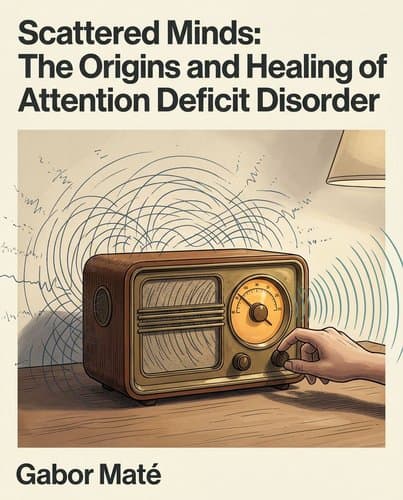
39899253_scattered-minds
by Gabor Maté
ADD isn't a broken brain—it's a sensitive nervous system shaped by emotional wounds. Gabor Maté reveals how attunement gaps in early childhood wire distraction…
In Brief
ADD isn't a broken brain—it's a sensitive nervous system shaped by emotional wounds. Gabor Maté reveals how attunement gaps in early childhood wire distraction and impulsivity into the brain, and why healing begins by restoring the relational conditions that were missing, not fixing a flawed individual.
Key Ideas
Ask about emotional environment, not diagnosis
If someone you love has ADD, the more useful question is not 'what medication helps?' but 'what emotional environment shaped this nervous system, and is that environment still active today?'
ADD results from relational deprivation
Five-sixths of the human brain's neural branching happens after birth, wired by the quality of emotional relationship. ADD is literally a developmental wound — the circuits of attention and self-regulation didn't wire because the conditions they needed weren't there, not because anything is inherently broken.
Attunement wires; love alone does not
Attunement — not love — is what wires the infant brain. A parent can love deeply while simultaneously being too stressed, depressed, or preoccupied to align moment-to-moment with what the infant is experiencing. Those are different things, and only attunement builds the circuits.
Each symptom protects something important
Every ADD symptom has a logic: distractibility is the brain's learned anesthetic against chronic pain; counterwill protects a fragile self from being overwhelmed; addiction self-medicates a dopamine deficit the person never knew they had. Understanding why each emerged changes how you respond to it in yourself or a child.
Parental regulation is the real intervention
When parenting an ADD child, your own emotional regulation matters more than any strategy. A parent who can tolerate their own anxiety — who doesn't need the child to behave immediately in order to feel okay — changes the child's nervous system over time. Technique follows from that foundation; it cannot substitute for it.
Medication helps; relationships heal the roots
Medication can produce real and significant relief — some adults describe it as noticing the world for the first time. But it addresses symptoms, not the underlying attunement deficit, low self-esteem, or fear of intimacy that developed alongside the neurology. Both paths of healing matter, with relationship as the foundation.
Lifelong neural rewiring through relationship
The brain's circuits can develop at any point in the life cycle. Whatever relational conditions were missing in childhood can be rebuilt — through therapy, consistent attunement in adult relationships, creative practice, or learning to extend toward oneself the compassion one would naturally offer a struggling child.
Who Should Read This
Curious readers interested in Mental Health and Neuroscience and the science of how the mind actually works.
Scattered Minds: The Origins and Healing of Attention Deficit Disorder
By Gabor Maté
10 min read
Why does it matter? Because the story you've been told about ADD leaves out the part that determines whether healing is possible.
Most people arrive at ADD with one of two maps. The first says it's a hardwired neurological condition — a brain that arrived slightly misconfigured, best managed with the right medication. The second says it's really a parenting or discipline problem dressed in clinical language. Both leave something important unnamed. Either way, you end up holding a verdict instead of an explanation. What Gabor Maté discovered — across decades of clinical practice, in neuroscience research he didn't expect to find illuminating, and in the evidence of his own ADD diagnosis — is that ADD is neither misfire nor excuse. It is the predictable outcome when a sensitive nervous system develops without the one thing it couldn't grow without. That thing isn't a gene. It isn't a technique. It's a quality of relationship, and it turns out it can still be built.
The Genetic Story Explains ADD — It Just Can't Explain Enough
The evidence that ADD is inherited is real. What it cannot survive is a close read.
Start with the twin studies that form the backbone of the genetic argument. When one identical twin has ADD, the other has it roughly 50 to 60 percent of the time. That sounds compelling — until you ask the question that somehow never gets asked: if ADD were genuinely driven by genes, and identical twins share every last one of them, why isn't that figure closer to 100 percent? The gap is not a rounding error. It is the space where environment lives.
The twin studies have a second problem they quietly ignore. A disproportionate number of the twins examined in these studies were adopted — and adoption is not a neutral background variable. Babies surrendered for adoption are typically born to mothers under acute stress: often unwanted pregnancies, often teenagers, often facing severe social pressure. Those infants spent nine months in a womb flooded with cortisol, the body's primary stress hormone, which directly shapes the developing nervous system. Then they were separated from the only voice and heartbeat they had ever known. Each one lands on a nervous system still forming itself around what it finds. When you account for this, the "hereditary" signal in twin adoption studies starts to look like an environmental signal that was never controlled for.
The adoption numbers make the point more bluntly. Children who were adopted appear in ADD clinical populations at eight to sixteen times their prevalence in the general population. That is not a number that waits quietly for a genetic explanation.
What ADD does involve, Maté argues, is an inherited predisposition, a word that matters precisely because of what it is not. A predetermination means something will happen, full stop. A predisposition means something is more likely to happen, depending on what surrounds it. These are not synonyms. Confusing them is the error that has shaped how ADD gets understood and treated for decades. The genes carry a potential; whether that potential becomes a lived reality depends on the circumstances the child is handed — above all, the emotional world they inhabit in the years when the brain is doing most of its building.
The Human Brain Is the Only Organ That Finishes Building Itself on the Outside
What organ in the human body finishes building itself only after you're born? Every other major system (heart, lungs, kidneys) arrives at birth mostly formed and ready to function. The brain is the exception, and the exception is extreme.
Five-sixths of all nerve-cell branching in the human brain occurs after birth. In the first year alone, new synaptic connections form at roughly three billion per second. By age four, the brain has tripled in mass; by adulthood, quadrupled. Three-quarters of your brain's physical growth happened outside the womb, after you had already arrived in the world. No other species outsources this much development to the postnatal environment. Chimpanzees, our closest evolutionary relatives, merely double their brain size after birth.
Evolution made a deal. Upright walking narrowed the human pelvis so much that a fully-formed brain could never have passed through the birth canal. So nature delivered infants early and let the brain finish growing in the world. The frontal lobes — governing impulse control, attention, and social judgment — gain the most from this arrangement. They also carry the most risk: a brain that develops outside the womb can be shaped by what the world provides. Or fails to provide.
Imagine an infant kept in a dark room, physically held, fed, and otherwise cared for, but never exposed to light. Despite healthy eyes and intact visual nerves at birth, within five years the thirty-odd neural networks that together produce sight would atrophy and die. Permanent blindness. No injury, no pathology. Simply: the circuits that required input to wire themselves never received any, and the brain eliminated what went unused.
ADD follows the same logic. The circuits governing self-regulation, impulse control, and sustained attention don't arrive hardwired. They are built. What builds them is not primarily genetics but the emotional environment of infancy. A calm, consistently available parenting relationship is not a soft preference; it is, literally, the construction material for the brain's regulatory architecture. When that material is scarce or unpredictable, as it often is when parents themselves are under stress, the circuits don't wire fully.
That a brain developed under those conditions isn't diseased. It grew to the maximum its circumstances allowed.
A Happy Mother Isn't Enough — Her Baby Needs Her to Be Present Moment to Moment
A research team set up two adjacent rooms connected by closed-circuit television. Mother in one, infant in the other, watching each other live and responding in real time. They did what they always do: she smiled, he smiled back; she made sounds, he answered. Both were happy. Then the researchers replaced the live feed with a recording from sixty seconds earlier. Same face, same warm smiles. His mother. Just not his mother right now.
The baby fell apart. The distress came on as sharply as in experiments where mothers go completely expressionless. Which forces a question: if the infant wasn't responding to happiness or warmth, what was he responding to? The answer is alignment — the continuous, moment-to-moment signal that someone is tracking what he's putting out. When that signal went missing, the happiness on screen became irrelevant.
Attunement, Maté's term for this, is different from love, from warmth, from effort. If you're a parent, or if you grew up wondering what was wrong with you, that distinction matters. A parent who is stressed, exhausted, or depressed can want desperately to be present and still fail to provide it, because attunement can't be performed. It runs through the parent's own nervous system, and a nervous system under chronic strain doesn't transmit the signal clearly.
The brain circuits responsible for attention and self-regulation wire themselves through attunement, not through good intentions. University of Washington researchers measured this directly, recording electrical activity in infants as their mothers played with them. Infants of non-depressed mothers showed the left-hemisphere activation that marks positive emotion. Infants of depressed mothers showed nothing — even when those mothers were actively trying to elicit joy. The effect was specific to the frontal areas responsible for self-regulation. The mothers weren't failing to try. They were failing to arrive.
ADD may carry the fingerprints of genetics, but what actually shapes the brain's attention circuitry is whether the infant's caregiver could be present. Maté suggests the acronym only tells half the story — the missing letters might just as well name what went absent: attuned presence itself.
The Wound Was Already There Before Anyone Did Anything Wrong
In a photograph from May 1944, a four-month-old stares past the camera with eyes that have no business on an infant: wary, tense, scanning some reality the frame can't contain. His mother holds him close, her face bent toward him with tenderness. Just over his shoulder, a yellow silk star is sewn to her jacket.
That is Gabor Maté, born in Budapest two months before the Nazi occupation of Hungary. His mother loved him completely. She would later say he saved her life; the sight of him in his crib was the only thing that kept her from ending her own life after her parents were transported to Auschwitz and murdered. And yet the baby in the photograph is not at peace.
Two days after German troops entered Budapest, Maté's mother called the pediatrician because her son had been crying without stop. The doctor's reply: "All my Jewish babies are crying." These infants knew nothing of the cattle trains. What had been written into their nervous systems (through every feed, every held moment, every pair of tense arms) was their mothers' terror. Anxiety transmits through the same channel as love. The closeness of attachment is what carries it.
Blame collapses exactly here. Maté's mother was not neglectful or cold. She was flooded. Her own nervous system had been shattered: first by genocide, then by weeks of suicidal despondency after her parents were killed, then by the moment when forced relocation to an overcrowded ghetto caused her breast milk to dry up that same day. What she passed to her son had been passed to her first — a terror that arrived through loss she hadn't chosen.
You don't need a Holocaust for this to work. Stressed parents, parents carrying wounds from their own childhoods, parents whose marriage is quietly disintegrating: these exist in households with no visible catastrophe and every outward sign of love. A developing brain doesn't need a villain in the house to be shaped by an anxious one. It only needs the people in it to be in pain.
Follow the chain backward far enough, through the parents to the grandparents, to whatever broke them, and blame becomes the wrong category. What you find instead is a long sequence of people doing what their nervous systems allowed, passing along what had been passed to them, wishing their children something they couldn't quite manage to provide.
What Runs in ADD Families Isn't a Disorder — It's a Trait That Kept Humanity Alive
What genetics transmits in ADD families is sensitivity — a nervous system calibrated to register finer gradations of the emotional world than most people experience.
Maté builds this case through the logic of allergies. When a bee stings someone without a venom allergy, the result is a welt and an itch. When it stings someone who is allergic, airways go into spasm, the throat can swell shut, the heart can become irregular. Same bee, same sting, entirely different physiological cascade, and what nearly kills the allergic person comes not from the sting itself but from their own immune system's hyperreactive response. The medical term for allergy is, precisely, hypersensitivity. People with ADD have the emotional equivalent: a mildly tense parental voice, an unexpected change of plan, and what fires inside them is the physiological equivalent of anaphylaxis. If you've watched this happen and thought you were watching drama, you were watching physiology.
ADD children carry disproportionate rates of physical allergies, asthma, and eczema alongside their attention difficulties. Allergies don't cause ADD; both conditions emerge from the same underlying trait. Sensitivity is the root; its branches appear in the immune system and in the emotional life simultaneously.
The evolutionary picture makes the point impossible to dismiss. If ADD, depression, and anxiety together affect a third of North Americans, natural selection over millions of years would not permit that many broken genes to survive. But a trait that produces artists, inventors, shamans, and prophets has obvious survival value for the species. What the ADD child carries is not damage. It is an exquisitely sensitive instrument handed circumstances too blunt to receive it. The diagnosis names a mismatch, not a defect.
Every ADD Symptom Made Perfect Sense to the Child Who Invented It
Imagine two people who each break a leg on a mountain. The first is with a companion. She lies still, feels the full pain, and waits while her friend goes for help. The second is alone in the snow. She spontaneously stops feeling the pain, climbs to her feet, and hobbles toward safety. Same injury, radically different response. The difference isn't willpower: it's whether help is available. When someone is coming, pain makes sense. It protects the leg from further damage. When no one is coming, blocking the pain is the only option left.
This is the body's logic for every ADD symptom. Tuning out, shame, counterwill, addiction: none of these are malfunctions. Each was once a precise answer to an impossible situation.
Take distractibility first. For the sensitive infant under chronic stress, with no reliable attunement to relieve the nervous system, tuning out is the lone exit. The body cannot sustain constant negative arousal (adrenaline, cortisol, stress hormones on a continuous loop) without it becoming physically toxic. So the infant does what the stranded skier does: blocks the signal. The tragedy is that once the neural pathway is worn deep enough, almost nothing is needed to retrigger it. Emergency medicine becomes the brain's default setting.
Shame works the same way, but turns inward. The child whose reactions are repeatedly treated as too much (too loud, too needy, too intense) eventually internalizes the verdict. The self-critical inner voice that never quite lets up isn't a character flaw that appeared from nowhere. It's the judgment of early caregivers, taken inside and made to sound like truth.
Steven was a gifted clarinetist, a teenage prodigy with an international solo career predicted for him, who quit at sixteen after years of a father who demanded four hours of daily practice and beat him for refusing. He spent two decades calling it the stupidest decision of his life, until Maté disagreed. Quitting had been one of the most necessary things Steven ever did: continuing would have meant surrendering his soul to a father who had no right to it. This is what Maté calls counterwill — the instinctive resistance that fires in any child who feels their self is being overtaken from outside. Steven hadn't chosen defiance; something beneath choice had chosen for him, a psychological immune system protecting a self too fragile to absorb that level of control. The shield cost him his career and saved his mind.
Addiction follows the same template, but neurochemically. The ADD brain runs chronically short on dopamine. Think of reaching for sugar when blood glucose crashes — except the crash is invisible and the craving gets called a character flaw. Addictive behaviors flood exactly those depleted circuits, so the addict is self-medicating a deficit they didn't know they had.
Every symptom traces back to a child doing the only thing available. The diagnosis names it. Understanding why it made sense is the first step toward not needing it anymore.
Parenting Techniques Don't Heal ADD — Parental Self-Regulation Does
The alarm goes off at seven-thirty, a full hour before school. By eight forty-five, the child has emerged from the bathroom with jam still on her face, shoes in hand, searching for the schoolbag she misplaced the night before. The bell is fifteen minutes away. The parent's voice has been climbing for twenty. He finally yells. The child's face closes. The drive is silent. When he leans to kiss her goodbye, she pulls away.
He got her there on time. That's the only thing that will not repeat tomorrow.
Parents of ADD children come to Maté asking what to do when the child won't get dressed, won't come to dinner, won't stop fighting. They've listened to tapes. Nothing holds. The methods aren't failing because they're wrong — they're failing because technique is a left-hemisphere function, and a parent pushed past their limit isn't operating there anymore. When anxiety floods in, something older takes over.
The real question isn't how to parent. It's who is parenting — the emotional state of the adult in that moment. A parent who can tolerate discomfort, who doesn't need the child to behave immediately to feel okay, transmits something no technique can: safety. The second version of that morning unfolds when the father decides punctuality is not life or death. He lets go. His voice stays even. The child reads no threat and has no alarm to react against. The attachment holds, and from inside that security, she can gradually learn what the world requires. He hasn't taught her to be on time. He's cleared the ground where that lesson can take root.
The news from neuroscience is unexpectedly generous. Neuroanatomist Marian Diamond at UC Berkeley showed that rats well past midlife, given enriched conditions for thirty days, grew dendritic branches nearly twice as long as their standard-cage counterparts. Even animals damaged before birth compensated structurally when the environment changed. The brain's regulatory circuits, including the very regulatory capacity ADD disrupts, remain modifiable well into adult life. The conditions that were missing in childhood can be rebuilt through relationship, regardless of when that relationship begins.
Psychiatrist Scott Peck defined love as extending oneself toward another's growth. What heals ADD is what caused it: the presence or absence of that stretching toward. And presence, unlike the past, is still available.
The Letters ADD Could Stand for Something Else Entirely
The word "attend" comes from the Latin tendere: to stretch toward something. By that definition, attention and love have always been the same gesture, and their absence the same wound. If you've carried an ADD diagnosis, or watched a child carry one, that reframe is either everything or nothing. Maté doesn't ask you to choose between the medication that finally lets you notice the trees outside your window and the relationship that built those circuits — or failed to. Both are real. The brain responds to chemistry and to attunement, and neither negates the other. The circuits missed in childhood remain open to development — at thirty, at fifty, at any point where someone, including you, is willing to stretch in your direction.
Notable Quotes
“peas thrown at a wall.”
“I can do this with half my brain tied behind my back,”
“It would be nice to get a break from myself at least for a little while,”
Frequently Asked Questions
- What does Scattered Minds argue about the origins of attention deficit disorder?
- In Scattered Minds, Gabor Maté reframes ADD not as a genetic defect but as a developmental response shaped by early emotional environments. He explains that five-sixths of the human brain's neural branching happens after birth, wired by the quality of emotional relationship. ADD is literally a developmental wound: the circuits of attention and self-regulation didn't wire because the conditions they needed weren't there, not because anything is inherently broken. This perspective shifts focus from medication alone toward understanding how the child's relational history shaped their neurology.
- What is the difference between attunement and love in parenting, according to Scattered Minds?
- Maté argues that attunement—not love—is what wires the infant brain. A parent can love deeply while simultaneously being too stressed, depressed, or preoccupied to align moment-to-moment with what the infant is experiencing. Those are different things, and only attunement builds the circuits needed for healthy attention and self-regulation. This distinction matters because it absolves parents of guilt while pointing toward what actually heals: the capacity to be present and responsive to a child's emotional experience, independent of good intentions or devotion.
- Why does Scattered Minds say ADD symptoms make sense?
- Every ADD symptom has a logic, Maté explains: distractibility is the brain's learned anesthetic against chronic pain; counterwill protects a fragile self from being overwhelmed; addiction self-medicates a dopamine deficit the person never knew they had. Understanding why each emerged changes how you respond to it in yourself or a child. Rather than viewing symptoms as defects to eliminate, Maté invites readers to see them as adaptive responses to relational injury—protective mechanisms that made sense given what the nervous system endured.
- Can brains rewire and heal from ADD later in life, according to Scattered Minds?
- Yes. Maté argues the brain's circuits can develop at any point in the life cycle. Whatever relational conditions were missing in childhood can be rebuilt—through therapy, consistent attunement in adult relationships, creative practice, or learning to extend toward oneself the compassion one would naturally offer a struggling child. Medication can provide real relief but addresses symptoms, not underlying attunement deficits or low self-esteem. Both paths of healing matter, with relationship as the foundation supporting genuine recovery.
Related Book Summaries
Read the full summary of 39899253_scattered-minds on InShort