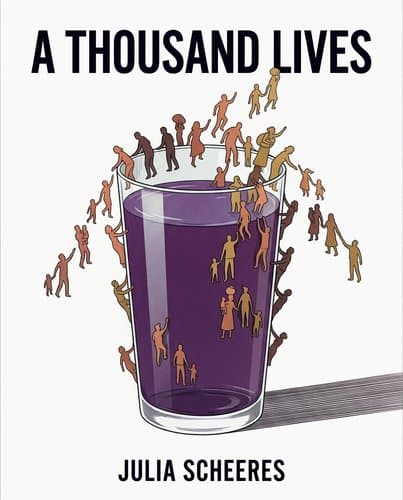
11369904_a-thousand-lives
by Julia Scheeres
Jim Jones didn't build a death cult—he built a racial justice movement, then methodically dismantled every escape route until murder became inevitable.
In Brief
Jim Jones didn't build a death cult—he built a racial justice movement, then methodically dismantled every escape route until murder became inevitable. Scheeres reconstructs Jonestown through the survivors and victims themselves, exposing the precise mechanisms of control that turned idealists into hostages.
Key Ideas
Incremental Control Hides Escalating Danger
Charismatic control is incremental: Jones did not ask for total submission on day one. He started with an integrated choir and free clinics, earned loyalty through genuine community, then introduced the blackmail documents, the beatings, and the isolation one step at a time. By the time the trap was visible, the exits were gone.
Mechanisms Matter More Than Labels
The word 'cult' is a cognitive off-switch: Scheeres refuses to use it because it lets readers dismiss victims as a category of unusually credulous people, rather than engaging with the specific mechanisms — legal leverage, physical exhaustion, information control, chemical sedation — that destroyed individual agency. Naming the tools matters more than labeling the group.
External Pressure Justifies Control Escalation
External pressure can accelerate a closed system toward catastrophe: the Stoen custody battle and the media scrutiny didn't expose Jonestown — they cornered Jones and gave him the siege narrative he needed to justify lockdown. Institutions that are trying to help can inadvertently accelerate the harm if they don't account for how a high-control leader will weaponize the pressure.
Premeditation Masked as Spontaneous Crisis
Premeditation is hiding in plain sight: Jones announced in 1975 that he would 'take a thousand' with him if he died for socialism. The rehearsed White Nights, the cyanide ordered by the pound, the medical journal sourced for lethal dosages — these were not the products of a psychotic break in November 1978. Recognizing the difference between erratic behavior and systematic preparation matters for identifying danger earlier.
Belonging Lost Persists After Escape
Survival is not the end of the story: Stanley Clayton escaped and spent years homeless and addicted, grieving a community that tried to kill him. The psychological infrastructure Jones built — the sense of family, of purpose, of belonging — did not disappear when the physical community did. Understanding what people lose when they leave high-control groups is essential to understanding why they stayed.
Who Should Read This
History readers interested in World History and Social Issues who want a deeper understanding of how we got here.
A Thousand Lives
By Julia Scheeres
14 min read
Why does it matter? Because the people who died in Jonestown weren't gullible — they were betrayed.
Most people who know the name Jonestown carry the same two-second version: a cult, a madman, mass hysteria, nine hundred people who drank the Kool-Aid. The phrase has become shorthand for a particular kind of contempt — for gullibility, for stupidity, for people who should have known better. What Julia Scheeres found inside fifty thousand pages of FBI documents tells a completely different story. The 913 people who died in the Guyanese jungle in November 1978 were not sleepwalkers. They were nurses, teachers, civil rights activists, elderly Black women who had survived Jim Crow, teenagers who read encyclopedias. They were idealists who wanted racial equality and found what looked like it. Then, incrementally, over years, every mechanism of resistance was taken from them — their mail, their children, their sleep, their capacity to trust each other, their sense of what was real.
The Genuine Appeal: What Made Peoples Temple Irresistible to People America Had Already Abandoned
Zipporah Edwards was between churches the Sunday she turned on her television and found a choir she'd never seen before. Not the faces or the robes — she'd grown up Baptist, she'd seen choirs — but the arrangement of them: Black hands and white hands, Black shoulders and white shoulders, pressed together in matching satin, singing the same hymns with the same fervor. She'd grown up in Alabama in the 1910s, where a sign at the edge of a neighboring town warned Black people to be gone before sundown. She'd watched a family friend get lynched for fighting back when white men kicked him. She'd ridden the train north with her family in 1918 looking for what her sister Hyacinth kept asking their father about: a better place. Now, decades later, in Indianapolis, she was watching a preacher named Jim Jones on a local channel, and something cracked open. She pulled Hyacinth into the room. 'I found my church,' she shouted.
That image — integrated bodies, shoulder to shoulder, unremarkable to themselves — was not a symbol to the sisters. It was proof that the world they'd been promised could actually exist. And Jones understood exactly what he was offering people like them. When Hyacinth and Zipporah missed a few services, he didn't send a card. He showed up at their home with twelve members of his congregation and held a prayer service in their parlor. That kind of attention — personal, persistent, almost aggressive in its warmth — was not something these women had ever received from any institution. It secured their loyalty for life.
The sisters' experience was the template. By the time Jones moved his operation to San Francisco and Los Angeles in the early 1970s, Peoples Temple had become something the government had never bothered to build: a genuine social safety net rooted in Black neighborhoods. Free health care. Free childcare. Drug rehabilitation, where members sat with addicts through the shaking and vomiting until the worst passed. Legal aid. Career counseling. Food. For people who had been discarded by every other institution — Stanley Clayton, growing up in West Oakland with an alcoholic mother and an empty refrigerator, related to Black Panther leader Huey Newton and equally certain the system had nothing for him — the Temple wasn't naive idealism. It was the only place offering anything real, and only a fool would have walked away from it.
The Fraud Was Built Into the Foundation: Jones Was Performing Miracles Before He Believed in Anything
The fraud was operational before the faith, which means there may have been no faith to begin with — or Jones was so tangled in his own performance that the distinction stopped mattering even to him.
Here is the mechanism: Jones's staff would slip elderly women Quaaludes concealed as vitamin C tablets. The sedative would knock them out or leave them disoriented, and while they were under, staff would put their legs in casts. At the next service, Jones would cut the cast off with great ceremony and command the woman to walk. The room would erupt. Another healing. Another miracle. The woman herself often couldn't say clearly what had happened to her — the drug had taken that — so the miracle filled the gap. This wasn't improvisation or Jones losing his way after years of sincere ministry. His aides were systematically stealing tranquilizers from hospital contacts and manufacturing occasions for him to cure. The infrastructure of deception preceded the congregation large enough to deceive.
His 'discernments' ran on the same logic. Staff posed as census workers, dug through trash, and in some cases broke into homes before services. Jones reviewed the notes behind dark sunglasses at the pulpit, making the research look like revelation. He would tell a woman what prescription bottles were in her medicine cabinet, or recite back the name of a dead relative she had mentioned only once, years ago, to a stranger at the door.
What makes this unbearable isn't the cynicism — it's that the cynicism was nested inside something that genuinely helped people. The free clinics were real. The integrated pews were real. Hyacinth Thrash's devotion was real, even if what triggered it — her apparent cancer healing — may have been a misdiagnosis, a spontaneous remission, or something Jones's team had quietly arranged. She felt a lump, then she didn't, and seven doctors confirmed it was gone. That experience was hers. Jones just made sure he was standing close enough to take credit.
The question of whether Jones ever believed in his own idealism is the wrong question. He built a machine that required constant fraud to keep running, which means he was always choosing to keep running it. That's not confusion. That's a decision, made again every day.
Loyalty Was Manufactured Through Documents You Signed Before You Knew What They Were
Every Temple member over eleven routinely signed the bottom of a blank piece of paper. They were told it was an attendance record, a meditation sheet, a formality. What they were actually signing was a blank instrument that Jones's staff could type over afterward: a false confession, a fabricated criminal admission. The papers were filed. Members were told they'd never be used — unless someone tried to betray the church.
Jim Bogue learned what that meant in practice. He'd joined in 1968, drawn to Jones's apparent gifts and his vision of a community held together by something other than loneliness. But after a few months, the glow curdled. At one membership meeting, a church secretary passed out paper and told everyone to confess to crimes they had not committed. Parents were instructed specifically to write that they had molested their children. Bogue hesitated, looked at the people he respected signing without pause, and wrote it. A sentence. His daughters' names. He handed it over and tried to forget it.
When he told Edith he wanted out, she went straight to Jones. By the following afternoon, a sheriff's deputy was pulling up Bogue's driveway with an eviction order. Within hours, an associate pastor arrived to remind Bogue exactly what was sitting in the church files under his name. The false confession wasn't a loyalty test. It was a lien on his future. Jones had already drained the joint bank account through Edith, removed Bogue's name from the care-home license, and turned his wife and children into leverage. Bogue was penniless, homeless, and holding a document that could send him to prison if he made noise.
He went back. Of course he went back.
The trap worked because it was sprung before anyone recognized it as a trap. By the time a member understood what they'd signed, the signing was already years in the past — and the document was already somewhere they couldn't reach.
The Jungle Was the Point: Jonestown Was Designed to Be a Place You Could Not Leave
Fred Lewis came home from his butcher shift one evening to find his apartment stripped. His wife of seventeen years was gone. His seven children were gone. The furniture had been hauled away and sold at the Temple's secondhand store. She had left him one thing: a mattress. No note.
Lewis wasn't even a Temple member. He had watched from the outside as his wife's devotion deepened over the years, and then one night in the summer of 1977, she and the children simply ceased to exist in his life. When he went to the Temple's Geary Boulevard building to demand an explanation, nobody answered the door.
What happened to his family was not a spontaneous exodus. It was a logistical operation, planned in exhaustive detail. Around midnight, roughly seventy Temple operatives fanned out across San Francisco's communes, knocking on apartment doors, cheerfully informing disoriented residents that Father had summoned them to the promised land. The roles were formalized: 'coordinators' stood watch over the phones so no one could call relatives; 'reassurers' managed those who hesitated; 'troubleshooters' handled anyone who resisted. For members who made it to the bus but then panicked about leaving pets behind, a designated 'freak-out table' was staffed with aides who promised the animals would be shipped to Guyana shortly. They were lying. Members were told they could return whenever they liked. Internal Temple memos, which survivors would later hand to investigators, described the departures as final.
The destination those buses were heading toward had been engineered to make 'return' a theoretical concept. Jonestown sat in the Guyanese jungle, thousands of miles from any American city, reachable only by a small plane that Jones controlled. Arriving members were asked to surrender their passports and money for 'safekeeping.' There was no cab to call, no bus route out, no road through the surrounding wilderness. The isolation wasn't incidental to Jones's project — it was the project. Every subsequent form of control he exercised, the night-long 'White Nights' where residents were roused from sleep and ordered to stand armed perimeters against invented mercenaries, the cyanide he began ordering by the pound, the leg irons welded onto teenagers who tried to run — all of it depended on the jungle being there, holding everyone in place. You cannot rehearse the end of the world with people who can simply walk away.
'Revolutionary Suicide' Was Not a Last Resort — It Was a Three-Year Plan
The mass death at Jonestown on November 18, 1978, is usually narrated as a catastrophe — Jones cornered by Leo Ryan, a U.S. Congressman who had traveled to Jonestown to investigate abuse reports, the whole structure finally collapsing under external pressure. The evidence tells a different story: Jones articulated the plan three years before it happened, and spent those three years rehearsing it on his congregation.
In September 1975, Jones told his followers: 'I love socialism, and I'm willing to die to bring it about, but if I did, I'd take a thousand with me.' He wasn't being dramatic. By 1977, when a custody dispute over a five-year-old boy named John Victor Stoen triggered Jonestown's first 'White Night,' the machinery was already in place. Seven hundred people streamed to the central pavilion in their pajamas; Jones handed out hoes and pitchforks and told them to face the jungle. They stood for six days, in shifts, believing mercenaries were massing in the tree line. When Jones introduced the concept of 'revolutionary suicide' and put it to a vote, almost nobody raised their hand. Two inner-circle loyalists voted to die. Everyone else wanted to fight. Jones then lied to the Guyanese Deputy Prime Minister, telling him that all but two members were prepared to commit mass suicide if the custody case wasn't dropped. The threat worked. The Stoens were expelled from the country within twenty-four hours.
That gap — two hands actually raised against the unanimous death wish Jones invented for outside consumption — tells you everything. He knew his followers wouldn't choose death. So he spent the next year making them rehearse it until the choice felt pre-made. The February 1978 drill is where the dread becomes concrete: nine hundred people lined up in the pavilion to drink from a vat of dark liquid Jones announced was poison. Guards marched those who hesitated to the front and stood over them while they drank. Nurses carried trays to the elderly. Jones told the crowd that the nursery workers and infants had 'already been taken care of.' A seven-year-old boy named Irvin Perkins, who had apparently been assigned to the punishment labor detail Jones called the learning crew, shouted 'Oh boy, I'll get off the learning crew!' The liquid turned out to be harmless. Jones called it a loyalty test. What he was actually doing was conditioning nine hundred people to form that line again — and to keep moving forward when they reached the front.
The Tools of Captivity: Exhaustion, Hunger, and a Pound of Cyanide for $8.85
The physical isolation came first. No road through the surrounding wilderness, no commercial flight, no way to walk forty miles of uncleared jungle to the nearest town without skills most residents didn't have. When sixteen-year-old Tommy Bogue and his friend Brian Davis tried exactly that in November 1977 — having spent months secretly learning from an Amerindian crew how to read vines, stun fish with plant toxins, and navigate by breaks in the canopy — armed guards intercepted them before they'd cleared the first night. Jones then delivered the lesson about what flight cost. Hot metal was welded around the boys' ankles. Their feet went into buckets of water to cool the burns. A three-foot chain connected the shackles. Heads shaved, prohibited from speaking to anyone but their armed guard, they were made to run everywhere they went, dragging the chain between them, chopping firewood for sixteen hours a day. In their second week, Brian slid his thumb over the wood splitter and whispered to Tommy: hit it. Just so they could stop. Tommy refused, then relented. The thumb was badly bruised, not broken, and they were sent back to the log.
The physical brutality was only the most visible layer. Jones broadcast his voice over the settlement's loudspeakers for up to twenty-four hours at a stretch — not always live, sometimes tape recordings of him reading news fabricated to terrify the community's Black majority: Black children being castrated in Chicago, the government behind it. Whenever the voice played, everyone was required to stop talking and listen. A dedicated surveillance team reported anyone who expressed a desire to go home. The exhaustion wasn't incidental — Jones articulated his philosophy plainly: keep them tired and poor. Tired people don't organize. Hungry people don't run.
And then there was the order placed with a California chemical supplier in 1978. Settlement doctor Larry Schacht had been researching methods in an Australian medical journal and found the number he needed: 250 milligrams of cyanide, the lethal adult dose. He ordered one pound of sodium cyanide from a company in Hayward. The cost was $8.85. One pound is enough to kill approximately 1,800 people. What makes that figure unbearable isn't the math — it's the invoice. The careful research. The cover story Schacht prepared in case anyone asked about the medical journal. The whole transaction had the texture of supply procurement, of a man with a budget and a checklist, moving methodically toward a conclusion he had already reached.
The Massacre Was Murder. Jones Died by the Quick Bullet He Denied Everyone Else.
Call it what it was: murder. The word 'suicide' was Jones's last, most consequential lie — and it has stuck with remarkable persistence in the decades since, embedded in the shorthand 'drinking the Kool-Aid,' which manages to imply gullibility, spectacle, and agency all at once. The evidence dismantles all three.
Ruletta Paul was first in line at the pavilion table on November 18, 1978. Her husband had escaped into the jungle that morning, leaving her with three small boys. She picked up a needleless syringe loaded with the mixture Dr. Schacht had prepared — grape Flavor-Aid, potassium cyanide, Valium, chloral hydrate, and potassium chloride — and squirted it into the mouth of her one-year-old son. Then she dosed herself and walked out to the field beside the pavilion to sit and rock her baby while the cyanide stopped his cells from absorbing oxygen. Some mothers followed her willingly. Others clutched their children to their chests and refused. Nurses tried first to talk them into surrendering their infants; when that failed, guards stepped forward and pried the babies free. A twelve-year-old girl named Julie Ann Runnels had a nurse's hands pressed over her mouth and nose until she swallowed. The audio recording made that day captures babies babbling in the background at the tape's start; within a few minutes, they are screaming. The screaming does not last long.
Three hundred and four children died at Jonestown. One hundred and thirty-one were under ten years old. Cyanide kills by suffocating the body's cells while the heart keeps beating, the lungs keep working, and consciousness briefly remains. The Australian medical journal Schacht used in his research called it agonizing. Jones had known this for at least a year. He ordered the poison anyway, in bulk, from the same California supplier he'd been using for months.
His own body was found with a single .38 caliber gunshot wound to the right temple. No cyanide. No convulsions, no the slow deprivation of oxygen he had administered to 905 others. He had reserved for himself the one death in Jonestown that was fast, clean, and painless. A man who spent three years telling his followers that dying together was a revolutionary act, who rehearsed that act on nine hundred people until the line between drill and execution dissolved — that man, when the moment arrived, did not drink from the vat on the table. He stepped to the side and took a bullet. It is what it was.
Survival Was Its Own Slow Catastrophe — and the Idiom That Outlasted Everyone Is an Insult
The morning after the massacre, Hyacinth Thrash opened her cottage door into brilliant sunshine and heard nothing. Usually the chimpanzee Mr. Muggs grunted in his nearby cage. That silence told her something before she knew what. She made her way to a neighboring residence and found her friend Birdie Johnson — identifiable only by her shoes beneath a draped sheet — dead in a chair. Five more women lay covered in their beds. Hyacinth went back to her porch and stood there waving a white towel, calling for help that would not arrive for two days. When Guyanese soldiers finally carried her to the pavilion, they asked her to identify the dead. Her sister Zipporah was lying on her back in the dirt just outside, wearing the red sweater she'd mentioned the afternoon before. There were too many bodies between them for Hyacinth to get closer.
Initial reports counted 409 dead because the bodies were stacked so deeply — parents on top of children — that investigators couldn't see through them to the ground. The final number was 913. When survivors returned to San Francisco, strangers screamed 'baby killers' at them on the street. Welfare offices turned them away. The FBI followed them. Four hundred and eight victims, most of them unidentified children, were eventually buried two to a casket in a mass grave in Oakland because their families were too ashamed or too poor to claim them.
And then American culture handed down its verdict in three words: drinking the Kool-Aid. The idiom, now deployed casually to mean credulous or blindly obedient, is the last lie Jones told about his own victims — that they were fools who chose this. The people in that pavilion were murdered. The children had no choice at all. The adults who might have refused were surrounded by armed guards, or had watched their children die first, or had been rehearsed into compliance through three years of midnight drills until the line between pretend and real dissolved. The idiom takes all of that — the rehearsals, the guards, the needle syringes, the signed-over passports — and converts it into a joke about gullibility. Zipporah Thrash died in a red sweater on a Tuesday afternoon. Her sister couldn't reach her. Help took two days. What gets erased, when we reduce all of that to a punchline, is exactly what it costs to erase it.
What 'Drinking the Kool-Aid' Costs the Dead
The phrase gets used constantly — in offices, in arguments, in headlines about sports fans and political movements. It means something like: you were credulous, you stopped thinking, you followed without asking. But Hyacinth Thrash was thinking. Jim Bogue was thinking. The mothers who refused to hand over their children and had them pried away anyway were thinking. What defeated them wasn't stupidity. It was a decade of blackmail documents, manufactured exhaustion, chemical sedation, and a jungle that went on for forty miles in every direction. The idiom takes all of that — the invoices, the chains, the rehearsals, the needle syringes — and converts it into a joke about gullibility. That conversion is the final service the idiom performs for Jones: it lets you avoid looking at what he actually built, and what it actually took to destroy 913 people who, at the start, were only looking for somewhere to belong.
Notable Quotes
“the black would rub off on her hands.”
“His blood pressure and pulse revealed he was dead,”
“Jim eventually went back to revive him. Anyone who doubted that he had died was urged to go back and look at him.”
Frequently Asked Questions
- What is 'A Thousand Lives' about?
- "A Thousand Lives" reconstructs the Jonestown massacre as systematic murder rather than mass suicide through the lives of five members. Julia Scheeres draws on declassified FBI records and survivor interviews to expose the incremental mechanisms—blackmail, isolation, physical exhaustion, and information control—that destroyed individual agency. Rather than treating Jonestown as an anomaly, the book offers a precise framework for understanding how charismatic leaders establish and maintain control in high-control groups, making it essential for recognizing similar dangers in contemporary contexts.
- How did Jim Jones establish and maintain control at Jonestown?
- Charismatic control operates incrementally: Jones did not demand total submission initially. He began with an integrated choir and free clinics that built genuine loyalty and community trust. Only after establishing this foundation did he introduce coercive tools—blackmail documents, beatings, and isolation—one step at a time. "By the time the trap was visible, the exits were gone." This gradual escalation is crucial: people were not naive but systematically manipulated through calculated steps that made resistance increasingly difficult and defection costly.
- Why does Scheeres avoid using the word 'cult' in her analysis?
- Scheeres avoids the label "cult" because it functions as a "cognitive off-switch" that lets readers dismiss victims as categorically credulous rather than engaging with the specific mechanisms that destroyed their agency. Legal leverage, physical exhaustion, information control, and chemical sedation were the actual tools of coercion—not psychological weakness. "Naming the tools matters more than labeling the group." By refusing the diagnostic label, Scheeres forces readers to confront precise, documented mechanisms of control, making the analysis applicable to identifying similar dangers in contemporary organizations.
- Was the Jonestown tragedy planned in advance or spontaneous?
- The evidence reveals systematic premeditation rather than spontaneous crisis. Jones announced in 1975 that he would "take a thousand" with him if he died for socialism. The rehearsed White Nights, cyanide ordered by the pound, and medical journals sourced for lethal dosages indicate calculated preparation. "These were not the products of a psychotic break in November 1978." Recognizing the difference between erratic behavior and systematic preparation matters critically for identifying danger earlier and understanding how high-control leaders operate with hidden intention beneath apparent chaos.
Related Book Summaries



Read the full summary of 11369904_a-thousand-lives on InShort