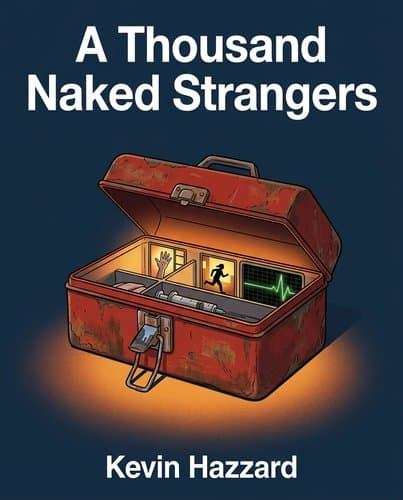
25111005_a-thousand-naked-strangers
by Kevin Hazzard
A paramedic's decade on Atlanta's streets reveals that the people drawn to emergency medicine aren't heroes—they're adrenaline-seekers who gradually discover…
In Brief
A Thousand Naked Strangers (Janu) traces Kevin Hazzard's decade as an Atlanta paramedic, using his own experience to examine what actually sustains people in emergency medicine. It reveals how competence is built through failure, how dark psychology keeps responders functional, and how the appetite for chaos — not altruism — is often what keeps them showing up.
Key Ideas
Appetite for chaos sustains caregiving roles
The people who stay in high-stress caregiving roles over time aren't the ones who feel called to serve — they're the ones who can tolerate, and often actively enjoy, the specific texture of chaos that role delivers. Vocation and appetite aren't opposites.
Burnout manifests as indifference, not dread
Burnout in emergency medicine isn't about being overwhelmed by the worst calls — it's about losing the capacity to care about the patients on the ordinary ones. The sign you're done isn't dread; it's indifference.
Failure and trauma form true curriculum
Real competence in crisis response is built from specific, humiliating failures — not training scenarios. The failures leave physical and psychological marks, and those marks are the actual curriculum.
Work coping mechanisms reshape personal relationships
The psychological defense mechanisms that make EMS workers effective — dark humor, flat affect, deliberate detachment — don't stay at work. They follow people home and slowly reshape who they are in relationship.
Partners share vocational burden without compensation
Any vocation that demands total presence eventually reveals that the people living alongside the practitioner are also inside the vocation, bearing its costs without its compensations. The partner or spouse is always on a second ambulance nobody talks about.
Caregiving and thrill-seeking motivations coexist
The difference between a caregiver and a thrill-seeker is genuinely thin. The most functional emergency responders are often the ones honest enough to admit both are present — and to not let that admission undermine the care they deliver.
Who Should Read This
Readers who connect with first-person stories about Memoir and Mental Health and want to see the world through someone else's eyes.
A Thousand Naked Strangers
By Kevin Hazzard
14 min read
Why does it matter? Because the people who show up to save your life may be there, at least partly, because they enjoy the chaos.
Here's the assumption: the person who runs toward screaming and blood and stopped hearts is wired differently from you — selfless, brave, built for sacrifice. Kevin Hazzard was none of those things. He was a twice-failed professional who enrolled in EMT school mostly because his wife told him to, panicked at his first witnessed death, and spent his early shifts hoping — genuinely hoping — that strangers would hurt themselves badly enough to make the shift interesting. What he found, and what this book excavates with uncomfortable honesty, is that the people best equipped to help in a crisis are often there for reasons they'd never put in a grant application. The line between caregiver and chaos-seeker turns out to be almost invisible. And the only way to find out which one you are is to keep showing up anyway.
You Don't Find Out Who You Are Until You Stop Running From the Worst Moments
Kevin Hazzard is sitting in the back of a parked ambulance with a dead woman and nowhere to put her. The hospital won't take a corpse. The nursing home says she's 'yours now.' His partner is inside arguing. So he reads through her chart to learn her name, finds out she was 88, and then — because what else do you do — calls his wife. She's been watching The Sopranos without him. When she asks how the woman died, he says 'peacefully,' which is true and also the most compressed possible description of watching someone open their eyes, tilt their head, let out a single breath, shed one tear, and stop.
Hazzard is 26, two nights into his EMT career, a former reporter who got here almost by accident. The longer path to that parking lot runs through 1997, when he was leading Jet Ski tours and two men collided and one came up missing the lower half of his face — blood and teeth in the water, skin hanging loose. Hazzard panicked. Not heroically paralyzed, not professionally stunned. Just panicked, useless, the thing you're not supposed to be. That moment followed him through a failed sales career and an abandoned journalism career and years of watching his military friends come back from Iraq with a particular quality of self-knowledge he couldn't name but recognized on sight. He enrolled in EMT school partly because his wife told him to stop talking and do something, but mostly because he needed to know if 1997 had defined him or if he could be something different.
What he discovers, first shift on a 911 ambulance, is not quite what he expected. A man shreds three toes off on a lawn mower and Hazzard's honest internal response is relief — even pleasure. He's glad this happened, glad he's the one who caught the call. His partner Jerry, seasoned and indifferent, barely glances at the injury. For Hazzard it's, as he puts it, magic. This is the part most accounts of emergency medicine quietly omit: the appetite. The hope that the next call is worse than the last. He's not there to heal; he'll hand that off to some doctor later. He's there for the raw, unmediated seconds right after the world breaks open. The question he carried from 1997 wasn't really 'can I help people?' It was 'can I stand in the wreckage without running?' The answer, it turns out, arrives as something closer to hunger than courage.
The Gap Between Classroom Medicine and Street Medicine Is Where People Actually Get Hurt
The system that trains people to save your life is held together with less than you'd hope. EMT certification in Georgia takes eight months — a certificate program, no college credit — and the curriculum is taught by whoever's available. In Hazzard's case, that means Alan, a fire department training officer for whom evening instruction is a second job he'd clearly like to stop doing. Alan's opening lecture is genuinely compelling: EMS as nineteenth-century house-call medicine, you going to them, one blood pressure cuff and a flashlight and common sense against the full range of human catastrophe. Hazzard scrawls in his textbook margin: 'EMS is medicine as modern anthropology?'
The seduction fades around month three, when Hazzard learns that another EMT class across town has been running practice scenarios since week one. His class hasn't done a single one. He corners Alan after class, physically stepping into his escape route. Alan insists they've already covered scenarios; Hazzard tells him they haven't even reached ongoing assessments yet. Alan thinks it's month two. Hazzard tells him it's month three. A pause. 'Shit,' Alan says — then says it again. The man who opened the course with a philosophy about the soul of emergency medicine doesn't know what month of his own class he's in.
But the classroom's failures are almost beside the point, because the real education arrives as a series of humiliations. On his Grady EMS ride-along, Hazzard watches two veteran medics wrestle a speedball patient with compound fractures so severe the broken bones have crossed each other through the skin. When the patient charges, the medics sidestep. Hazzard freezes. Later, in the ambulance, he ties the man's restraint with a shoelace knot. The patient, still running on cocaine, unties it in minutes and grabs Hazzard's genitals.
The People Who Stay in EMS Fall Into Two Categories — and Only One Should
What actually separates the medics who last from the ones who don't? Not resilience. Not calling. The answer Hazzard gets from his rotating cast of part-timers is bleaker and more clarifying than either of those: everyone burns out. The long nights, the eleven-dollar hourly wage, the holidays missed, the blood and vomit that comes with a paycheck roughly equivalent to a Starbucks barista's — it accumulates. Burning out isn't a personal failure. It's a structural feature of the job, as predictable as shift change. The real question is what you become afterward.
The part-timers give Hazzard a word for one possible answer: Killers. Not metaphorical ones. The term refers to medics who stayed too long, lost their way, and are still technically employed but have hollowed out somewhere essential. They teach him through horror stories — an informal curriculum in what a medic must not become. One story is enough. An old man is found barely alive at home. Cancer. Heart failure. Kidney failure. No family. No hope. The medic who shows up covers the patient's mouth with a gloved hand. The story is told without verification and with no follow-up, which is precisely what makes it stick. Hazzard can't prove it happened. He also can't prove it didn't.
Hazzard includes himself in the accounting. He realizes it fully on a call to a man kept alive by a balloon pump and IV drips in a room with no furniture except a hospital bed, the patient in a diaper, machines breathing for him. Hazzard doesn't understand the nurse's medical history. He backs away from simple instructions. He fails them. At the hospital, an ER tech steps in to do the job Hazzard is botching and asks without glancing up: 'So what's that make you?' Not a question. An indictment. The word Tourist, which Hazzard had been applying to himself with a kind of relief — present but not committed, watching but not responsible — turns hollow in an instant.
The appetite that brought him here, the hunger he felt when the lawn mower call came in, the almost predatory relief at being the one on scene, turns out to carry a warning. Hunger without commitment is just voyeurism. The road from Tourist to Killer is shorter than it looks.
Caring About the Patient and Enjoying the Carnage Are Not Mutually Exclusive — and That's the Uncomfortable Part
Think of a war photographer. Technically, the job is documentation — bearing witness so the world knows what happened. But the best ones will tell you, if you press them, that there's something else in the viewfinder: the compositional thrill of a perfect shot, the satisfaction of being exactly where history is cracking open. Does that appetite make them less committed to the truth? Or is it precisely what gets them to the front line in the first place?
Hazzard and his partner Chris spend the drive between calls debating an aesthetic framework they call the Perfect Call. It requires midnight timing, no backup available, multiple mechanisms of injury — a car wreck that starts a fire, a gunshot that kills one person and ignites the scene for the others. Dead bodies present for atmosphere. Patients on the edge who need exactly what the two of them can provide. They argue about whether the patient has to survive for the call to qualify. They decide: no. The patient's outcome is beside the point. The call, they conclude, is about the experience of the responders.
Then comes Thanksgiving. An elderly woman aspirates an entire broccoli floret during a family argument and dies under the dinner table — dentures dislodged, wig askew, dying loudly in front of everyone. Hazzard and Chris arrive to find a family in various stages of collapse: some crying, one brother demanding respect for a mother he helped kill with his bickering, the brother's sister attacking him until someone physically carries her outside. They shock the woman's chest repeatedly, break her sternum doing compressions, use a hand-powered suction device that sounds like an accordion toy to extract the broccoli — still bearing a single set of tooth marks — from her blocked airway. None of it works. Time of death: 19:23.
Afterward, cleaning the ambulance, Hazzard steps on her dentures. They shatter on the steel floor. He carries the two pieces inside, finds the niece, holds them out, and confesses. She thanks him. He writes that he wants to cry, wants to hug her, wants to spend the rest of his life doing exactly this job.
Hold both of those things at once. The man who just concluded that the patient's survival is irrelevant to a call's quality is the same man undone by broken dentures and a stranger's forgiveness. The aesthete who scores calls like a gymnastic routine is the same person who can't walk away from a niece without needing her to know what happened to her grandmother's teeth. These aren't two different people showing up on alternate shifts. It's the same person, on the same call, carrying both things simultaneously — the hunger and the grief.
The uncomfortable implication is that the hunger might be load-bearing. Without it, you don't race to Thanksgiving calls on your day off. Without it, you don't push the ambulance hard to beat the fire truck there. Without it, you don't kneel on a stranger's floor at midnight and try to pull death back by its collar. Compassion alone might get you certified. It probably won't get you through year three. What keeps Hazzard showing up — what keeps any of them showing up — is something rawer and harder to defend in polite company. The job requires you to want the catastrophe. The grace, if there is any, is in what you do once you arrive.
Competence Is Earned Through Failure, Not Training — and the Failures Leave Marks
His finger is inside a dead woman's skull. Not metaphorically — literally. He's doing a final count of bullet holes before arriving at the hospital, running his hand under her head to check for entry wounds, when it slips through a gap in the bone. He realizes this because every time he presses, her eyes open. Every time he releases, they close. The firefighter riding along stares at him. 'That's probably not good.' 'No, I don't think that's good.' 'I'm not gonna do that again.' 'Probably best.' She dies in surgery an hour later.
This is Hazzard's first real test as a full paramedic at Grady — the call every new medic knows is coming and cannot prepare for. The woman has been shot six times at close range, which he identifies not as rage but as something past it: pure hatred, the arithmetic of intimacy gone wrong. He arrives to find her lying in blood that has thickened to the consistency of pudding, her eyes fixed hard to one side from a brain bleed already in progress. His partner is an EMT, meaning every decision belongs to him alone. What follows is less a medical response than a controlled falling-forward: suction the blood, backboard, IVs, fluids, a seizure that interrupts his radio call to the hospital, enough sedative to floor a horse. Then serenity. Then the skull.
That moment only becomes bearable as comedy. The flat exchange with the firefighter is the only frame that fits — not because the situation is funny, but because humor is the load-bearing wall when everything else has already collapsed. Hazzard cleans the truck afterward and goes back in service. The woman is dead. He is, in some sense, fine.
Except the job is also doing something to him he hasn't consented to. Around this same period, he carries a dead man's skull fragment home in the tread of his boot — walks around the house for ten minutes before his wife hears the scratch on the floor and he pries it out. He finds this funny. He suggests keeping it. He sits with that for a moment: the response that used to live in him before all of this — the instinct toward horror, the knowledge that this is wrong — has been quietly replaced by something flatter and harder to name. He goes into his dead friend John's decomposing apartment alone, opens windows, thumbs through books, unloads a pistol, and feels nothing. A year earlier, he would have waited in the car.
He names it clearly: the job's central illusion is that you're saving lives, when most of what you're actually doing is witnessing death, absorbing it, until the shock that used to protect you wears smooth. The evidence of that change accumulates in the things you stop noticing, the things you start finding funny, the skull fragment you almost kept — a human being becoming just another thing you accidentally bring home on your shoes.
The Job Doesn't Just Change You — It Slowly Empties You of the Thing That Made You Good At It
Hazzard is crouched on a second-floor balcony at midnight: a woman beaten with a baseball bat by her own daughter, blood pooled on the concrete, cops everywhere, a news helicopter combing the tree line, a restless crowd pressing against the police tape. A genuinely critical patient. The kind of scene that used to feel electric. He yawns. No adrenaline, no hypervigilance. Just a tradesman doing a job he's done a thousand times.
His EMT instructor had warned him about this. Watch for the feeling, the instructor said — that live-wire alertness that arrives with a bad call, the hypervigilance that keeps your hands from shaking when everything goes wrong. When it goes, go with it. Hazzard filed that away and forgot it, the way you forget advice that doesn't yet apply to you.
The thing that's gone is the appetite. The hunger that drove him out of journalism and into EMT school, that made him secretly glad when the lawn mower call came in, that had him racing ambulances to beat the fire trucks to the scene. It didn't vanish in a crisis. It leaked out across years of rotating bad partners, Christmas shifts staring at a windshield, the grinding repetition of calls that were never what dispatch said they were. By the time Hazzard registers its absence, it's been gone long enough that he can't identify when it left.
The job's cruelest feature is that the transformation happens below the threshold of daily awareness. You don't notice you've changed until you're sitting on a balcony in the middle of someone else's catastrophe, waiting to feel something, and the only thing that comes is fatigue.
The Journey Was Never Solo — and the Person Who Paid the Highest Price Wasn't the One in the Ambulance
Driving through Atlanta with their kids strapped in the backseat, Hazzard tells Sabrina he thinks it's time to quit. She says she thinks so too. He expected resistance — she's been paying every bill for years, her salary funding his lobster habit and their vacations while he collected an EMT's hourly wage — but what she offers instead is a confession he hadn't seen coming. She's been alone. Not just logistically alone, in the way you're alone when your partner works nights and holidays and New Year's Eve. Alone in the deeper sense: present at every party, every dinner, every midnight toast, but always partly somewhere else, running the mental math of wherever he might be and what might be going wrong.
One New Year's Eve she called him at midnight, as they'd arranged, and he told her about the call he'd just run — a couple of bodies, one disemboweled — and she realized it was already past one in the morning. She'd lost track. Not because she was distracted but because she'd been so far inside her own private version of wherever he was that actual time had slipped. Their marriage, she tells him, had been conducted largely through handwritten notes on the kitchen counter — 'Please run the dishwasher. Would you like a fat lip with that mouth. Love you. You, too.' — because that was the form intimacy took when they kept opposite hours. She read the chaos he lived in not from what he told her but from what she could piece together: the day she saw him on the news at a courthouse where a judge had just been shot.
Hazzard had experienced the entire decade as a solo expedition — a man testing himself against the worst the city could produce. She'd been on the same journey the whole time, carrying it differently. He'd been transformed. She'd watched the transformation without being asked, without a role, without a way to help.
The Honest Reason People Who Could Leave Choose to Stay Is Also the Reason They're Good At the Job
Why do people who could leave — who have the skills, the credentials, the clear evidence that the job is breaking them — stay anyway? The answer Hazzard arrives at after a decade on an Atlanta ambulance is the one nobody puts on the recruitment poster.
At the end of the book, a man falls forty feet from a tree in the Deep South heat. His chainsaw keeps running when he doesn't, and when he hits the ground it opens his face from ear to ear — skin, jaw muscle, bone, all of it churned into something barely recognizable as a human mouth. Walking down the weed-choked ravine toward this patient, Hazzard gets pulled backward in time: he's in the water off Charleston in 1997, useless and panicking while a man bleeds into the bay. Then he's at his first EMT class, staring at textbook photographs and wondering if he can actually do this. A decade of self-doubt on a loop. Then he reaches the patient and it stops. Everything outside the call ceases. What follows is pure operational present: suction, backboard, stopping every few steps up the hill to clear the blood because there's too much of it to manage in motion, the patient talking or maybe gurgling, teeth loose on the ambulance floor. He rolls the entire backboard sideways because that's the only way to keep pace with the hemorrhage. The patient reaches the surgical team alive. Afterward, Hazzard finds an ER tech and talks basketball. He describes the call, later, as something he's tempted to call perfect — not because the outcome was certain, but because the person who showed up had no panic left in him. The question 1997 had lodged in him was finally answered, not with a speech but with a suction catheter.
The epilogue names what made that possible, and it's not nobility. Hazzard argues that medics don't need to be heroic or tough or even particularly good people. The single qualifying trait is that they enjoy the madness — the specific, transgressive pleasure of moving toward what every reasonable instinct says to flee. He calls it a peculiar drug: panic, near-death, the freedom that only arrives when the ordinary world has cracked open and the rules either don't apply or haven't been written yet. Burned-out medics who quit and drift back — the ones the profession calls retreads — don't return for the paycheck. They return because nothing in ordinary life replicates the feeling of a stranger pressing their limp child into your hands and transferring, without words, everything they have left. That feeling is the job. The medicine is just the mechanism for getting there.
Hazzard's final line is that the crew who someday shows up at his door will be there for the same reason he showed up for everyone else's. Because it's fun. Received as a punchline, that lets you off the hook. Received as a thesis — which is what it is — it reframes everything in the book. Every competent, even heroic act across a decade on Atlanta's streets was simultaneously true as service and true as pleasure. Those two things aren't in tension. The pleasure is why the service gets done at all.
What 'I'm Tempted to Call It Perfect' Actually Means
Here is what the book finally tells you: when the epilogue lands on 'because it's fun,' that's the thesis, not a punchline. Every competent, even heroic act described across a decade on Atlanta's streets was simultaneously true as service and true as pleasure. Those two things aren't in tension. The pleasure is why the service gets done at all.
Notable Quotes
“Where is my damn medevac!”
“All three? You wanna take all three?”
“Let's take two. Which one you wanna leave?”
Frequently Asked Questions
- What is A Thousand Naked Strangers about?
- A Thousand Naked Strangers is Kevin Hazzard's memoir of his decade working as an Atlanta paramedic. The book examines what actually sustains people in emergency medicine through his personal experience. It reveals how competence is built through failure, how dark psychology keeps responders functional, and how the appetite for chaos—not altruism—is often what keeps them showing up. The memoir provides insight into the psychological and practical realities of long-term emergency response work.
- Who sustains careers in high-stress emergency medicine?
- The people who stay in high-stress caregiving roles over time aren't the ones who feel called to serve — they're the ones who can tolerate, and often actively enjoy, the specific texture of chaos that role delivers. Vocation and appetite aren't opposites. This insight fundamentally reframes how we understand career sustainability in emergency medicine. Rather than altruism or professional duty being primary motivators, the ability to thrive in and crave chaos proves more predictive of long-term success in EMS work.
- What causes real burnout in emergency medicine?
- Burnout in emergency medicine isn't about being overwhelmed by the worst calls—it's about losing the capacity to care about the patients on the ordinary ones. The sign you're done isn't dread; it's indifference. This distinction is crucial because it suggests burnout emerges not from rare traumatic cases but from gradual erosion of emotional engagement with routine work. Understanding this difference is essential for identifying when emergency responders have truly reached their limit and need intervention.
- How does being a paramedic affect your personal relationships?
- The psychological defense mechanisms that make EMS workers effective—dark humor, flat affect, deliberate detachment—don't stay at work. They follow people home and slowly reshape who they are in relationship. Additionally, any vocation demanding total presence reveals that people living alongside the practitioner also bear its costs without its compensations. The partner or spouse is always on a second ambulance nobody talks about. These coping strategies prove essential for emergency work but exact a profound toll on intimate relationships.
Related Book Summaries

Read the full summary of 25111005_a-thousand-naked-strangers on InShort