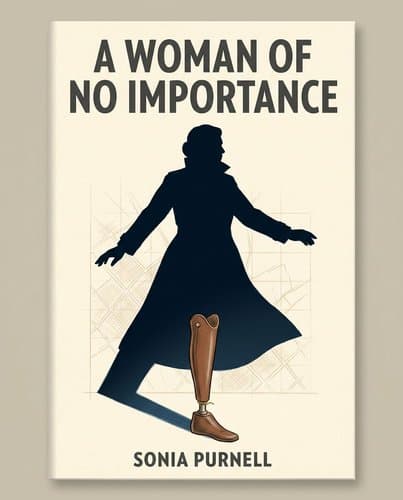
40595446_a-woman-of-no-importance
by Sonia Purnell
The Gestapo named her their most wanted Allied spy while the agencies she served dismissed her as unqualified. Virginia Hall's story reveals how gender…
In Brief
The Gestapo named her their most wanted Allied spy while the agencies she served dismissed her as unqualified. Virginia Hall's story reveals how gender, disability, and outsider status became the ultimate operational cover—and why the people institutions reject often become their most indispensable operators.
Key Ideas
Credentials Block Crisis-Ready Operators
Institutions screen for credentials and conformity — the qualities that help someone advance in peacetime hierarchies. In genuine crisis, these filters often reject exactly the people who will prove most effective, because crisis rewards improvisation, unconventional networks, and comfort with operating without formal authority.
Social Invisibility Defeats Surveillance Systems
Invisibility is an operational asset that no training program can manufacture. Virginia Hall succeeded where credentialed male agents failed partly because she moved through society's structurally invisible classes — women, sex workers, minor officials, foreign nationals — whose social position made them immune to the enemy's surveillance assumptions.
Qualified Doubt Strengthens Network Trust
Even the most skilled operator can be penetrated through channels they partially trust. Alesch worked not despite Virginia's suspicion but partly because of it: her cautious, qualified acceptance of him signaled to her own network that the priest was probably safe. Doubt that stops short of action can be more dangerous than either full trust or full rejection.
Informal Operators Gain Delayed Recognition
The gap between impact and institutional recognition tends to be widest for people who work through informal networks and relationships rather than formal authority. Virginia Hall ran SOE's entire French operation, orchestrated a precision prison break, and helped liberate a French département before Paris fell — and retired with a mandatory severance check and a building named after her forty years late.
Crisis Heroes Threaten Peacetime Institutions
The same qualities that make someone indispensable in crisis — operating outside formal authority, building coalitions from unexpected people, moving unseen through hostile environments — tend to make institutions deeply uncomfortable with them in peacetime. The story of what happened to Virginia Hall after the war is not an aberration; it is the institutional logic working exactly as designed.
Who Should Read This
History readers interested in Memoir and Military History who want a deeper understanding of how we got here.
A Woman of No Importance
By Sonia Purnell
9 min read
Why does it matter? Because the woman history almost forgot won the war's most important battle using the very weapons her enemies gave her: invisibility, improbability, and the assumption that someone like her couldn't possibly matter.
Here's what you probably expect: a story about a woman who overcame her disadvantages — the missing leg, the female body, the decade of institutional rejection — and triumphed anyway. That's not this book.
Virginia Hall's prosthetic leg meant she walked where no one looked twice. Her gender meant she moved through occupied France while male agents were being pulled off trains. Her American passport made her legally beneath Nazi concern until she became the most wanted spy on the continent. The institutions that spent ten years refusing her — the State Department, the British Army, the SOE — accidentally built the perfect operative: someone the enemy couldn't see coming.
The book's ugliest argument isn't what the war did to her. It's what happened the moment peace arrived.
The Woman Every Institution Rejected Was Being Forged Into the Weapon They Needed
Christmas Day, 1933, Smyrna, Turkey. Virginia Hall is twenty-seven years old, unconscious on an operating table, while surgeons saw off her left leg below the knee. Three weeks earlier she had stumbled climbing a wire fence during a snipe hunt in the Gediz marshes, grabbed for her falling shotgun, and fired a cartridge of lead pellets into her own foot at point-blank range. Gangrene had followed. Now sepsis set in — a poisoning of the blood that, in the days before antibiotics, killed most of the people it found. Her organs were failing. The amputation was a last bet.
She survived, barely, and in the delirium experienced what she would later describe as a vision. Her father Ned, dead two years, appeared at her bedside and told her it was her duty to survive. She believed him. She drew on that instruction for the rest of her life, and never in conditions less dire than those that first produced it.
The suffering was catastrophic. What followed was more telling. Virginia recovered, returned to her clerical post at the State Department, and applied for the third time to become a diplomat. Rejected again, this time under a rule explicitly barring amputees. Her male replacement in Venice was granted a higher title and higher pay. A family friend brought her case to Roosevelt, himself semiparalyzed by polio, who did not pursue it; the Secretary of State thought she might make a fine career girl, but only in the clerical grades.
She resigned in 1939. By 1940 she was driving an ambulance toward the German advance in France, pressing the clutch with a prosthetic foot, because it was one of the few military roles open to foreign women. The institutions had spent a decade finding reasons to refuse her, and in doing so had unknowingly manufactured someone for whom the rules no longer held any authority — someone with nothing left to protect and nothing left to lose. Not the daughter her mother had groomed for a Baltimore marriage. The other version, the one the institutions had made. That was exactly who the war needed.
She Built SOE's Entire French Network From the People the Nazis Would Never Suspect
On a Lyon backstreet that looked like an ordinary tenement building, Germaine Guérin hosted two operations on separate floors. Upstairs, in an apartment hung with tapestries and stocked with wardrobes of Paris couture, she held evening salons for the city's wealthy men. Downstairs, she ran one of Lyon's most profitable brothels. German officers, French police, and Vichy officials were regulars at both — paying exorbitant prices for black-market Scotch and prime steaks, never once asking what their hostess was doing with the gasoline and coal they so willingly handed over.
What they were doing: transporting Allied agents and Resistance escapees across a city under occupation.
Virginia had been introduced to Germaine by William Simpson, a badly burned RAF pilot with amputated fingers and a permanently scarred face, who was waiting in Lyon for repatriation and believed the two women would recognize something in each other. He was right, though Virginia came to the meeting carrying a prejudice (just a year earlier, she'd written with contempt about French prostitutes who entertained German soldiers). Now she was asking one to run safe houses, store weapons, and recruit informants.
Germaine's girls went further than anyone expected. They spiked clients' drinks to loosen their tongues and photographed documents found in sleeping men's pockets. Some went further still: using heroin smuggled into France inside the American diplomatic pouch, they offered German clients what was presented as a novelty. Those who accepted became addicted; pilots among them lost their eyesight and were grounded. Virginia called these women her "tart friends" and noted that, thanks to their German companions, they knew "a hell of a lot."
The network Germaine made possible was invisible to the occupiers for the same reason it was available to Virginia: it existed outside the channels the Germans expected to monitor. Standard agents worked through hotels, offices, and radio transmission lines — the channels German counterintelligence had been trained to watch. Virginia's circuit ran through a brothel, a gynecologist's consulting room converted into her command post, a laundry window where the position of two mended stockings signaled whether a message was waiting. The enemy's surveillance apparatus had no vocabulary for any of it.
Her Greatest Wartime Operation Had No Authorization, No Official Record, and Almost No Recognition
Twelve SOE agents arrived at Vichy's Mauzac internment camp in early 1942, half-starved and awaiting possible execution. Virginia had eighteen months of groundwork behind her. She had no authorization to break them out. She arranged it anyway.
She recruited Gaby Bloch, the Jewish wife of one imprisoned man, as her field proxy, coaching her on how to spot corruptible guards. Three were approached; two backed out. The one who stayed asked only to join the Free French. Inside, lead agent Georges Bégué used prison bread to mold the barracks lock and filed a key from scratch. The prisoners' choir sang obscene songs every evening to cover the hammering.
The wireless set arrived hidden under the cassock of a seventy-year-old legless priest, a World War I veteran carried into the barracks in his wheelchair. Once inside, he beckoned the men close: "Now, one of you look under my cassock — where my legs should be." Bégué guessed immediately who had arranged it. Within a week, he was transmitting from inside the camp.
On the night of July 15, a complicit guard distracted his chief with two liters of white wine. A prisoner who'd been threatening to talk found something in his beer that night. Twelve men went through a gap in the wire in twelve minutes, then vanished into a waiting truck. Virginia's network spread the rumor that an RAF bomber had airlifted them out, directing the manhunt the wrong way.
Four of the twelve became distinguished circuit heads. SOE historian M.R.D. Foot later called Mauzac one of the most useful operations of the war. Virginia was nominated for a Commander of the British Empire — while still in enemy territory — and turned down. An internal SOE memo in 1944 recorded that "many of our men owe their liberty and even their lives" to her. No one outside SOE ever read it.
The Man She Cautiously Trusted Was Selling Her Network to the Abwehr One Name at a Time
How does the sharpest counterintelligence mind in occupied France get fooled? By someone who knew exactly what she was looking for and gave it to her.
In August 1942, a powerfully built priest appeared at Dr. Rousset's surgery in Lyon, identifying himself as the new courier from a Paris Resistance circuit called WOL. He spoke French with a German accent — explained away as Alsatian — and his credentials looked impeccable: he knew Virginia's field name, the doctor's code name, and the correct password. He had even brought a note in a handwriting she recognized. His name was Robert Alesch.
She had doubts from the start. He described a WOL colleague as tall and blonde when the woman was actually a petite brunette. He pressed, too quickly, for the names of other agents — insurance, he said, in case Virginia "disappeared overnight." She asked London to vet him. They found nothing. She kept him in the fold anyway, because fourteen months running twenty-five organizers and six wireless operators with no command authority and no permanent backup had worn down the margin between doubt and certainty.
The man was Agent Axel of the Abwehr — a Luxembourger, not an Alsatian, driven by ambition and fury at missing a prestigious Paris parish post. He had been spending SOE funds on two mistresses and was weeks from moving into an eight-room apartment in the 16th arrondissement. His father, supposedly shot by the Germans, was entirely alive. But none of this is the worst of it.
Before Alesch ever sat down with Virginia, he had already handed the Abwehr the WOL circuit's detailed coastal defense photographs of Dieppe. The Germans recognized their accuracy, doctored the images to remove key gun positions on the surrounding cliffs, and returned them to Virginia as usable intelligence. On August 19, 1942, Allied commandos — nearly four thousand, most of them Canadian — landed on that beach not knowing what waited above them. More than half were killed, wounded, or captured in a single day.
The knowledge arrived too late for Germaine Guérin, who ended at Ravensbrück as prisoner number 39280, and for sixty WOL members who never came home.
The London desk that had refused to give Virginia command of the network she was already running alone never answered for that choice.
'Cuthbert Is Being Tiresome, but I Can Cope' — London Had No Idea What That Meant
Somewhere above six thousand feet on the Col de Mantet, November 1942, Virginia Hall stopped long enough to send a message to London. She was in a shepherd's hut with two strangers, hiding her prosthetic leg — a blood-soaked sock would end her escape faster than any patrol. The message read: "Cuthbert is being tiresome, but I can cope." The duty officer in Kent had no idea Cuthbert was her leg. He signaled back: "If Cuthbert is tiresome, have him eliminated."
To understand what it cost, you need the climb. Virginia had been running on wartime rations for fourteen months. The passeur she'd paid 55,000 francs had no idea she wore a prosthetic and would have left her on the mountain if he knew. Eight thousand feet of ascent in November snow, no cane, no snowshoes — one side of the path a drop of several hundred feet, the other a slab of ice with nothing to grip. She carried her bag on her right side to disguise her gait. Hours of sideways steps across frozen terrain had worked the rivets loose; her stump was an open wound, blood seeping through a sock she couldn't let anyone see. She hid it. She kept going.
Klaus Barbie — the Gestapo chief who'd made Lyon his headquarters — was plastering WANTED posters across France: THE ENEMY'S MOST DANGEROUS SPY: WE MUST FIND AND DESTROY HER. The woman he was hunting was bleeding in a shepherd's hut, telling London she could cope.
The Night Halifax Bombers Fell From the Sky Proved What She Could Do When Someone Finally Let Her Lead
The moment Virginia Hall was given genuine command authority, she used it to liberate an entire French département. She had spent the previous months in peasant disguise (gray hair, penciled wrinkles, shuffled gait), passing German Seventh Army convoy routes to London from a farmer's attic while driving his cows to pasture. She'd crossed back into France as the designated assistant to a 62-year-old OSS officer who twisted his knee in the landing surf; she set him aside and built a guerrilla network across three central French départements herself.
At the Bream drop zone on the Vivarais-Lignon plateau — chosen for its flatness, tested with a handkerchief held to the wind — thirty men waited past 1 a.m. under an inky purple sky for planes that might not come. Virginia stood among them in army jacket and khaki trousers, an orange silk square knotted at her neck. She had organized everything: sticks arranged 150 paces apart in a Y to guide the pilots, sentries on the perimeter, ox-drawn carts at the field's edge, fifteen minutes to clear the site without trace. Fayol, the local Resistance chief who had spent weeks calling her the "redheaded witch," had come to watch. If the planes didn't come, her authority was probably finished.
They came. Three Halifax bombers banked right, dropped to under 600 feet, and opened their hatches. Twenty metal containers and ten packages thudded onto the grass: three tons of Brens, Stens, grenades, explosives, medicines, and boots. The silk parachutes were stuffed into bags for village women to sew into dresses. The containers went into a waterfall. The site was clean in fifteen minutes. There would be 22 drops in all.
By August, the men she'd trained and armed — grown from 30 to 400, organized into five companies — had liberated the entire Haute-Loire. Eight hundred German soldiers surrendered to her maquisards on August 19; the département was free two days before Allied armies entered Paris. A declassified military report found that the intelligence she'd gathered posing as a milkmaid along roadsides, relaying German Seventh Army convoy routes to London, had been central to trapping up to 100,000 enemy soldiers in the Falaise Pocket, the decisive Allied breakthrough of the Normandy campaign. An OSS officer who watched from the field described her directing operations with the unhurried calm of someone who had already worked out every contingency.
After the War, Her Own Government Did What the Gestapo Couldn't: Made Her Disappear
The institutions that spent a decade refusing Virginia Hall a diplomat's title spent two more decades ensuring she never held real authority again.
She joined what became the CIA in 1946 as its first female operations officer in the covert division and ran paramilitary networks in France, the same terrain she'd mastered under fire. Then in 1956 an unnamed supervisor posted an annual appraisal calling her results negligible and her work deficient in originality and drive. He filed it immediately before going on leave so she couldn't challenge him directly. He had never actually overseen her work. Her previous supervisor said, on the record, that he'd choose her for the same job again. Virginia's written rebuttal was scorching: the rating, she said, was "based on nothing." But the damage held.
The supervisor wasn't a rogue. The CIA's own internal review panel had already confirmed that the institutional assumption (women being more emotional, less objective) was simply accepted policy. The lone proposed reform: admitting women to the agency gym one day a week. E. Howard Hunt, later imprisoned for Watergate, watched Virginia move through the building and concluded she made the career bureaucrats uneasy in direct proportion to how much more she'd actually done. "No one knew what to do with her," he observed. "She was a sort of embarrassment."
She hit the mandatory retirement age in 1966, at sixty, with no offer to continue as a consultant. The CIA's own classified report later acknowledged her experience had been systematically wasted, that she'd been "shunted into backwater accounts" because she overshadowed colleagues who felt threatened. She died in a Maryland hospital in July 1982, at seventy-six, having told almost no one about most of what she'd done.
The Woman in Khaki Who Never, Ever Gave Up on Freedom
The CIA named a building after her in 2016. Gabriel Eyraud — the last of the men she'd armed on that plateau — died the following year, having spent seven decades occasionally pausing to think of her face. Her MBE certificate had gathered dust in a London desk for sixty years before anyone thought to deliver it. You can read these as administrative oversights. They are not. They are the institutional logic completing its arc: acknowledge the person, belatedly, once she's safely gone and can no longer embarrass anyone.
What the men on that plateau understood, and the bureaucrats never could, is that Virginia Hall's greatness wasn't a credential to be conferred. It was daily practice — improvised from the margins, under fire, by someone every system had already written off. The building at Langley bears her name. The men who fought beside her remembered her face.
Notable Quotes
“Cette obscure clarté tombait des étoiles”
“This dark light falling from the stars”
“Cette obscure clarté tombait des étoiles,”
Frequently Asked Questions
- What is 'A Woman of No Importance' about?
- A Woman of No Importance tells the true story of Virginia Hall, the most effective Allied spy of World War II. Drawing on declassified files and new research, the book by Sonia Purnell reveals how Hall's gender, disability, and nationality made her invisible to enemy surveillance in ways no training could replicate. The narrative demonstrates that the qualities institutions routinely screen out — improvisation, informal networks, and operating without authority — are precisely what crisis demands. Hall succeeded where credentialed male agents failed partly because she moved through society's structurally invisible classes, making her immune to enemy surveillance assumptions.
- What are the key takeaways from 'A Woman of No Importance'?
- The book reveals how institutions screen for credentials and conformity — qualities that help in peacetime but often exclude the most effective people in crisis. "Institutions screen for credentials and conformity — the qualities that help someone advance in peacetime hierarchies. In genuine crisis, these filters often reject exactly the people who will prove most effective, because crisis rewards improvisation, unconventional networks, and comfort with operating without formal authority." Virginia Hall's success stemmed partly from her structural invisibility as a woman, disabled person, and foreigner. Additionally, the book shows how informal networks and improvisation proved more valuable than formal authority in actual operations.
- What were Virginia Hall's main accomplishments in World War II?
- Virginia Hall was extraordinarily effective during the war despite being overlooked by institutions. "Virginia Hall ran SOE's entire French operation, orchestrated a precision prison break, and helped liberate a French département before Paris fell." However, her recognition lagged far behind her impact—she "retired with a mandatory severance check and a building named after her forty years late." The book shows how the same qualities that made her indispensable—operating outside formal authority and building coalitions from unexpected people—made institutions uncomfortable with her in peacetime. Her post-war experience demonstrates institutional logic working as designed.
- How does the book explain invisibility as an operational asset?
- Invisibility cannot be taught through training programs—it's a structural advantage. "Invisibility is an operational asset that no training program can manufacture. Virginia Hall succeeded where credentialed male agents failed partly because she moved through society's structurally invisible classes — women, sex workers, minor officials, foreign nationals — whose social position made them immune to the enemy's surveillance assumptions." The book argues this advantage extends beyond spycraft: the qualities that emerge from working outside institutional notice—improvisation, unconventional networks, operating without formal authority—are precisely what crises demand. This creates an institutional paradox where the most effective people in emergencies are often least recognized in peacetime.
Related Book Summaries


Read the full summary of 40595446_a-woman-of-no-importance on InShort