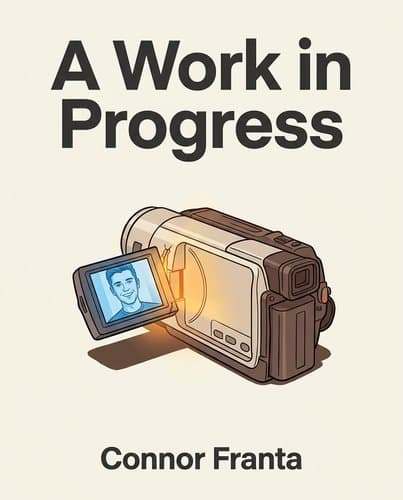
22886113_a-work-in-progress
by Connor Franta
A decade of YouTube fame, athletic achievement, and picture-perfect relationships couldn't fill the gap between Connor Franta's performed self and his hidden…
In Brief
A decade of YouTube fame, athletic achievement, and picture-perfect relationships couldn't fill the gap between Connor Franta's performed self and his hidden truth—until one bathroom mirror moment dismantled everything and revealed that the curated life is always just a placeholder for the real one.
Key Ideas
The Public Self Is Strategic Construction
The self you perform publicly is always a construction — not a lie, but a placeholder. The gap between that self and your private reality isn't vanity; it's the universal cost of growing up before you know who you are.
Success Rings Hollow Without Inner Truth
External success cannot compensate for internal concealment. Connor's YouTube career was at its most successful during his most miserable period — the metrics meant nothing against the weight of a single hidden truth.
Loyalty Is Deliberate Action, Not Feeling
Loyalty is a choice you make at small cost to yourself. The snowball story isn't about friendship as feeling; it's about friendship as deliberate action — you earn your place beside someone by putting yourself in trouble to get there.
Invisibility Before Creation Is Strength
When you can't explain a creative idea to anyone, that's not a weakness in the idea — it's evidence you're the only one who can see it yet. Build it anyway; they'll see it when it exists.
One Concealed Truth Corrupts Everything
Suppressing one part of yourself rarely stays contained. Connor framed his artistic interests as crushed by gender norms, his relationships as ordinary flings, his depression as generic unhappiness — all real, all also displacement for something he couldn't yet name.
Private Admission Enables Public Courage
The first person you have to say the hard thing to is yourself. Connor's bathroom mirror moment at 5 a.m. preceded every other disclosure by eight days — the public courage required the private admission first.
Deferred Living Becomes Perpetual Loss
Deferred living is a slow emergency. The taxi driver's story about a father and brother who planned to live well 'eventually' — and never did — is the book's most urgent argument: the cost of waiting is not abstract.
Who Should Read This
Readers who connect with first-person stories about Memoir and Self-Improvement and want to see the world through someone else's eyes.
A Work in Progress
By Connor Franta
11 min read
Why does it matter? Because the self you perform in public is always a placeholder for the one you haven't met yet.
Here's the thing about Connor Franta: he spent four years building a career out of showing you everything, while hiding the one thing that actually mattered. Four million subscribers. Hundreds of videos. Eighteen hours of carefully edited, perfectly lit proof that he was fine — happy, funny, relatable, fine. And underneath all of it, a teenager from Minnesota lying awake at night. A Work in Progress is not really a book about YouTube. It's the record of a decade-long performance — son, athlete, boyfriend, creator — executed so convincingly that even the performer forgot it was a performance. Until he didn't. Until 5 a.m. in a bathroom mirror, alone, when the edit finally ran out. I know that sounds dramatic. It's actually the opposite — it's the quietest, most ordinary kind of courage. If you've ever kept something that big that quiet for that long, you'll know exactly what I mean.
The 18 Hours That Hid Everything
Here's a number that reframes everything: eighteen hours. That's how much of himself Connor Franta shared with his subscribers across four years of weekly YouTube videos — five polished, edited, deliberately shaped minutes every Monday from 2010 to 2014, out of the 10,080 minutes available in any given week. He does this math himself, early in the book, and what makes it striking is that he presents it as a confession, not an achievement. Those eighteen hours are the constructed version. The curated one. The self that gets to rewind, reshoot, and start over until every word lands right. The book exists, he says, because real life doesn't work that way — it's one unedited take, full of mistakes you have to live with rather than cut around. So when a memoir arrives from someone who has spent years professionally editing his own image, the question worth asking isn't how he got famous. It's what those eighteen hours left out. The persona that did make it into the Monday upload — the funny, self-deprecating kid from La Crescent, Minnesota who started talking into his dad's camcorder at age six — is someone you'd genuinely want to hang out with. But it's also, by his own admission, a performance. And what stayed off camera is the whole point of this book. That's where we're going next: back to La Crescent, to a father who had his own complicated relationship with performance, and to the version of Connor Franta that never made the cut.
The Kid Who Couldn't Be Made Into Anyone Else
His father had a vision: the next Dan Gable. For anyone who doesn't know the name, Gable won Olympic gold at Munich in 1972 without surrendering a single point in the entire tournament — the kind of mythic athletic achievement that gets passed down through generations of sports-loving fathers. So when Connor was young, his dad signed him up for junior wrestling tournaments, drove him to competitions, and watched proudly as his son placed fourth. Out of four. His sister Nicola, who had roughly zero stake in the family wrestling legacy, turned out to be more interested in perfecting her takedown technique than Connor ever was. His father's own letter in the book names what this proved: 'You had a mind of your own. If you didn't want to do something, no one could make you.' The stubborn streak that showed up in time-outs and backtalk and a two-mile runaway attempt that ended because he got hungry — it wasn't defiance for its own sake. It was a self that kept refusing to be fitted into shapes designed by someone else.
The warmth of Connor's origin story is real. His parents met as Peace Corps volunteers in the South Pacific, married after coming home, and raised him in a small Minnesota town. He swam laps for eight years — starting as a chubby nine-year-old who hated sports, finishing at seventeen by winning the mile at the Wisconsin YMCA State Championship, crying and eating spaghetti to celebrate. You can feel the genuine affection for all of it.
But then, in the middle of a breezy listicle of childhood memories, there's this: a first kiss from a girl, at fifteen, in a school hallway. It felt strange, Connor notes — and not in the way first kisses are supposed to feel strange. He didn't enjoy it. His response to himself was careful, almost clinical: maybe that would change with time. It's the quietest sentence in the book, and in the context of everything that comes after, it lands like a small stone dropped into still water. The wrestling story shows a kid who couldn't be made into someone else's athlete. This one shows a kid who was just beginning to sense that the shape he was being asked to fit might not be the right one at all.
Loyalty Is a Snowball Aimed at a Stranger
A snowy recess, a teacher named Mrs. Lewis, and a kid standing alone against a wall. Jacob had mouthed off and earned a fifteen-minute timeout — nothing unusual there. What happened next is the whole argument. Connor walked over and asked to serve the punishment alongside his friend. Mrs. Lewis refused: that wall was strictly for kids in trouble. So Connor packed a snowball, turned to face the nearest innocent bystander walking by, and threw it as hard as he could. Direct hit. Then he looked back at the teacher and shrugged — guess I'm in trouble too. He got his wall, he got his fifteen minutes next to Jacob, and he got a friendship that still hasn't ended.
The story works because the choice is so small and so deliberate. Nobody had to know. Most kids would have laughed and kept playing. But Connor didn't wander toward that wall by accident — he engineered the situation, at actual cost to some unfortunate stranger's face, because showing up mattered more than staying comfortable. That's the distinction the chapter keeps pressing on: friendship isn't something that accumulates passively, like followers or Facebook connections. It's a series of small, chosen acts. You decide to go stand against the wall. Or you don't.
Franta maps this out with a taxonomy that's less a ranking than a temperature reading: best friends are the ones you can sit with in total silence and feel fine; good friends are the ones you'll call without needing an occasion; acquaintances are the people whose names you know; strangers are just everyone who hasn't had the chance yet. He counts his own best friends at three, his good friends at a dozen, and admits that took him by surprise. The number felt small at first. Then it didn't. Three people you'd do the snowball thing for is, it turns out, a lot.
Which raises the quieter question underneath all of this — not just who you'd show up for, but what you'd show up for. What you're willing to engineer a situation around.
The MacBook Argument Was Never Really About a MacBook
Think about the last time you told yourself a story about why you wanted something — a simpler, safer version of the true reason. Not a lie exactly. More like a translation into a language the room could handle. That's the subtext running under one of the book's warmest anecdotes.
At thirteen, Connor wakes his father before dawn to pitch a thousand-dollar MacBook. He'd done his homework: battery life, creative software, long-term cost-effectiveness. His clincher — 'it's like an investment!' — lands well enough that his father can only respond with reluctant non-resistance rather than an actual no. Connor buys it ten minutes later. The machine becomes the one on which he teaches himself video editing and photo manipulation, and by his own account, that's the direct line to everything his career becomes. Great origin story. Clean narrative arc. Creative kid follows gut, ignores skeptics, wins.
But hold that story next to the other thing he admits in these same chapters: that throughout high school, he actively suppressed his interest in art, theater, and creative clubs — because those pursuits read as too feminine in his school's social hierarchy, and being perceived as too feminine terrified him. He found ways to perform enthusiasm for football instead. He hid the part of himself that wanted to make things. The exhaustion he describes isn't just about social performance — it's the specific exhaustion of someone keeping something larger under control, using one acceptable cover story after another.
So the MacBook argument was partly about a MacBook. It was also thirteen-year-old Connor finding a version of his creative hunger that was defensible — technological, investment-minded, future-oriented — rather than the kind that would invite harder questions. Passion dressed up as practicality. He got to follow the pull toward making things without having to name what was really pulling him. The gut instinct and the suppression were doing the same job from different directions: moving him toward himself, while keeping the most vulnerable part of himself just far enough out of the conversation to stay safe.
The Success That Couldn't Touch the Sadness
Here's the disorienting detail: during the period when his depression was at its worst — crying himself to sleep, barely able to leave the apartment, moving through his days on autopilot — his YouTube career was actively thriving. The subscribers were growing. The videos were landing. By any external measure, things were going great. And it did nothing. That's not the expected story. You'd think a creative outlet that millions of people love would offer at least some relief. But Connor names it flat-out: not even the platform he'd built could reach wherever the sadness lived. External success and internal concealment were running on completely separate circuits, and the concealment was winning.
The reason, once you see it, is impossible to unsee. The YouTube career — the one that was supposedly thriving — was built on a version of himself he was actively maintaining as a fiction. He had a video on his channel titled 'I'm Not Gay,' posted as a wall against audience speculation, while simultaneously building a brand around honesty and self-expression. That video wasn't a momentary lapse. It was the architecture of the whole thing. Every upload was proof he could perform his way through anything. The platform wasn't a refuge from the concealment. It was one more stage on which to sustain it.
College lasts exactly as long as it needs to. He's passing classes he sleeps through, disillusioned with the athletics that used to anchor him, waiting for something he can't quite name. Then a text arrives from a YouTube friend about a summer internship in Los Angeles, and his reaction is the most self-aware thing in the book: he recognizes immediately that this is what he'd been waiting for, because it meant someone else could make the decision for him. He didn't want to choose — he wanted permission. His parents ask two practical questions, get two yeses, and that's it. Months of internal war collapse into a ten-second conversation.
The Los Angeles move works. The career accelerates. And then, in the middle of all that forward momentum, the concealment gets louder, not quieter. The city of dreamers is where the internal voice finally found a megaphone — demanding acknowledgment at full volume, every minute, while he maintained the same surface as always. The gap between who he appeared to be and who he actually was had never been wider. It had taken a decade to get that wide. And closing it would require something no subscriber count or change of scenery could substitute for: saying the true thing out loud, first to himself, then to someone else.
5 a.m., a Bathroom Mirror, and the Smile That Greets an Old Friend
January 3, 2014. A bathroom in Los Angeles, 5 a.m. Connor is alone, staring into the mirror — not performing, not editing, just looking. Tears gather. His body starts shaking, first a tremor, then something deeper: what he describes as equal parts rage and terror. And then, to his own reflection, he says it for the first time in twenty-two years: 'I'm gay.' A whisper. He stays with that for a moment — just the word, hanging there — then says it again, louder. And then the thing that surprises even him: a smile. Not a relieved cry or a collapse. A smile. The kind, he says, that you give an old friend you've been missing.
That image does something the prior decade of suppression couldn't: it shows you that what he was afraid of wasn't a monster. It was just him. He'd been managing a fiction so long that meeting the truth felt like a reunion rather than a reckoning.
Eight days later, also at five in the morning, under the pretense of just wanting to hang out, he tells a friend. Says the words out loud to another person for the first time. His friend's response is short: 'You're okay, and it will all be okay.' No drama, no damage. A decade of anticipated catastrophe, and the actual response fits in one sentence.
What follows is a cascade. His mother, surprised outside a hotel on her last night visiting California, skips past the details entirely and asks whether he's seeing anyone. His father gets a call arranged by his mother within hours of landing home — she'd barely touched down before she made it happen. The two of them weep together long distance, Connor and his father, and his mother somewhere on the line too, over something that turned out to be, at its core, just love. His siblings respond the same way: warmly, immediately, without flinching.
The pattern matters. Every person Connor feared telling responded with something close to immediate warmth. Which means the decade of silence wasn't protecting him from their reaction — it was protecting him from having to know, for certain, that the fear had always been bigger than the thing feared. That's the math he does afterward: he wished he'd told them sooner. The love was there the whole time.
He posted the coming-out video on December 8, 2014. He'd filmed it two days earlier, hated the leaf blowers in the background and the shifting light, nearly deleted it. Then he watched it back and recognized that what he'd mistaken for a mess was actually honesty — unscripted, shaky, real. He uploaded it just after ten in the morning and watched the response come in with one hand covering his eye. The relief, he says, was bigger than he'd imagined. The people in his life had been ready the whole time.
Incomplete Is the Most Honest Thing You Can Offer
The most trustworthy ending isn't the one where everything works out — it's the one where someone shows you exactly how far they've come and admits they're not done yet. That's the ending Connor Franta actually gives you, and it earns its weight precisely because he refuses to round up.
The recovery he describes after coming out isn't triumphant. It's smaller and stranger than that. He notices he can go for a walk and feel something. He gets coffee with a friend and it registers as genuinely good. He creates something and finds himself smiling at the result — not performing a smile, just having one. He describes this as feeling reunited with a best friend he'd lost years ago and couldn't stop grinning at. That image is almost comically understated for what it's actually describing: a person rediscovering the ability to experience ordinary happiness after years of numbness. The reunion isn't with another person. It's with himself.
What makes this land is what he doesn't claim alongside it. He doesn't say the depression is cured, or that coming out resolved everything, or that the version of himself he's reassembling is finished. The book ends with him at twenty-two, mid-reconstruction, offering the only thing he actually has: evidence that the direction changed. The gap between who he performed and who he was — the one that took a decade to open — is closing. That's all. That's enough.
A taxi driver in Los Angeles told him that his father and brother spent their whole lives deferring the good part, promising themselves they'd get to it eventually. Neither made it. Ten minutes in a cab, and suddenly 'eventually' sounds like the saddest word in the language. Franta's answer to that story isn't to arrive somewhere — it's to stop waiting to begin. The smile at random times, the coffee, the walk: these aren't proof he figured it out. They're proof he started. Incomplete, mid-sentence, offered anyway. That's the most honest thing he has.
The Smile That Was Always There
Here's what stays with you after the book closes: Connor Franta, mid-twenties, walking somewhere unremarkable, and just — smiling. Not for a camera. Not for a subscriber count. Not as proof of anything. Just a grin that arrived without being summoned, because something small and ordinary was actually good, and for once he let himself notice it. The sun's probably in his eyes. He's probably a little tired. He doesn't look happy in the way he'd know how to caption. He just looks like a person, outside, in the middle of a Tuesday, and okay with that. That's not a triumphant ending. It's better than that.
Notable Quotes
“I said, walking into my parents' bedroom while they were still sleeping. I thought that if I caught him half-awake, he'd say,”
“he groaned, head not moving on the pillow.”
“he said in his morning voice.”
Frequently Asked Questions
- What is A Work in Progress by Connor Franta about?
- A Work in Progress is Connor Franta's memoir exploring the gap between his public persona as a successful YouTuber and his private reality as a closeted gay man. The book draws on Franta's Midwestern background as an athlete-turned-internet-personality to examine how external success can mask internal suppression. It offers a framework for understanding the universal cost of growing up before knowing who you are and what it takes to finally tell the truth. The memoir speaks to the tension between performed and authentic identity.
- What are the key takeaways from A Work in Progress?
- A Work in Progress emphasizes that the self you perform publicly is always a construction—a placeholder rather than a lie. External success cannot compensate for internal concealment; Connor's YouTube career thrived while he was most miserable. The book argues that suppressing one part of yourself rarely stays contained, and that deferred living is a slow emergency. It illustrates how loyalty is built through deliberate action, and that when you can't explain a creative idea to anyone, that's evidence you're seeing something others will understand once it exists. The memoir ultimately prioritizes personal authenticity.
- What does A Work in Progress say about success and fulfillment?
- A Work in Progress demonstrates that external success cannot compensate for internal concealment. Connor Franta's YouTube career was at its most successful during his most miserable period—the metrics meant nothing against the weight of a single hidden truth. The book reveals how achievement without authenticity creates a hollow foundation for wellbeing. Success becomes meaningless when built on suppression. The memoir argues that true fulfillment requires alignment between public and private self. It shows that no amount of external validation can substitute for the courage to tell the truth first to yourself, then to others.
- Why should I read A Work in Progress?
- A Work in Progress speaks to anyone navigating the gap between public presentation and private reality—a universal experience. The memoir offers practical wisdom about identity formation, creative courage, and what it costs to live authentically. Connor Franta's story is particularly relevant for LGBTQ+ readers, though the insights about suppression, loyalty, and deferred living apply universally. The book challenges readers to examine where they're performing rather than living. Its most urgent argument—the taxi driver's story about a father and brother who never lived well because they kept waiting—demonstrates that the cost of waiting is not abstract.
Related Book Summaries
Read the full summary of 22886113_a-work-in-progress on InShort