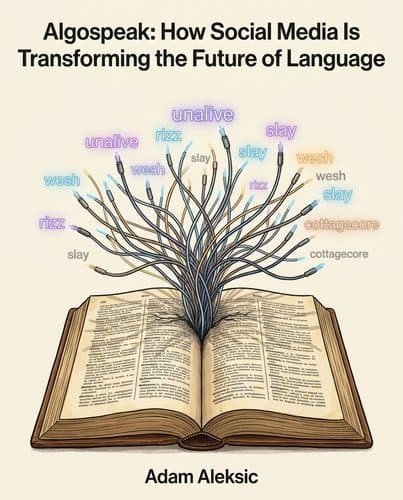
220458608_algospeak
by Adam Aleksic
Algorithms are now the most powerful force shaping human language—not by censoring words directly, but by deciding which ones survive.
In Brief
Algorithms are now the most powerful force shaping human language—not by censoring words directly, but by deciding which ones survive. From AAVE slang stripped of its origins to 'unalive' born from shadowban evasion, Algospeak reveals how Silicon Valley's engagement metrics are quietly rewriting how we think and speak.
Key Ideas
Slang Invention vs. Corporate Profit Gap
When you hear a new slang term, ask who invented it and who profited from its spread — the answer is almost never the same person, and the gap between them usually involves a marginalized community and a corporate brand
Censorship Creates New Survival Vocabulary
'Shadowbanning' and algorithmic suppression don't just remove content — they actively shape which words get invented, because creators pre-emptively euphemize to survive, producing entirely new vocabulary (like 'unalive') as a side effect of censorship
Influencer Accent Engineered for Engagement
The influencer accent — uptalk, vocal fry, emphatic prosody, speed — is not a personality quirk. It is an engineered response to retention metrics. Recognizing it helps you notice when you are being kept watching rather than being informed.
Same Algorithm Creates Safety and Radicalization
Filter bubbles protect minority communities and radicalize isolated ones using identical architecture. The same mechanism that gave autistic TikTokers a safe space gave incels a recruitment pipeline. The difference is not the algorithm — it is who finds the bubble second.
Language Credit Disappears Within Generations
Credit for language has a half-life: if only 50% of people who share a word also share its origin, attribution disappears within a few rounds. The terms your kids use as casual slang — 'slay,' 'tea,' 'yass' — were survival tools in communities that no longer receive credit for inventing them.
Identity Labels Are Advertising Metadata Tags
The '-core' and generational labels you use to describe yourself are not self-expression — they are metadata tags that make you easier to sell to. The more precisely you can be labeled, the more valuable you are to a platform's advertising model.
Who Should Read This
Readers interested in Cultural Studies and Social Issues, looking for practical insights they can apply to their own lives.
Algospeak: How Social Media Is Transforming the Future of Language
By Adam Aleksic
10 min read
Why does it matter? Because the slang in your mouth was engineered there.
You probably think
A Museum Tried to Be Sensitive and Accidentally Exposed a Corporate Conspiracy
A Seattle museum curator, trying to show sensitivity on the thirtieth anniversary of Kurt Cobain's death, wrote that the Nirvana frontman had 'un-alived himself.' Visitors were furious. The placard was replaced within days after the backlash spread. What made it so jarring was the collision of contexts. An online word, built for dodging AI content filters, had wandered into a museum and gotten caught.
Here's the full paper trail. In 2013, the word 'unalive' appeared in an episode of the animated series Ultimate Spider-Man, then drifted around meme sites without gaining real traction. It might have stayed there forever, a footnote in obscure internet history, except that in 2019 the Chinese government began holding social media companies legally accountable for the videos their users posted. ByteDance, which ran a short-video app called Douyin inside China, responded by building a 'sensitive words' tool — an automated keyword library designed to flag and remove content touching on the Hong Kong protests or the detention of Uyghur people in Xinjiang. That filtering architecture was then ported into Douyin's international version: TikTok. The keyword lists were presumably adjusted for Western audiences, though the exact contents remain hidden behind corporate secrecy. What isn't hidden is the effect: creators trying to share mental health experiences found their videos quietly suppressed or deleted. So in early 2021, a handful of them started reaching for that dormant Spider-Man meme. 'Unalive' was obscure enough to slip past the filters, functional enough to mean what they needed it to mean, and by 2022 it had exploded across the platform.
By 2023 it was in middle school hallways, showing up in student essays about Hamlet. The corporate decision that put the word in their mouths has been completely erased — which is exactly how language has always worked, just telescoped from centuries into four years.
The Algorithm Doesn't Just Spread Language — It Selects for It
Aleksic knows this process from the inside. When he posted an etymology video explaining that 'pencil' traces back to the Latin word for 'tail' — the same root that gives English 'penis' — TikTok blocked the post entirely. He respelled it 'pen*s,' got through the filter, and the video still tanked, almost no traffic from the recommendation engine. A Harvard-trained linguist, teaching the documented history of a school supply, had been quietly deprioritized by a content system that couldn't distinguish pedagogy from pornography. He stopped making videos about sexual etymology. That decision was made by a keyword filter, not a person — and it shaped what he taught his audience next.
That's how the selection works. Creators notice which videos the recommendation engine pushes to new viewers versus which ones die in existing followers' feeds. Certain keywords keep videos alive, so creators use those keywords more. The algorithm sees sustained engagement and recommends more content containing them. Users engage, creators respond, the cycle locks in. Aleksic calls this the engagement treadmill. By summer 2023, creators were making videos about 'rizz' because 'rizz' was trending — and it was trending because creators kept making videos about it. The Oxford English Dictionary named it Word of the Year. A feedback loop had quietly walked a piece of niche slang onto the dictionary's most prestigious page.
The museum curator from the previous section stumbled into the same mechanism. 'Unalive' didn't spread because it was the clearest or most compassionate word for what it describes. It spread because it survived the filter and 'suicide' didn't, because the engagement it generated fed the treadmill, because TikTok's architecture kept rewarding its use until it outcompeted every alternative. What feels like organic cultural drift has a paper trail. Corporate keyword lists, shadow suppression, retention metrics — these are the machinery doing the selecting. The words that win aren't the fittest for communication. They're the fittest for the algorithm.
Influencer Accents Aren't Affectations — They're Engineering
Why does every lifestyle creator on your feed seem to speak the same way — that bouncy, uptalk-heavy rhythm where every sentence sounds like it might become a question? The easy answer is imitation. The true answer is engineering.
MrBeast's team accidentally proved this in 2024 when a leaked onboarding memo circulated online. Thirty-six pages of internal guidance treated every element of a video — including how to speak — as an optimization variable. Aleksic tracked the numbers: in his earliest videos, MrBeast spoke at around 170 words per minute, close to the average English speaker. Today he hovers near 200 wpm, and the variance in his pacing has collapsed from a standard deviation of 42 wpm down to 14. He didn't gradually become a more energetic person. He ran an experiment on his own voice, found the cadence that kept viewers watching, and locked it in. The leaked memo confirms what the data implies: retention is the goal, and speech is a lever.
The lifestyle influencer accent follows the same logic through different mechanics. Its signature move — ending sentences with a rising intonation that sounds like an unfinished question — isn't a verbal tic. It's a perpetual dopamine cliff-hanger. Every sentence sounds like something is coming next, so you keep watching to hear what it is. Vowels get stretched, certain words get over-stressed, pauses get filled with lengthened sounds — all because silence costs you the audience, and half a second of dead air is enough. Aleksic points out that children's television uses the exact same vowel-lengthening to hold the attention of toddlers. The influencer accent is Sesame Street, reverse-engineered for adults by trial and error and retention analytics.
What looks like a regional quirk or an annoying personality trait is actually a technology — one shaped less by who these creators are than by what the algorithm rewards when they speak.
Every Word Invented to Survive Gets Stolen to Sell Something
In 2014, a teenager named Kayla Newman posted a Vine video bragging about her eyebrows being 'on fleek.' Within a week, celebrities had picked it up. Then IHOP and Taco Bell were tweeting about fleek food. Forever 21 was printing it on T-shirts. Ariana Grande and Kim Kardashian were saying it to their millions of followers. Kayla Newman got nothing — no royalties, no licensing fees, no credit in most of the posts using her word.
Aleksic frames this not as an injustice unique to Kayla, but as the predictable output of a mathematical process. If only half the people sharing a piece of content credit its source, the second round of sharing credits it a quarter of the time, and so on. Within a few cycles, attribution has effectively vanished. Credit has a half-life, and on social media the half-life is very short. Kayla tried to trademark 'on fleek,' but by the time the phrase died out a few years later, the corporations had already cashed in and moved on.
This pattern runs much deeper than one Vine. The words 'slay,' 'serve,' 'mother,' 'tea,' 'yass,' and 'throwing shade' all came out of the Black and Latino queer ballroom houses of 1980s New York City — underground communities that built their own vocabulary as a survival mechanism during the AIDS crisis, when they were being failed by both the healthcare system and their own families. Those houses took in gay and transgender youth who had been cast out and gave them shelter. Calling a fierce performer someone who 'slays' meant something specific in that context, woven into a world of genuine stakes.
Today those words are classified as 'internet slang.' When Aleksic surveyed more than two thousand teachers and parents in 2024, over half reported hearing children use ballroom vocabulary regularly. Eighty-five percent believed their kids had no idea the words came from African American English at all. The journey from survival language to middle-school filler took roughly four decades, with TikTok compressing most of it into the last five years. A phrase that once signaled belonging to a community keeping each other alive now signals that you're caught up on what's trending.
The language got appropriated precisely because it was so good. It was forged under pressure, by people with a genuine need to express something the existing language couldn't hold. That made it vivid, flexible, and irresistible to outsiders looking for a way to seem cool. You can take 'slay' out of the ballroom and put it in a Duolingo marketing video. You cannot take the ballroom with it. The word arrives in its new home already stripped of the weight that gave it meaning, and the people who invented it watch from a distance as a company builds its brand on their ingenuity and sends them nothing.
Filter Bubbles Protect You and Destroy You at the Same Time
Think of a filter bubble as a greenhouse. The controlled climate lets fragile, specialized things grow that couldn't survive in the open. But greenhouses have glass walls, and glass breaks.
The autistic TikTok community built exactly that kind of shelter. Over several years, creators there developed their own vocabulary — including the word 'acoustic' as a soft, private pun on 'autistic,' a way to make light of a difficult reality among people who actually lived it. The algorithm did its job: it clustered those creators together, kept pushing their content to people who engaged with it, and grew a genuine community with its own inside language. The greenhouse worked.
Then, in early 2023, 'acoustic' escaped. The same recommendation engine that had carefully tended the community's filter bubble eventually decided the word had viral potential beyond it. Once the meme spread to the general TikTok population, the context that made it work — the shared understanding, the self-directed humor, the trust — evaporated entirely. Strangers started dropping 'acoustic' into comments on any video that featured someone being passionate or nerdy, as shorthand for a slur. Aleksic got the comments constantly on his linguistics videos. People who had no idea where the word came from, no stake in the community that invented it, used it to reduce autistic people to a punchline. The greenhouse didn't just stop protecting them. It became the mechanism of delivery for the thing they needed protection from.
This is what Aleksic calls context collapse: when words built for one audience reach a completely different one, stripped of the assumptions that made them safe. And here's the part that should unsettle you — nothing went wrong with the algorithm. It performed exactly as designed. The autistic community's survival language was strip-mined for mainstream cool the same way ballroom vocabulary and 'on fleek' were, just faster, and with a sharper edge. The architecture that sheltered the community and the architecture that exposed it were the same architecture, doing the same thing at different moments in the same cycle.
Your Identity Is Now a Hashtag the Algorithm Invented for You
Your identity online feels like self-expression. Aleksic's argument is that it's actually a business asset — one the platform built, named, and is now selling back to you.
The '-core' explosion is the cleanest evidence. The suffix had existed since the 1970s in punk music, where 'hardcore' meant brutal and uncompromising. A few music subgenres borrowed it — emocore, speedcore — and it sat there quietly for decades. Then TikTok arrived, and by 2020 the Aesthetics Wiki listed over 150 '-core' categories: cottagecore, goblincore, clowncore, traumacore, and well past the point of parody. That's not a grassroots fashion movement. Each label is a metadata tag. When you engage with a cottagecore video, the algorithm logs 'cottagecore' as a useful signal about you, clusters you with others who match that tag, and starts routing both content and advertising your way. The identity feels personal. From the platform's perspective, it's a targeting parameter.
The mechanism becomes even clearer when you follow the money into a physical store. Sophie, who owns a boutique in Manhattan, originally described her cheerfully maximalist products as exactly that — maximalist. Then younger customers started leaving comments calling her items 'preppy.' Preppy historically meant the stiff, conservative look of elite preparatory schools. To Gen Alpha it means bright, pink, and vivid. Sophie ran the test: she tagged her videos with #preppy instead of #maximalist and watched her reach explode. She rebranded her entire TikTok presence around the word, and now when you search 'preppy stores in New York City,' cutandcropped is usually first. A retailer's A/B test on hashtags quietly rewrote what a decades-old word means for a generation of teenagers.
TikTok's business platform, in a 2021 document, was unusually candid about the logic: 'Your brand becomes part of their identity.' That's the whole game, stated plainly by the people running it. Platforms don't just observe the identities users bring to them — they generate new ones, validate them through algorithmic amplification, and then hand them to advertisers as fresh demographic categories. The phrase Aleksic keeps returning to captures the paradox exactly: the more specific your label, the more precisely you can be targeted. A goblincore Gen Z Swiftie isn't more of an individual than someone who just likes dark aesthetics. They're just easier to sell to.
The Same System That Homogenizes Language Is Also Decolonizing It
Consider what's happening to the sign for 'dog' in American Sign Language. The traditional version involves tapping one hand against your waist — perfectly legible in person, completely useless on a phone camera, where your waist is off-screen. So younger Deaf creators migrated to a double-snap of the letters 'DG,' which also mimics calling a dog's attention. You can watch, in real time, a hardware constraint rewriting a language's grammar. The phone's aspect ratio is doing what centuries of contact with English couldn't: forcing ASL to adapt at the level of syntax.
The same system is also bypassing the Académie Française. Young people in former French colonies — communities the Académie was never really built for — are pulling Arabic loanwords like 'cheh' (roughly, 'serves you right') and 'wesh' ('what's up') into their posts and rap lyrics. The Marseille rapper Jul built a fanbase across France partly on this vocabulary; by the mid-2010s, 'wesh' had migrated from banlieue slang into mainstream French conversation. Not because any official body sanctioned it. Because TikTok's recommendation engine has no loyalty to the language planning committees of Paris. A colonial institution built to centralize French is being outflanked by the algorithm's simple logic: if people engage with it, it spreads.
The same machine running the engagement treadmill — the one that made 'rizz' a dictionary word and let corporations mine ballroom slang for ad campaigns — is also making it easier for marginalized languages to evolve on their own terms, faster than any official reform could manage. The technology doesn't choose sides. It amplifies whatever humans bring to it. What humans keep bringing, with a kind of relentless absurdity, is the same thing they always have: new ways to say what the existing language wasn't built to hold.
The Question Worth Carrying Forward
Here is the thing that keeps staying with me: a Deaf teenager films herself signing 'dog,' realizes her waist is off-screen, and invents a new gesture on the spot. No committee approved it. No algorithm designed it. A physical constraint met a human need, and language moved. That's the same story the whole book tells — just finally visible, because you can watch it happen in a six-second clip.
Every generation has mourned the language arriving behind them. Someone in Chaucer's England was appalled by what the young people were doing to perfectly good words. Those words are unreadable to us now, and somehow English only got richer. The question was never whether algorithms would change language. They already have, and irreversibly. The real question is whether you understand the system well enough to notice when it's steering you — and whether the communities doing the actual inventing will ever get to keep what they build.
Notable Quotes
“encouraging tighter gestures and giving the new versions a way to spread quickly.”
“rarely pushes videos by Deaf people without English captions or voice-over.”
“hearing people will try and pinpoint”
Frequently Asked Questions
- What does Algospeak examine about how social media changes language?
- Algospeak examines how recommendation algorithms have become the dominant driver of language change—shaping slang, accents, and vocabulary more powerfully than any previous cultural force. The book reveals how censorship mechanics, filter bubbles, and advertising incentives quietly dictate which words we invent, borrow, and spread. Through analysis of linguistic trends and internet culture, Adam Aleksic demonstrates that corporate interests and algorithmic incentives shape everyday speech in ways most people never recognize, offering readers insight into the hidden forces behind viral language adoption.
- How does algorithmic censorship create new words?
- According to the book, 'Shadowbanning' and algorithmic suppression don't just remove content—they actively shape which words get invented, because creators pre-emptively euphemize to survive, producing entirely new vocabulary (like 'unalive') as a side effect of censorship. This reveals that the language we encounter online is not organically developed but engineered in response to platform restrictions. When creators face content removal risks, they invent new words as workarounds to express the same ideas. Understanding these dynamics exposes how corporate platform control drives linguistic innovation and shapes everyday speech in ways most people never recognize.
- What does Algospeak reveal about influencer accents?
- The influencer accent—characterized by uptalk, vocal fry, emphatic prosody, and speed—is not a natural personality quirk but an engineered response to retention metrics. Aleksic argues that influencers subconsciously adopt these vocal patterns because they increase viewer engagement and watch time on algorithmic platforms. By recognizing the influencer accent, readers can distinguish between being kept watching (through emotional manipulation) versus being informed. This awareness reveals how even seemingly personal speech patterns are shaped by platform algorithms designed to maximize screen time and advertising exposure.
- What does Algospeak say about language credit and marginalized communities?
- Algospeak reveals that language credit has a 'half-life'—when only 50% of people sharing a word also know its origin, attribution disappears within several rounds. Terms like 'slay,' 'tea,' and 'yass,' now used casually as mainstream slang, were originally survival tools in marginalized communities that no longer receive credit for inventing them. This pattern repeats across internet culture: words emerge from communities (often LGBTQ+, Black, or other minoritized groups), spread virally, and get absorbed into mainstream speech without attribution. The result is cultural erasure where marginalized creators are forgotten while others profit from their linguistic innovations.
Related Book Summaries

Read the full summary of 220458608_algospeak on InShort