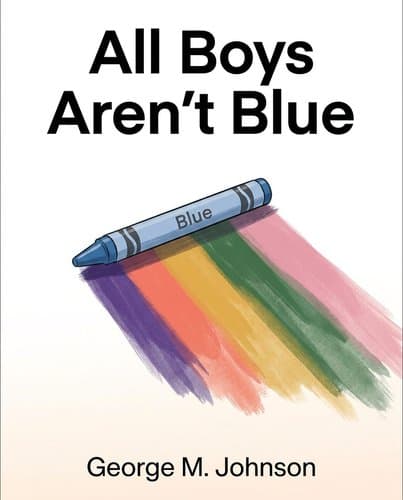
44280883_all-boys-aren-t-blue
by George M. Johnson
Growing up Black and queer means absorbing a thousand gentle erasures from people who love you—each small compromise rational, the cumulative cost a life spent…
In Brief
Growing up Black and queer means absorbing a thousand gentle erasures from people who love you—each small compromise rational, the cumulative cost a life spent in performance. Johnson maps how those quiet "stop saying that" moments compound into an adult who must painstakingly relearn how to exist without a mask.
Key Ideas
Respectability bargains collapse identically
Suppressing Blackness and queerness operate through the same mechanism — the respectability bargain — and both collapse for the same reason: the institutions demanding them were never actually going to grant safety in return. Confronting one requires confronting the other.
Gentle erasures leave invisible scars
The most durable damage doesn't come from hostile strangers. It comes from gentle, loving erasures administered by people protecting you — the quiet 'stop saying that' on a couch — because those leave no obvious wound to trace back.
Small compromises become lifelong performance
Each individual compromise a queer Black child makes is rational. The cumulative cost is a life spent in performance: specific joys abandoned, specific words silenced, a smile withheld for thirty years. Naming the pattern is different from naming any single moment of cruelty.
One person outweighs institutions
One person who decides to apply the same rules to your queer life as to everyone else's — same welcome, same expectations, same grandmother's kitchen — can be a more sustaining force than any institutional change.
Coming out is never finished
Coming out is not a single event. You re-enter the closet with every new job, every new city, every new person. Building a life of openness is a continuous practice, not a resolved milestone.
Feared communities hold unexpected belonging
The communities you've been taught to fear most — the ones whose rejection seems most catastrophic — are often where you encounter the most complete acceptance. The institutions that demanded the performance were also, unexpectedly, where you found your people.
Who Should Read This
Readers who connect with first-person stories about Memoir and Social Issues and want to see the world through someone else's eyes.
All Boys Aren’t Blue
By George M. Johnson
11 min read
Why does it matter? Because the mask was built for you before you knew you were wearing it.
His grandmother called him "Honeychild": soft, deliberate, a name that held both love and instruction inside it. George M. Johnson spent thirty years tracing what those instructions actually cost him. The damage in this memoir didn't come from obvious villains — the kid who throws slurs on the playground, the teacher who won't learn a preferred name, the stranger on the corner with something to prove. It came from a grandmother who loved him without condition, a mother who held him after his teeth got kicked out, a community doing its best to shield a Black queer boy from a world that would punish him for exactly what he was. The harm arrived gently: one erased word, one corrected walk, one quiet "let it go." The person who received all that careful protection grew up owing a debt he didn't know existed until the bill arrived.
You Cannot Earn Safety from Institutions That Were Never Going to Grant It
The bargain Johnson made wasn't with bullies or classmates. He was negotiating with institutions that had already written the verdict before he walked in the door.
Follow the arc of the n-word through his life and you can see exactly how the con works. As a kid in a Black neighborhood, the word moved through his friendships like punctuation — a greeting, a joke, weighted differently depending on who said it and how, but never with the hard "-er" that made it something else. Then came Catholic high school in Edison, New Jersey, overwhelmingly white and Filipino. The word became a liability, fast. He stopped using it and started watching: any white student who tried that syllable got checked immediately. It was a kind of service he provided to the room, and nobody thanked him for it, because being the kid who policed racial language is its own kind of visibility — and not the kind that makes you feel safe.
By college — back at a predominantly Black school — the word came back. But around the same time, the NAACP and the National Action Network launched a campaign to "bury" it, arguing that abandonment would drain it of power. Johnson joined. He was in his respectability phase: good grades, a degree in hand, learning to perform the version of Blackness that white society might finally accept as equal. Dropping the word felt like discipline, like doing the right thing, trading something small for something larger. He didn't see yet that he was running the same logic on his queerness: fold it away, clean up the edges, present a self the institution could accept. Two suppressions, identical machinery.
The bet collapsed in early 2012. Trayvon Martin was shot by a man who'd decided before any exchange of words what kind of threat a Black teenager in a hoodie represented. Then Tamir Rice, twelve years old and playing in a park, was killed by police in seconds. Johnson writes about sitting with this, the way the logic he'd built started going cold in his chest. Didn't matter if you were articulate or cautious, whether you buried the word or not. The kid with the Skittles was careful. The kid in the park was just playing. The verdict was already in. There was no such thing as a respectable Negro in the eyes of a system that had always needed Black people to register as a threat.
Respectability isn't a personal failure of nerve. It's a rational bet on a game that was rigged before you sat down. Johnson made that bet on language, on presentation, on suppressing whatever might complicate the pitch. What broke through when Trayvon and Tamir died was the recognition that the terms were never going to land in his favor. They were never going to land in anyone's favor. That was the point.
The Mask Wasn't Built by Enemies — It Was Built by People Who Were Afraid for You
Eight years old, mid-gossip with a group of girls, and something rolls off his tongue that had never existed before: Honeychild. Wrist bent, full of sass — inspired by his uncle's girlfriend Crystal, who went by "Honey," whose done nails and blond-streaked hair and white Cadillac made young George privately wish he could carry the name himself. The girls looked stunned for half a second, then followed his lead. He had invented a word.
Within weeks it spread across the entire class, then escaped into someone's living room, where a parent decided a boy had no business creating something so feminine. The parent called the teacher. The teacher called his mother. His mother sat him down on the couch that evening and delivered the verdict quietly: Mrs. P. says it's become a class distraction. You have to stop. He said "Okay, Mommy" and went back to his room. He never said the word again.
Notice what didn't happen: no punishment, no contempt, no raised voice. His mother wasn't shaming him; she was maneuvering, as carefully as she knew how, a world that made Black queer boys pay for visibility. The harm came through love, not cruelty. Love as the delivery mechanism for erasure — that's what made it hold. He marks that night as the first time he put on the mask: the closed-lip smile, the performance of a self that needed no protecting.
Here's what makes it sting. Gay lingo now saturates mainstream culture. Shade. Yaaassss. The vocabulary Johnson calls "Black femme" (terms invented by trans women, queer men, and nonbinary people building private languages out of exclusion) currently appears on every reality show, in every group chat, casually deployed by people who face none of the consequences its creators still do. The word that summoned him to the couch is now unremarkable. The problem was never the word. It was who was saying it.
At five, a white kid knocked his baby teeth out at the corner of Lansdowne and Marshall. Strangers are where the obvious violence lives. What the Honeychild conversation shows you is that suppression doesn't need an enemy. It needs someone who loves you and is frightened of what the world does when it finds out who you are. The mask wasn't forced onto his face by a hostile stranger. It was handed over gently, on a couch, by someone trying to keep him safe. That's why it fit so well.
Every Rational Compromise Adds Up to a Childhood You Didn't Choose
How many reasonable decisions does it take to trade away a childhood? Each one arrives with its own logic, its own arithmetic — and each one, in the moment, makes perfect sense.
In fifth grade, Johnson is the only boy who plays Double Dutch at recess. Every day he climbs the hill overlooking the football field, jumps in between the two ropes, and finds the one space where the part of himself that feels most alive can breathe. He imitates the girls holding down their chests as they jump, privately connecting to a femininity he hasn't yet named. He takes welts from the ropes and considers them proof of effort. It's his daily freedom.
Then Todd walks up the hill. A white kid who fits in at a predominantly Black school (which is its own kind of currency), he delivers the news: the boys have been calling Johnson a fag, and it's gotten bad enough that Todd risked association by saying so. Johnson's physical reaction is immediate, a nerve firing through his body. Not anger. Fear, and a familiar calculation: walking away from this fight reads as admitting it. Todd offers a middle path. Play one day of football. Make it stop.
Johnson goes down the hill. He runs a slant route, catches the ball, and drags three defenders into the end zone without going down. His teammates crowd around to celebrate. Someone calls him tough. He looks back on it as one of the best days he had in elementary school — and he means it, which is what makes it cut. The joy was real.
What also stayed was the sadness. Sports became his social armor from that day forward: football and basketball for belonging, then track and field in high school because running was something he actually loved without having to prove anything to anyone. The shield worked. What it shielded him from included the question of who he was when no one was watching.
The math was always the same: one defensible decision, one rational exit, until the exits add up to a life. The cowboy boots cut the other way. In California, while every cousin reaches for the hottest sneakers of the moment, Johnson holds out for black boots with silver tips and a small heel — the heel that reminded him of his mother in her heels. He walked through Disneyland in those boots, the only one not matching, and was happy. Somewhere above him, the Double Dutch ropes were still. He would get good, over the years, at not looking back up the hill.
One Person Deciding to Be Your Entire Circle Can Change the Trajectory of Everything
At BJ's Wholesale, Nanny hands young George a hundred-dollar bill and tells him to pick out his stock. He chooses Pop Rocks — bulk, by the case. Back home, she sits him down with a notepad: count every piece, figure out the price per unit, calculate the profit margin. Loan terms: twenty dollars a week until the debt is cleared.
The operation ran for months. He worked the playground before the bell and after dismissal, moving candy to every kid within reach, until parents started calling the school to report that their children were coming up short on lunch money every week. Pop Rocks empire, shut down.
For years, Johnson understood this as Nanny teaching him to hustle. She ran multiple income streams simultaneously (home nursery, catering jobs, registered nursing, flea market tables) and pointed him toward that same resourcefulness. The soup kitchen fit the same frame: when Catholic high school required 250 community service hours per year and no organization existed to accommodate him, Nanny started one from scratch at their church. Every Saturday morning they cooked meals for homebound congregation members and drove routes through Plainfield delivering them, for four straight years, until she was confident he had enough hours to graduate. He read it as mentorship. He filed it away as love.
He didn't see the structure until late in high school. Around age ten, his cousins had begun forming the tight crews they'd carry into adulthood (same sneakers, same sports leagues, same school hallways all the way through), and his younger brother had become the undisputed leader of his own circle. George had his books. He'd been trying to pass as someone who fit, and it wasn't working. He was isolated, and she'd been watching the whole time. What all the candy runs and flea market Saturdays and soup kitchen routes had in common was a single intention: she'd decided to become his circle herself, because she could see he didn't have one.
You see the full shape of it in the phone call when Johnson was twenty-five, crying through words he'd been holding for years. She didn't flinch. Told him he didn't need to cry, that nothing he'd said was an embarrassment, that she had always known, that she loved him regardless. And then: when you start dating someone, he has to come meet me first, just like all the other grandkids bring their person to the family before anyone else.
Not an exception. Not a gracious accommodation for his particular situation. The same rules, the same kitchen, the same welcome. She had been constructing that welcome for fifteen years — and when he finally stepped into it, he discovered he'd always been inside it.
The Places That Demanded the Performance Were Also Where You Found Your People
There's a particular irony in institutions that require you to perform your way in: they select for people who know how to perform, which means the room you finally enter is full of others doing exactly what you've been doing all along.
Johnson entered Alpha Phi Alpha, one of the original historically Black fraternities, chasing masculinity like a credential, something he could display and make the questioning stop. The fraternity's intake process delivered what he expected: an older brother called on speakerphone during a practice session, announced he'd heard Johnson was gay, used a slur, and hung up. Johnson cried — not from hurt but from the familiar rage of having to answer that question again. His line brother Gerald crossed the room and held him first. Then the rest followed. What none of them said aloud, but several understood: the line held four straight brothers and four queer ones, all moving through the same process, in the same rooms, under the same institution.
The machine was doing what it always did. The people inside it were doing something else.
Then a line brother named Kenny asked directly on the way to the mall: So, George, are you gay?
Johnson said yes. For the first time in his life, to a heterosexual person, the word came out.
Kenny was nineteen, from Philadelphia, formed in exactly the neighborhoods that taught young men to treat that question as a weapon. His response: Nigga, I don't care about that. You my brother and I'm a always have your back. No conditions.
Johnson calls it a miracle. And it was — because what happened in that car can't be manufactured by policy or mandate. It came from one person who had decided, privately, what loyalty meant. That person existed inside the fraternity, the same institution that had told Johnson, through an older brother on speakerphone, that a gay man wasn't welcome.
Johnson spent years believing survival meant performing loudly enough to forestall the question. What he discovered was quieter: a car on the way to the mall, Kenny asking directly, and the word finally finding its way out. He called it the first time he'd ever been himself with the very people society kept telling him would never accept him.
The Water Was Never Going to Be Safe — Swim Anyway
There's a scene early in the memoir where his cousins throw him into ten feet of water and call it a swimming lesson. He flailed. They jumped in. That's the whole book, really — not the drowning, but who decides you're worth the water.
Every morning he wakes up and enters the deep end again: the racism, the homophobia, the quiet institutional machinery that sets the terms it has no intention of keeping. No school curriculum gave him back thirty years of closed-lip smiling. No political movement returned his Double Dutch. What moved him toward something like wholeness was Nanny writing a loan agreement on a notepad, a line brother in a moving car deciding loyalty meant no conditions. Specific people. Specific moments. Not policy — presence.
The systems are still the systems. The question the book leaves you holding isn't whether they'll change. It's whether you'll be the one who jumps.
Notable Quotes
“I've accepted that this cancer is going to take me one day. I'm not saying I'm leaving tomorrow, but I just want all my business handled.”
“I said yes, and you responded,”
“I remember G on the top bunk saying,”
Frequently Asked Questions
- What is All Boys Aren't Blue about?
- All Boys Aren't Blue is a memoir by George M. Johnson that traces how Black queer identity is gradually suppressed through small, loving erasures by family, institutions, and community rather than overt hostility. Johnson explores how each individual compromise accumulates into a life of performance. The memoir examines what it takes to dismantle that mask and build an existence of sustained openness. The work reveals that suppressing Blackness and queerness operate through the same mechanism—the respectability bargain—and both collapse because the institutions demanding them were never going to grant safety in return.
- What does All Boys Aren't Blue reveal about how Blackness and queerness are suppressed?
- All Boys Aren't Blue reveals that suppressing Blackness and queerness operate through identical mechanisms: the respectability bargain. Both collapse for the same reason—the institutions demanding them were never going to grant safety in return. The most durable damage comes not from hostile strangers but from gentle, loving erasures administered by people protecting you, like a quiet "stop saying that" on a couch, because those leave no obvious wound to trace back. Johnson emphasizes that each individual compromise a queer Black child makes is rational, but the cumulative cost is a life spent in performance: specific joys abandoned, specific words silenced, a smile withheld for thirty years.
- What are the main lessons from All Boys Aren't Blue?
- All Boys Aren't Blue teaches that confronting the suppression of Blackness and queerness requires addressing both simultaneously, as they collapse through the same false promises of respectability. The memoir demonstrates that one person who decides to apply the same rules to your queer life as to everyone else's—same welcome, same expectations, same grandmother's kitchen—can be more sustaining than institutional change. Additionally, communities you've been taught to fear often provide complete acceptance, while institutions demanding performance unexpectedly became where Johnson found his people. The work emphasizes that building a life of openness is continuous practice, not a resolved milestone, as you re-enter the closet with every new job, city, or person.
- How does All Boys Aren't Blue address coming out?
- All Boys Aren't Blue presents coming out not as a single event but as continuous practice requiring repeated negotiation throughout your life. Johnson explains that you re-enter the closet with every new job, city, and person, making building a life of openness an ongoing challenge rather than a resolved milestone. The memoir explores how these repeated erasures compound original damage from childhood. However, the book highlights that authentic acceptance can emerge from unexpected communities. When one person decides to apply the same rules to your queer life as everyone else's—offering the same welcome and expectations—it can sustain you through this continuous practice of living openly.
Related Book Summaries
Read the full summary of 44280883_all-boys-aren-t-blue on InShort