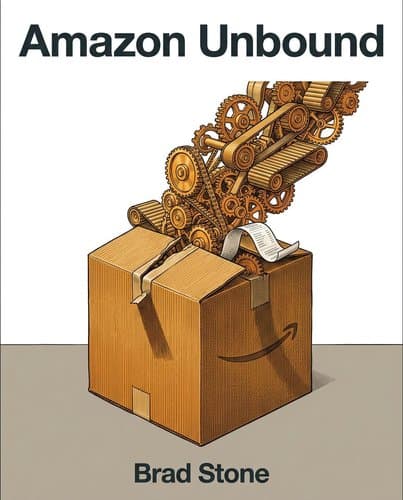
56695159_amazon-unbound
by Brad Stone
Amazon's legendary flywheel—low prices, relentless growth, customer obsession—works exactly as designed, except the costs land on warehouse workers…
In Brief
Amazon's legendary flywheel—low prices, relentless growth, customer obsession—works exactly as designed, except the costs land on warehouse workers, third-party sellers, and entire communities instead of Amazon's balance sheet. Brad Stone reveals why a machine built to externalize harm cannot fix itself from within.
Key Ideas
Revenue thresholds override customer obsession principle
'Customer obsession' has a dollar threshold. Amazon knowingly accepted a measurable drop in customer purchase completion to expand sponsored ads once they generated billions per year. This is not hypocrisy — it is revealed preference. The principle holds until a sufficiently large revenue stream overrides it.
Low prices externalize costs onto workers
Amazon's low prices do not eliminate costs — they shift them. DSP arm's-length employment, warehouse injury rates, and seller account suspensions are real economic costs that simply do not appear on Amazon's income statement because they land on workers, contractors, and small businesses instead.
Infrastructure dominance destroys dependent seller interests
A marketplace that becomes essential infrastructure for its sellers will eventually develop interests that directly conflict with those sellers. The merchants Bezos named in shareholder letters in 2014–2016 were mostly off the platform or financially destroyed by 2020 — by the same marketplace logic that originally enabled them.
Anti-union design structural to logistics model
Amazon's anti-union architecture — DSPs, noncompete lawsuits, employee surveillance heat maps scoring union risk, firing Covid whistleblowers — is not a reaction to specific organizing drives. It is a structural design choice built into the logistics model from the start, treated internally as a core business requirement.
Market dominance forestalls meaningful antitrust regulation
By the time a company is large enough to regulate meaningfully, it has already shaped the political and economic landscape of the places it operates in. Antitrust frameworks built around consumer prices cannot capture the harms of platform dominance — which is itself an argument Stone shows Amazon understood and used.
Who Should Read This
Business operators, founders, and managers interested in Business Leaders and Business Strategy who want frameworks they can apply this week.
Amazon Unbound
By Brad Stone
11 min read
Why does it matter? Because the same system that made Amazon extraordinary is precisely why it cannot stop causing harm.
You probably ordered something from Amazon this week. It arrived faster than seemed possible, cost less than anywhere else, and required almost no effort on your part. That experience — frictionless, cheap, reliable — is one of the genuine achievements of modern commerce. And it was made possible by a machine that systematically transfers its costs onto everyone who isn't the customer.
Brad Stone, whose reporting produced this book, spent years inside Amazon's orbit, reading the leaked memos, tracking down fired whistleblowers, interviewing the small sellers who were celebrated in Jeff Bezos's shareholder letters and then quietly destroyed. What he found is not a story of a good company that lost its way. It is something more unsettling: a company whose finest achievements and deepest harms are produced by the same logic, the same people, the same machine. The question isn't whether Amazon can be fixed. It's whether fixing it would leave anything recognizable behind.
Amazon Wins by Committing to Things That Look Insane Until They Work
In a rented Boston apartment, a temp worker looked around at the walls, covered in acoustic fabric hiding devices he couldn't see, and whispered into the room: "This is so dumb. The company behind this should be embarrassed."
The apartment had been furnished with decoy electronics: Xbox consoles, tablets, pedestal microphones, televisions. Scattered at different heights around the rooms were roughly twenty concealed Amazon devices, each hidden behind fabric that blocked them from view while letting sound pass through. Workers spent eight hours a day, six days a week, reading scripted requests from an iPad — "ask to play your favorite tune," "ask anything you'd like an assistant to do" — into what appeared to be an empty room.
The devices were Alexa prototypes. Their speakers were off; they never answered. But their seven microphones captured everything and streamed audio to Amazon's servers, where another group of workers annotated the recordings, teaching the software that "turn on Hunger Games" meant the Jennifer Lawrence film.
AMPED was born in spring 2013 after Jeff Bezos walked out of a meeting in frustration. The Alexa team had proposed delaying the product's launch and doubling the speech science staff. Bezos did the math on how long it would take to close the data gap with Apple and Google, concluded the team wasn't serious, and left the room.
So Amazon contracted with an Australian data-collection firm, which rented apartments in twelve cities and ran the same operation in each.
When device team lead Greg Hart showed Bezos the six-page AMPED plan and its multimillion-dollar price tag, Bezos broke into a grin. "Now I know you are serious about it! What are we going to do next?" By 2014, Amazon had multiplied its store of speech data by a factor of ten thousand, closing a gap with Apple and Google that had seemed insurmountable.
The Echo launched in November 2014. Reviewers called it "the future." What they didn't know, and what the temp worker whispering into an apparently empty Boston apartment didn't know, was that the future had been assembled through years of expensive, unglamorous, slightly absurd commitment that would have looked indefensible at almost every step along the way.
That's the pattern. Amazon's most consequential products don't emerge from clean roadmaps. They emerge from a willingness to rent apartments across twelve cities, plant hidden microphones in walls, and keep going when the CEO walks out of the room. The ingenuity is real. So is the indifference to costs, in money, in years, in labor, that would stop any reasonable organization from proceeding.
Low Prices for Customers Are High Costs for Everyone Amazon Doesn't Count
Amazon's low prices aren't funded by efficiency — they're funded by costs that don't appear on Amazon's books. The savings are real. The people paying for them just aren't Amazon's shareholders.
When Dave Clark built Amazon's last-mile delivery network in the mid-2010s, the design choice that mattered most wasn't operational. It was legal. Clark and his colleagues explicitly noted that every major ground carrier except UPS ran with nonunion drivers. FedEx Ground, DHL, every competitor. Amazon would match that structure. Rather than hire drivers directly, Amazon would contract with independent delivery service partners: small businesses that employed the drivers, leased the vans, and absorbed the liability for what happened on the road. The design had a name in labor economics: the fissured workplace, the deliberate gap between the company generating demand and the workers fulfilling it. That gap blocked collective bargaining, excluded drivers from Amazon's benefits, and shielded Amazon from legal exposure when something went wrong.
The stakes of that structure became visible in December 2016, when an 84-year-old Chicago grandmother named Telesfora Escamilla was struck and killed by a driver for a company called Inpax, one of Amazon's delivery partners. Inpax had previously fired that same driver for what court filings described as a preventable hit-and-run. He had no commercial driver's license. He'd been at Inpax for two months. The Department of Labor later found the company had underpaid dozens of workers and violated overtime law. Amazon settled the Escamilla family's civil suit for $14 million.
The arm's-length structure made that settlement possible. Direct hires would have made Amazon the employer of record. DSPs made Amazon a customer.
Clark had told an earlier version of this story as a triumph. During a 2002 snowstorm, he drove a rented van through icy roads from a Kentucky warehouse to a Louisville UPS facility, hand-delivering packages a trucking company had abandoned. He got Teamsters pounding on the van windows. He recounted this to employees as a lesson in customer obsession: whatever it takes. Fifteen years later, that same principle — whatever it takes — became the organizing logic of a delivery system that contracted with over a thousand small companies and gave Amazon plausible distance from every accident, wage violation, and death that followed.
By 2019, Amazon had surpassed UPS and the U.S. Postal Service to become its own largest carrier. Free one-day shipping was now a Prime perk. Those are the numbers Amazon chose to report. The miles logged by DSP drivers under algorithmic pressure, and the liability those miles carried, appeared elsewhere: in ProPublica investigations, in court filings, in $14 million paid to one family in Chicago.
The Rhetoric of 'Customer Obsession' Has a Threshold — Past It, the Customer Loses
The harm Amazon pushed onto its delivery partners was one kind of accounting. Inside retail, the numbers had been doing something quieter.
Dave Stephenson, Amazon's retail finance chief, sat behind a stack of binders in a sixth-floor conference room and did math on his smartphone while roughly two dozen executives watched in silence. Jeff Bezos had just asked what retail unit profitability looked like in 2017 if you stripped out advertising revenue. No one had calculated that before. Five minutes passed. Stephenson produced a number. The room exhaled. Then Bezos asked for 2016. Then 2014. He was not curious — he was tunneling, looking for when the decay had started.
The answer, when the numbers were laid out, was damaging. Advertising had been covering a multi-year deterioration in Amazon's retail economics. Strip it out and the business Amazon called its core was quietly stagnating. Bezos threw out months of planning and demanded the document be rewritten from scratch: hiring slashed, a commitment to restore underlying profitability with no advertising revenue to soften the picture.
That meeting is easy to read as Bezos defending the customer: forcing accountability, refusing to let one profitable division mask another's failings. But the same period contains a decision that tells the other story. When Amazon's engineers tested whether sponsored ads should appear above organic search results, they found something precise and uncomfortable: a statistically detectable drop in the number of customers who completed purchases. The damage was small. It was also real and consistent. Bezos expanded the ads anyway. By 2017, advertising generated $4.65 billion annually. One Amazon computer scientist later said it plainly: Jeff was the one who signed off on it.
"Customer obsession" had driven Prime, free returns, and relentlessly lower prices. Those things were real. But when the revenue from letting advertisers crowd the search results was large enough, the principle renegotiated its own terms. The customer would absorb the cost, and the principle would not notice.
The same logic reached the sellers Amazon had publicly celebrated. Wendell Morris, founder of a yoga accessories business called YogaRat, was named by Bezos in a 2014 shareholder letter as proof that small companies could build something real on Amazon's platform. Six years later, Morris had gone from seven employees to one and from four million dollars in annual revenue to under one and a half million, knocked out not by a single policy but by the accumulation of sponsored listings from Chinese competitors, algorithmic account suspensions, and the rising cost of advertising he had to pay just to remain visible. He had not built YogaRat expecting to be ground up as the platform scaled past him. The flywheel that served customers was the same one that crushed him.
Bezos Defended Journalists and Silenced Workers — This Is One Consistent Policy, Not Two
Does Jeff Bezos genuinely believe in free expression, or is that just what owning a major newspaper looks like from the outside?
The evidence for the genuine version is hard to dismiss. When Iran imprisoned Washington Post reporter Jason Rezaian on espionage charges in 2014, Bezos spent eighteen months tracking the case from Seattle. When a prisoner exchange finally came together, he didn't send a deputy. He flew his $65 million Gulfstream to a U.S. Army hospital in Germany himself. The cargo included streamers, protest signs, burritos, and beer — Rezaian had told Anthony Bourdain on television that those were what he missed most. Then Bezos flew the reporter and his wife home.
That is not brand management. It cost real money and real time.
Now hold that image next to March 2020, at an Amazon fulfillment center in Staten Island.
Chris Smalls was a five-year Amazon employee who believed his warehouse was unsafe during the early Covid outbreak. When he organized a small lunchtime protest outside the building (on his own time, having already been placed on quarantine leave), he was fired that afternoon. Amazon cited the quarantine violation.
Then Vice News published a leaked memo from Amazon's S-team (its senior leadership council) in which general counsel David Zapolsky described Smalls as "not smart or articulate" and proposed making him "the face of the entire union/organizing movement" — calculating, explicitly, that if the story became about Smalls personally, Amazon would win the PR battle. Zapolsky later apologized and said he hadn't known Smalls was Black when he wrote it. That apology doesn't change what the memo was: a document from the top of Amazon's legal function, produced during a public health emergency, focused not on worker safety but on narrative control.
The pattern isn't simple hypocrisy. Bezos did believe in press freedom. The personal evidence from Germany makes that clear. But the speech he defended moved through channels he could see and trust: editors, standards, attribution, publication. Worker speech inside Amazon's warehouses was informal, unmediated, and outside that structure. The company built heat maps scoring every Whole Foods location for unionization risk. It hired analysts to track "labor organizing threats." Across 2020, it fired Smalls, warehouse worker Jana Jumpp, logistics employee Katie Doan, and others — each termination framed publicly as a policy violation, none acknowledged as retaliation.
Bezos built an institution that fought for the press and against workers, and called both of those things the same value: an honest, accountable organization. The flywheel doesn't distinguish between the two. It optimizes.
The Machine Has Outgrown Its Creator — and the Regulators
Amazon ended 2020 with revenue up 37 percent, its most profitable year ever, Bezos's wealth 70 percent higher than when the pandemic began. On February 2, 2021, Bezos announced he was handing the CEO role to Andy Jassy and becoming executive chairman, making time, he said, for the Earth Fund, the Washington Post, Blue Origin. The framing was a founder stepping back. The company he left no longer needed him to keep running.
The systems Stone documents (the delivery service partner model that insulates Amazon from driver accidents, the advertising flywheel that covered a multi-year decay in retail profitability, the marketplace enforcement that suspended small sellers' accounts without explanation while Chinese competitors flooded the same categories) don't need a CEO. They run on architecture. The anti-union heat maps scoring Whole Foods locations on racial diversity and turnover; the intelligence analysts tracking "labor organizing threats" inside fulfillment centers: these were processes, not decisions. No single executive had to approve Chris Smalls's firing on the same afternoon he organized his protest. The machine identified the situation and responded.
The House subcommittee's 450-page antitrust report, published October 2020, ran into the same wall. Its most serious charge — that Amazon used AWS profits to subsidize below-cost retail pricing and crowd out competitors — couldn't be substantiated because Amazon never produced the financial data to prove it, and regulators couldn't see inside the box.
What the Flywheel Doesn't Have a Switch For
Bezos told his employees Amazon would fail someday — go bankrupt, like every great company before it. He said it as a warning against complacency. You can also hear it as something else: an acknowledgment that he understood the machine had grown past what any single person could steer. He stepped back, handed Andy Jassy the title, became a chairman with better hobbies. MacKenzie Scott started giving billions away. These look like endings. They aren't. The DSP driver delivering your package still carries risk her actual employer never will. The seller suspended without explanation still has no one to call. The search result you clicked still went to whoever paid most to be there. Stone doesn't give you a villain because the architecture isn't a villain — it was designed to optimize one variable, the customer experience, at the expense of everyone outside it. And the harder question he leaves you with isn't who built it. It's whether any institution we have was ever equipped to check it.
Notable Quotes
“ask to play your favorite tune”
“ask anything you'd like an assistant to do.”
“This is so dumb. The company behind this should be embarrassed!”
Frequently Asked Questions
- What does Amazon Unbound reveal about Amazon's 'customer obsession' principle?
- Brad Stone demonstrates that "'Customer obsession' has a dollar threshold." Amazon knowingly accepted measurable drops in customer purchase completion to expand sponsored ads once they generated billions yearly. Stone explains this is "not hypocrisy — it is revealed preference. The principle holds until a sufficiently large revenue stream overrides it." Amazon's core principle isn't absolute; it consistently bends to financial incentives large enough to override it, proving the principle is conditional rather than truly fundamental to the company's long-term operations.
- How does Amazon shift economic costs to workers and sellers in Amazon Unbound?
- According to Stone, "Amazon's low prices do not eliminate costs — they shift them." Real economic burdens — including DSP employment structures, warehouse injury rates, and seller account suspensions — land on workers, contractors, and small businesses instead of appearing on Amazon's income statement. These costs disappear from corporate accounting because Amazon structurally externalizes them onto external parties. This cost-displacement strategy is fundamental to achieving low prices while maintaining healthy profit margins, making it not an unintended side effect but a deliberate core business model feature.
- What does Amazon Unbound reveal about Amazon's treatment of its merchants?
- Stone documents that "The merchants Bezos named in shareholder letters in 2014–2016 were mostly off the platform or financially destroyed by 2020." This wasn't accidental but inevitable, driven by the same marketplace logic that originally enabled these merchants' success. Once a platform becomes essential infrastructure for sellers, structural conflicts emerge. Amazon gains leverage to extract value through rate increases, policy changes, and preferential treatment of its own products. The merchants who initially built platform success ultimately became expendable once the platform achieved dominance and sustained profitability.
- Why does Amazon Unbound argue the company cannot reform itself?
- Stone argues that Amazon's harms — worker exploitation, systematic union-busting, and cost-shifting — are not fixable bugs but intentional features of its business model. Amazon's anti-union architecture, including DSP employment structures, aggressive noncompete lawsuits, employee surveillance systems, and firing of Covid whistleblowers, reflects core business logic rather than management failings. Stone contends that "the company cannot reform itself from within because those harms are features of the model, not failures of it." Meaningful reform would require dismantling the system's structural foundations entirely.
Related Book Summaries

Read the full summary of 56695159_amazon-unbound on InShort