215526423_an-abundance-of-katherines
by John Green
A math prodigy tries to formula his way out of heartbreak after being dumped by 19 girls named Katherine—only to discover that the pattern he's obsessively…
In Brief
A math prodigy tries to formula his way out of heartbreak after being dumped by 19 girls named Katherine—only to discover that the pattern he's obsessively mapping is himself, and that genuine connection requires surrendering the illusion of control entirely.
Key Ideas
Pattern recognition imprisons the self-aware
The same intelligence that helps you analyze your failures can trap you in them — pattern recognition becomes a prison when the pattern you're studying is yourself
Fear of abandonment creates itself
When you're terrified of being abandoned, you often behave in ways that produce the abandonment you fear; Colin's solipsism is not a character flaw but a feedback loop, and naming it is the first step to breaking it
Memory is constructed argument not truth
Memory is not a recording — it's an argument you make about yourself. When Colin discovers he misremembered being the victim in a relationship where he was actually the one who left, the entire 'Theorem' has to be rebuilt on more honest foundations
Grieve the future you imagined
Grief for a relationship is often grief for the imagined future that relationship represented — once you separate the actual person from the life you had pictured, the mourning becomes more precise and therefore more survivable
Surrendering control precedes genuine connection
You can describe the past with mathematical precision and still have no power to predict the future — surrendering the illusion of control over outcomes is not defeat, it's the precondition for genuine connection
Stories matter more than genius
Storytelling is not a lesser form of mattering than genius — it's the only form of mattering that actually scales, because every story you tell changes the listener by an infinitesimal but permanent amount
Who Should Read This
Readers interested in Novels and Literary Fiction, looking for practical insights they can apply to their own lives.
An Abundance of Katherines
By John Green
10 min read
Why does it matter? Because the intelligence that saves you from confusion is the same intelligence that traps you in it.
Here's the thing about being smart enough to see your own patterns: it doesn't actually help. You can know, with complete clarity, exactly why you keep making the same mistake — trace the logic, name the variables, draw the graph — and still make it again tomorrow. Colin Singleton has dated nineteen girls named Katherine, been dumped by every single one, and understands the psychology of this better than most licensed therapists. Understanding, it turns out, is not the same as escaping. This is a book about a boy who tries to solve heartbreak with mathematics, which is unbearably funny until you realize you've done the same thing with whatever your own private system is — the spreadsheet you built to track whether someone likes you back, the formula you ran on every text. The cure isn't a better theory. It's learning to tell a different story about yourself, and being brave enough to not know how it ends.
The Boy Who Could Name Every Senator But Couldn't Figure Out Why He Kept Getting Dumped
Colin Singleton is face-down on his bedroom carpet, not crying exactly, but experiencing what he would later describe as the mathematical opposite of crying — not you plus tears, but you minus something. He is eighteen years old, freshly graduated, and he has just been dumped by a girl named Katherine for the nineteenth consecutive time. Rather than weep or sleep or call someone, he does what Colin does: he takes the words she wrote in his yearbook — 'yrs forever' — and rearranges the letters until they say something true. What he lands on is 'sorry fever.' That feels about right.
Here is the thing about Colin. He read the Chicago Tribune headline at age twenty-five months. He can anagram almost anything in real time. He knows the distinction between a prodigy and a genius with the precision of a surgeon: prodigies learn what other people have already worked out, while geniuses discover what nobody knew before. Colin, at eighteen, has decided with devastating certainty that he is the former and will never be the latter — a boy who absorbed the world's knowledge like a sponge but has never wrung out a single original drop.
The cruel irony is that his pattern-recognition skills, the very thing that made adults gasp in delight when he was small, turn against him the moment he applies them inward. He can identify his failure with clinical exactness: nineteen Katherines, all spelled K-A-T-H-E-R-I-N-E, all of whom dumped him. He has constructed a whole taxonomy of romantic fate — Dumpers and Dumpees, two categories, no exceptions, and he knows which one he is. The precision doesn't help. If anything, it locks the cage. The more accurately you can describe the shape of your disaster, the more permanent it feels.
When You Can't Stop Being Hurt, You Build a Machine to Predict the Hurting
Grief has two speeds: falling apart, and building something to make sense of the fall. Colin Singleton, sitting up in a Tennessee field with a broken pencil and a freshly cracked skull, chooses the second option.
The Eureka arrives not during any moment of dignity. Colin has just tumbled down a slope while exploring the roadside grave of Archduke Franz Ferdinand, split his forehead on a rock, and is lying in orange dirt while Hassan presses a borrowed shirt against the wound. And then, in the way that keys materialize the moment you resign yourself to walking, the idea arrives. Colin describes the sensation as what he imagines a thousand simultaneous orgasms might feel like, though less inconvenient. He pulls out his notebook — pencil snapped clean in half from the fall, still usable — and begins to sketch.
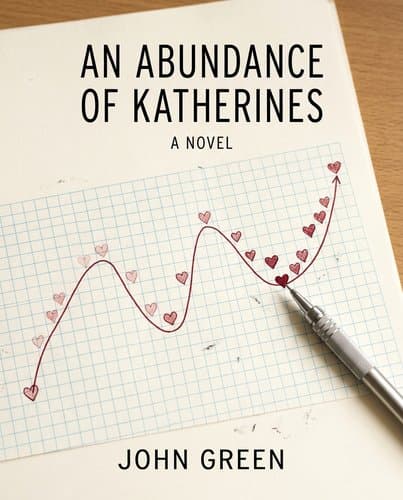
The graph is elegantly simple: horizontal axis is time, vertical axis is happiness. The moment a relationship begins and the moment it ends both land at zero. What happens in between tells you everything. If the curve dips below the line, the man ended it. If it crests above, the woman did. Colin's nineteen-Katherine record puts his own curve firmly, repeatedly, humiliatingly above zero.
The Theorem, beneath the math, is a conversion engine. You feed in humiliation, you get out data. You take the fact that the same thing has happened nineteen consecutive times and instead of calling it a character flaw, you call it a sample size. The wound doesn't disappear — it becomes evidence. Colin has no marketable skills, no original discoveries, no genius to show for a childhood spent being pointed at by adults. But he is, as he thinks to himself with complete sincerity, a world-class expert in getting dumped. The Theorem is the first time that expertise might actually count for something.
LindseyLee Wells shows up with a first-aid kit, hears about nineteen girls all named Katherine, and stares at him the way you stare at a dog that's learned to open a refrigerator: impressed, uncertain, unsure whether to be concerned.
The Theorem Needs Five Variables Because One Person Is Never Enough to Explain a Breakup
Think of a map drawn by someone who has only ever traveled alone. It captures every road they've taken with extraordinary precision, every dead end labeled, every wrong turn noted. But it can't account for the roads other people use, the shortcuts only locals know. It is useless.
That's the Theorem's problem, and Colin almost never figures it out.
Sitting in a hot car outside a nursing home in Gutshot, Colin has the formula mostly built — eighteen Katherines graphed correctly, the curve of each relationship rising or plunging according to who ended it. But the math keeps betraying him. Katherine XVIII, who wrecked him for months, looks identical on the graph to Katherine V, who lasted three and a half days. The Theorem is accurate about the shape of endings but blind to their weight.
Lindsey, who has been watching him sketch and occasionally suggesting that he sounds insane, offers a fix: five variables. Age. How popular each person was relative to the other. How attractive. Who dumped whom. And whether each person leaned inward or outward — introvert or extrovert. Colin, who previously had only been tracking one number, tries to object on the grounds that this is his Theorem. But the variables work. The formula grows complicated enough that it starts doing something unexpected — it starts looking, to Colin, almost beautiful. He realizes he has been treating the formula as math, which he merely tolerates, and needs to treat it as language, which he loves.
The irony the novel keeps pressing on is this: the Theorem gets smarter the moment it requires another person's input. A formula designed to explain why Colin can't connect with people only works once he actually connects. Lindsey says there's no romance in geometry. Colin says just wait. He means it as a promise about the math.
Your Best Friend Is Not a Supporting Character in Your Own Life Story
Hassan comes home from his first real date with real news — he kissed someone, and not just anyone, a girl who seemed to defy physics in the back of a moving truck — and before he's even fully through the door he's acting it out, one hand illustrating the truck's motion, grinning like a man who cannot believe his own luck. Colin's response is to mock the girl's intelligence and dismiss the whole event as scientifically implausible. So Hassan, who has spent four years mopping Colin off his bedroom floor after each new Katherine catastrophe, finally says the thing he's been assembling in silence this whole time.
It comes out as a list of receipts. Every breakup that Hassan absorbed. Every hour he spent as an audience for someone else's romantic suffering. Every time he watched his best friend vanish into a Katherine and then emerge, wrecked, expecting the machinery of Hassan's patience to crank back up. 'What problems have you listened to of mine?' he demands. It's a real question with a real answer, and the answer is: almost none.
What makes the accusation stick is Hassan's diagnosis of the mechanism underneath. Colin isn't selfish in the ordinary way — bored by other people, contemptuous of them. He's terrified they'll leave. And that terror is doing exactly what Colin most fears: it makes him a bad friend, and bad friends get left. The Theorem Colin has been building to predict abandonment also describes how he keeps producing it. There is a horrible geometry to this. The defense becomes the wound.
Colin's reply is not a counterargument. It's a genuine question: how do you stop being scared of that? He doesn't ask it rhetorically. He actually doesn't know. And that small, honest confusion lands differently than all his graphs and variables — because here is something his pattern-recognition can see perfectly clearly and still cannot fix. Knowing the shape of the problem turns out to be a completely different skill from knowing how to change it.
The Memory You Trust Most Is the One Most Likely to Be Wrong
What's the actual flaw in the Theorem of Underlying Katherine Predictability? You might assume it's the mathematics — too many variables, too many competing curves. But when Colin finally fixes it, sitting in the Tennessee woods with hornet venom still cooking under his skin, the repair takes about thirty seconds. The formula was never the problem. The problem was the data Colin had fed into it from the start.
Somewhere between a gifted-student summer camp in Michigan and the present catastrophe, Colin had quietly erased a memory. Katherine III — ten-year-old Katherine Mutsensberger — was supposed to be the first Katherine who dumped him. That was the founding myth. So when Hassan mentions knowing her from homeschooling circles back in Chicago, Colin does the only logical thing: he calls her. From a rotting log in the Tennessee wilderness, with a phone almost out of signal, he reaches Katherine III and asks whether she was the one who ended it. She pauses. No, she says. He came to her at a campfire sing-along in front of all her friends and explained, with the calm of a forty-year-old corporate attorney, that he just didn't see things working out long-term. She was devastated. He was ten.
Hassan's response is perfectly calibrated: he tells Colin to picture him in a tutu on a unicycle, then declares him a Dumper. The joke lands, but underneath it is something that doesn't. Colin has spent years building his self-concept on two foundations — that he was a prodigy who absorbed knowledge like no one else, and that he was a Dumpee who absorbed romantic damage like no one else. One phone call cracks both simultaneously. His memory, the instrument he trusted above everything, had edited him into a permanent victim so convincingly that he forgot being the perpetrator.
The eventual breakthrough in Chapter 17 is not really a math problem solved. When Colin adjusts the formula and it clicks into place, the fix is almost insultingly simple — one small change to a single variable. The Theorem was correct all along. It just had the wrong person in the Dumper slot for one data point.
Sometimes the Most Beautiful Thing Is a Cloud of Tampon Strings Over a Memphis Parking Lot
Colin is standing in a soybean field in Tennessee heat, holding his phone like it might detonate, listening to the woman who wrecked him not bother to listen to the voicemail he just left her. Katherine XIX — the Katherine — tells him briskly that they made a really good decision, that he should take some time, that she has to go pack for camp. And Colin, who can hold the entire periodic table in his head and recite Senate seats by state, cannot produce a single sentence in response. He listens to the line go dead and lies down in the orange dirt and lets the tall grass close over him.
He cries for the first time since the breakup. What breaks through isn't grief for Katherine exactly — it's grief for a future that never existed. Mornings at Northwestern that never happened. The right to sleep over whenever they wanted, which they never had. A version of his life that had seemed, until about three minutes ago, like a reasonable expectation. He surfaces with a sentence that lands harder than anything in his Theorem: you can love someone so much, but you can never love people as much as you can miss them. He was mostly missing an imagined future wearing her face. The actual Katherine — the one who just told him to call back after camp — had been slipping out of that imagined future for months before she officially left.
You Don't Remember What Happened — You Remember What You've Decided Happened
The actual Eureka moment in this novel has nothing to do with mathematics. It happens in a cave, in the dark, with Colin telling the story of his romantic history out loud for the first time — and discovering that the story he'd been living inside was one he'd written himself, badly, years ago.
Lindsey challenges him to narrate all nineteen Katherines the way a person talks, not the way a spreadsheet calculates. So Colin does it: two sentences each, K-1 through K-19, starting with the girl who asked him to be her boyfriend and then broke up with him inside three minutes, moving through the violin prodigy, the girl who kissed him in a sandbox and announced that boys were gross, all the way to the Katherine who just told him to call back after camp. He's telling this as a story — with settings and characters and comic timing — rather than plotting it as a series of data points. And somewhere around the middle of that retelling, he admits something he's never said out loud: Katherine III didn't dump him. He dumped her. In front of all her friends. With the clinical composure of a ten-year-old who had decided, reasonably and devastatingly, that he didn't see things working out long-term. He had rewritten that memory so thoroughly that he forgot being the one who caused it. The founding myth of Colin Singleton — Eternal Dumpee, romantic victim, boy to whom things happen — was a revision he'd made to his own history and then filed as fact.
Here's the thesis, delivered not as an equation but as a moral: you don't remember what happened. You remember what you've decided happened. And since memory is a choice dressed up as a record, the story of your life isn't a fixed document — it's a draft. Colin closes his nineteen-Katherine retelling with the observation that breaking up isn't something done to you; it's something that happens with you. Dumpers and Dumpees, the two iron categories he'd organized his identity around, dissolve the moment he admits he's been both. Lindsey's verdict is that he's just told an amazing story. Colin's body confirms it before his brain catches up: something about the telling, he thinks, made his gut grow back together. The thing that heals him isn't prediction — it's narration.
The Future Can't Be Graphed, and That Turns Out to Be the Good News
Imagine you could build a perfect model of how a river flows — every bend mapped, every current measured, every eddy catalogued with scientific precision. Now ask it where the next leaf will land. The model is flawless and completely useless, because a leaf isn't part of the system; it falls from outside it. Colin Singleton's Theorem has exactly this problem, and a poker game on a screened-in porch in Gutshot, Tennessee is what finally proves it.
Hassan wins a hand with a full house, and as the pennies slide across the table, something clicks for Colin: you can absolutely build a formula that explains why you won or lost any poker hand in the past. Feed in the probabilities, reconstruct the decisions, graph the outcome. Perfect sense. But no formula predicts the next hand, because the next hand hasn't been remembered yet — and the future, unlike the past, carries no obligation to be logical. Colin stops trying to outrun what's coming and starts finding it beautiful instead. He whispers 'Eureka' for the first time in his life without shouting it, which feels right, because this discovery has no fanfare in it.
The thought he follows it with is genuinely vertiginous: if the future is infinite, it will eventually erase everything, including every prodigy who ever made an adult gasp. No level of genius survives long enough to matter that way. But then Colin lands on the alternative. Say he tells someone about hunting a feral hog in Tennessee. The story is small. It changes the listener by almost nothing — an infinitesimal shift. But that shift ripples outward, smaller and smaller, and never fully stops. He will be forgotten. The change won't be.
Colin doesn't abandon the desire to matter; he finds a version of it the future can't delete. Not certainty. Not fame. Just this: the permanent fact that you changed someone by telling them something true.
The Graph Ends Where the Story Begins
Picture Colin behind the wheel somewhere past Gutshot, passing an exit he recognizes, not taking it. No formula told him to keep driving. The passenger seat has someone in it. That's enough.
This was never really about heartbreak or wasted potential or whether prodigies can become geniuses. It's about the difference between treating your life as a data set and treating it as a story still being told. Colin spent years feeding his history into equations, trying to predict what came next — and the only thing that actually healed him was narrating the past honestly enough to see where he'd lied to himself.
So: what would you do if you stopped trying to graph your own arc? The future won't confirm your predictions. But it will remember, in some infinitesimal and permanent way, every true thing you were brave enough to say out loud — the way Colin eventually remembered Katherine XIX not as a variable but as a person he'd gotten wrong, badly, in ways that turned out to matter.
Notable Quotes
“Mommy, am I ever going to have a Eureka moment?”
“I wanna have a Eureka moment,”
“Of course, Colin baby. Of course you will.”
Frequently Asked Questions
- What is An Abundance of Katherines about?
- An Abundance of Katherines (2006) follows a teenage prodigy who tries to mathematically predict heartbreak after being dumped by nineteen girls named Katherine. Through his obsessive theorem-building, the novel explores how pattern recognition can trap you in your past rather than free you from it. The book reveals that "surrendering the illusion of control over outcomes is not defeat, it's the precondition for genuine connection." Colin's journey demonstrates how the same intelligence that helps you analyze failures can paradoxically trap you in them, and how confronting the stories we tell ourselves about relationships is essential for moving forward.
- What does An Abundance of Katherines teach about pattern recognition?
- The same intelligence that helps you analyze your failures can trap you in them. An Abundance of Katherines demonstrates that "pattern recognition becomes a prison when the pattern you're studying is yourself." Colin's attempts to create a mathematical theorem for heartbreak reveal how recognizing patterns in your life doesn't automatically grant you control over them. The book also shows that "when you're terrified of being abandoned, you often behave in ways that produce the abandonment you fear." Understanding this feedback loop—how Colin's solipsism generates the outcomes he fears—is crucial to breaking free from repeating the same relationship mistakes.
- What does An Abundance of Katherines reveal about memory and relationships?
- Memory is not a recording—it's an argument you make about yourself. An Abundance of Katherines demonstrates this through Colin's discovery that he misremembered a crucial relationship, believing he was the victim when he actually was the one who left. This realization forces him to rebuild his "Theorem" on more honest foundations. The novel reveals that "grief for a relationship is often grief for the imagined future that relationship represented." Once you separate the actual person from the life you pictured, mourning becomes more precise and therefore more survivable. This insight fundamentally transforms how Colin understands his heartbreak.
- Is surrendering control important in An Abundance of Katherines?
- Yes—surrendering control is central to the novel's message. An Abundance of Katherines teaches that "you can describe the past with mathematical precision and still have no power to predict the future." Colin learns that "surrendering the illusion of control over outcomes is not defeat, it's the precondition for genuine connection." The book emphasizes that "storytelling is not a lesser form of mattering than genius—it's the only form of mattering that actually scales, because every story you tell changes the listener by an infinitesimal but permanent amount." Personal growth comes from accepting uncertainty and connecting authentically with others, not mastering predictive patterns.
Related Book Summaries



Read the full summary of 215526423_an-abundance-of-katherines on InShort