2175_madame-bovary
by Gustave Flaubert, Mark Overstall, Malcolm Bowie, Margaret Mauldon
Emma Bovary's tragedy isn't adultery or debt—it's that the romantic fantasies absorbed in girlhood create a template so vivid that real life can never measure…
In Brief
Emma Bovary's tragedy isn't adultery or debt—it's that the romantic fantasies absorbed in girlhood create a template so vivid that real life can never measure up, a gap Flaubert reveals as not personal weakness but the universal human condition of living in a world that sells beautiful lies.
Key Ideas
Stories install templates reality cannot satisfy
The stories we absorb in youth don't just shape our desires — they can install a template of life so vivid that actual experience perpetually disappoints by comparison. Emma's tragedy is the logical endpoint of a romantic education that had no interest in preparing her for reality.
Emma's diagnosis proves accurate, cure fatal
Flaubert shows that Emma's contempt for her environment is not simply delusion: the agricultural show, the club-foot disaster, and Homais's triumph confirm that provincial mediocrity is as hollow as she perceives it. The novel's cruelty is that her diagnosis is accurate and her remedy is poison.
Feeling forever exceeds available language limits
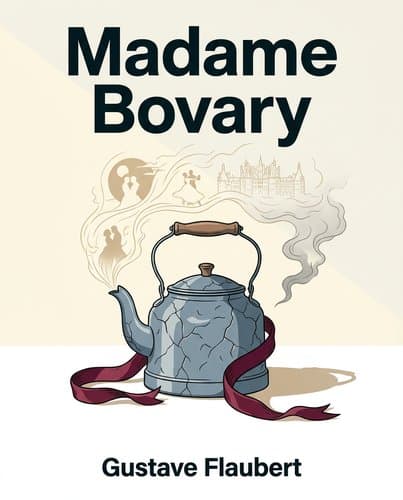
The gap between genuine feeling and the language available to express it is not Emma's personal failure — Flaubert calls it a universal human condition (the cracked tin kettle). Rodolphe's cynicism is as much a failure as Emma's romanticism: he cannot distinguish real depth from conventional phrasing.
Fantasy cycles intensify without ever resolving
Desire fueled by fantasy is not self-correcting. Emma's response to each disappointment is to seek a more intense version of the same fantasy — a new man, a new city, a new debt — rather than revise the underlying template. The cycle only ends when the resources run out.
Morality is arbitrary in the real world
The novel's final accounting is deliberately unjust: Charles loved without calculation and died of grief; Emma suffered acutely and died grotesquely; Homais, who caused harm at every turn, received the Legion of Honour. Flaubert is not offering a moral universe — he is describing the one we actually inhabit.
Who Should Read This
Readers interested in Literary Fiction and Classics, looking for practical insights they can apply to their own lives.
Madame Bovary
By Gustave Flaubert & Mark Overstall & Malcolm Bowie & Margaret Mauldon
12 min read
Why does it matter? Because the stories you were fed as a child may have already ruined you for the life you actually have.
Most people read Madame Bovary as a story about a woman who wanted too much — the affairs, the debt, the beautiful ruin of it all. That reading isn't wrong, exactly. It's just too comfortable. It lets everyone who isn't Emma off the hook.
Here's what Flaubert is actually doing: Emma doesn't destroy herself because she's weak or vain or morally defective. She destroys herself because, as a girl, she was handed a vocabulary for life — moonlit skiffs, passionate viscounts, love as a kind of violent weather — and then dropped into an existence that vocabulary simply cannot describe. The gap between those two things doesn't produce dissatisfaction. It produces agony. And the novels, the convent, the keepsakes with their tissue-paper engravings — none of that was unique to Emma. It was the education of her entire world.
What follows is the story of what happens when beautiful lies meet ordinary life, and why the catastrophe belongs to all of us.
Before Emma Bovary Could Ruin Her Life, Literature Had to Ruin Her Imagination
Emma Bovary's tragedy wasn't weakness of character — it was the result of a very thorough education. By the time she married Charles, her imagination had been systematically colonized by images reality could never match, and the colonization was so complete she couldn't have identified it as damage even if she'd tried.
Here's what Flaubert is actually doing in the convent chapters: he's showing you a curriculum. At thirteen, Emma entered a religious school and found it easy to love — not out of faith, but for the sensory atmosphere. The incense, the candlelight, the whispered intimacy of the confessional. She invented small sins just to have a reason to kneel there longer, mistaking the pleasure of the aesthetic experience for something spiritual. That confusion — between how something feels and what it means — turns out to be the engine of her entire life.
Then, when Emma was fifteen, an elderly seamstress began supplementing that religious diet with something equally potent. The woman moved through the convent mending linen and smuggling novels in her apron pockets, novels packed with fainting heroines, noblemen who wept beautifully, and an inexhaustible supply of horses ridden to death in the service of passion. Emma consumed this for six months as though it were scripture. The authors signed their verses with aristocratic titles — counts, viscounts. Status and romance arrived in the same package, indistinguishable from each other.
Flaubert's diagnosis of what this produced is precise: Emma was more sentimental than artistic. She didn't love beauty for what it was; she needed it as a delivery system for feelings she couldn't access any other way. The novels didn't teach her to observe the world — they taught her to measure it. Every experience would now be held against some ideal version and found wanting. She loved the sea only when it was stormy, and green fields only when they contained ruins.
When Charles arrived at her father's farm, what she felt wasn't love — it was the disturbance of a new presence, which her trained imagination immediately processed as the overwhelming passion she'd been promised. A pattern was already in place, waiting. She slotted him into it, and the mistake was structural before it was personal.
The Man She Married Is Already the Novel's First Joke — and Its Deepest Tragedy
A fifteen-year-old boy stands at the front of a classroom in Rouen, ordered to announce his name. He opens his mouth and what comes out sounds like 'Charbovari' — a sound so garbled the whole room erupts, chanting it back at him in a rising wave of mockery the teacher can barely suppress. The boy is wearing a cap that is its own punchline: a structural nightmare of bearskin, velvet lozenges, rabbit-skin panels, a cardboard polygon, and a dangling gold tassel, clearly assembled by someone trying to approximate gentility without quite knowing what it looked like. When he's ordered to stand, he drops it. A neighbor elbows it away as he reaches for it. He picks it up again. He has no idea what to do with his hands.
Flaubert gives us this scene first — before Emma, before the romance, before any of it — because he wants you to see Charles clearly before you judge him through her eyes. And what you see is this: a boy trying hard in a world that finds him inherently absurd.
The adult version turns out roughly the same. Charles becomes a country doctor by grinding through memorization rather than understanding, fails his first medical exam because he preferred dominoes, passes the second through sheer repetition. His mother places him in a practice in Tostes and finds him a wife. The shape of his life is set before he's had much say in any of it.
Here's the thing Flaubert is actually doing: he builds the case for Emma's dissatisfaction so thoroughly, with such precise sympathy, that you almost miss what he's quietly assembling on the other side. Charles loves Emma with a completeness the novel's more sophisticated characters — Rodolphe, with his seducer's calculus; Léon, with his literary poses — simply cannot manage. He asks for her everywhere. He watches her without agenda. When she dies, he doesn't recover; he just stops, worn through by grief, and follows her not long after.
The novel's cruelest joke isn't that Emma married the wrong man. It's that she married the only person in the book who loved her honestly, and that honesty — unadorned, unperforming, nothing like the template — was precisely what made him invisible to her.
The Wedding Cake Is Made of Paste, and So Is Everything Emma Desires
A confectioner from Yvetot, newly established and eager to impress, constructs a towering centerpiece for Emma and Charles's reception. At the base, a temple made of blue cardboard, ringed by stucco statuettes and fake stars pressed from gilt paper. Above it, a dungeon of sponge cake with battlements built from candied fruit and almond fragments. At the very top, a small meadow in green icing, chocolate boats, and a Cupid balanced on a swing made of chocolate, its uprights topped with actual roses. The guests respond with genuine wonder.
Here's what Flaubert is actually doing: this cake is not a joke at the guests' expense. It's an accurate portrait of Emma's entire romantic education — ambition and beauty constructed from cheap, flimsy materials, magnificent at a glance, unable to hold its shape under any real pressure. The architectural metaphors (temples, dungeons, fortifications) gesture toward permanence and grandeur while being made of things that dissolve. Emma wanted a midnight wedding with torches. She got forty-three people and sixteen hours at a trestle table in a cart shed.
She sits through it perfectly composed, revealing nothing. Charles fumbles at crude jokes he cannot quite land. The gap between them is already the whole novel wide — and she is already, without knowing it, measuring the distance.
One Night at a Marquis's Chateau Is Enough to Make the Rest of Life Unbearable
What does it actually take to make an ordinary life feel uninhabitable? Not just disappointing — uninhabitable, the way a house becomes uninhabitable after a flood, structurally compromised even after the water recedes. One night, it turns out. One night if the right kind of beauty gets in.
The Marquis d'Andervilliers invites the Bovarys to his chateau at Vaubyessard as a minor social courtesy — Charles once lanced an abscess for him, and the Marquis noticed Emma's bearing wasn't quite that of a peasant. She arrives and steps into a world assembled entirely from the materials of her convent-novel imagination: ancestral portraits with gilt frames, the odor of truffles and warm linen, champagne so cold it makes her shiver, a decrepit duke at the end of the table who was once, rumor had it, the lover of Marie Antoinette. This last detail matters to her more than his gravy-dripping chin and bloodshot eyes. The history forgives everything. She is inside the life she's been rehearsing at last.
Then the waltz. A man known only as the Viscount — the title doing its full work on her — leads her onto the floor and everything stops being separate. The room turns like a disc on a pivot, lamps and furniture and paneling spinning into one continuous blur, their legs commingling, her head briefly resting on his chest before he guides her back. The world was static before this. Now she has felt what it is for it to move.
Here's what Flaubert is actually doing with the return journey. Charles holds the reins with his arms stretched wide, the horse too small for its traces. The harness breaks and gets mended with string. Charles finds a discarded cigar case in the road and tries, gamely, to smoke from it — sputtering and spitting until Emma takes it from him and shoves it to the back of a cupboard. Two entirely different scales of existence are simultaneously real, and she is living on the wrong one.
She stores her satin dancing shoes in the attic afterward. The soles are yellowed from the ballroom wax. She handles them like relics. The ball becomes a hole in the calendar — every Wednesday she measures how many weeks since it happened, the details blurring but the longing sharpening with each count. Flaubert's word for what the experience left behind is a 'crevice' — the kind a storm opens in a mountain overnight. The structure holds. But it has been permanently changed.
The World Emma Contemns Is Genuinely Contemptible — Which Is the Novel's Cruelest Trick
Emma Bovary's contempt for provincial life is not entirely wrong. That's Flaubert's cruelest trick, and it's worth sitting with: the world she despises is genuinely, demonstrably mediocre.
The agricultural show makes this impossible to deny. A regional councillor mounts a platform and delivers a speech on civic progress and rural industry, the kind of address that uses the word 'duty' often enough to sand it smooth of meaning. Below him, pens of livestock. And threading through his oration, line by line, is Rodolphe's seduction of Emma — Flaubert cuts between them with the precision of a surgeon, so that every rhetorical flourish about fidelity to the soil arrives in counterpoint to whispered words about irresistible attractions and shared destinies. The comedy is devastating. But then, at the ceremony's center, something shifts.
Catherine Leroux is called forward to receive a silver medal worth twenty-five francs — the prize for fifty-four years of unbroken service on the same farm. She is elderly and frightened. Her hands, deformed by decades of labor, hang at her sides like the knotted joints of old wood. She stands before what Flaubert calls 'the radiant bourgeois,' the men in their sashes and frock coats, and she seems not to understand what is happening to her. When she finally takes the medal, her intention is to sell it and use the money to pay for masses. The moment is not satirized. It simply sits there, in the middle of all the pomposity, asking you what exactly civilization has done for this woman.
Flaubert validates Emma's revulsion while showing you that her alternatives — romantic love, passionate escape, the life imagined from novels — are no less hollow than the ceremony she scorns. Catherine Leroux is proof that the provincial world grinds people down without apology. The agricultural show is exactly as absurd as Emma thinks it is. But Rodolphe, whispering beside her, is his own kind of performance, just as calculated as the councillor's speech and far more dangerous to her specifically. He has already decided what will happen. The tenderness is a technique.
What Flaubert refuses to grant Emma is the fantasy that somewhere beyond this world waits one large enough to contain everything she's been promised — and the next section follows her as she starts collecting on that promise.
The Language of Love Is a Cracked Tin Kettle, and Everyone Is Banging on It
Imagine trying to describe the color blue to someone who has never seen it — every word you reach for already worn smooth by everyone who tried before you. That's the problem Flaubert poses at the novel's philosophical center, and he poses it through Rodolphe's biscuit tin.
Rodolphe keeps his conquest trophies in a box: garters, locks of hair, a small portrait of Emma that's already chipped at one corner. When he decides to break things off with her, he sits and lets her letters fall through his hands one by one, reading them with the detached amusement of someone reviewing old receipts. His verdict: what a lot of rubbish. And here's what makes his dismissal so technically correct and so completely wrong at the same time — Emma's declarations are, in fact, full of clichés. Moonlight and stars and souls commingling. The entire vocabulary of the romantic novels she devoured as a girl, laundered through her own desperation and handed back to Rodolphe as original feeling. He is right that the language is second-hand.
But Flaubert steps in here — which he almost never does — and makes the move that changes everything. Human speech, he says, is like a cracked tin kettle on which we bang out tunes to make bears dance when what we want is to move the stars. The clichés aren't evidence that Emma's feeling is false. They're evidence that genuine feeling and the language available to express it are permanently, structurally mismatched. Rodolphe dismisses her because the words are familiar. What he can't process — what his practiced seducer's intelligence simply can't register — is that she actually means them, means all of them, in the only words she has.
He then writes his farewell letter with studied elegance, pausing at one point to drip water on the page to simulate a tear he doesn't feel. The letter arrives hidden under a layer of apricots in a delivery basket. Charles, finding it while Emma is feverish and collapsing, thrusts the fruit at her nose because he thinks the smell might revive her. He has no idea what he's holding. The cruelest thing in that scene isn't Rodolphe's calculation. It's that the thing destroying Emma gets mistaken for something wholesome — and that's the tin kettle problem in its most physical form: meaning carried in the wrong container, by the wrong hands, to devastating effect.
Emma's Death Is Not a Punishment — It Is a Joke the Universe Tells at Her Expense
The blind man who begs along the road to Rouen appears throughout the novel like a recurring bad joke — disfigured, his existence pure grotesque fact. He reappears at Emma's window as she is dying, and this time he is singing. The song is about a young woman dreaming of love on a summer day, its imagery cheerfully lewd, its tone entirely indifferent to the woman inside gasping through her final minutes. Emma raises herself from the pillow, turns her eyes toward the sound, and dies laughing — not peacefully, not beatifically, but with what Flaubert calls an atrocious, frantic, despairing laugh that terrifies everyone in the room.
Here's what Flaubert is actually doing: he has arranged Emma's death so that every apparatus that might redeem it — religious ceremony, romantic suffering, tragic dignity — either misfires or arrives as mockery. The priest does anoint her, pronouncing the sacrament over the eyes that chased worldly spectacle, the lips that told lies, the hands that reached for what wasn't hers. There is a moment where she seems almost transfigured, and you think Flaubert might relent. He doesn't. The blind man's song arrives precisely to cancel any consolation. Whatever meaning the anointing offered, the universe answers with a dirty tune about petticoats.
Then the vigil. The priest Bournisien and the pharmacist Homais — faith's representative and rationalism's — sit beside Emma's corpse conducting their running argument about Voltaire and the saints. They grow tired. They fall asleep in their chairs. They wake, eat, pour each other drinks, and find in the warm animal companionship of appetite that they get along rather well. A discharge of black fluid ruins Emma's dress while they hobnob. The body is a biological inconvenience. The men are fine.
Charles, meanwhile, begins to come apart. He sits in the garden, weeps, stops eating. The man who loved Emma with the only uncalculated love in the book simply deteriorates — not dramatically, not tragically in any shape the word usually takes, but quietly, the way a thing does when there's nothing left holding it together.
Mediocrity Always Wins: Homais Gets the Legion of Honour
Charles dies broken in his garden, Berthe ends up working in a cotton factory, and Homais — the pharmacist, the self-promoter, the man who filled every room with the sound of his own opinions — receives the Legion of Honour he has spent the entire novel coveting. No ironic commentary follows. Flaubert offers the sentence and stops. The joke doesn't need explaining.
What makes this devastating rather than merely cynical is the path Flaubert walks you through first. After Emma's death, Charles begins, inexplicably, to become her — adopting her tastes in clothes, ordering patent leather boots, wearing white cravats, even dabbing cosmetics on his moustache. He keeps a candle burning opposite her empty chair. He spent their entire marriage being found insufficient by her standards, and now that she is gone he surrenders to those standards completely — the woman who could never see him clearly shaping him into someone she might have loved. There is something so grotesque and so tender in this that it becomes the novel's most honest love scene: the only moment Charles is entirely his own, and it looks exactly like Emma.
His final encounter with Rodolphe, the man who seduced and abandoned her, happens by accident at a market. No confrontation follows. Charles looks at him across the square, feels something drain out of him, and when they finally speak he offers not fury but a limp absolution: it was the fault of fatality. Rodolphe finds this comic, and a little mean. He is not wrong to find it comic, and completely wrong about what it means. What Charles is actually doing is the hardest thing in the book — releasing the narrative that suffering should produce justice. He has figured out, or been ground down to the point of accepting, that it doesn't.
And so the novel closes with its true verdict: the world does not run on passion or grief or authentic feeling. It runs on Homais — relentless, self-satisfied, utterly untroubled by the wreckage around him, collecting his medal while everyone else's story ends in a factory or a grave.
What the Cracked Kettle Is Really Asking
Here is the thing Flaubert leaves you with, underneath all the grotesque comedy and the unpaid bills: Emma's stories were wrong, but the hunger that sent her looking for them was real. And then there's Charles. He had no borrowed vocabulary, no romantic template, no novels filling his head with what love was supposed to feel like. He just loved her — steadily, stupidly, without irony or performance. And it counted for nothing. The world Flaubert describes didn't reward his sincerity any more than it punished Emma's delusion. He died holding a lock of her hair, having understood almost nothing and felt everything. The uncomfortable question isn't whether you'd have made Emma's mistakes. It's whether authentic feeling — unmediated, unliterary, genuinely yours — was ever going to be enough in the first place.
Notable Quotes
“Vichy, Seltzer, Barege waters, blood purifiers, Raspail patent medicine, Arabian racahout, Darcet lozenges, Regnault paste, trusses, baths, hygienic chocolate,”
“Then at the back of the shop, behind the great scales fixed to the counter, the word”
“appears on a scroll above a glass door, which about half-way up once more repeats”
Frequently Asked Questions
- What is Madame Bovary about?
- Madame Bovary traces the destruction of Emma Bovary, a doctor's wife whose romantic fantasies collide with provincial French mediocrity. The novel exposes a universal condition: the gap between the language of desire and the reality it can never satisfy. Inherited illusions shape appetite, distort judgment, and compound into ruin. Stories absorbed in youth install a template of life so vivid that actual experience perpetually disappoints by comparison. Emma's tragedy reveals how romantic education, unconcerned with preparing readers for reality, creates victims of their own imagination rather than architects of their lives.
- Why is Emma Bovary's downfall inevitable?
- Emma's destruction is built into her romantic formation. The stories that shaped her created a template of life so vivid that provincial reality can never match it; each disappointment intensifies her longing for a more vivid existence elsewhere. Rather than revise her expectations, Emma responds to each letdown by seeking a more intense version of the same fantasy: a new man, a new city, a new debt. Flaubert shows that desire fueled by fantasy is not self-correcting. The cycle compounds until resources—financial and physical—run dry, leaving only destruction in its wake.
- Is Flaubert criticizing Emma or exposing the limitations of her world?
- The novel's cruelty lies in its refusal to choose. Emma's contempt for her environment is not delusion but accurate diagnosis: the agricultural show, the club-foot disaster, and Homais's triumph confirm that provincial mediocrity is as hollow as she perceives it. Yet the novel also shows that her only remedy was poison. Flaubert reveals that the gap between genuine feeling and language available to express it is not Emma's personal failure but a universal human condition. Even Rodolphe's cynicism fails as utterly as Emma's romanticism—he too cannot distinguish real depth from convention.
- What is the novel's perspective on justice and morality?
- The novel offers no moral comfort. Charles loved without calculation and died of grief; Emma suffered acutely and died grotesquely; Homais, who caused harm at every turn, received the Legion of Honour. "Flaubert is not offering a moral universe — he is describing the one we actually inhabit." Virtue provides no protection, vice carries no punishment, and chance governs outcomes more than character. The novel's final pages strip away consolation that suffering ennobles or that wrongdoing brings consequences. Instead, we confront the actual distribution of fate: arbitrary, indifferent, utterly impervious to moral desert.
Related Book Summaries


Read the full summary of 2175_madame-bovary on InShort