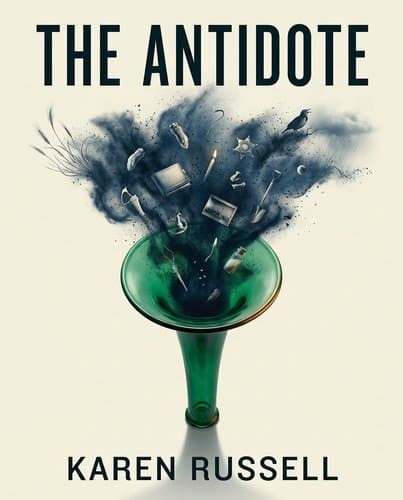
214537790_the-antidote
by Karen Russell
Forgetting is never free — every buried truth accumulates interest until someone pays the debt. Karen Russell explores how suppressed memory moves through…
In Brief
Forgetting is never free — every buried truth accumulates interest until someone pays the debt. Karen Russell explores how suppressed memory moves through bodies, communities, and landscapes, revealing that reckoning doesn't deliver resolution, only the brutal clarity needed to rebuild.
Key Ideas
Suppression's Debt Always Compounds
Forgetting is never neutral — every act of deliberate suppression, personal or communal, creates a debt that accrues interest and will eventually be called in, usually by someone who didn't take out the loan.
Institutions Absorb Perpetrators' Responsibility
Complicity often wears the face of compassion: the systems we build to absorb others' pain (therapeutic, legal, institutional) can function as laundering operations for those with power, leaving the caregiver holding what the powerful refuse to carry.
Intergenerational Trauma Inherits as Feeling
Inherited guilt doesn't dissolve when it's hidden — it transmits. The next generation doesn't inherit the memory of the crime but inherits the psychic weather it creates: the inexplicable melancholy, the irrational luck, the unnamed weight.
Survival Demands Displacing Pain Downward
The same displacement logic runs in both directions: the persecuted can become persecutors without noticing the transition, because survival on a hierarchy always requires someone lower on the ladder to absorb the cost.
Truth Clarifies Ground For Rebuilding
Restoration is not the same as resolution. The rain breaks the drought but floods the crops. The truth exposes the killer but the camera gets shot. The mother finds her son only after his death. What remains is not happiness but the capacity to build again on ground you now see clearly.
Open Wounds Hold Sacred Weight
A wound that never fully closes can become a form of porousness — a capacity to hold what others cannot bear. Whether that becomes a mercy or a trap depends entirely on whether the holder is allowed to set down the weight when it is no longer theirs to carry.
Who Should Read This
Readers interested in Literary Fiction and Novels, looking for practical insights they can apply to their own lives.
The Antidote
By Karen Russell
12 min read
Why does it matter? Because the memories you've paid to forget are still shaping everything around you.
We tell ourselves that forgetting the worst things is a kindness — a mercy the mind extends to keep us functional, keep us moving forward, keep the body from folding under the weight of what it has seen. In 1935 Nebraska, a woman called the Antidote has built a business from exactly that instinct. For a fee, the people of Uz whisper their unbearable memories into a green earhorn, and she carries them so they don't have to. It sounds like a gift until you notice who else is paying — because when the same mechanism that lets a grieving mother sleep at night also lets a murderous sheriff govern without guilt, forgetting stops being private mercy and becomes communal rot, the dust that buries a town from the inside out. Karen Russell's novel asks what happens when the infrastructure of suppression finally fails, and everything a community chose not to know comes flooding back up through the ground.
When Forgetting Is a Business, Someone Always Pays the Price
A prairie witch wakes up on a Sunday morning in 1935 feeling what she can only call bankruptcy — a terrifying lightness where the weight of thousands of stored lives used to be. She presses her fists into her own stomach, hunting for the secrets as if they might simply be misplaced. They are not.
She is what locals in Uz, Nebraska call a Vault: for a fee, she absorbs her customers' memories through a painted green earhorn, entering a trance so complete that she never knows what they've told her. The comfort she sells is precise. She describes herself to clients the way you might describe a safe-deposit box — the container has no opinion about its contents. Half the town has been banking with her since the boom years.
The Black Sunday dust storm changes all that arithmetic. Their secrets were siphoned out of her flesh and into the whirlwind. They are simply gone.
The consequences arrive in the form of John Boyet. He's been a faithful customer for twelve years, and now he wants his past back before he leaves for California. This is what a bank run looks like when the collateral is human memory: a hollowed-out man waving a fistful of yellowing deposit slips at a woman who has nothing left to give him. When she cannot produce his withdrawal, his hands close around her throat.
The whole social architecture of Uz — its kept secrets, its swallowed griefs, its crimes conveniently forgotten — turns out to have been built on the assumption that the Vault would never go empty. It did. And now everyone who paid to forget is about to remember why they came to her in the first place.
The Club Has Always Been in Your Hand — You Just Forgot You Were Holding It
Deposited guilt doesn't disappear. It transmits, shape-shifting from the original crime into the next generation's inexplicable wound — arriving without a return address, as intimate and sourceless as a birthmark.
Harp Oletsky's first memory has a catalog number: Deposit 69818060-1-77. He is six years old, his birthday cake cooling on the kitchen counter back home, when his father steers him by the shoulders into the center of a community rabbit drive near the Loup River. The town has spent the morning herding hundreds of jackrabbits into a fenced pen; now the men move through the enclosure with ax handles and hammer shafts, bringing them down. Harp sees the rabbits' eyes through the wire and recognizes something — they didn't choose to be here either. He tries to run. His father grabs him. The screaming doesn't stop when the last animal stills; it migrates inward, where it keeps going. When one rabbit is found still breathing at the end of the slaughter, Harp's father presses the club into the boy's hands. This is the transaction: not the animal's death, but the instrument's transfer. The father means to toughen the son. What he actually does is hand the wound forward.
Harp spends his whole life afraid without knowing why. His father's guilt, it turns out, came from somewhere too. Then the storm comes and the Vault empties and the memory rushes back in, and standing in the wreckage of the farm he finally understands: the club has always been in his hand. He had only forgotten he was holding it. His father's voice arrives inside him, exhausted and final — you can put it down now — as if the old man spent decades waiting for permission to say it.
The Antidote That Becomes the Poison: How Mercy Enables Monsters
What does it mean to take someone's pain away? The obvious answer — that it relieves them — turns out to be the terrifying one.
Ant, the prairie witch at the center of the novel, has spent years accepting deposits from the Sheriff's prisoners, coerced into the arrangement by Iscoe himself, believing she functions as a kind of mercy instrument: absorbing what people cannot carry, holding it safely, letting them walk lighter into their lives. Then one night Sheriff Victor Iscoe decides he wants what his terrified victims get. He leans over Ant's emerald earhorn and pours in the memory of Mink Petrusev — a Russian widow whose body he and his young deputy hauled up a sand dune in the dark, buried in a shallow pit, and burned with kerosene so she couldn't blow apart his reelection campaign.
Ant is supposed to be in trance. She is not. She experiences the whole night from inside the Sheriff's skull — the scrape of dry earth under his fingernails, the smell of his aftershave mixing with prairie ozone, the moment he brings a shovel down on Mink's skull to finish what he started. She learns in that same buried hour that Iscoe has been purchasing rabbit's feet in bulk — ten dollars for ten charms at a Gordon emporium — and planting them on murder victims to manufacture a serial killer narrative, one that let him pose as the hero who caught the monster while an innocent boy named Clemson Dew awaited his second execution. The rabbit's feet were never evidence of a killer's ritual. They were props in the Sheriff's campaign advertisements.
When Iscoe finishes his deposit, something happens that cuts deeper than the confession itself. He sounds almost giddy. He knocks over his chair. A sound that isn't quite laughter tears out of him — the physical release of a man who has set down a crushing load. He leaves with a spring in his step, ready to kiss babies and shake hands at Town Hall the next morning. Ant, alone behind the curtain, vomits into the washbasin.
The realization she arrives at is precise and devastating: she is not the antidote to the Sheriff's poison. She is its delivery mechanism. Every time she absorbed his guilt, she returned him to the world scrubbed clean, his conscience emptied and his capacity for the next crime fully restored. The Vault that promised to hold everyone's darkness has been, all along, the thing that kept the darkness moving.
What the Camera Sees When the Photographer Looks Away
Cleo Allfrey, a Black photographer hired by the Roosevelt administration to document Dust Bowl poverty in Nebraska, understands framing better than her boss ever will. Roy Stryker sends shooting scripts and telegrams demanding she tell the story of 'human erosion' — meaning White erosion, as it turns out, since Congress controls the funding and Congress responds to White faces in extremis. Cleo complies, up to a point. Then she buys a secondhand Graflex Speed Graphic from a Dannebrog pawnshop, and the camera starts making its own decisions about what counts as real.
The clearest instance arrives when Cleo develops a negative she shot at an archaeological dig on what was once a Pawnee settlement. She expects a photograph of an open, ransacked grave — the kind of image that confirms what the 1930s looks like, which is aftermath. Instead, after a second pass through the fixing bath, a living city surfaces on the emulsion. The scale is impossible: a bird's-eye view she couldn't have taken from where she stood. Women are raising cottonwood-beam lodge walls, measuring and fitting the beams by hand. Children hang from the silver branches of trees that haven't grown on this land for a century. Sunflowers and corn and squash press up to the edges of the frame. Cleo holds the negative up to the light and the image presses back — the warmth of those walls, the noise of that ordinary afternoon, rising out of the same dirt she'd just photographed as a wound. The dig site is gone. What the camera chose to see was the moment before the dispossession.
Any act of framing is a choice about which version of a place is the true one. Stryker frames the prairie as a catastrophe requiring federal rescue. The Sheriff frames a string of unsolved murders as the work of a single ritual killer — a story assembled with bulk-purchased rabbit's feet and the manufactured guilt of Clemson Dew, an innocent boy already scheduled to die for crimes the Sheriff committed. Cleo frames her Founder's Day exhibition around the hopeful images — ecological restoration, linked arms on the horizon, an oak tree full of children who don't look related — while locking the hellscapes in the root cellar. She knows she's curating. She does it anyway, with open eyes, which is the only thing that separates her selection from the Sheriff's.
The Settler and the Serf Are Running the Same Play from Opposite Sides
Tomasz Oletsky arrives in Nebraska in 1873 knowing exactly what state erasure looks and smells like. He has lived it: in Prussian-occupied Poland, his church burned, his language outlawed, his grandfather imprisoned for sheltering a priest. When a railroad recruiter promises him six hundred acres, he boards the ship. Within weeks of filing his claim, he is watching the U.S. government do it again, two miles from his fence line, to the Pawnee people: annuities withheld through winter, children seized for a boarding school built to burn the bridges between them and everything they were. He recognizes every instrument. He does nothing. When a runaway student — an eleven-year-old girl with an eye swollen shut from trachoma, who has bolted through the snow rather than go back — is found hiding near the frozen river, Tomasz hauls her to the Genoa school and collects the five-dollar bounty. The man who fled Kulturkampf has become its local franchise.
Harp Oletsky, Tomasz's son, discovers all of this sixty years later when his father's hidden memory deposit comes open. He takes what he finds to the podium at Founder's Day in Uz, in front of two hundred neighbors gathered to celebrate twenty-five years of the town's existence. He does not deliver the speech they came for. He names the Founder's Pact — the signed agreement never to sell or rent land to Black families — and then draws a longer line: the Kinkaid Act's 640 "free" acres were Pawnee land, the settlers were an invading army of pale children armed with railroad spikes and barbed wire, and the Pawnee who farmed these plains for centuries were marched to Oklahoma while Polish immigrants filed their preemption claims. The plow that broke the plains, Harp tells the room, is the same plow that broke his family in German-occupied Poland — the imperial plow that clears people before it clears land. The dust burying their houses is not weather. It is the consequence of a moral failure that got called prosperity and then got deposited into a Vault so no one had to feel it.
The room does not receive this well. Chairs fly. Neighbors who have fished and farmed beside Harp for decades call him a traitor. The fury is the measure of the recognition — you only mob a man for saying what some part of you already knows.
A Wound That Never Closes Becomes a Door
Antonina Rossi's water breaks at three in the morning in a triangular attic cell with a nailed-shut window, her arms bound to her sides in a custom-fitted leather straitjacket. The Superintendent sleeps directly below her. Every girl who has ever been confined up here knows that if you scream, you get gagged. So Antonina labors in silence, sweating into a cushion that smells of every woman who suffered here before her, reading graffiti scratched into the plaster by previous inmates — one girl managed only her name and the number of weeks she had left. Antonina can't scratch anything. She can only count contractions and talk to the baby she has refused, at every opportunity, to surrender.
The birth itself breaks her open with joy. She experiences the pain as dynamite clearing a mountain so light can pour through. When the baby — dark-haired, alive, furious with the indignity of arrival — is placed on her chest, she holds what she has been fighting toward for nine months inside a place designed to wear her down. Then she is drugged, and when she wakes the sheets are cold and the nurses' faces have arranged themselves into rehearsed sympathy. Your son died while you slept. He's already been sent to the cemetery. She knows they are lying. She can hear it in the theatrical sadness of their voices, can feel it in the way they won't quite meet her eyes. She says so, plainly. They sedate her again.
She walks eight miles in a borrowed coat with blood soaking through her skirt, aiming for a police station, before a storm turns the sky artichoke green and something much older than language tells her to run. Nobody comes after her. Nobody files a report. A stolen baby from a reformatory for fallen women does not generate paperwork the institution wants to keep.
A Vault — a prairie witch — is not someone born with unusual empathy. She is someone whose wound never closed. The shock that opened the door was never permitted to heal, and so the door remains: a permanent vacancy, a hollow where something irreplaceable used to be. Antonina describes it as the space her son left, widening rather than contracting with each passing year, until she had room inside her for everyone else's grief as well as her own. Dell's apprenticeship fails for exactly this reason — her mother's death is present, but not yet worn into the specific shape of that hollow. The borrowed coat. The artichoke sky. Eight miles in bare feet toward a police station that will never take her report. You don't choose to become a container for what no one else can carry. The loss does that to you, slowly, and mostly without your permission.
The Rain That Breaks a Drought Cannot Undo What the Drought Revealed
Antonina is scrambling through a window with one bare foot, her borrowed shoe lost in the stampede, when the sky splits open and stops a lynch mob in its tracks. Men who were seconds from laying hands on her — the cheerful baker who used to bring her cookies, the Iscoe brothers dragging Dell Riis toward a sedan — all of them suddenly go still, chins lifted, palms open, weeping into the first rain in years. She escapes in the confusion. The crisis dissolves. You could read the scene as a rescue, and in one sense it is.
But the novel is more honest than that. The rain that drowns the mob's rage falls for twenty-four straight hours. The Republican River swells to four miles wide. Harp's wheat is torn out by the roots. The farmhouse is pulled off its foundation and reduced to splinter piles and overturned trucks. The rain that broke the drought does not restore what the drought revealed — it floods it.
And yet. When Harp climbs the ladder out of the root cellar at dawn and sees the ruins, what moves through Harp is not despair but something he can only call relief. The bubble of inexplicable good fortune that had kept his fields untouched while everyone around him suffered has finally burst. He is reunited with the general fate. Whatever isolated him from his neighbors — the enchanted yields, the mysterious protection — is gone, and what he feels is gratitude for the unsealing. Anything that is yours alone can become a curse, even luck. He pushes his fingers into the wet soil and listens to the meadowlarks picking through the wreckage of his barn, and understands that the birds are stitching something together even here, even now.
The most quietly devastating piece of the novel's ending doesn't belong to any of these large external events. It belongs to Antonina, alone in the ruined field before dawn, pressing her emerald earhorn against the chest of the half-collapsed scarecrow the way a doctor might press a stethoscope to listen for signs of life. What pours through the funnel is her son's entire existence: the penny juke, the Christmas tree decorated with a brother named Auggie, her own distinctive large ears mapped onto a stranger's face, and finally his death in a car accident in Rushville on the day the dust storm blotted out the sun. She had been carrying the shape of him — the hollow silhouette of the child she lost — for twenty years. Now the silhouette fills. He had a nickname and a voice that dropped three octaves when he turned twelve, and he waited in the field for her to find him. He stayed.
Restoration is not resolution. The wheat is gone, the camera is shattered, the son is dead. But grief that has been kept at arm's length finally drawn close — surrendered to rather than wrestled — turns out to be something other than destruction. It turns out to be the ground beneath the ground, still there, asking what you plan to build next.
What Was Always Growing Under the Dust
What the book finally asks you to sit with is not whether buried things surface — they always do, with or without your cooperation — but whether you'll be awake enough to recognize them when they do. Cleo stands in the fallowland and watches light pour out of the ground in a color that has no name, and the reason she can see it is because she has built her own frame. The emptiness she perceives in damaged places is always a misreading. The Pawnee farmed this ground for a thousand years. Antonina's son spent his whole life six hours from Antonina, who was waiting. The rabbits' screaming never left Harp — it only waited until he was ready to hear it as an instruction rather than a wound. The question is not when the buried things rise. It's whether you'll be present enough to receive them.
Notable Quotes
“I know as little about what I contain,”
“as a safety deposit box knows about its rocks. As a jar of pickling vinegar knows about its floating roots.”
“I wonder what I just told you, ma’am? It’s gone clean out of my head!”
Frequently Asked Questions
- What is The Antidote about?
- The Antidote examines how suppressed memory — personal, communal, and generational — accumulates into a debt reshaping lives of those who never chose to borrow it. Karen Russell traces the hidden costs of forgetting: inherited guilt, complicit institutions, and landscapes scarred by buried truth. Russell argues that "Forgetting is never neutral — every act of deliberate suppression, personal or communal, creates a debt that accrues interest and will eventually be called in, usually by someone who didn't take out the loan." This framework helps readers understand how unacknowledged histories operate as living forces rather than settled pasts, creating consequences for future generations who had no role in creating them.
- What does The Antidote reveal about complicity and compassion?
- Russell reveals: "Complicity often wears the face of compassion: the systems we build to absorb others' pain (therapeutic, legal, institutional) can function as laundering operations for those with power, leaving the caregiver holding what the powerful refuse to carry." This insight exposes how institutions designed to help may inadvertently serve those in power by absorbing and obscuring suffering. Rather than distributing burden equitably, these systems transfer emotional and psychological weight to those least able to bear it. Russell's analysis suggests that understanding complicity requires looking beyond intentions to examine how power structures operate through the machinery of care itself, making compassion a mechanism of inequality rather than liberation.
- What does The Antidote reveal about inherited guilt and trauma?
- Russell demonstrates that "Inherited guilt doesn't dissolve when it's hidden — it transmits. The next generation doesn't inherit the memory of the crime but inherits the psychic weather it creates: the inexplicable melancholy, the irrational luck, the unnamed weight." This transmission occurs not through explicit knowledge but through emotional and psychological patterns that seem mystifying to those experiencing them. The book provides readers with language to recognize inherited burdens and understand how unprocessed pain moves across generations. Russell reveals how the weight of suppressed trauma reshapes lives of descendants who never chose to carry it, creating invisible architecture that determines their emotional landscape and relational possibilities.
- What are the main arguments in The Antidote?
- Russell argues that "Restoration is not the same as resolution. The rain breaks the drought but floods the crops. The truth exposes the killer but the camera gets shot. The mother finds her son only after his death. What remains is not happiness but the capacity to build again on ground you now see clearly." She also observes that wounds never fully close can become porousness—"a capacity to hold what others cannot bear." Whether this becomes mercy or trap depends on whether holders can set down the weight. These arguments suggest confronting hidden truths requires accepting incomplete resolutions and recognizing the profound burden of bearing witness.
Related Book Summaries

Read the full summary of 214537790_the-antidote on InShort