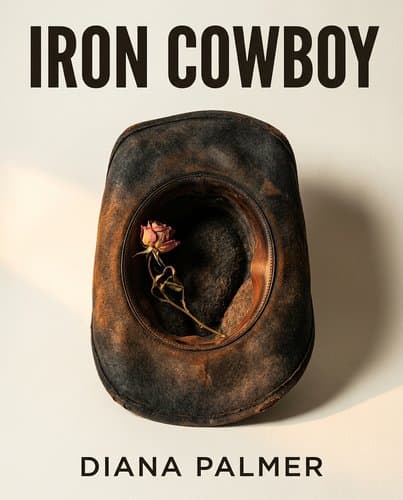
2081250_iron-cowboy
by Diana Palmer
Two people so shattered by loss that their brutal collisions feel like proof they're still alive—Palmer's wounded billionaire romance reveals how grief drives…
In Brief
Two people so shattered by loss that their brutal collisions feel like proof they're still alive—Palmer's wounded billionaire romance reveals how grief drives us toward intensity rather than safety, and why being chosen by someone secretly devastated feels more real than happiness ever could.
Key Ideas
Attraction grounded in shared grief
Diana Palmer's formula works emotionally because it grounds attraction in shared grief rather than shared happiness — the cemetery scene earns its power because both characters have lost everyone, and recognition of loss is the book's most genuine form of intimacy
Same intensity codes romance and assault
The same narrative move — coding Jared's intensity as romantic inevitability — functions as seduction in Chapter 5 and as the mechanism of assault in Chapter 7; the book uses a single tonal register for both, which is why the Chapter 7 scene produces such discomfort without the story acknowledging a shift has occurred
Tony's disgust reveals moral crisis
Tony 'the Dancer' is the book's most reliable moral compass: his disgust at Jared's post-encounter cruelty is the clearest signal the text offers that something went wrong, making his presence in the wedding ending both a comfort and an unresolved question
Self-harm agency mirrors assault vulnerability
Sara's act of self-harm to fake her own death is the novel's most striking image of female agency — and the fact that it occurs in the same chapter as her assault, with no narrative bridge between them, is the book's most honest admission of the contradictions it's carrying
Being chosen by the devastated
Category romance at its best externalizes a real emotional truth — that grief drives people toward intensity rather than safety — and the Diana Palmer variant is unusually direct about that logic; readers who return to this genre repeatedly may be drawn less to the wealth fantasy than to the specific feeling of being chosen by someone who is also, secretly, devastated
Who Should Read This
Readers interested in Novels and Relationships, looking for practical insights they can apply to their own lives.
Iron Cowboy
By Diana Palmer
9 min read
Why does it matter? Because the book that makes millions of readers swoon and cringe at the same time is doing something more complicated than wish-fulfillment.
Most people assume category romance is comfort food — predictable, soft, easy to digest. Diana Palmer's Iron Cowboy is comfort food the way a shot of whiskey is a beverage. Technically accurate. Misses the point entirely. What Palmer is actually doing, underneath the brooding billionaire and the fragile small-town girl, is staging a collision between two people so hollowed out by loss that ordinary tenderness feels thin and unconvincing. The complication is that the same scenes delivering that raw, almost unbearable recognition can also make you put the book down and stare at the wall. Holding both things at once — the fantasy and the trouble inside it — is exactly what this book demands.
Two Broken People Meet in a Cemetery, and That's Not a Metaphor — It's the Whole Engine
Jared Cameron is standing at a child's grave on Father's Day when Sara Dobbs walks up behind him and reads the headstone. Ellen Marist Cameron would have been nine years old that day. She'd gone to the zoo with a friend's family and on the way home, a drunk driver crossed the median and hit the car on the side where she was sitting. She died instantly. A week later, Jared's wife overdosed. He says this to Sara with the flat affect of someone who has rehearsed the facts into something bearable — and then his voice breaks anyway on the phrase "a child of great promise."
Sara came to the same cemetery to talk to her grandfather, who was, she says simply, all the family she had left. Two people, different griefs, same graveyard on the same afternoon. It would read as heavy-handed symbolism if Palmer didn't immediately do something disarmingly human with it: Sara steps forward and wraps her arms around this man she barely likes — he's been rude about her car, her raincoat, her mismatched clothes — and holds on. No speech. No calculation. Just a person recognizing that another person is drowning.
He stiffens, then holds her back. The wind moves through the trees around them.
What makes this work is the thing Sara says before she does it: "It hurts more not to talk about them." She isn't offering comfort from a position of wisdom. She's stating a fact she learned the hard way, about her own losses. That's what she gives him — not sympathy, but recognition. Two people who understand that grief doesn't want managing, it wants witnessing.
The rest of the setup follows from this moment. They form a quiet agreement, no promises attached: if either of them gets sick, the other will be there, because there's no one else. A pact between two people who have stopped expecting permanence from anyone. It gets tested almost immediately when Sara's vague stomach pain turns out to be a ruptured appendix and she ends up in emergency surgery. Jared stays. He doesn't make it romantic or significant — he just stays, because that's what he said he would do.
The Fantasy Runs Deeper Than Money: What the 'Iron Cowboy' Is Actually Selling
Tony Danzetta is Jared Cameron's bodyguard — a Cherokee man wanted in two or three countries, depending on who you ask. He fills a doorway and moves quietly enough that people step back without knowing why. He can shoot pennies off clothespins without touching the pins. He has eaten snakes in Malaysia and, on one occasion he declines to elaborate on, a cat. When Sara Dobbs lands in the hospital with a ruptured appendix and her elderly tabby Morris stops eating out of distress, Tony picks the lock on her apartment, feeds the cat, and then — because Morris still won't eat — loads the animal into a laundry hamper lined with a crocheted afghan and brings him to the ranch to recover alongside his owner. Jared explains this to Sara by displaying a hand covered in colorful bandages from where Morris bit him during transport. The bodyguard wanted in multiple jurisdictions is fine. The billionaire got bitten repeatedly and kept going.
Jared has a staff. He has a White Horse Ranch with wells sunk in every pasture so his cattle have water during a drought while everyone else's fields crack. He has a sleek attorney named Max who arrives by stretch limo and dresses like she's walking into a magazine shoot. He has enough financial weight that he negotiates his own security arrangements with federal agencies rather than simply complying with them. None of that is what makes him a romance hero. What makes him a romance hero is that he reads Rommel and Montgomery for pleasure, knows grief from the inside out, and sends his terrifying associate to break into an apartment at night because a cat is sad.
The billionaire romance fantasy is almost never really about money. The wealth makes the gesture possible. The gesture is what makes it matter. What the genre sells is this: someone powerful enough to have anything chooses you, and turns out to be privately undone in ways that need exactly what you have to offer. The permission slip and the devastation come as a set.
She Is Wise About Grief and Catastrophically Blind to Danger — the Book Needs Both at Once
Sara knows, on instinct, that grief wants witnessing rather than management. She demonstrates this in the cemetery without being taught, without hesitating. That same woman, three chapters later, will walk directly toward harm without registering it.
The book makes this possible by coding Jared's escalating pressure as romantic intensity, so Sara's failure to read danger looks indistinguishable from desire. The groundwork is laid early. When Harley Fowler, the decent local cowboy who would never dream of frightening anyone, kisses Sara, she feels nothing. When Jared touches her hair, she feels a thrill. Palmer makes this explicit so the reader absorbs the lesson: with Harley, no spark; with Jared, the charge in the air is almost visible.
So when Jared carries Sara into her own house after her appendectomy — she is still healing from surgery, he has been drinking — and the encounter moves past what she agreed to or anticipated, the narrative has already done its work. His rough insistence has been framed, scene by scene, as the language of a man too undone by her to hold back. When she tries to stop him and can't, the book offers his earlier disclosure — 'when you smile, the emptiness goes away' — as the explanation. The reader has been handed the key and told it opens everything.
The rupture the story creates and then papers over is right there in Chapter 7, written with enough clinical clarity that you register what happened. His control is gone, she is in pain, she is crying afterward, and his first instinct upon understanding what he has done is to accuse her of engineering it for financial advantage. These are not the beats of a consummated romance. But the way the book has been teaching you to read Jared — the intensity coded as desire, the prior tenderness weaponized as context — asks you to hold those two readings simultaneously and decide they are the same thing. Many readers will. That's what the book is built for.
Chapter 7 Asks You to Hold Two Things That Won't Fit Together
Tony Danzetta walks out. That's the detail the book hands you like evidence. The mercenary who has eaten snakes in Malaysia, who has worked for Jared Cameron through things the novel doesn't fully name, looks at what Jared did to Sara and quits. He doesn't negotiate a severance or file a complaint. He leaves. The book's most morally uncomplicated character — the man who earlier risked cat bites to comfort a grieving tabby — draws a line, and Jared is on the wrong side of it.
Here is what Tony witnessed. After Jared drinks too many beers and pushes past Sara's attempt to stop him, the scene doesn't cut to morning light and tangled sheets. Palmer writes it through Sara's body: the pain where pleasure had been, the sobs she can't contain, the misery that is audible rather than hidden. Jared returns to himself and registers all of it. And then, instead of reaching for her, his first instinct is accusation. He calls her mercenary. He suggests she planned the whole thing. He threatens, if she's pregnant, to force a termination. The cruelty arrives precisely where comfort should be, filling the space where a different kind of man would have been devastated by his own failure.
You can feel the book straining at this point. It has spent six chapters building Jared as a man defined by his capacity for grief, his tenderness with loss, his willingness to stay when staying costs him something. That man and the man delivering threats over a woman's broken sobs are not easy to reconcile. You reach for the earlier version — the one at the graveside, the one who said her smile made the emptiness go away — and use him to explain the later one. Intensity bled into carelessness, beer and abstinence stripped his control, he panicked when he understood what she'd never told him. The book offers all of this as context.
But Tony doesn't accept it. And Tony is the book's own conscience speaking. When the character whose entire function has been loyal protection walks out in disgust, the novel is acknowledging, briefly and then quickly moving past, that what happened in that room was a wound. Not a rough seduction that landed wrong. A wound.
Holding both readings at once — the romantic arc the genre is building toward, and what the text actually describes — is the specific discomfort Chapter 7 creates and never resolves. This isn't a reason to put the book down. It's a reason to read it with your eyes open, because the genre earns nothing by pretending the seams aren't there.
Sara Stabs Herself to Fake Her Own Death, and This Is the Book's Most Honest Scene
The kidnapping attempt happens fast. Two men grab Sara outside the bookstore where she works. They want Jared — he's a multimillionaire oil tycoon, and some South American operation has decided he's worth leveraging — and Sara is the lever. What she does next is remarkable: she reaches into her pocket, takes out a small knife, and drives it into her own appendectomy incision. The wound is still healing. She makes herself bleed, makes herself look like someone dying or suicidal or both, and the kidnappers back off from a hostage who appears to be actively killing herself. She bought her own freedom with a move that required nerve, timing, and the cold calculation that pain now is better than wherever these men were taking her.
The book finds this impressive. It should. But this is the same chapter, the same narrative hand, that twenty pages earlier wrote Sara as someone who couldn't find the words to stop Jared. The woman who just outwitted professional criminals by stabbing herself went home that night and sobbed, unable to move, while the man she loved accused her of staging the whole thing for financial gain. The contrast doesn't explain itself. The book doesn't try.
What it accidentally reveals is simple: Sara is most completely herself when the threat is clear and Jared isn't in the room. The genre needs her helpless in his arms and resourceful everywhere else, and in Chapter 7, Palmer stacks both versions so close together that the seam splits open. Later, in Chapter 12, he becomes tender enough that the reader almost forgives it. Almost. The pocketknife makes sure you remember what the softness is sitting on top of.
The Wedding Happens, the Reckoning Doesn't — and That Gap Is the Whole Genre
The gap between what Jared did in Chapter 7 and how the book ends is not an accident. It's the product being sold.
Chapter 12 delivers everything the genre promises. The kidnapping plot resolves with tactical elegance — Tony wired in a van with kidnappers who don't know he understands their language, armed with a garrote concealed in his watch and a commando knife inside his slacks, listening in Arabic to the plan to kill Sara, then Tony, then Jared once the ransom clears. He can't react without revealing he understood, so he nods along and makes belligerent remarks about how Jared is his to deal with personally. The thriller mechanics are fully committed, the trap closes, the bad men are taken. And then the book pivots entirely to feelings.
Jared proposes. He promises a bookstore with a children's activity center. He maps out a future involving snack shops and Oklahoma City. When Sara tells him, with quiet relief, that she isn't pregnant — 'something monthly started up this morning' — he doesn't flinch. He says they can grow together first, build the foundation before the family. It's tender. It's attentive. It sits directly on top of the scene where he threatened, over her sobs, to force a termination if she was carrying his child.
The wedding happens. Mercenaries and Jacobsville locals fill the same room. Morris the cat rides to the reception in a chauffeured limousine tucked inside a crocheted afghan, which is either the most absurd detail in the book or its most honest one — a declaration that this world runs on warmth, that chosen family includes the traumatized tabby, that the community is large enough for everyone.
What the book is doing here is worth naming: grief makes people reach for intensity over safety. When loss has reduced you to the bone, the person who makes the emptiness go away feels like the one thing you can trust. The romance genre takes that psychological logic and externalizes it into plot. Tony's moral verdict gets folded into the thriller and discharged there. The cat in the limousine tells you the story ended warmly. You are invited to let the warmth be enough.
The book doesn't ask you to forget Chapter 7. It asks you to weigh it against the wedding, the bookstore, the man who stayed at the hospital.
What the Mercs at the Wedding Are Actually Celebrating
Here is what stays with you: Morris the cat arriving at a wedding reception in a limousine, wrapped in a crocheted afghan, while Tony — who has eaten things in Malaysia he won't discuss, who quit in moral disgust over what Jared did to Sara, who spent an afternoon nodding along to a murder plan while hiding a garrote in his watch — takes his seat among the guests like it's the most natural thing in the world. Diana Palmer is not pretending the wound didn't happen. She's making a different bet: that chosen-ness, even when it costs something, even when it arrives imperfect and unearned, is what broken people actually reach for. Grief doesn't drive you toward safety. It drives you toward the person who makes the emptiness quiet. The romance genre has always understood that. The readers who love this book and the readers who can't finish it are usually responding to the exact same pull.
Notable Quotes
“I come to talk to my grandad,”
“He died recently of a massive coronary. He was all the family I had left.”
“He looked out across the crop of tombstones with blank eyes.”
Frequently Asked Questions
- What is Iron Cowboy by Diana Palmer about?
- Iron Cowboy (2008) is a category romance centering on a wounded billionaire rancher and a small-town woman who are brought together by shared grief and volatile attraction. The novel delivers emotional intensity through Palmer's signature formula: desire rooted in loss, high-stakes conflict, and eventual resolution. The story provides readers with a concentrated portrait of how devastation and longing intersect, exploring the complex emotional landscape where two people find connection through their mutual experience of loss and their fierce attraction to each other.
- How does Diana Palmer's formula work in Iron Cowboy?
- Diana Palmer's formula works emotionally because it grounds attraction in shared grief rather than shared happiness. The cemetery scene earns its power because both characters have lost everyone, and recognition of loss becomes the book's most genuine form of intimacy. This approach inverts traditional romance by making devastation itself the foundation of connection. Palmer's method demonstrates that grief drives people toward intensity rather than safety, and the specific emotional truth the novel externalizes is that being chosen by someone who is also secretly devastated creates a unique form of emotional resonance.
- What are the narrative issues in Iron Cowboy?
- Iron Cowboy uses a single tonal register for both seduction and violation, creating discomfort without acknowledging the shift. The narrative move that codes Jared's intensity as romantic inevitability functions as seduction in Chapter 5, but operates as the mechanism of assault in Chapter 7. Because the book employs the same emotional language for both scenes, the Chapter 7 scene produces significant discomfort without the story acknowledging that something fundamentally has changed. This tonal consistency masks a crucial distinction in consent and agency, leaving readers with unresolved tension that the narrative itself fails to address.
- What is the significance of Sara's self-harm in Iron Cowboy?
- Sara's act of self-harm to fake her own death is the novel's most striking image of female agency. It occurs in the same chapter as her assault, with no narrative bridge between them, which is the book's most honest admission of the contradictions it's carrying. The juxtaposition reveals how the novel simultaneously presents female agency and female violation without reconciling them. The text uses the same emotional register for scenes of empowerment and harm, leaving the contradiction unresolved. This placement forces readers to confront the uncomfortable truth that the narrative cannot integrate these contradictory elements.
Related Book Summaries
Read the full summary of 2081250_iron-cowboy on InShort