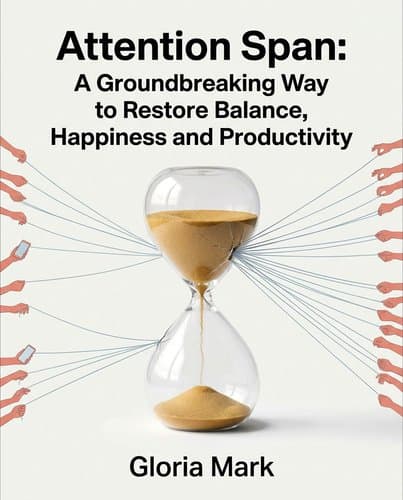
60795084_attention-span
by Gloria Mark
Your fractured focus isn't a willpower problem—it's an engineered outcome. Cognitive scientist Gloria Mark reveals how algorithms and workplace culture…
In Brief
Attention Span: A Groundbreaking Way to Restore Balance, Happiness and Productivity (2023) explains why chronic distraction is a systemic problem — engineered by algorithms, workplace culture, and interface design — not a failure of personal discipline.
Key Ideas
Assess energy fuel, not just time
Before starting high-stakes work, check your resource level honestly — not just whether you have time, but whether you have fuel. Difficult creative work done at 3 p.m. after six hours of meetings produces worse outcomes than the same work done at 11 a.m. with a clear schedule.
Budget recovery time per interruption
Budget 25 minutes of recovery time per significant interruption, not just the interruption duration. If you have a deliverable due today, design your morning around fewer context switches, not more hours.
Distinguish genuine recovery from avoidance
Rote activity (simple games, light scrolling, unchallenging tasks) is legitimate cognitive recovery — empirically the highest-happiness attentional state — but practice meta-awareness to distinguish 'replenishing' from 'avoiding difficult work I need to do.'
Rhythm beats flow as productivity model
Stop chasing flow as the benchmark for a good workday. Flow is rare in knowledge work. The productive target is rhythmic movement between focused work and genuine low-demand recovery — your attentional states follow a natural daily arc, and working with it is more sustainable than fighting it.
Visualize end-of-day before distraction impulses
Before opening a distracting app or game, run a 10-second forethought exercise: visualize your end-of-day in detail — not abstractly, but emotionally — and include what you will have finished and how you will feel. The more concrete the image, the more likely your current choice aligns with your actual goals.
Know your self-control type first
Blocking software is not a universal fix: high-self-control people are measurably harmed by it (it removes micro-breaks they use as a self-regulation tool); low-self-control people benefit. Know which you are before installing anything.
Add friction to bad habit impulses
Your impulse to check your phone often fires before you are consciously aware of it — muscle memory activates the schema before deliberate choice catches up. Reducing friction for good habits and adding friction for bad ones (phone in another room, distracting apps hidden) is more effective than willpower applied after the impulse has already fired.
Who Should Read This
Curious readers interested in Focus and Cognitive Psychology and the science of how the mind actually works.
Attention Span: A Groundbreaking Way to Restore Balance, Happiness and Productivity
By Gloria Mark
10 min read
Why does it matter? Because your distraction is not a character flaw—it's a measurement.
You probably think your attention is a character issue. Some people have it, some don't, and if you can't get through forty minutes without checking your phone, that says something about you.
It's not a willpower story. Gloria Mark spent two decades measuring exactly this — not theorizing about it, not running surveys, but logging every screen switch, every app change, every detour from the task at hand across thousands of hours of real work. Her answer is not what most people expect, and it changes what a real solution looks like.
Your Attention Has Declined to 47 Seconds—and It's Been Falling for Twenty Years
Your inability to focus is not a character flaw. It is a measured, two-decade trend — and it is getting worse.
Gloria Mark, a psychologist, spent twenty years tracking one thing: how long knowledge workers actually stay on a single screen before switching to another. The method was unobtrusive: software recording every switch between applications, websites, and windows, through thousands of hours of observation covering managers, financial analysts, software developers, and administrative assistants. The data runs from 2004 to 2021.
In 2004, the average time on any screen before switching was 150 seconds (two and a half minutes). By 2012, it had dropped to 75 seconds. By 2016, it had settled around 47 seconds, where it has held ever since. Two independent teams got there separately: a Microsoft Research group logging 20 software developers over 11 workdays found 50 seconds; Mark's own doctoral student, Fatema Akbar, measured 50 office workers across 3–4 weeks and arrived at 44 seconds. Three research efforts, different populations, same curve. The convergence matters more than the precision. Something happened over those two decades that cut sustained screen attention in half, and then in half again.
There's one more detail from 2016 worth noting. The median was 40 seconds — the midpoint, meaning half of all observed attention episodes were shorter than that. The average of 47 isn't pulled up by long focused stretches with occasional glances. The distribution is just short, across the board.
None of this breaks down by job type or generation. Boomers, millennials, Gen Z: same pattern. Senior researchers, junior admins, people coding complex software: every subgroup landed on the same curve. That's what makes self-blame structurally incoherent: if your attention were a personal failing, you'd expect it to cluster in certain kinds of people. It doesn't. It's a feature of the environment, not the person inside it.
Your Brain Runs on a Fuel Tank That Empties by Noon
Imagine your capacity for focused work as a tank of gas with no refill station within reach. You start the morning full. Each email you process, each meeting you sit through, each notification you resist burns some of it. By midafternoon, you're running on fumes. The default destination becomes social media, not the quarterly report.
This isn't a metaphor. It maps onto brain physiology.
Psychologists call it cognitive resource theory, and it traces back at least to Roy Baumeister's ego depletion research in the late 1990s. The premise: the mind maintains a finite pool of attentional capacity, and processing information draws from it. When demands exceed what's available, performance degrades. The reason you reach for your phone at 3 p.m. is depletion.
The physiology is measurable. When you focus on a demanding task, a brain region becomes metabolically active, consuming oxygen and producing carbon dioxide; vessels dilate to carry the waste away. During sustained focus, blood velocity gradually decreases, suggesting resources aren't being replenished while the task continues. The tank empties in real time, through the blood.
Blain, Hollard, and Pessiglione ran the six-hour version of this. Participants spent a day on demanding cognitive work, periodically choosing between a delayed 100-euro reward and a smaller immediate payout. Early on, most waited for the larger sum. By hour six, they increasingly took the lesser amount — and brain scans traced the shift to decreased activity in the region governing self-regulation. A depleted brain takes the easy reward. That's the mechanism behind the afternoon scroll.
Attention is a resource you spend and must replenish. That constraint explains the 47-second average, the 3 p.m. crash, and the gravitational pull of distraction. What drains it fastest has a more unsettling answer than most people expect.
The Internet Wasn't Built to Distract You—It Was Built to Think Like You, Which Is Worse
Gloria Mark is being followed by a pair of boots. She clicked on them once, on a shopping site, and now they appear everywhere — in The New York Times, on Facebook, next to a tribute to Rolling Stones drummer Charlie Watts, where they read as rocker boots. She knows exactly how it works. She studies attention for a living. And still she can't stop noticing them.
That's the tell. The problem isn't discipline. It was never the right frame.
Most advice about digital distraction treats it as a habit problem: turn off notifications, use an app blocker, schedule phone-free hours. That's a mop against a flood. The architecture of the internet and the algorithms running on it were built, deliberately and with deep knowledge of human psychology, to make distraction the predictable outcome.
The architecture traces back to 1945, when engineer Vannevar Bush published a proposal in The Atlantic for a device he called the Memex. The problem Bush identified was simple: existing information systems organized knowledge the way librarians found convenient, not the way human minds actually work. The Dewey decimal system sorts things by category. To find what you need, you have to translate your thoughts into someone else's taxonomy. Bush wanted to flip that. His Memex would organize information by association, the way memory does. Think of pizza and your mind connects to cheese, to a specific restaurant, to a friend you ate there with. The Memex would link documents the same way, so following a thought from one to the next felt as natural as thinking.
That's what the internet became. The node-and-link structure of every web page is a direct implementation of Bush's associative indexing, modeled explicitly on how semantic memory works. When you're reading a Wikipedia page about a documentary and one name catches your eye, and you click it, and an hour later you're deep in the history of the Harlem Renaissance — you didn't fail at focus. You followed a chain of associations the system was engineered to make irresistible. The click isn't a decision. It's a reflex the architecture was built to trigger.
Then the algorithms arrive on top of that structure, and the problem compounds. Every platform has been assembling a psychographic profile of you since the first day you used it. Cambridge Analytica's researchers found that analyzing just 300 of your Facebook likes lets an algorithm predict your Big Five personality traits better than your romantic partner can. That data feeds engines that know your emotional frequency, your moments of depletion, and exactly which content will pull curiosity or laughter or anxiety at the lowest point of your afternoon.
The boots aren't following Mark because she has weak willpower. They're following her because she's connected to a system designed, from its foundational architecture to its outermost algorithms, to find the exact moment she's most likely to say yes.
The Most Productive Thing You Did Today Might Have Been Candy Crush
What state are you trying to reach when you sit down to do your best work? Most people would say flow. Mihaly Csikszentmihalyi, the psychologist who coined the term, defined it as total absorption so complete that time dissolves. The problem is that almost nobody actually reaches it.
A mid-1990s survey Csikszentmihalyi ran found that 42 percent of Americans and 35 percent of Germans rarely or never experience it. Mark's own years of workplace observation confirmed the same: in knowledge work, flow almost never appears. Competing tasks and constant interruptions make it nearly impossible.
So the dominant model — strive for flow, treat anything less as failure — is wrong. Here's what Mark found instead.
Working at Microsoft Research, she and colleagues mapped attentional states along two axes: engagement and cognitive demand. Focus is high on both: demanding work that requires real effort. Rote is high on engagement but low on demand: scrolling social media, playing Candy Crush. Then they measured which states people actually inhabit, and how mood tracked with each.
They used experience-sampling: probes appeared on participants' computer screens 18 times a day for a full workweek, each prompting a report on engagement, challenge level, and mood. The expectation was that focused work would produce the best mood.
People were happiest during rote attention. Not flow, not focus — the mindless stuff. The reason is structural: focused work is both engaging and demanding, and the cognitive demand generates stress; stress suppresses positive emotion. Rote activity uses almost no resources while still delivering the subjective sense of doing something. It costs nothing and pays in mood.
There's a tension Mark doesn't fully resolve. The same Candy Crush and Twitter feeds that replenish cognitive resources are also the primary distraction channels she documents elsewhere. Rote activity restores you; uncontrolled rote activity is the depletion. The way through is a rhythm model: focus and rote as alternating phases, not competing failures. The goal isn't sustained deep work or surrendering to mindlessness. It's knowing which mode you're in and managing the switch.
One Interruption Doesn't Cost You Minutes—It Costs You the Next Half-Hour
A physician who'd heard about Mark's research once confessed something that should have sounded extreme: to write a grant proposal, he bought a round-trip flight from California to Washington, D.C. Not for a conference. For the Wi-Fi barrier. He lacked the discipline to stay off the internet at home. At 35,000 feet, he was safe.
That sounds neurotic until you see the numbers. When a significant interruption hits — one that lasts two minutes or more — people don't just lose the interruption time. Mark's workplace studies, tracking 36 knowledge workers across three companies, found that after a significant interruption, people took an average of 25 minutes and 26 seconds to return to their original task. They didn't go straight back, either. They worked through an average of more than two other tasks first, pulled from one thing to another before circling back. One interruption costs the next half-hour.
Psychologist Bluma Zeigarnik explained why in 1927. Working in a Berlin laboratory, she interrupted people mid-task, then later asked what they remembered. They recalled the interrupted tasks better than the completed ones. The finding: incompletion creates unresolved psychological tension, and that tension keeps the memory alive, cycling in the background, demanding return, quietly consuming resources. The Zeigarnik effect persists because incompletion signals the task as unresolved, and the mind keeps cycling that signal back into working memory until the loop closes or the task gets written down. Every half-finished document, every email thread left open, every task you were pulled away from adds to that drain.
The drain extends past the workday. A Baylor University team studied 57 people in a sleep laboratory, dividing them into two groups: one wrote down unfinished tasks before bed; the other wrote down tasks they'd already completed. The unfinished-tasks group fell asleep significantly faster. The more detailed their lists, the faster they dropped off. Writing the tasks down moved the Zeigarnik tension out of working memory and onto paper; the mind stopped rehearsing what wasn't done.
The doctor on the plane wasn't being dramatic. He was engineering a space the interruption machine couldn't reach. The data says he had the right idea.
You Can't Opt Out of the System—But You Can Learn to Move Through It with Intention
The most common fix for digital distraction is blocking software, and it backfires for the people who need it least. Mark has the data to show exactly how the split plays out.
Thirty-two knowledge workers used site-blocking tools for a week. The result divided cleanly along a personality line. People with low self-control reported less mental strain: removing the temptations they'd normally lose to relieved the exhausting work of constant resistance. But participants with strong self-control reported increased workload. For them, the blocked sites had been legitimate cognitive micro-breaks, low-stakes browsing that let the mind briefly decompress between demanding tasks. The software eliminated that valve. One participant missed her last commuter shuttle home. Another told Mark she felt noticeably more productive but also more tired. At the study's end, only two of the thirty-two continued using the software.
Most productivity advice ignores this split. The question isn't whether to reduce distraction but how, and the how has to match the person. More importantly, outsourcing your attention management to an app means never developing the capacity to manage it yourself. When the app is unavailable, the skill isn't there.
Mark proposes two internal tools: meta-awareness and forethought. Meta-awareness is the practice of noticing your own behavior in real time, catching yourself about to switch screens as the impulse forms, not forty minutes after you've surfaced from a TikTok spiral. It works through a single question inserted at the moment of temptation: what value will I actually get from this? The question sounds trivial. The pause it creates is not. Between the cue and the click is where agency lives, and meta-awareness makes that gap visible.
Forethought operates upstream. Before starting something you know can consume you, simulate your end-of-day in enough detail to create friction. Mark confesses she's genuinely unable to stop playing an anagram game once she starts. She won't rest until she reaches the highest level, and even success doesn't end the compulsion. Her rule is absolute: she doesn't open the game unless she can first picture, in specific detail, how playing it won't affect what she needs to finish that day: the document closed, the time still available, how she'll actually feel. Abstract good intentions produce no friction. Concrete visualization does.
Neither technique is easy. Both require catching yourself at the moment the reflex forms, before momentum takes over. The forces engineered to pull your attention away — algorithms, interface design, the social signals that make staying offline feel like missing out — won't diminish. But forethought and meta-awareness are learnable, and unlike any app, they travel with you.
The Goal Was Never Sustained Focus—It Was a Tank That Doesn't Run Dry
After a serious illness forced her to step back from the pace that had defined her career, Mark stopped asking how to be more productive and started asking something simpler: what keeps the tank from running empty? The shift, from output as the goal to well-being as the foundation, is the book's quiet thesis. Productivity, she concluded, is a byproduct. Chase it directly and you drain the very resource it requires.
What she's offering isn't a detox or a system. It's permission. Stop treating the valleys in your attention as failures — they're part of the arc. Design your mornings around your peaks, give rote activity its legitimate role as recovery, and practice catching yourself at the moment before the click. You cannot opt out of the system built to capture you. But the 47-second average is not a verdict on your character. It is a measurement of an environment. And environments, unlike character, can be worked with.
Notable Quotes
“and instead say the correct answer,”
“In order to perform the Stroop task accurately, one needs to actively maintain in one's mind the goal to”
“nothing else seems to matter.”
Frequently Asked Questions
- What is Attention Span by Gloria Mark about?
- Attention Span explains why chronic distraction is a systemic problem engineered by algorithms, workplace culture, and interface design—not a failure of personal discipline. Drawing on decades of field research, Gloria Mark demonstrates that attention works as a finite, depletable resource. The book provides evidence-based strategies for managing focus, structuring your day, and recovering effectively. Mark reveals that difficult creative work done at 3 p.m. after six hours of meetings produces worse outcomes than the same work done at 11 a.m. with a clear schedule. It challenges conventional productivity advice by offering practical frameworks for sustainable performance.
- Why does Gloria Mark say flow isn't the right productivity goal?
- Mark argues that flow is rare in knowledge work and shouldn't be your productivity benchmark. Instead, she recommends rhythmic movement between focused work and genuine low-demand recovery—your attentional states follow a natural daily arc, and working with it is more sustainable than fighting it. Rote activity like simple games and light scrolling provides legitimate cognitive recovery and the highest-happiness attentional state. The goal isn't constant peak performance but strategic variation that respects your brain's actual capacity and recovery needs.
- How much recovery time does Gloria Mark recommend after interruptions?
- Mark recommends budgeting 25 minutes of recovery time per significant interruption, not just the interruption duration itself. If you have a deliverable due today, design your morning around fewer context switches, not more hours. Research shows that after being interrupted, it takes substantial time for your attention to fully reset—the interruption is just the beginning of the cost. Understanding this timeline helps you schedule realistically and protect high-stakes work by frontloading it into your day when you have full cognitive capacity.
- What does Gloria Mark recommend before opening a distracting app?
- Before opening a distracting app or game, run a 10-second forethought exercise: visualize your end-of-day in detail—not abstractly, but emotionally—and include what you will have finished and how you will feel. The more concrete the image, the more likely your current choice aligns with your actual goals. This micro-intervention leverages how impulses fire before conscious awareness catches up. By creating a vivid, emotionally-resonant mental image of your desired end-state, you interrupt automatic patterns and align immediate choices with deeper intentions.
Related Book Summaries
Read the full summary of 60795084_attention-span on InShort