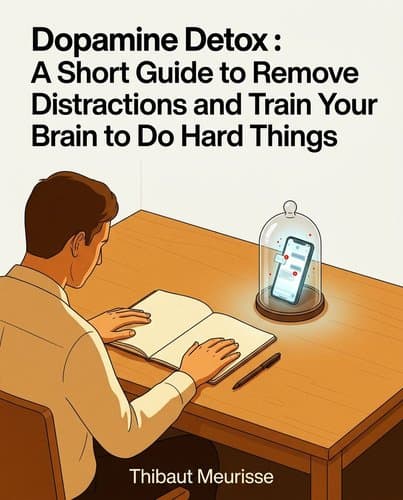
58503121_dopamine-detox
by Thibaut Meurisse
Your brain isn't broken — it's been hijacked by trillion-dollar attention systems that engineered chronic overstimulation. Deliberately lower your stimulation…
In Brief
Dopamine Detox : A Short Guide to Remove Distractions and Train Your Brain to Do Hard Things (2021) explains how chronic overstimulation from modern technology raises your dopamine baseline and makes focused work feel neurologically impossible.
Key Ideas
Dopamine fuels anticipation, not satisfaction
Recognize that dopamine drives anticipation, not satisfaction. The empty feeling after getting what you wanted is not a personal failure — it is how the mechanism works. Expecting stimulation to eventually resolve the craving is the trap.
Friction protects from biggest distraction
Add friction to your single biggest stimulation source first. Move your phone to another room, delete apps from your home screen, install Newsfeed Eradicator for Facebook, or DF Tube to remove YouTube recommendations. Start with one source — partial detoxes are more sustainable than complete ones.
Work first protects focus baseline
Start every working session with a closed system. Open your document or project file before you open email, any browser, or any social app. The first thing you open sets your stimulation baseline for the next hour.
Paper reminders beat digital impulses
Write your Cans and Can'ts list on paper and put it on your desk — not your phone. The physical reminder is the point. When the urge hits, the list is a decision prompt, not a rule you have to remember.
Relapse recovery beats guilt spirals
When you relapse, skip the guilt and restart the routine the next morning. The platforms are engineered to pull you back — occasional failure is the expected output of competing against trillion-dollar attention systems, not evidence that the approach doesn't work.
Friction cost outweighs reward value
Count the friction steps between you and each unwanted behavior. Every step added is a chance for laziness to work in your favor. The goal is not motivation — it is making the bad behavior cost more energy than it returns.
Who Should Read This
People working on personal growth in Focus and Habit Formation, especially those tired of generic motivational advice.
Dopamine Detox : A Short Guide to Remove Distractions and Train Your Brain to Do Hard Things
By Thibaut Meurisse & Kerry J. Donovan
8 min read
Why does it matter? Because procrastination isn't a character flaw — it's a calibration problem.
You've been telling yourself it's a discipline problem. That if you just cared more, tried harder, got up earlier, you'd finally do the thing. But discipline isn't why you spent forty minutes rearranging your desktop instead of opening the document. Something else is happening — something more mechanical.
Every app, every notification, every engineered food product has been raising the stimulation threshold your brain needs just to feel normal. Meaningful work hasn't gotten harder or less important. It's that sitting down to write, plan, or build now feels physically wrong — not because you lack motivation, but because the gap between stimulation and silence has become too wide to cross.
The gap is closeable. Not through willpower, but by building conditions where high stimulation isn't available, so your baseline drops and the work stops feeling like punishment.
Dopamine Doesn't Make You Feel Good — It Makes You Want More
Dopamine is not a pleasure chemical. That one correction changes everything about why you can't start the work that actually matters.
Here's what dopamine actually does: it fires when you anticipate a reward, not when you receive one. It evolved to keep our ancestors moving: hungry, motivated, relentlessly seeking food, shelter, mates. When a hunter spotted prey across a field, dopamine surged. That surge wasn't pleasure; it was urgency. The neurochemical equivalent of a gun going off at the starting line.
Notice what happens at the finish line. When the reward arrived — when the hunt succeeded — dopamine dropped. And in that drop was a hollowness where satisfaction was supposed to be.
You've felt this. You scroll to the end of your social media feed, close the app, and feel emptier than before you opened it. You finish a long email session and feel vaguely drained. You watch three YouTube videos when you meant to watch one, then sit there knowing you've wasted an hour and still want more. The reward never resolves the craving — because the craving was never about the reward. It was about the seeking.
Modern technology plugs directly into this loop. Social media, email, gaming, news: all of them optimized not to satisfy you, but to trigger the next anticipation cycle. A notification promises something. A headline teases a reveal. A recommended video hints at something worth watching. Each one fires dopamine through the suggestion of reward, never through its delivery. The loop keeps running because the resolution never comes.
And here's what that does to the work you actually want to do: it makes it feel impossible to start. When your brain has spent the morning in a high-stimulation seeking loop, pinging between emails, feeds, and videos, the sustained attention required to write a chapter, build a proposal, or tackle a real project feels like lifting against gravity. Those tasks don't promise a quick dopamine hit. They require you to sit with discomfort before any reward appears. Against a brain already flooded with seeking signals, that discomfort feels insurmountable. An invisible barrier, impossible to cross. The loop is working exactly as it was designed to. The problem was never you.
That's the starting point. None of this got here by accident.
The Platforms Are Engineered to Exploit Your Brain — And the Casualty Is Your Long-Term Thinking
One of the engineers who built Facebook's notification system eventually stood up in front of an audience and said he was sorry. His name is Chamath Palihapitiya: years at Facebook, senior enough to know exactly what he'd helped ship. The products, he told the crowd, "wire your brain for super-fast feedback." What makes that unusual isn't the conclusion. It's who's delivering it — and what it admits: the loop wasn't accidental. It was designed.
The mechanism works like a slot machine because the underlying design is identical. Slot machines pay on deliberately irregular schedules. Unpredictability is what makes them compulsive. A machine that paid every third pull would bore you; one that pays at random keeps you pulling because any pull might be the one. Facebook, Instagram, and YouTube use the same logic. Most notifications are nothing — a spam like, an irrelevant tag. But occasionally one delivers something real: a message from someone you care about, a reply that matters. Because you can't predict which, every red dot feels urgent. The notification doesn't inform you. It commands you.
What drains in the process isn't just time. Harvard researcher Edward Banfield spent decades studying why some people succeed long-term while others don't. His conclusion: the single most important predictor of financial and personal success is long-time perspective, the ability to think several years ahead while making decisions in the present. The slot-machine loop attacks this directly. When your brain is conditioned to expect a hit within seconds, it starts applying that expectation to everything. Real goals that take years start to feel broken. In practice, that shows up as taking the higher salary over the better career path, selling investments the moment they're up, or dropping any project that doesn't show results within a week. Patience stops feeling like a virtue and starts feeling like evidence that something's wrong with you.
The argument is about engineering, not willpower. Unpredictable reward schedules are the design, not a side effect. Engagement drives advertising revenue, so every architectural choice that keeps you scrolling longer is a profitable one. Your attention is the product. Time is the visible cost. The real one is the capacity to think in years.
Willpower Won't Save You — But a Modem in a Storage Room Might
One afternoon, the author carried his internet modem four floors down to his building's storage room and locked it away. Not because he was unusually disciplined. Because he was betting on the opposite — that he was fundamentally lazy.
Getting the modem back meant leaving the apartment, calling the elevator, descending four floors, opening four separate doors to reach the storage room, then reversing the entire sequence to return. Twelve discrete steps between him and the internet. Twelve moments where his brain could calculate the effort and decide it wasn't worth it.
It worked. Not because he grew stronger. Because he made the pull weaker.
The claim is deliberately unflattering: humans avoid wasting energy whenever possible. We resist effort by default. Every friction point between us and a behavior is a small tax the brain must decide to pay. Add enough tax and the behavior stops happening. Not through discipline. Through inertia. The modem wasn't gone. But twelve steps away might as well be a different country when you're trying to "just quickly check something."
Willpower keeps failing most people for a structural reason. You resolve every night to use your phone less and spend every morning ignoring that resolution, not because your character is weak but because you're trying to win a contest between intention and an engineered pull that operates below the level of conscious choice. The phone is in your pocket. The tab is already open. The friction is zero. Of course you lose.
The fix is structural. Make unwanted behaviors mechanically harder. Phone in the next room instead of on your desk. Notifications off. Browser extensions like Newsfeed Eradicator strip the Facebook feed down to a blank page, turning a casino into a utility. DF Tube removes YouTube's recommendation queue so you can watch one video you chose, not whatever autoplay selects next.
The same logic runs in reverse. Reduce friction for what you actually want to do. His own setup: word processor open the night before, music already playing, timer set for forty-five minutes. Once the session is running, stopping it feels like wasted energy. The brain resists closing a document it just opened, halting music mid-block. The laziness that creates the problem becomes the mechanism that solves it.
This is not about motivation. You don't need to want to write more than you want to scroll. You just need twelve steps between you and scrolling, and zero steps between you and writing. The brain will do its lazy math from there.
The practical starting point is simple: draw two columns on paper. One side holds what you'll allow — offline reading, a focused writing session, a specific task list. The other holds what's off-limits: social feeds, news sites, YouTube autoplay. Then (this is where most people skip a step) physically redesign your environment to impose friction on the second list and remove it from the first. Not a one-time inspiration project. A durable system. The modem doesn't move itself back upstairs. That's the whole point.
The First Thing You Open in the Morning Sets Your Stimulation Baseline for the Day
What difference does it make whether you check email before starting work, or after? The task is the same either way. Surely it evens out.
It doesn't.
Before opening anything else on his computer each morning, Meurisse opens the file for whatever book he's currently writing. He doesn't check his phone. He doesn't glance at email. The day begins in one specific kind of application. He argues that choice explains more about his daily output than any motivation technique or goal-setting system.
The vocabulary he uses to explain it: open systems versus closed systems. An open system — email, social media, any browser tab pointed at the internet — has no finish line. There is no inbox that empties, no feed that ends. Every click opens three new branches; every reply generates two more. You can't complete an open system; you can only abandon it. And when you finally do, your brain is running hot: stimulation elevated, seeking mode active, the loop still spinning.
A closed system is just a file — whatever the work actually is — with nowhere to go but the work itself. No recommendations, no notifications, no branching paths. Open a manuscript, and the only thing available is the manuscript.
Here's why the sequence matters. A dopamine detox lowers your baseline arousal, reducing stimulation until the friction of hard cognitive work drops to something manageable. Spend your first thirty minutes in an open system and you've already burned that effect. Your brain, fresh off a social media loop, is calibrated to fast feedback. A 45-minute writing block offers no fast feedback. Against a brain already revved up by seeking, the task feels wrong. Not hard. Wrong.
Start in a closed system and you carry the low-stimulation state intact into the first work block. The detox protected it. The sequence preserves it.
What matters is what you open first. One choice sets the arousal baseline everything else runs on. Meurisse describes it as "just one tiny decision" that can reshape an entire day. Stimulation propagates forward. Start low, and the hard work feels workable. Start high, and every task you care about has to fight through the noise you created before 9 a.m.
No willpower required. Just open the manuscript before the inbox.
Your Focus Is Worth Money to You — and to Trillion-Dollar Platforms That Want It First
Think of your attention as a plot of commercial real estate in the most valuable district on earth. You have plans for it — deep work, meaningful relationships, the projects that matter. But you are not the only bidder. Instagram, YouTube, and Facebook have been acquiring land in that district for over a decade, with advantages you don't have: engineering teams, behavioral psychologists, and a business model that depends entirely on winning more of your hours than you intended to give.
The struggle to stay focused isn't a willpower contest. It's a resource competition, and you're competing against organizations whose revenue scales directly with how long your attention stays on their platforms. They have a financial stake in the scrolling.
Which means relapse was never evidence of personal failure. It was the expected outcome of stepping away from your phone for three days and returning it to your pocket in an unchanged world. The notifications still arrive. Guilt about the relapse is worse than useless. It consumes the same attention the platforms do, while producing nothing. The prescription is mechanical: restart the routine, one day at a time, no drama.
The structural fix runs on two tracks. Keep the environmental changes intact: friction on the feeds, closed systems before open ones, the modem still in the storage room. Those aren't one-time inspiration projects; they're the permanent conditions that make the next restart easier. And actively cultivate the "here-and-now" neurotransmitters: endorphin, oxytocin, serotonin. Unlike dopamine, which sharpens hunger for the next hit, these rise in states of presence and contentment; they don't create an itch, they quiet one. A slow walk where you actually look at things. A meal where you notice the taste. Time with someone you care about, without a screen. These don't compete with platforms on stimulation. They run on a different register.
The sharpest claim the book saves for last: excitement and fulfillment are not on the same spectrum. Excitement is external stimulation generating more hunger for stimulation. Fulfillment surfaces when the seeking stops — when you're deep enough in work, a relationship, or even boredom, that the itch quiets. They don't trade off. They're in opposition. The more time you spend chasing notifications, the further you get from the state where they'd stop mattering.
The platforms know your focus is worth money. The question is whether you do.
The Work You Keep Avoiding Is the Only Place Fulfillment Lives
You have the map now. You know the mechanism — what the pull is, where it comes from, why willpower alone keeps losing. The only question left is what you do the next time you feel it.
Not someday. The next time. When the work gets hard and the phone is right there, and you know exactly what will happen if you pick it up — and you pick it up anyway. That moment is the whole game. The book spent two hundred pages giving you language for it. Using the language costs nothing. Moving a router to a storage room (or whatever your equivalent is) costs maybe fifteen minutes and a little embarrassment. The gap between knowing and doing is where most people live permanently.
That's the bet Newport is making: that you're not most people.
Notable Quotes
“was the most important determinant of financial and personal success in life.”
“ability to think several years into the future while making decisions in the present.”
“wire your brain for super-fast feedback.”
Frequently Asked Questions
- What does Dopamine Detox explain about modern overstimulation?
- The book explains how chronic overstimulation from modern technology raises your dopamine baseline and makes focused work feel neurologically impossible. This creates a cycle where constant exposure to high-stimulation sources trains your brain to need more stimulation to feel rewarded. When you're always chasing notifications and social media updates, your brain adapts by raising what qualifies as rewarding. The solution involves adding friction to these stimulation sources and resetting your baseline so meaningful work becomes accessible again without relying on willpower or constant external rewards.
- What practical techniques does the book recommend for dopamine detox?
- "Add friction to your single biggest stimulation source first." Start by moving your phone to another room, deleting apps from your home screen, or installing tools like Newsfeed Eradicator for Facebook and DF Tube for YouTube—"partial detoxes are more sustainable than complete ones." Another technique: start every working session with a closed system, opening your project file before email or social apps. Write your Cans and Can'ts list on paper and place it on your desk. These methods leverage friction so unwanted behaviors cost more energy than they return.
- How should you respond to relapse during a dopamine detox?
- When you relapse, "skip the guilt and restart the routine the next morning." "The platforms are engineered to pull you back — occasional failure is the expected output of competing against trillion-dollar attention systems, not evidence that the approach doesn't work." Relapses don't indicate weakness. Instead of dwelling on guilt, which triggers another stimulation-seeking cycle, simply resume your practices the next day. This perspective removes the shame spiral that derails personal change. Accepting that occasional failure is normal when competing against attention-hijacking systems allows you to maintain momentum toward your goals.
- What is the key insight about dopamine and satisfaction?
- Dopamine drives anticipation, not satisfaction. "The empty feeling after getting what you wanted is not a personal failure — it is how the mechanism works." This explains why chasing stimulation to resolve your craving fails: each satisfied desire only resets the cycle. "Expecting stimulation to eventually resolve the craving is the trap." Understanding this neurological truth fundamentally changes strategy—instead of seeking more stimulation, you focus on resetting your dopamine baseline so meaningful work becomes accessible again without relying on willpower or constant external rewards.
Related Book Summaries
Read the full summary of 58503121_dopamine-detox on InShort