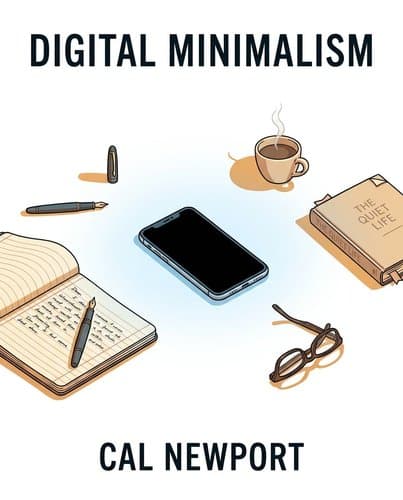
40405444_digital-minimalism
by Cal Newport
Your phone isn't a neutral tool—it's a precision-engineered attention trap built by corporations using psychology against you. Newport shows you how to fight…
In Brief
Your phone isn't a neutral tool—it's a precision-engineered attention trap built by corporations using psychology against you. Newport shows you how to fight back not with willpower or screen-time limits, but by reasoning from your deepest values to decide exactly which technology earns a place in your life.
Key Ideas
Evaluate digital tools against your core values
Before adopting any digital tool, ask three questions: Does this serve something I deeply value? Is it the best way to serve that value (or would a monthly phone call accomplish more than daily Instagram browsing)? How specifically will I use it — and how will I know when I've drifted into compulsive territory?
Use friction to prevent compulsive app use
Delete social media apps from your phone but keep browser access if you want it. Mobile is where the attention engineering is most sophisticated; removing the apps forces a small friction that dramatically cuts compulsive use while preserving deliberate access.
Protect daily solitude from external inputs
Protect at least some daily time from all external inputs — no phone, no podcasts, no music. Even a walk without earbuds counts. Solitude (time when your mind is free from other minds) is when your brain processes what it has accumulated, and the smartphone has made it the first genuinely scarce resource in cognitive history.
Batch communication into scheduled time windows
Schedule texting and social media into specific time windows and keep your phone on Do Not Disturb the rest of the time. Treat incoming texts as asynchronous, not demands for instant response — this naturally motivates richer communication to fill the gap.
Analog crafts provide genuine satisfaction
Build one analog craft or skill practice into your week — something where physical reality gives you unambiguous feedback. The satisfaction this provides is categorically different from social media approval, and it addresses the self-worth deficit that likes and retweets only pretend to fill.
Build alternatives before removing digital habits
Don't start a digital break without first identifying what you'll do with the time. Without planned alternatives, you'll fill the void with the same habits you're trying to break. The compulsive phone use papers over an underdeveloped leisure life — remove the filler before building the alternative and you get misery, not freedom.
Prioritize real conversation over digital metrics
Stop counting digital connection (likes, comments, texts) as relationship maintenance. It isn't. Prioritize actual conversation — voice calls, face-to-face time — and use digital tools only to arrange those conversations. Your social circle will appear to shrink; what's actually happening is you're discovering which relationships had substance.
Who Should Read This
People working on personal growth in Focus and Habit Formation, especially those tired of generic motivational advice.
Digital Minimalism
By Cal Newport
9 min read
Why does it matter? Because your phone isn't distracting you by accident.
Most people who feel stuck to their phones diagnose themselves the same way: lacking discipline, needing better habits, failing to be more intentional. It's a tidy story — and it's exactly what the companies building these tools want you to believe. Because as long as the problem is your willpower, the solution is your responsibility, and the engineering that manufactured your dependency goes unexamined. Newport reframes compulsive phone use as a structural outcome rather than a character flaw — the intended result of billions of dollars spent reverse-engineering human psychology. The fix isn't notification settings and screen-time limits. It requires a philosophy: a clear, value-grounded framework for deciding what technology is actually for in your life, built before the next app has a chance to colonize your attention.
The Inventor of the Like Button Can't Safely Use Her Own Creation
Leah Pearlman doesn't manage her own Facebook page. She hires someone to do it for her — to post, to check, to absorb whatever comes back. Not because she's too busy. Because she's one of the people who built it, and she knows exactly what it does. Pearlman was the product manager who developed the Like button and wrote the announcement blog post when it launched in 2009. The most psychologically potent feature in social media history is partly her invention. And she can't safely face it.
That discomfort is knowledge. The Like button was built around a principle neuroscientists have understood since the 1970s, when researcher Michael Zeiler ran experiments on pigeons. Zeiler found that unpredictable rewards (a food pellet that arrives sometimes but not always) release more dopamine than rewards on a predictable schedule. The animal pecks more frantically when it doesn't know what it will get. Every post on Facebook works the same way: you publish something and wait to see what arrives — likes, comments, or silence. That unpredictability is the hook. Not the content, not the connection. The not-knowing.
Facebook's notification icon was originally blue, matching the site's color scheme. Hardly anyone clicked it. They changed it to red, the color of alarms, and clicks skyrocketed. No one stumbled onto this. Someone ran the test, read the result, and made the change.
In 2017, Sean Parker, Facebook's founding president, explained the design logic publicly. The question the team asked, he said, was simply: how do we consume as much of your time and conscious attention as possible? The answer was periodic dopamine hits (a like, a comment, a notification) timed just often enough to keep you coming back. Parker didn't call it a mistake. He called it a hack: a deliberate exploitation of how human brains work, deployed at scale for profit.
That's why your phone is harder to put down than any other object in your life. You're not losing a fair contest with your own impulses. You're losing a lopsided one against engineers whose job is to make sure you keep losing. The compulsive checking, the scroll that turns ten minutes into forty — those aren't signs of weak character. They're the intended output of a system designed by people who, like Pearlman, are often too smart to use it themselves.
A Digital Sabbath Is Bringing a Pocketknife to a Billion-Dollar Arms Race
The tips you've been given are too small for the problem you have. Turning off notifications, leaving your phone in another room at night, observing a digital Sabbath — these are reasonable measures against ordinary temptations. They're the wrong tool for what you're up against.
By 2017, 88 percent of Facebook's revenue came from mobile apps. That same year, Facebook's market capitalization exceeded $500 billion — more than ExxonMobil. Google, at over $800 billion, was the second most valuable company in the United States. Extracting eyeball minutes had become more lucrative than extracting oil. None of that is background context. It explains why those companies have unlimited resources to prevent you from using their products less.
Here's the arithmetic Newport offers: the average person spends 350 minutes a week on Facebook's products. A deliberate user, someone who identifies which features actually matter and uses only those, could accomplish everything meaningful in 20 to 30 minutes. That's a tenfold gap. If that gap became widespread, Facebook's ad inventory would collapse by an order of magnitude. The company works hard to position itself as a "foundational technology," like electricity, something you just use without stopping to ask how much or why. Deliberate use is an existential threat to the business model. A digital Sabbath isn't.
Newport's conclusion is blunt: the addictive design of these tools and the cultural pressure behind them are too strong for willpower and tips. What you need is a complete philosophy rooted in your actual values, one capable of answering which tools deserve your time and which don't, and giving you the confidence to ignore everything else.
The Amish Have a $400,000 Computer-Controlled Milling Machine. They're Not Anti-Tech — They Have a Better System.
Behind a horse stable in Lancaster County, a ten-year-old girl in a bonnet operates a $400,000 computer-controlled precision milling machine that produces pneumatic parts for the surrounding Amish community. When Kevin Kelly visited to research his 2010 book on technology, he expected to find communities frozen in time. He found Rollerblades, solar panels, diesel generators, chemical fertilizers, and disposable diapers. He found, as he put it, "ingenious hackers and tinkers."
What the Amish actually do is evaluate every new tool before adopting it. When something appears, an early adopter asks the parish bishop for permission to try it. The community watches. The question, in the words of scholar Donald Kraybill, is: "Is this going to bolster our life together, or is it going to tear it down?"
The car ban shows how this plays out. When automobiles arrived in the early 1900s, Amish communities noticed something specific: car owners started spending Sundays driving to other towns for sightseeing instead of visiting the sick and elderly. The question, as always, was what the technology was doing to the social fabric. Most Amish communities now prohibit owning a car while allowing members to ride in cars driven by others — a distinction that sounds contrived until you understand what it's protecting.
The Kraybill question is the one most people skip: does this bolster what we care about, or tear it down? They sign up first, then spend years managing the fallout.
Laura, a Mennonite schoolteacher in Albuquerque, has never owned a smartphone — not because her church prohibits it, but because she decided it didn't fit how she wants to live. "My decision gives me a sense of autonomy," she told Newport. "I'm controlling the role technology is allowed to play in my life." What might look like smugness from the outside is something more concrete: the freedom that comes from deciding in advance what a tool is for, so you're not relitigating it every time you reach for your phone.
That's what makes willpower and tips the wrong tools: the compulsive design is too strong, the cultural pressure too sustained. What works instead is something more foundational — a philosophy rooted in your actual values, built before the next app has a chance to colonize your attention.
In Week One of Her 30-Day Break, Daria Knew the Hourly Weather in Four Cities
In the first week of her 30-day digital break, Daria, a management consultant, kept reflexively pulling out her phone. She'd reach for it between tasks, in elevators, during any gap in the day. Then she'd remember: the social media and news apps were gone. The only thing left that still updated was the weather. So she checked that. By the end of the week, she was tracking hourly conditions in three or four cities.
Most people don't anticipate this part. The urge to check has nothing to do with Instagram or Twitter or the news. It's a free-floating impulse that lands on whatever's available. After two weeks, it faded. "I lost almost any interest in checking things online," Daria said.
Newport's argument for a 30-day break rather than a gradual diet is this: you can't make clear decisions about which technologies deserve a place in your life while you're still inside their gravitational pull. The compulsion biases you. A month away gives you the distance to see your habits plainly and, more importantly, to figure out what you actually want in the space they were taking up.
Tarald, a father, spent the 30 days at the playground actually watching his sons. He'd been the kind of parent who missed the small victories — a child figuring something out, turning around looking for recognition — because his eyes were on his phone. The break didn't require him to schedule more time with his kids. It just removed what he'd been putting between himself and them.
When the 30 days end, Newport offers three questions for deciding what comes back: Does this tool serve something I genuinely value? Is it the best way to serve that value, or would a monthly phone call do more for a relationship than scrolling through someone's photos? And if it does come back, exactly when and how? Not "I use Facebook" but "I check Facebook on Saturday mornings, on my desktop, with notifications off." The goal isn't abstinence. It's intention.
Lincoln Drafted the Emancipation Proclamation in Solitude. Your Phone Is Making That Impossible.
On a summer evening in 1863, a Treasury employee named John French arrived unannounced at a government cottage north of Washington. A servant led him to a small parlor where he found Abraham Lincoln alone — shoes off, one leg draped over the chair's arm, turning a fan in his hand, "in deep thought."
Lincoln had arranged his life around moments like this. The cottage at what's now the Armed Forces Retirement Home was his summer residence during the war, two miles from the White House. Here he drafted the Emancipation Proclamation at a desk overlooking Union Army tents on the back lawn. Before the Gettysburg Address, he walked alone through the adjacent military cemetery at night.
Solitude, as Newport defines it, is a state where your mind is free from input from other minds. You can find it in a crowded room. A phone check in complete quiet destroys it. The cottage gave Lincoln the space to think.
What the iPod began — continuous sound filling the gaps of daily life — the smartphone completed with the quick glance: a micro-habit engineered to fill every remaining silence. NYU professor Adam Alter tracked his own usage expecting ten phone checks per day. The Moment app recorded forty, totaling three hours. That number probably understates the real average; careful people are more likely to download tracking apps.
Jean Twenge has studied generational data for 25 years. Around 2012, she watched gradual trend lines for teen depression and suicide suddenly become, in her words, "steep mountains and sheer cliffs." The only variable that shifted at exactly that moment was widespread smartphone ownership. "It's enough for an arrest," she said, "and as we get more data, it might be enough for a conviction."
Lincoln's cottage gave him something simple: freedom from other people's claims on his attention. The smartphone is the first technology in history that can eliminate that entirely.
Social Media Makes You Feel Both Connected and Lonely. The Science Finally Explains Why.
Why do studies on social media keep landing on opposite conclusions — some finding it makes people lonelier, others finding it happier? Both are right. The difference between them explains what these tools actually do to your social life.
The studies that found positive effects measured specific behaviors in isolation: a personal message from a close friend, a week of posting more than usual. Those behaviors genuinely improved mood. The studies that found negative effects measured something different: total social media use. Brian Primack at the University of Pittsburgh surveyed a nationally representative sample of 19-to-22-year-olds across eleven platforms in 2017 and found the heaviest users were three times more likely to be lonely than the lightest, a result that held after controlling for age, gender, income, and education.
The paradox dissolves once you see the mechanism. Holly Shakya at UC San Diego and Nicholas Christakis at Yale tracked over 5,200 people and found that Facebook use and offline interaction moved well-being in equal and opposite directions. More social media doesn't add to your social life — it trades against it. "Where we want to be cautious," Shakya said, "is when the sound of a voice or a cup of coffee with a friend is replaced with likes on a post."
Scrolling displaces what MIT's Sherry Turkle calls conversation: face-to-face, high-bandwidth exchanges the brain evolved to crave. A like delivers one bit of information. An afternoon with a friend delivers everything else. Fill the hours you take back with actual people, and the phone loses its grip.
The Problem Isn't Too Much Phone. It's Not Enough of Something Else.
Think of it like hunger. If you reach for chips every afternoon, the problem isn't chips. It's hunger. Removing the chips leaves you uncomfortable and irritable. The chips weren't the point; the emptiness was.
When social critic Michael Harris spent a week in a remote cabin without internet or cell service, he described the experience, by day two, as torture. The interesting thing is what was actually missing. He wasn't craving any particular app, not the way a smoker craves a cigarette, knowing exactly what's missing. His discomfort was diffuse, directionless. He simply didn't know what to do with himself once the screens were gone. The distress was existential, not chemical. What the internet had been doing, quietly and constantly, was papering over a void, sparing him from noticing he had no real answer to what to do with free time.
Newport's prescription follows directly: fill the void first, with what he calls high-quality leisure — activities that demand real effort and return something no algorithm can replicate. Matthew Crawford holds a philosophy PhD from the University of Chicago and now runs a motorcycle repair shop in Richmond, Virginia. He describes what craft provides that social media cannot: it places your competence before a verdict that cannot be appealed. The building stands or it doesn't. The engine runs or it doesn't. Social media offers something different: likes, retweets, what Crawford calls "the boast of a boy" — approval unbacked by demonstrated skill.
Newport's minimalists report the same pattern: once they invest their free time in something demanding, digital habits they assumed were essential start feeling frivolous. The question shifts from "how do I resist the pull?" to "pull toward what?" The goal was never less screen time. It was a life full enough that the screen had nowhere to insert itself.
The Question Worth Sitting With
The real question here isn't whether you use your phone too much. It's whether the life your phone is displacing was actually there to begin with — or whether it was always just waiting for you to build it. The people who came out of the 30-day break transformed weren't the ones who showed the most willpower. They were the ones who discovered, almost by accident, what they'd been meaning to do all along: learn something slow, finish something difficult, sit with someone they loved without half their attention elsewhere. The phone didn't require heroic resistance once that happened. It just had less to offer. So the useful question isn't what you're willing to give up. It's what kind of afternoon you'd actually want — and whether you've given yourself any reason to look up from the screen long enough to have it.
Notable Quotes
“Amish communities are not relics of a bygone era. Rather, they are demonstrations of a different form of modernity.”
“Amish lives are anything but antitechnological. In fact, on my several visits with them, I have found them to be ingenious hackers and tinkers, the ultimate makers and do-it-yourselvers. They are often, surprisingly, pro-technology.”
“cruising down the road you may see an Amish kid in a straw hat and suspenders zipping by on Rollerblades.”
Frequently Asked Questions
- What is Digital Minimalism about?
- Digital Minimalism argues that compulsive smartphone and social media use results from deliberate corporate attention engineering, not personal failure. Cal Newport provides a framework for evaluating technology through your deepest values and offers practical strategies for reclaiming solitude and authentic connection. The book explains why mobile devices are the primary battleground—they employ sophisticated attention engineering. Newport's solutions include deleting social media apps from phones, protecting daily solitude time, scheduling digital communication into windows, building weekly analog skills, and prioritizing face-to-face conversation over digital interaction. The core message is that principled technology choices can restore autonomy and genuine human connection in an attention-hijacking digital world.
- Why should I delete social media apps from my phone?
- Removing social media apps from your phone is the most effective first step because mobile platforms employ sophisticated attention engineering. While you can maintain browser access, deleting the apps creates friction that dramatically cuts compulsive use without eliminating deliberate access. The smartphone is where corporate attention manipulation is most refined. The small barrier of opening a browser instead of tapping an app provides a crucial moment for your brain to pause and ask whether you actually want to engage. This interrupts the automatic habit that hijacks time throughout your day, making it the highest-leverage intervention available to regain control of your attention.
- What practical strategies does Cal Newport recommend for digital minimalism?
- Newport recommends several interconnected strategies. First, protect daily time from all external inputs—no phone or podcasts—because solitude is now the scarce cognitive resource where your brain processes information. Second, schedule texting and social media into specific windows with Do Not Disturb enabled otherwise, treating messages as asynchronous. Third, build weekly analog skill practice for physical feedback, addressing the self-worth deficit social media pretends to fill. Fourth, before a digital break, pre-plan alternatives; without them, you'll fill the void with compulsive habits. Additionally, delete social media apps from your phone but keep browser access, which creates friction needed to interrupt automatic reach-for-phone patterns. Each strategy addresses different dimensions of how digital platforms engineer compulsive use.
- What are the key takeaways from Digital Minimalism?
- Digital Minimalism's core insight is that technology choices should flow from your deepest values. Before adopting any tool, ask: Does this serve something I deeply value? Is it the best way? How will I use it? Newport reframes real connection—digital interaction like likes isn't relationship maintenance. Actual conversation and face-to-face time build genuine relationships; use digital tools only to arrange these. Expect your social circle to appear smaller; you're discovering which relationships have substance. Additional practices include protecting daily solitude, scheduling digital communication into windows, building analog skills, and treating texts as asynchronous rather than demands for instant response. Together, these interconnected strategies counter the sophisticated attention engineering designed into smartphones and social platforms to hijack your autonomy.
Related Book Summaries
Read the full summary of 40405444_digital-minimalism on InShort