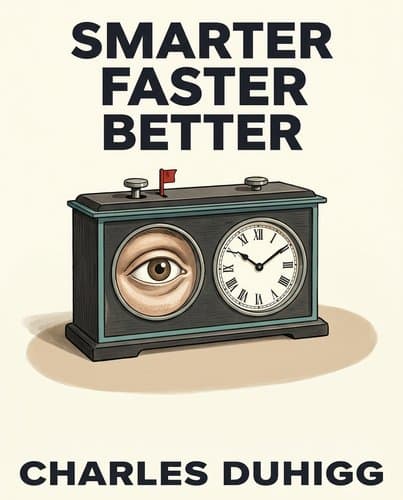
25733966_smarter-faster-better
by Charles Duhigg
Being busy and being productive require entirely different mental operating systems. Duhigg reveals the eight science-backed habits—from building psychological…
In Brief
Being busy and being productive require entirely different mental operating systems. Duhigg reveals the eight science-backed habits—from building psychological safety in teams to pre-loading mental models before crises—that separate people who generate real output from those who just stay busy.
Key Ideas
Reframe Pointless Tasks Through Personal Control
When a task feels pointless, reframe it as a choice: ask why it matters to you personally and identify the smallest decision within it you can control. The goal is to activate perceived control, not find extrinsic motivation.
Equal Voice Norm Builds Team Safety
Before any team meeting, establish one explicit norm: no one speaks twice before everyone has spoken once. Psychological safety is built through behavioral patterns, not declarations.
Pre-Load Mental Models Through Scenario Planning
Before a high-stakes situation, spend five minutes running 'what if' scenarios out loud — not to predict the outcome, but to pre-load a mental model so your attention has somewhere to go when things go wrong.
Pair Stretch Goals With SMART Planning
Pair every stretch goal with a SMART execution plan. The stretch goal forces innovation by making the target feel impossible; the SMART goals tell you what to do on Monday morning. Neither works without the other.
Average Contradictory Forecasts Before Deciding
When making an important decision, generate at least three contradictory probability estimates (from base rates, recent data, and expert opinion) and average them. The discomfort of holding contradictory futures is the point — it's what prevents false certainty.
Learn Through Physical Engagement Not Passivity
When you need to learn something that matters, find a way to do something physical with the information: handwrite it, draw it, explain it aloud, or run a small experiment that tests one variable. Passive reading and passive listening produce far less retention than active struggle.
Prioritize Commitment Signals Over Star Talent
When hiring or building a team, prioritize commitment signals over star credentials — candidates who demonstrate investment in the mission over time, not just talent. Commitment cultures outperform star cultures in every measurable long-term outcome.
Who Should Read This
Business operators, founders, and managers interested in Time Management and Focus who want frameworks they can apply this week.
Smarter Faster Better
By Charles Duhigg
14 min read
Why does it matter? Because the people getting the most done aren't working harder — they're thinking differently.
Duhigg — who'd spent nine months writing this book without taking a day off — thought he'd found the world's most productive human: surgeon, Harvard professor, WHO adviser, bestselling author, three kids. He wanted to know how Atul Gawande packed it all in. The answer, when it came back, was that Gawande was busy that week because he'd bought concert tickets with his kids and was planning a vacation with his wife. Not grinding. Vacationing. That gap between what Duhigg assumed and what was actually true turns out to be the whole book. Because the difference between genuinely productive people and merely busy ones isn't hours logged or sacrifices made — it's a set of cognitive habits most of us never think to build. How motivation gets made when a task feels meaningless. Where you point your attention under pressure. How you set goals that push you forward without locking you into the wrong direction. These aren't personality traits. They're learnable moves. And once you see them, you can't unsee them.
Motivation Lives in the Brain, Not the To-Do List
Robert Philippe had built a Louisiana auto-parts empire through forty years of handshakes, back-road drives, and bourbon-soaked deal-making — except the bourbon was always club soda, because Robert never touched the stuff. Then, midway through a celebratory trip to South America, something shifted. Back home, he stopped going to the office. He sat in front of the television without changing the channel. When his wife asked what he wanted for dinner, he shrugged. Neurologist Richard Strub ran every test available: normal IQ, normal blood work, no depression. What he eventually found was a faint shadow on an MRI — tiny burst vessels in a region called the striatum, deep in the center of the brain. Robert wasn't sad. He just had no drive left at all.
The striatum is the brain's relay station, translating decisions made in the prefrontal cortex into actual movement and emotional engagement. When it's damaged, motivation doesn't diminish. It vanishes entirely. French neurologist Michel Habib documented this across fourteen similar patients: a professor who could quote research papers from memory but sat mute until someone asked him a direct question; a teenager who got sunburned on a beach because she couldn't motivate herself to move out of the shifting sun.
Which raises an unsettling question: if motivation has a specific address in the brain, what actually turns it on?
Mauricio Delgado, a neuroscientist at the University of Pittsburgh, built one of the most deliberately boring experiments in psychology to find out. Participants lay inside an fMRI scanner and guessed whether a number would be higher or lower than five. The game was rigged — everyone won round one, lost round two, in a fixed sequence. It didn't matter. People played for hours, their striata lighting up with anticipation on every guess. When one participant learned the outcomes were predetermined, he still wanted to take the game home. Delgado's follow-up revealed why: when the computer made the guesses instead of the participant, striatal activity went nearly silent. Same odds. Same game. Zero engagement. The only variable was whether the person felt they were making a choice.
Motivation isn't triggered by rewards or outcomes. It's triggered by perceived control. The brain needs to believe it's the one deciding.
That's what makes Viola Philippe's instinct so striking. After Robert's diagnosis, she started pelting him with trivial decisions — soup or sandwich, this table or that one — every single day. She wasn't feeding him information or cheering him up. She was giving his striatum something to do. Slowly, pieces of Robert came back, one small choice at a time.
Team Performance Has Almost Nothing to Do With Who's on the Team
Talented people are almost irrelevant to team performance. What actually determines whether a group succeeds is the unwritten rules — the norms — it develops for how members treat one another.
Google learned this the hard way. When researchers launched Project Aristotle to find the formula for the perfect team, they started where any data-driven organization would: with the people. They examined 180 teams across the company, looking for patterns in personality mix, introversion-extroversion balance, shared hobbies, demographic diversity, educational background. After thousands of hours of analysis, they found nothing. Not a weak signal — nothing. Teams with nearly identical compositions produced wildly different results. The 'who' simply didn't predict the 'how well.'
So the researchers pivoted to norms. And one finding from a Harvard researcher named Amy Edmondson kept rising to the surface. In the late 1990s, Edmondson had studied error rates across hospital wards and found something that looked, at first, like a paradox: the wards with the strongest team cohesion reported more mistakes, not fewer. The obvious interpretation — that close-knit teams were somehow less competent — turned out to be exactly backwards. Nurses on those wards weren't making more errors. They felt safe enough to report them. On wards where the culture was punitive, where admitting a mistake meant bracing for humiliation, errors stayed hidden. Cohesion wasn't what mattered. What mattered was whether people believed the group was a safe place to be honest — that speaking up wouldn't cost them.
Google's data confirmed this was the single most important norm a team could establish. And once you understand it, the tactics follow naturally. Don't interrupt. Summarize what colleagues say so they know you heard them. Admit what you don't know. Don't end a meeting until everyone has spoken at least once.
The shift is subtle but total. You stop asking 'do we have the right people?' and start asking 'do our people feel free to be honest with each other?' That second question turns out to be far harder to answer.
Under Pressure, Your Brain Locks Onto the Wrong Thing
Four hours into Air France Flight 447's crossing from Rio to Paris, junior pilot Pierre-Cédric Bonin was doing nothing. The Airbus A330 was flying itself at 32,000 feet, and Bonin was watching. Then three metal probes on the fuselage clogged with ice crystals, the autopilot cut out, and an alarm sounded. Bonin's attention, which had been drifting for hours, snapped to the instrument panel. The most prominent thing in his visual field was a small aircraft icon on his primary flight display, tilted slightly to the right. He fixated on it. In the effort to level those tiny digital wings, he kept pulling back on the control stick — raising the nose, climbing, bleeding off lift. The stall alarm screamed 'STALL! STALL! STALL!' for most of the next three minutes. He kept pulling back. His last words, as the ocean filled the windshield: 'But what's happening?'
He wasn't incompetent. He was caught in what cognitive psychologist David Strayer calls cognitive tunneling. When the brain shifts abruptly from passive monitoring to emergency alertness, the spotlight of attention doesn't scan — it seizes. It locks onto the nearest, most obvious stimulus, even when that stimulus is irrelevant. For Bonin, it was a tilted icon. The stall warnings, the altitude readings, his copilot's voice — everything else became noise. And when he finally latched onto a mental model at all, it was the wrong one: 'I'm in TO/GA, right?' — a ground-level emergency procedure, a takeoff abort, that works near the ground where air is dense but at altitude only worsens a stall. Practiced instinct, applied to the wrong situation, killed 228 people.
The wreckage at the bottom of the Atlantic revealed something almost unbearable: none of the plane's computers had malfunctioned. Every sensor that iced over eventually thawed. By the final minutes, the instruments were showing the crew exactly what they needed to know. The plane didn't go down because of what Bonin didn't know. It went down because, without a robust mental model running in the background — a story about what the flight should look like, what the warning signs meant, what his hands should do — he had no way to direct his attention when it mattered most.
Crisis doesn't sharpen focus. It collapses it. The spotlight gets brighter, but it swings to whatever is closest, whatever is loudest, whatever the hands already know how to do. Experience and training don't override this — they can make it worse, by loading up a library of practiced reactions ready to fire before judgment catches up. The model you carry into the situation determines where your attention lands when the alarms start. Without one, attention drifts toward whatever is most salient. And the most salient thing is almost never the right thing.
Ambitious Goals Backfire Unless You Pair Them With Something Boring
What happens when a competent, disciplined leader with clear goals nearly destroys everything they were appointed to protect?
That question sits at the heart of how goal-setting actually works — and why having the right system matters less than most people assume.
Edwin Locke and Gary Latham, the psychologists who helped develop the SMART framework in the 1970s, eventually documented its central pathology. People with SMART goals, they found, become more likely to seize on easy tasks and stall on harder ones — chasing the emotional reward of getting something done rather than asking whether it's worth doing. Specific. Measurable. Achievable. Realistic. Timeline-based. All correct. Completely beside the point.
Jack Welch's fix at GE was to force the opposite problem. He told his aircraft engine division to cut manufacturing defects by 70 percent in three years. Managers said it was impossible. Welch said they had three years. The impossibility was the point: a goal nobody knows how to achieve forces people to rethink everything. The division ended up retraining every worker as a quality auditor, then discovered that still wasn't enough. They started hiring only FAA-certified candidates, which required offering more autonomy to attract them, which forced them to abolish centralized scheduling entirely and let teams self-organize. By 1999, defects had dropped 75 percent. No SMART goal would have required any of that. The audacity generated the innovation.
That's a satisfying result. And then there's Eli Zeira.
Zeira was Israel's military intelligence chief in 1973, and he was running both systems. His stretch goal — to end the hair-trigger mobilizations that were wearing Israel's reserve forces to exhaustion — was genuine. His methods were disciplined and step-by-step. He was doing everything right. On October 6, Egypt's 23,000 soldiers crossed the Suez Canal while Israel scrambled to respond to an attack it had been warned about for days.
The problem wasn't Zeira's goals. He'd simply stopped asking the question he literally carried in his pocket — written on a small note: and if not? As Soviet military families were airlifted out of Cairo and 1,100 artillery pieces massed along the Suez, he didn't read it. Cognitive closure — the emotional need to have decided something, to be done with a question — had turned his decisive strength into catastrophic rigidity. Good goals, poorly examined, still point the wrong direction.
Zeira's failure was one person's. But the same dynamic plays out at scale — and when the pathology is baked into an organization's structure rather than one leader's blind spot, the written reminder in your pocket doesn't help at all.
The Smartest Organizations Give Power to the People Closest to the Problem
Rick Madrid spent twenty-seven years at GM's Fremont plant doing as little as possible. By his own account, work was an interruption in his leisure time. He poured vodka into plastic cups wedged inside car frames so colleagues could sip as the vehicles rolled past. When he noticed a defect, he marked it with a crayon and let it continue down the line — someone else's problem, eventually, in the back lot. The plant's one inviolable rule: the line never stops.
Then Toyota partnered with GM to reopen the plant, and Madrid was sent to Japan for training. Standing on the floor of a Toyota factory outside Toyota City, he watched a worker drive a bolt into a doorframe and misthread it. Madrid expected what he always saw at home: a wax-crayon mark, the defect carried along. Instead, the worker pulled a hanging cord above his head. A yellow light started spinning. A manager walked over and stood behind the worker, waiting. The worker issued orders. The manager fetched tools and arranged them on a tray the way a surgical nurse lays out instruments. When the car reached the end of the station without the repair finished, the entire assembly line stopped. A senior manager arrived and, instead of shouting, handed over a new bolt. The worker rethreaded the hole, completed the repair, pulled the cord again, and the line restarted. Total calm throughout.
Madrid was stunned. He'd once watched a colleague fall into a pit below the line at GM. They'd waited for the car to pass before pulling him out. 'For so many years, I had learned you don't stop the line, no matter what,' he said. One misthreaded bolt had just overturned everything he knew about how organizations worked.
What Toyota had built — and what the NUMMI plant eventually exported to California — was a system where the person nearest the problem held the most authority. The worker, not the manager, decided when to stop. This only functions inside a culture where mistakes aren't punished and management's commitment to workers is real. NUMMI promised never to lay off employees unless the company's survival was at stake. When recessions hit — four times over thirty years — executives took pay cuts instead. Each time, workers responded by working harder than before.
The authority to pull the cord was only meaningful because the people holding it trusted the company had their back. Decentralized authority without that trust is just chaos. Commitment without that authority is just paternalism. The two only work together.
Better Decisions Come From Holding Contradictory Futures at Once
The Good Judgment Project started with a federal grant and a strange question: can ordinary people be trained to forecast geopolitical events more accurately than professionals? Researchers at the University of Pennsylvania and UC-Berkeley recruited lawyers, graduate students, and avid newspaper readers — people with no foreign policy background — and put them through brief online tutorials in probabilistic thinking. The core lesson was simple but disorienting: stop treating the future as a single thing that will or won't happen, and start treating it as a distribution of competing possibilities, each with a weight attached. After even a few hours of this training, participants' forecasting accuracy improved by as much as 50 percent compared to untrained groups.
The Sarkozy example shows exactly how this works. Asked to predict the French president's reelection odds, a probabilistic thinker doesn't search for the one true answer — they identify several independent variables drawn from historical base rates and current polling: incumbency advantage (67% win rate historically), approval ratings (pointing to a 25% chance), economic conditions (45% chance). No single variable is obviously more reliable than the others, so you average them: roughly 46%. Sarkozy received 48.4% of the vote and lost. Non-experts with a few hours of training had called a French presidential election within two percentage points — not by being brilliant, but by refusing to commit to one story about the future when three contradictory stories were available.
Most of us equate good decision-making with confidence: pick a position, defend it. What the GJP data showed is the opposite. The forecasters who performed best were the ones most willing to hold conflicting scenarios simultaneously and assign honest probabilities to each. Certainty, it turns out, is often just a way of pretending the other possibilities don't exist. The discipline is in leaving them all on the table, weighted, until the evidence forces one of them out.
Breakthroughs Require Breaking the Frame You're Already Inside
A researcher named Brian Uzzi spent years studying what separates the most-cited academic papers from everything else — analyzing nearly eighteen million papers to find the pattern. The answer surprised him. The highest-impact work wasn't built from revolutionary new ideas. Ninety percent of its content had already been published elsewhere. What made it land was unusual pairing: taking concepts from fields that had never talked to each other and putting them in a room together. Uzzi's conclusion was blunt: the people we call exceptionally creative are mostly intellectual middlemen, moving ideas between domains.
Kristen Anderson-Lopez is standing on a picnic bench in Prospect Park, singing to trees and trash cans. It's 2012, she and her husband Bobby are months behind on songs for a Disney movie nobody has figured out yet, and she's asking herself a question that sounds simple: what would it feel like to be Elsa? Cursed. Judged constantly. Expected to be perfect and punished anyway for falling short. Kristen knows that feeling — she's lived it in the sideways glances from other parents when she lets her kids eat ice cream or watch an iPad in a restaurant because she and Bobby need five minutes of peace. She doesn't think she should have to apologize for it. Neither should Elsa. Arms spread wide, she starts singing: let it go, let it go, that perfect girl is gone. Bobby records her on his iPhone. They've just found the song that unlocks the film.
Kristen wasn't a middleman between academic fields. She was a middleman between her own life and a fictional character's. Same mechanism as Uzzi's papers. You take something you know from the inside — the specific texture of being judged, of being exhausted by other people's expectations — and you loan it to a problem that seems unrelated. The frame breaks open because you brought something from outside it.
The question isn't whether you're capable of this. The question is whether you're doing it deliberately — and that's what the next piece of the process is about.
You Learn by Struggling With Information, Not by Receiving It
Passive reception of information isn't learning — it's exposure. Cincinnati's public schools proved the difference by accident.
South Avondale Elementary had everything data evangelists could want: sophisticated software, color-coded dashboards tracking every student's attendance, test scores, and classroom participation, weekly memos from a visualization team. The school was receiving more information about its students than most districts dream of. Ninety percent of teachers admitted they barely glanced at any of it. In 2008, 63 percent of third graders were failing the state's basic benchmarks.
The intervention that followed added nothing — no extra funding, no new teachers, no tutoring programs. What it added was friction. Teachers were required to walk into a spare room and physically transcribe test scores onto index cards, sort those cards by hand into color-coded piles, then tape hand-drawn graphs onto the walls. The same data that had washed over them for years suddenly became material they had to wrestle with. One teacher noticed that kids from the same neighborhood were struggling on the same problems and started assigning them shared reading. Another spotted a math gap and invented a school-wide drill timed by stopwatch. Within a year, the school had moved from 'academic emergency' to 'excellent' by state standards. Eighty-four percent of students passed the math exam.
The information hadn't changed. The relationship to it had. When teachers were forced to manipulate data rather than receive it, they had to actively generate meaning from it — pulling structure out of raw numbers rather than letting pre-built charts do it for them. That generation process is where learning happens. Passive reception skips it entirely. The awkwardness was the mechanism.
This is what the research keeps returning to: friction in how you process information isn't an obstacle to learning, it's the engine of it. Plot the numbers on paper. Explain the idea out loud. Change one variable and watch what happens. The goal isn't to make things harder — it's to make yourself do the work that dashboards are quietly doing for you.
The Productivity You Already Have
Here is something worth sitting with before you close this book: you are already doing most of this. Joshua Tenenbaum's research on Bayesian reasoning shows that the human brain is, beneath the noise, a surprisingly capable probability machine — constantly updating predictions, weighing evidence, revising. The South Avondale teachers weren't waiting for a controlled study; they were changing one variable, watching what happened, adjusting. That instinct is yours too. The gap between someone grinding through days and someone who actually seems to be thinking isn't raw intelligence. It's deliberateness — the small, almost uncomfortable act of noticing what your mind is already reaching for and deciding to aim it. Atul Gawande bought concert tickets with his kids instead of working through the weekend. That's not a productivity hack. He just chose, on purpose, what his brain would do next. So can you.
Notable Quotes
“We can't transfer fuel, we can't jettison it. The trim tank fuel is stuck in the tail and the transfer tanks are useless.”
“That moment is really the turning point,”
“When de Crespigny decided to take control of the mental model he was applying to the situation, rather than react to the computer, it shifted his mindset. Now, he's deciding where to direct his focus instead of relying on instructions.”
Frequently Asked Questions
- What is 'Smarter Faster Better' about?
- Charles Duhigg's 'Smarter Faster Better' draws on neuroscience, psychology, and case studies to explain why some people and teams achieve more than others. The book identifies eight core productivity concepts — including motivation, focus, goal-setting, and decision-making — and shows how applying the right mental frameworks can help you produce better results without working harder or longer. Rather than promoting hustle culture, Duhigg demonstrates that sustainable high performance comes from understanding the psychological principles that drive human behavior and organizational effectiveness. It provides practical frameworks applicable to both individual contributors and teams seeking better results.
- How does Charles Duhigg suggest reframing unmotivating tasks?
- When a task feels pointless, Duhigg advises: "ask why it matters to you personally and identify the smallest decision within it you can control. The goal is to activate perceived control, not find extrinsic motivation." This reframing works by shifting focus from external pressure to internal agency. Rather than forcing enthusiasm for boring or repetitive work, you reconnect with personal choice. Even in constrained situations — assembly lines, mandatory training, admin tasks — finding one micro-decision you control changes your psychological relationship to the work. This transforms obligation into ownership and sustainable engagement.
- What does Smarter Faster Better recommend for building psychological safety in teams?
- Duhigg argues that psychological safety is built through behavioral patterns, not declarations. His concrete recommendation is: "Before any team meeting, establish one explicit norm: no one speaks twice before everyone has spoken once." This simple rule forces equal participation and prevents dominant voices from monopolizing discussion. When quieter team members are required to contribute early, it signals that their input is valued. Over time, this pattern creates a culture where people feel safe taking interpersonal risks. The mechanism works through repeated behavior, not through trust-building exercises or mission statements alone.
- What does Smarter Faster Better say about setting and achieving ambitious goals?
- Duhigg recommends pairing every stretch goal with a SMART execution plan: "The stretch goal forces innovation by making the target feel impossible; the SMART goals tell you what to do on Monday morning. Neither works without the other." The stretch goal creates psychological motivation and pushes creative thinking, while SMART goals provide concrete action steps. Together they prevent two common failures: pursuing vague aspirations without implementation, or getting lost in task-level details without directional clarity. This dual-framework approach balances inspiration with practicality.
Related Book Summaries
Read the full summary of 25733966_smarter-faster-better on InShort