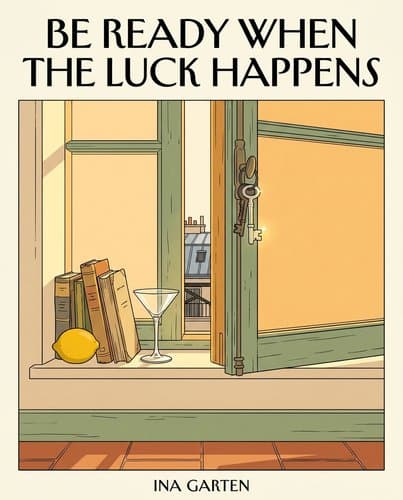
209192698_be-ready-when-the-luck-happens
by Ina Garten
Ina Garten spent decades calling herself lucky—but her memoir reveals the obsessive preparation, painful self-knowledge, and uncompromising quality standards…
In Brief
Be Ready When the Luck Happens (Octo) is Ina Garten's memoir tracing how deliberate preparation, uncompromising quality standards, and hard-won self-knowledge — not luck — drove her unlikely rise from government bureaucrat to beloved culinary icon.
Key Ideas
Preparation enables opportunity recognition
'Be ready when the luck happens' is not a passive instruction — it means doing the unglamorous preparation (testing recipes obsessively, building independent credit, learning the business) long before any opportunity appears, so you can recognize and seize it when it does
Separate external judgment from self
The critical voice in your head telling you you're not good enough is probably not yours — it was installed by someone else, and the work of separating their judgment from your own is the actual prerequisite for doing anything original
Difficult choices create perceived luck
'I was just lucky' is often a story successful people tell to stay comfortable; the more honest account includes the specific, sometimes painful choices about quality and self-knowledge that came first
One believer catalyzes wider success
Find the one person — in publishing, in business, in your personal life — who genuinely sees what you're trying to do. Garten's career turned repeatedly on single believers: Jeffrey, Roy Finamore, Chip Gibson, Eileen Opatut. The crowd comes later.
Non-negotiable quality protects core identity
Never compromise on quality in the thing that defines you. Garten fought her publisher over book design, nearly quit television over creative control, and went to court over her own face on a package — each time the principle was the same: dilution is not a negotiation, it's an ending
Recognize peak happiness in present
Recognize peak happiness while you're inside it. Nora Ephron toasted 'To better times!' at Christmas Eve lunch six months before she died — she knew the moment was the good time, not a prelude to one
Who Should Read This
Readers who connect with first-person stories about Memoir and Self-Improvement and want to see the world through someone else's eyes.
Be Ready When the Luck Happens
By Ina Garten
11 min read
Why does it matter? Because the story Ina Garten told about herself was wrong — and the real one is more useful.
The story Ina Garten told for years is a good one: a bored White House analyst stumbles across a tiny cookie shop, something clicks, and the rest is coq au vin and Paris apartments and Jeffrey. It's genuinely appealing — the idea that a charmed life can just arrive, that luck can look like that. She called it luck, repeatedly, with apparent sincerity. Then Oprah smacked her on the arm in front of a thousand people and said: no you don't.
What this memoir actually contains is more useful and more uncomfortable than a charmed life. It's the record of a woman who taught herself to cook with the discipline of a policy analyst, who rebuilt her own psychology in therapy before rebuilding her brand, who learned to recognize the difference between a door opening and a door worth walking through. The luck was real. But she'd been standing at the door for years before it moved.
She Thought She Was Lucky. Oprah Smacked Her Twice.
Picture Ina Garten sitting next to Oprah Winfrey in front of a thousand people, having just finished a speech about how lucky she was. Lucky to love food at a moment when the world wanted food content. Lucky that the Food Network found her. Lucky, lucky, lucky. The word must have landed strangely, because Oprah reached over and smacked her on the arm. 'You weren't lucky,' she said. 'You make your own luck.' Garten started to push back — actually, she really did feel lucky — and Oprah smacked her again. Then Lesley Stahl, stepping to the podium to introduce the next honoree, looked out at the room and asked why successful women always credited luck while successful men credited talent.
Three smacks. And Garten still wasn't sure they were right.
That discomfort is what makes this book's opening argument interesting. It would be easy to read the 'I just got lucky' framing as modesty, the socially acceptable version of success. But when a 60 Minutes producer did what journalists do — dug into the actual record — a different portrait emerged: a woman who earned an MBA, worked as a budget analyst for the White House, taught herself to cook through sheer repetition, got up in the middle of the night to bake a thousand baguettes, and spent years methodically testing recipes across thirteen cookbooks. The correspondent described her career as built on hard work, business acumen, and a refusal to leave things to chance. Garten barely recognized the person being described. It was her life, recounted forensically, and she found it almost unrecognizable.
The 'Oh Shit!' Moment Was Actually Years in the Making
On a Monday morning in 1978, Ina Garten was at her desk at the White House Office of Management and Budget, grinding through a nuclear energy budget, when the phone rang. It was Diana Stratta, the owner of a small specialty food store in Westhampton Beach, calling to say she accepted the offer. The offer Garten had made as a stalling tactic — $20,000 for a business she wasn't sure she actually wanted to buy — had been received as a real bid, and now it was done. She sat there thinking, in her own words, that she had just bought a specialty food store.
The story sounds impulsive. She spotted a three-line newspaper ad, drove five hours to a beach town in the off-season, smelled chocolate chip cookies baking in a 400-square-foot shop, and felt something click. That part is true. But the impulse landed on a decade of accumulated competence she'd never quite connected to her name.
She had been teaching herself to cook relentlessly since moving to North Carolina as a young army wife — working through Julia Child recipe by recipe, making the same dish for Jeffrey, then making it again, before serving it to anyone else. She had renovated a series of houses in Washington, figuring out kitchen triangles by asking herself how she actually moved through the space to make coffee. She had navigated mortgage applications in a city where a banker literally refused to look at her while informing Jeffrey that her income didn't count — she'd probably just get pregnant and quit. She stayed quiet because they needed the loan. Then she went home and cut up every credit card in Jeffrey's name and applied for new ones in her own. That's not the behavior of someone who drifts through life on good fortune. That's someone who identifies the structural problem and fixes it.
The household she grew up in offered almost no model for any of this. Her father administered punishment for infractions she didn't understand. Her mother ran the kitchen as private property — cooking was her job, studying was Ina's job — which meant that the daughter who would eventually build an empire around food wasn't allowed to touch a pot until she left home. What that environment produced was a finely calibrated sensitivity to control.
By the time Diana called that Monday morning, Garten had already answered the question most people spend years circling: she knew what she was good at, she knew what she loved, and she knew those two things overlapped. The 'oh shit' that followed wasn't someone jumping off a cliff. It was someone who had been building the runway for years finally deciding to use it.
The Voice in Your Head Isn't Yours — It's Your Parents'
Doing the work competently, it turns out, isn't enough if the voice in your head keeps dismantling the reasons to bother.
The voice that told Ina Garten she wasn't good enough wasn't hers. It took a therapist named Cecily Stranahan to point that out, and the realization reorganized everything that came after.
Garten arrived in East Hampton in 1985 running on adrenaline and not much else. The new store, a former Dean & DeLuca location, greeted her with open hostility — customers who'd loved the old place transferred their resentment onto her, regardless of what she did. She cut the pasta salad price in half. Then in half again. The hostility didn't budge. That experiment told her something useful: the problem wasn't price, it was her. They simply didn't want her there yet. She smiled, cranked the music, and waited them out. Competent behavior — but underneath it, a woman burning out on two stores and a husband commuting to Tokyo, collapsing in her rental house whenever she had twenty minutes, exhausted and, as she'd later describe it, a little lost.
When a friend suggested Cecily, Garten went. What she said in that first session sounds almost too simple: she was working constantly and not having any fun. What Cecily uncovered over the years that followed was considerably less simple. The childhood Garten came from — one with emotional and sometimes physical abuse — had installed a critical voice so familiar she'd never questioned whose it was. Cecily named it: that voice belonged to her parents, not to her. The practical instruction Garten gave herself after that was almost comically concrete. Whenever the contemptuous internal narrator kicked in, she'd preface the thought: that's what my mother would have said. Not a rebuttal, just a label. It created just enough distance to ask the follow-up question — but what do I think?
Cecily also asked her, early on, what she'd consider fun. Garten had never asked herself that. She came up with a convertible, because it's hard to be miserable in one, and a massage. The next day she rented a red 1964 Mustang and booked an appointment. Thirty-nine years later, both habits are still intact. Therapy, for Garten, wasn't about insight for its own sake. It was about learning to locate herself inside her own life — which, it turned out, required a specific car, a standing appointment, and a borrowed label for every voice that wasn't hers.
The Lemon Bar That Launched a Million-Copy Cookbook
Chip Gibson didn't greenlight Ina Garten's cookbook because of her resumé or her proposal or her credentials in the food world. He did it because Martha Stewart once threw her black Suburban into a screeching U-turn on a Hamptons road, announced she absolutely had to stop at Barefoot Contessa, and made him taste a lemon bar. That's the story — the impulsive swerve, the dessert, the publisher's conversion. It sounds like the purest luck imaginable.
Except Garten had spent years making those lemon bars worth the U-turn. Before a single copy of the cookbook existed, she was working like, in her own words, a mad scientist — scaling store recipes designed to feed a catering operation down to quantities a home cook could actually manage. A chocolate cake built to produce forty meant the math for one was never simple division. She'd change a single variable, make the whole thing again, change another, make it again, until the home version was as good as the commercial one. Her standard wasn't professional approval; it was whether a customer would get out of bed, find parking, and walk to the store specifically for this dish. The unglamorous arithmetic of that process is what the lemon bar represented when it landed in Chip Gibson's mouth.
When the book finally came out, one executive at the publishing house picked up a copy and announced it would never sell. The logic was reasonable by industry standards: bestselling cookbooks at the time were comprehensive bibles with hundreds of recipes and no photographs. Garten's had seventy-five recipes and full-page images. The executive wasn't wrong about the conventions. She was wrong about Garten, who had written the book she herself wanted to buy and refused — after a genuine fight with her editor to reclaim control of the design — to let anyone dilute it into something safer. The book sold 1.4 million copies and is still selling a quarter-century later.
'I Don't Want an Apartment in Paris — I Want a Paris Apartment'
The Paris apartment is where Garten first articulates the distinction cleanly. When she finally found a habitable flat on the Left Bank, she kept telling herself she didn't want an apartment in Paris — she wanted a Paris apartment. The difference was total: she ripped out every wall, tore up the floors, moved the kitchen to the light-facing side, and sourced furniture by working backward from the seventeenth and eighteenth centuries because, as an antiques dealer friend explained, anything more recent was too ornate to sit alongside the modern pieces she'd already bought. The result took years, cost a fortune, and couldn't be rushed. Authenticity isn't a vibe — it's a specification, and specifications are expensive.
The Contessa Premium Foods lawsuit shows what happens when that standard gets tested by people who've calculated you'll fold. When a new ownership group took over the company and began selling products with her name and her food photography — and a face that wasn't quite hers on the packaging — she hired Paul, Weiss, one of the most expensive law firms in the country, to fight them. Her own lawyer told her the litigation would cost more than she could possibly recover. She went ahead anyway. Her resolution was characteristically practical: she didn't need to win at trial, she needed them to stop. She offered six months of continued sales in exchange for a cash payment and a commitment to redesign the packaging. They took it. The point wasn't the money. The point was that 'stay true to your vision' isn't a personality trait you perform in interviews — it's a line you hold in contract negotiations, in design meetings, and, when necessary, in federal court.
It's Always Cocktail Hour in a Crisis — But She's Barely a Drinker
What does it tell you about someone's emotional intelligence when their most viral moment is a joke they're not even the audience for?
On April Fools' Day 2020, with the pandemic blurring every day into the last, Garten pulled two absurd props from her basement — a martini glass the size of a birdbath and an oversize cocktail shaker — and filmed herself mixing an entire bottle of vodka into a cosmopolitan, shaking it with both hands, and drinking from something closer to a punch bowl than a glass. The caption: 'It's always cocktail hour in a crisis.' The video spread like the thing everyone needed to hear. What makes it perfect is that Garten barely drinks. Her friends watching would have caught the wink immediately. She wasn't performing relatability — she was performing the idea that even someone with no particular relationship to cocktails understood that a locked-down world needed permission to exhale.
That's the skill the video demonstrates, and it runs through everything else in this chapter. A few days before, she'd posted a photo of her pantry and offered to help followers figure out what to cook with whatever they had on hand. Nearly nine thousand people responded — asking about orzo, self-rising flour, ramen noodles they'd panic-bought and now didn't know what to do with. She answered as many as she could, and her Instagram became a space where strangers helped each other through a problem that felt, on its surface, like a kitchen question but was actually about feeling less alone. 'My followers saved me,' she said afterward, meaning it.
Jeffrey Believed It First — And That Was the Whole Infrastructure
The Balch Hill moment in the prologue is the proof of concept. Teenage Ina refuses to climb, then refuses to not-climb, and instead zigzags back and forth across the path in tiny lateral increments, barely gaining altitude, half-convinced she's about to be dumped. She looks back expecting anger — the only response she knew from home — and finds Jeffrey doubled over laughing, calling her clever. That single data point restructured her risk calculus for the next sixty years. She grew up in a house where an unconventional solution was a punishable offense. He showed her it could be the funniest, most interesting thing in the room.
What the book doesn't quite resolve is the tension sitting right at its center: the woman who fought hardest for independence — who separated from Jeffrey, insisted he see a therapist before she'd reconsider, refused any arrangement that made her the wife and him the man — credits him, in the end, as the sole reason she learned to believe in herself. Both things are true simultaneously, and neither cancels the other. She needed out from under the traditional structure to discover who she was. And the reason she could trust that the door was worth opening was that one specific person had already been standing on the other side of it, laughing.
Be ready when the luck happens, Liza Minnelli told a young Rob Marshall. That's the instruction this book actually leaves you with — not hustle culture's demand for constant output, not magical thinking's demand for belief. Just: do the work, stay prepared, and keep the door open so you'll recognize the moment when it arrives. Which is, come to think of it, exactly what Jeffrey did when he looked out a library window at a girl with a blue ribbon in her hair and decided to be ready.
The Door You Leave Open
Here's what Garten spent decades getting wrong about her own story: luck isn't the thing that happens to you, it's the thing that finds you — but only if you've already shown up. None of that preparation looks like readiness from the outside. It just looks like someone who cares more than necessary about something most people would approximate. Then the phone rings on a Monday morning, or a Suburban screeches to a halt, and suddenly all of it was the point. The instruction isn't to grind harder or believe louder. It's simpler and harder than either: know what you love, do it with everything you have, and leave the door open. Liza Minnelli's mother called that being ready for your luck. Which is close enough to a plan.
Notable Quotes
“Oh, we don’t count her income,”
“She’s just going to get pregnant and quit her job, so we only consider your income.”
“You actually don’t even exist on paper,”
Frequently Asked Questions
- What is 'Be Ready When the Luck Happens' about?
- 'Be Ready When the Luck Happens' is Ina Garten's memoir exploring how deliberate preparation, uncompromising quality standards, and self-knowledge — rather than luck — drove her rise from government bureaucrat to culinary icon. The book guides readers in distinguishing their own voice from internalized criticism, identifying key allies, and recognizing peak happiness moments. Garten reveals the unglamorous work behind her success: obsessive recipe testing, building independent credit, and learning the business. She argues that 'I was just lucky' is often a comfortable story successful people tell, when the honest account includes specific decisions about quality and self-knowledge that came first.
- What does 'be ready when the luck happens' actually mean according to Garten?
- 'Be ready when the luck happens' is not a passive instruction — it means doing unglamorous preparation before any opportunity appears, so you can recognize and seize it when it does. This includes testing recipes obsessively, building independent credit, and learning the business thoroughly. The readiness isn't about waiting for external luck; it's about the deliberate, behind-the-scenes work that precedes visible success. Garten's career demonstrates this repeatedly: her preparation enabled her to spot and capitalize on moments others might miss. She argues successful people often downplay this preparation when claiming luck, obscuring the actual hard work and difficult choices required to succeed.
- What role does self-doubt and internalized criticism play in Garten's memoir?
- Garten addresses how the critical voice telling you you're not good enough is probably not originally yours — it was installed by someone else during your life. The work of separating their judgment from your own is the actual prerequisite for doing anything original. This insight runs through her story: distinguishing between authentic self-knowledge and absorbed external criticism enables independent choices about quality and direction. Garten illustrates this through career decisions where she consistently chose what she believed was right rather than what others expected. Overcoming internalized judgment, she suggests, is essential before you can recognize and act on genuine opportunities that align with your vision.
- What is the importance of quality and maintaining principles in Garten's story?
- Never compromising on quality in the thing that defines you is central to Garten's philosophy. She fought her publisher over book design, nearly quit television over creative control, and went to court over her own face on a package — each time the principle was the same: 'dilution is not a negotiation, it's an ending.' These weren't minor disputes but fundamental choices protecting her vision. Garten also emphasizes finding the one person who genuinely sees what you're trying to do — Jeffrey, Roy Finamore, Chip Gibson, Eileen Opatut. These single believers sustain you through unglamorous preparation; the crowd comes later, but loyalty to quality standards enables your voice to survive intact.
Related Book Summaries


Read the full summary of 209192698_be-ready-when-the-luck-happens on InShort