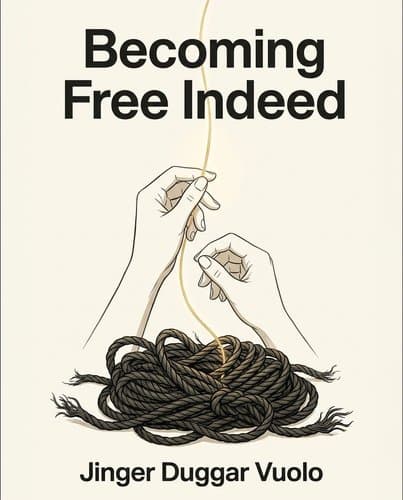
62837289_becoming-free-indeed
by Jinger Duggar Vuolo
When rule-keeping becomes your theology, failure becomes spiritual death. Jinger Duggar Vuolo maps the difference between disentanglement and…
In Brief
When rule-keeping becomes your theology, failure becomes spiritual death. Jinger Duggar Vuolo maps the difference between disentanglement and deconstruction—showing how to separate the actual Jesus from the control systems built around his name, and why that distinction is the only exit that doesn't cost you your faith.
Key Ideas
Exclusive Access Creates Structural Dependence
Any teacher who claims special 'keys' to spiritual success available only through their system is — whether consciously or not — engineering your dependence on them. The structure of the claim is the warning sign, independent of the teacher's sincerity.
Transactional Thinking Regardless of Rules
Legalism isn't primarily about strictness; it's about believing rule-keeping earns God's favor and failure loses it. That transactional structure can exist with very liberal rules, and it produces fear and exhaustion regardless of what the rules say.
Theology Shifts Through Quiet Observation
Genuine theological change rarely arrives as a crisis. It usually comes from sustained, quiet exposure to people who handle the same texts differently — not from argument or trauma, but from watching someone read.
Disentangle or Reject Everything
Disentanglement and deconstruction are different moves: disentanglement asks 'what in my formation was genuinely Christian and what was man-made addition, and can I separate them?' Deconstruction treats the whole structure as unified — accept it all or reject it all. The destination determines which process you were doing.
Hidden Dangers Requiring Essential Guidance
Authoritarian religious control and abuse share a mechanism: both require a leader who can define hidden spiritual dangers, make their guidance essential for navigating those dangers, and make leaving feel like spiritual death. The theology and the predation are not separate problems.
Can You Know Independently of Teacher
Before trusting any religious authority, ask one question: does this teaching point me toward someone I could know independently of this teacher — or does it make me progressively more dependent on this teacher to access that person?
Who Should Read This
Readers who connect with first-person stories about Memoir and Christianity and want to see the world through someone else's eyes.
Becoming Free Indeed
By Jinger Duggar Vuolo
11 min read
Why does it matter? Because the religion that raised you and the God it claimed to represent might be two very different things.
Jinger Duggar Vuolo stayed a Christian — and she has something precise to say about why.
Famous family, ultra-strict faith, cameras in every room. Someone raised inside all of that either closes ranks or walks away. Both endings have been written a thousand times. Both are, in their own way, easy.
She did neither. She also rejected most of what she was taught about what being a Christian meant. Not deconstruction — she's exact about the word — but disentanglement: the slower, stranger work of separating a person from the system built in that person's name.
The question this book answers is how someone learns to tell the difference between genuine faith and manufactured indispensability (the practice of populating ordinary life with hidden dangers only one teacher can neutralize), and why people who can't tell the difference so often end up with nothing at all.
Two People Left the Same Childhood Faith — Only One Ended Up Selling a $275 Starter Pack
In the fall of 2019, Joshua Harris — whose book on courtship had sold over a million copies and shaped how a generation of evangelicals thought about dating — announced he was no longer a Christian. The news came after his marriage ended and four years after he left the Maryland megachurch where he'd pastored for eleven years. Two years later, he was selling a $275 online course he called a "Deconstruction Starter Pack," with free enrollment for anyone his earlier ministry had hurt.
Harris had spent years selling Christians a system for staying. Now he was selling them a system for leaving. The product changed; the model didn't.
Jinger Duggar grew up in a world Harris would have recognized. She was on television from age ten, raised in a large, deeply conservative family shaped by the same evangelical subculture: courtship instead of dating, rules governing hemlines and music, a leader whose authority was assumed rather than examined. When she hit adulthood and found her childhood faith insufficient, the cultural script offered two options: deconstruct like Harris, or dig in and defend. She chose neither.
She calls her path disentanglement. The idea is surgical: the true gospel of Jesus had gotten tangled up with man-made rules and a teacher whose name she'd spend a decade avoiding, and she has spent eight years separating those threads — not tearing everything down, not pretending the problems weren't real, but pulling apart what was genuinely Christian from what had been added on top.
The $275 starter pack is the tell. Harris packaged leaving the same way the system he'd once championed packaged staying: rules and authority and costs, just pointing in the opposite direction. You can exit legalism and rebuild the same architecture around doubt. Jinger's argument is that you don't have to. The threads of real faith are still there. The work is finding them.
The Most Dangerous Religious System Is the One That Feels Like Spiritual Health
Bill Gothard, the evangelical teacher whose Institute in Basic Life Principles had shaped her entire childhood, built a system that felt, from inside it, like spiritual health. That's the part that's hardest to explain to anyone who wasn't raised in it: the guilt felt like righteousness, the fear felt like devotion, and the self-torment registered as evidence you were taking God seriously. The trap was invisible because it was indistinguishable from the path.
Consider what Jinger calls her "overactive conscience." After she became a genuine Christian at fourteen, she began feeling guilty about activities the Bible never condemns. Broomball with her family (the Duggars played several times a week) started to trouble her. She worried God might want her to read Scripture or serve at home, and that if she went to the rink anyway, He might cause a car accident on the way there as punishment. She would skip movie nights to read her Bible upstairs, and experienced that solitude as spiritual progress. The self-denial felt like discipline. The isolation felt like consecration.
What makes this more than individual psychology: Gothard's system gave her no signal this was a malfunction. He taught that an active conscience indicated closeness to God, that the Christian who felt uneasy about recreation was more serious about holiness than the one who went along without question. The guilt wasn't a warning. It was the product.
The Communion detail shows the system at its sharpest. Most Sundays, Jinger would skip the bread and the cup. Not because she doubted the practice, but because Gothard's teaching had convinced her that receiving Communion with a single unconfessed sin could result in God punishing her with death. Before each service, she would scan her week, searching for anything requiring apology or confession. Certainty was impossible — memory is imperfect, conscience unreliable — so she refused the bread and cup while the congregation took it around her. That refusal felt like reverence. Like being careful with sacred things.
Gothard didn't offer cruelty; he offered precision. He presented a God who communicated clearly through seven universal principles governing everything from finances to marriage to which foods kept you inside God's protection, who rewarded exact obedience with health, money, and a good marriage. Step out of line and all protection was gone. The terror inside that promise produced the guilt cycles, the Sunday paralysis, the solitary Bible reading during family movie nights. Every moment of that terror felt to her like evidence she was taking God seriously. Not a signal that something had gone wrong. A feature.
He Populated the World with Hidden Dangers Only He Could Neutralize
What separates a teacher who gets things wrong from a teacher whose system requires him to get things wrong in a particular way? The distinction sounds abstract until you hear the story of the widow and the painting.
Gothard told this story to thousands of seminar attendees. A woman had lost her husband and three sons, all of them drowned at sea. A pastor came to comfort her. He pointed to a framed sailing-ship painting on her wall and told her it was responsible for their deaths. If she hadn't hung that picture, her sons wouldn't have been drawn to the sea. Gothard presented this not as a pastoral failure but as an example of the right response. A man of God had spotted a hidden spiritual danger the widow, in her innocence, had missed.
Jinger watched this seminar on a video call with Jeremy during their long-distance courtship, and her reaction was horror — not just at the cruelty of blaming a grieving woman for her children's drowning, but at something she recognized and couldn't unsee. She thought of the skirt. At one point she'd worn a hemline that rode above her knee when she sat down. She went to thrift stores and searched for longer ones. She wrote about it in her journal. The logic was identical to the pastor's: an innocent object (a painting, a hemline) contained spiritual peril invisible to the untrained eye.
That was the design. Gothard populated ordinary life with dangers scripture never identifies. Bad art could curse your children. Wrong bread fiber brought divine judgment. Gothard taught that refining wheat stripped away what God had built into grain, that processing it was a form of tampering with creation; Jinger replaced every bag of white flour in the kitchen. Communion taken with a single unremembered sin could result in death. None of these risks were self-evident from reading the Bible, and that was the point. They required a guide. Gothard called his principles the "keys to success" in the Christian life, claiming to have discovered them himself. If the world contains hidden spiritual threats ordinary Christians cannot detect without specialized instruction, then the man with the instruction becomes indispensable.
Jinger's conclusion, after months of working through this with Jeremy: any teacher who insists the Christian life requires secret knowledge only they possess should be avoided. Sincerity changes nothing about the logic of a system designed to make the teacher essential to everyone inside it.
Genuine Faith Doesn't Change in a Crisis — It Changes in Long Car Rides
Jinger sat in the front seat of a small truck while her sister Jessa and Ben Seewald talked theology in the back. Ben was courting Jessa; Duggar courtship rules required a chaperone whenever they traveled together, and Jinger, thirteen months younger, was the obvious candidate. The drives ran long. The conversations didn't stop. And mostly, she listened.
Ben wasn't quoting verses. He was working through entire passages, reading long enough to let the text make its own argument rather than stopping at the line that proved a point. He wasn't asking what a passage meant for him that day, or what practical application he should carry into the week. He was reasoning toward what it said about God. The difference sounds minor until you've spent years hearing the other kind. Gothard's method was to find a problem, locate a verse or two, and build an hour of opinion on top of it, presenting that opinion as what the Bible said. Ben's method was to keep reading until the text had finished talking.
Jinger didn't register this as instruction. But something was accumulating. She began searching the Bible on her own for passages about God's sovereignty and found them everywhere — Daniel, Isaiah, Matthew, Colossians — verses she had read before without any category for what they were saying. She had spent years using Scripture as a reference manual, flipping to whichever verse best supported a position, asking at every turn what the passage meant for her day, her outfit, her schedule. But the question assumed something: the Bible existed primarily to organize her behavior. These drives were slowly making that assumption visible.
The shift, when she finally named it, was plain: she had been asking what the verses meant to her, and she needed to be asking what God was saying about Himself. The Bible was organized around God. He was the main character. She was not.
Nothing dramatic caused that realization. No confrontation, no crisis, no argument that broke through a wall. It happened across hours in a truck cab, watching someone read differently, until a different way of reading became possible for her too. That shift in how she read Scripture was also, eventually, how she would learn to read Gothard.
The Theology That Controlled Her and the Predator Who Preyed on Her Used the Same Machine
Gothard built something with a deadbolt that worked from both sides — and he held the key to both.
His system ran on one premise: he could see spiritual dangers ordinary Christians couldn't. Wrong music, wrong hemlines, wrong art: he had identified the hidden threats and mapped the precise obedience required to stay safe. That positioning made his teaching powerful enough to control consciences. He was the arbiter of what God required, the keeper of the keys to His protection. It also made abuse possible.
The women who became "Gothard's girls" followed a predictable path. They first encountered him at large conferences, where he moved through hallways nodding generically at the crowd. When he stopped for a particular young woman and poured out compliments about her "radiant countenance," it didn't feel like flattery. It felt like an anointing. Many came from fatherless homes and found in him the authoritative male figure they'd lacked. Others were daughters of parents who treated him as practically a biblical apostle. By the time he told one of these women privately that God had a special plan for her life and suggested she come work at his Chicago headquarters, she had spent years learning that his read on God's will was more reliable than her own.
At headquarters, these women lived in dormitory housing, worked without pay, and followed strict rules forbidding physical contact between unmarried men and women. Then, after the rest of the staff had gone home, Gothard would call one of them in. He would begin by talking. Eventually he would hold her hand, rub her feet — contact that his own framework had defined as spiritually dangerous for any other unmarried couple in the movement. Ten of these women filed a federal lawsuit in 2016, alleging conduct far beyond that. He admitted in writing to the hand-holding, the hugs, the hair-touching, and called it sin. The case was dropped not because the court found the claims false but because the statute of limitations had expired.
There was no mechanism inside IBLP, Gothard's organization, for reporting him, because he was the mechanism. He had written the moral framework everyone operated within. Reporting him to the board meant asking people whose entire worldview he had constructed to evaluate whether he had violated principles he had authored. The same structure that had convinced Jinger that a skirt hemline could invite divine punishment, that a painting of a sailing ship could cause your children to drown, was the structure that made a midnight summons to the founder's office feel like spiritual opportunity rather than danger. Control of the conscience and control of the body ran on the same code.
She Couldn't Walk Away — Not Because of Rules, but Because She Found a Person
What do you do when the religious system that shaped you turns out to be someone's invention? Joshua Harris's answer was to walk away, package the departure, sell a course. The assumption inside that move is that if the system was false, what the system pointed to must be false too. Jinger's book argues this is a category error.
When she finally named Gothard as a false teacher — quoting Matthew 7 on wolves in sheep's clothing, 2 Corinthians 11 on false apostles who disguise themselves as servants of righteousness, Colossians 2 on hollow philosophy, and Romans 16 on men who cause divisions — she knew exactly what fifteen-year-old Jinger would have concluded: that saying this meant abandoning Christianity entirely. The teacher and the faith had been presented to her as the same thing. She'd been trained to hold them together.
Disentanglement and deconstruction look identical from the outside. Both involve tearing things apart. The question is what you're tearing toward. Harris ended up building the $275 course (the departure package to mirror the arrival package he'd once sold) because departure became the product. The system had been the center all along, and once it failed, there was nothing beneath it. Jinger kept reaching past the system toward the figure it had always claimed to serve, and found he was actually there. She closes the book speaking to readers who came hoping for an apostasy story, the girl in long skirts who finally got free and stopped believing. The rules turned out to be empty. Jesus didn't.
She had been studying the same Bible that supplied the language for naming Gothard's tactics, and it kept pointing past him to someone else. John 10:28-29: "I give them eternal life, and they will never perish, and no one will snatch them out of my hand." Jinger describes her retention of faith not as a victory of determination but as something being done to her by someone who would not let go. A system you hold onto can be destroyed when you discover it was built on invented premises. A person holding you doesn't change when your understanding of the system collapses. She had not held on. She had been held.
The Diagnosis She Found on His Own Website
The most unsettling detail isn't the manipulation or the ruined Sundays at the Communion table. It's this: Bill Gothard's own website hosts an article on cult tactics that describes, with precision, what his seminars did to Jinger. He wrote the diagnosis. He sold it as the cure.
That mechanism works so reliably because the need it targets is genuine. You want someone to tell you the hidden shape of a good life — with enough certainty that the uncertainty stops. Any system that meets that need with sufficient precision will find takers.
The only protection she found was a distinction between trusting a structure and trusting a person. A structure collapses when you discover it was invented. A person who was there before the structure, and remains after it, does not. That's her answer. The question she leaves open is what yours would be.
Notable Quotes
“stage and went straight to the”
“proclaim the Lord's death until he comes”
“for people who are unpacking and have questions and [are] changing their belief who feel really alone in doing that.”
Frequently Asked Questions
- What is Becoming Free Indeed about?
- Becoming Free Indeed traces one woman's journey out of a psychologically controlling religious system while keeping her faith intact. The book draws a clear line between legalism—the belief that rule-keeping earns God's favor—and genuine Christianity, explaining how these systems operate and why they can feel spiritually necessary even when harmful. Readers gain a practical framework for identifying spiritual manipulation and separating authentic faith from the man-made structures built around it, allowing them to understand both what they're leaving and what they might preserve.
- How does Becoming Free Indeed define legalism?
- According to the book, legalism isn't primarily about strictness; it's about believing rule-keeping earns God's favor and failure loses it. This transactional structure can exist with very liberal rules, and it produces fear and exhaustion regardless of what the rules say. This definition distinguishes legalism from the actual content of religious rules, making it possible to identify legalistic systems even when they appear permissive or modern. Understanding this distinction helps readers recognize controlling religious patterns in unexpected contexts and evaluate their own spiritual formation.
- What are the signs of spiritual manipulation according to Becoming Free Indeed?
- The book provides a framework for identifying spiritual manipulation: any teacher claiming special 'keys' to spiritual success available only through their system is engineering dependence on them, whether consciously or not. The structure of the claim itself is the warning sign. Additionally, before trusting any religious authority, ask whether the teaching points you toward someone you could know independently of the teacher—or whether it makes you progressively more dependent on that teacher to access that person. This test distinguishes healthy spiritual guidance from manipulation.
- What does Becoming Free Indeed say about disentanglement vs deconstruction?
- The book distinguishes disentanglement from deconstruction as different processes of religious transition. Disentanglement asks: what in my formation was genuinely Christian and what was man-made addition, and can I separate them? Deconstruction, by contrast, treats the whole structure as unified—accept it all or reject it all. The book notes that the destination determines which process you were actually doing. This distinction matters because it clarifies whether someone is reforming their faith or abandoning it entirely, and it helps readers understand their own spiritual journey.
Related Book Summaries

Read the full summary of 62837289_becoming-free-indeed on InShort