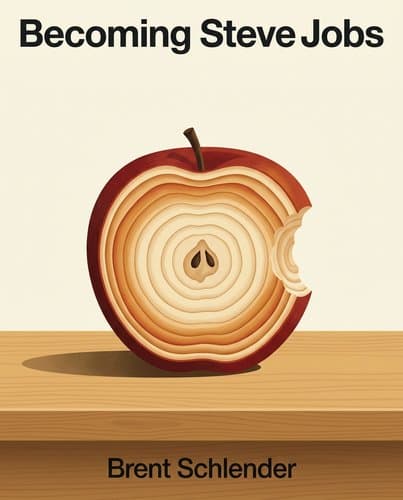
22318382_becoming-steve-jobs
by Brent Schlender, Rick Tetzeli
Steve Jobs's greatest innovations came after 12 years of failure, humiliation, and exile—not before. Schlender and Tetzeli reveal how the wilderness…
In Brief
Becoming Steve Jobs (Marc) reframes the familiar Jobs myth by tracing how failure, exile, and twelve difficult years transformed a brilliant but destructive young founder into an effective leader.
Key Ideas
Learn from post-failure growth, not early success
The traits most worth copying in a founder or leader are usually the ones they developed after their first major failure, not the ones that made them famous early — study the post-wilderness version, not the myth
Talent requires discipline to avoid compounding failures
Unmanaged talent compounds like debt: every year Jobs's brilliance ran ahead of his discipline at NeXT, the gap between his vision and his results grew wider — technical genius without prioritization is a liability, not an asset
True leadership means mission over personal ego
The most reliable signal that someone has genuinely grown as a leader is whether they can make a decision that makes the mission bigger than their own ego — Jobs's choice to use Dreyfuss's voice on 'Think Different' is a more useful data point than any product launch
Seizing opportunities requires operational discipline foundation
Incremental opportunism — following your nose from iMovie to iTunes to iPod to iPhone — is only possible if you've built the operational discipline (cash flow, talent retention, the ability to reverse course) that lets you recognize and act on each next step
Influence without control manages difficult talent
The Pixar lesson: keeping a difficult but talented principal at a structured distance — giving them influence over outcomes without control over process — is a legitimate management strategy, not a workaround; Catmull's approach with Jobs is a template worth studying
Decisive leadership carries governance failure risks
The same leadership style that makes a decisive, taste-driven CEO extraordinary also creates the conditions for governance failure — options backdating, no-poach agreements, Antennagate — and the book's honest answer is that these may not be separable
Who Should Read This
Readers interested in Business Leaders and Leadership, looking for practical insights they can apply to their own lives.
Becoming Steve Jobs
By Brent Schlender & Rick Tetzeli
12 min read
Why does it matter? Because the version of Steve Jobs you already know is the wrong one to learn from.
Here's the assumption most people carry: Steve Jobs succeeded by being relentlessly, unapologetically himself — the vision, the fury, the reality distortion field, all of it baked in from birth. The iPhone was inevitable because the genius was always there. Except the actual record doesn't support that story. The man who eventually built the most valuable company on earth spent the twelve years after his first act failing at nearly everything he touched, bleeding money, alienating the people who believed in him, and building products that almost nobody bought. And here's the part that actually matters: the specific qualities that made his second act extraordinary — the patience, the willingness to trust other people and wait — were qualities the young Jobs simply didn't have. He developed them slowly, painfully, after forty. Which means the version of Jobs worth understanding isn't the legend. It's the slow learner.
The Myth Cries in the Parking Lot
It's 1979, and Steve Jobs — already famous, already a millionaire at twenty-four — is sitting in a conference room in Marin County with a group of people who had literally eradicated smallpox from the planet. Larry Brilliant, the epidemiologist who helped pull it off, has invited him to a gathering of the Seva Foundation, an organization of doctors, activists, and counterculture figures including Ram Dass and Bob Weir of the Grateful Dead. Jobs promptly hijacks the meeting. He tells them they don't know the first thing about marketing, that they need to hire a man named Regis McKenna immediately, and he lectures them from a standing position, pointing at individuals for emphasis, ignoring every attempt to redirect him. Eventually Brilliant does the only thing left to do: he throws Jobs out.
Fifteen minutes later, someone finds Jobs in the parking lot, slumped over the steering wheel of his Mercedes convertible, crying. It had been raining. He'd put the top down anyway. When Brilliant came out and put an arm around him, Jobs looked up and said: "I'm sorry. I'm too wound up. I live in two worlds."
That image — the rain, the expensive car, the sobbing wunderkind — is the one that gets left out of every simplified version of the Steve Jobs story. The version you've probably absorbed goes something like this: he was born a visionary, born difficult, half genius and half jerk from the very beginning, and the only thing that changed was the scale of his canvas. That story is clean. It also happens to be wrong. He could see, clearly and correctly, that the Seva Foundation needed better marketing. He was right. He was also catastrophically unable to communicate that insight without detonating the room. The genius and the cruelty weren't two sides of a stable coin — they were the same uncontrolled energy, and the only thing that would eventually separate them was time.
The difference between the Jobs who built Apple and the Jobs who eventually transformed it wasn't destiny. It was decades of hard, often painful learning. That's the actual story.
Unmanaged Talent Is Its Own Kind of Failure
The failure at NeXT wasn't bad luck. It was a portrait of a man given a blank canvas and every resource, who spent all of it on the frame.
When Jobs left Apple in 1985 and founded NeXT, he was thirty years old, flush with cash, and finally free to build exactly the machine he envisioned — a high-powered workstation for universities, the computer that would change how scientists thought. The goal was legitimate. The execution was a slow, expensive disaster driven by one consistent problem: Jobs couldn't tell the difference between what mattered and what merely looked good.
The sharpest illustration is the factory he built in Fremont, across the bay from his Redwood City offices. Jobs designed it as a showpiece — a manufacturing facility so beautiful it would become famous on its own terms. The robots on the production floor were repainted in the precise shade of gray he preferred. The space was immaculate, almost ceremonial. He walked Schlender through it with evident pride, pointing out each deliberate detail. The plant, he explained, was designed to produce six hundred NeXT computers a day. At that rate, it could theoretically generate a billion dollars in hardware annually. It never came close. In its best month, it shipped roughly six hundred machines total.
That gap — between the billion-dollar infrastructure and the few-million-dollar reality — was the whole story of NeXT in miniature. Jobs had simultaneously commissioned a corporate information system designed for a company a hundred times larger than his, and paid a hundred thousand dollars to the legendary designer Paul Rand for a logo with the contractual stipulation that Rand would produce only a single draft and Jobs could take it or leave it. Meanwhile, the actual product was years late. When it finally debuted in 1988, it lacked color graphics — a standard feature on competing workstations — and cost nearly ten thousand dollars when he'd promised three thousand.
The pattern wasn't perfectionism. He kept mistaking what looked excellent for what actually worked. Jobs poured his energy into every surface — the logo, the case, the factory floor — while neglecting the one thing that determined whether any of it mattered: a machine people could actually use and afford. The man who had stood up at the Seva Foundation and lectured epidemiologists about marketing was now running a company where the aesthetics of the robot paint scheme got more attention than the product roadmap. The talent was still there. But talent without the discipline to prioritize doesn't build companies. It builds very expensive monuments to itself.
The School You Can Only Attend by Failing
What actually changed Steve Jobs? Not the public humiliation of being pushed out of Apple, which he metabolized as resentment rather than instruction. Not the years of expensive failure at NeXT, which mostly confirmed his belief that other people kept getting in the way of his genius. What changed him was a ninety-minute drive up the coast to a building full of computer scientists who had figured out, before he did, how to keep him from ruining everything.
When Jobs acquired Pixar from George Lucas in 1986, he assumed he'd bought a hardware company. Ed Catmull, Pixar's quiet, methodical president, had spent years building a team of researchers who treated collaboration the way Jobs treated product design — as something worth getting exactly right. Catmull looked at his new owner clearly and saw two things simultaneously: genuine intelligence and a reflexive cruelty that Jobs himself didn't fully understand. Catmull observed that Jobs hadn't intended the harm — it was a skill deficit, not malice. That distinction mattered, because it meant the behavior could be shaped.
Catmull's approach was almost disarmingly simple in its structure. He kept Pixar in San Rafael, ninety minutes north of NeXT. He arrived at Monday meetings with a prepared agenda, handed Jobs real information, and never told him what to conclude. He excluded Jobs from the creative Brain Trust where films were actually developed — not to diminish him, but because Jobs's habit of rapid-fire judgment would have poisoned the room. The distance wasn't geographic. It was a carefully maintained structure that gave Jobs genuine influence over strategy and finances while keeping his volatility away from the work itself.
The lesson took years to land. But at some point in those Pixar years, Jobs began to understand something he'd been unable to see at NeXT: that the best results come from people you've trusted enough to leave alone. Catmull and John Lasseter made Toy Story without Jobs directing a single frame. When it opened in 1995 and became an immediate classic, Jobs slipped into a side office during the IPO celebration, picked up the phone, and called his friend Larry Ellison. 'Hello, Larry? I made it.' Two words. A decade of near-bankruptcy behind them. What he'd made wasn't just money — it was the first genuinely great thing he'd been associated with that he hadn't tried to control into submission.
The Moment He Stopped Making It About Himself
The morning after ad agency Chiat\Day submitted two versions of the 'Think Different' voiceover — one read by Richard Dreyfuss, one read by Jobs himself — Jobs called creative director Lee Clow and said they had to use Dreyfuss. His reasoning: 'If we go with mine, it'll become about me. And this can't be about me. It's about the company.'
For the man who'd paid Paul Rand $100K for one logo, take it or leave it, this was a genuinely strange sentence to hear him say. The man who had repainted factory robots to his preferred shade of gray now sat with a version of himself he preferred and chose to shelve it anyway.
What made the decision legible was everything that had happened in the previous two years. Jobs had watched Gil Amelio sweat through his shirt at the 1997 MacWorld keynote, losing his place on the teleprompter, rambling past the hour mark while developers in the audience grew restless — then walked out and handled the same room in twenty minutes with no notes. He sold his NeXT shares six months after the acquisition closed, a quiet signal of no confidence, and waited for the board to draw its own conclusions. They did. That patience, in a man who had once let his fury at IBM executives torpedo a deal worth hundreds of millions, was not temperamental. It was learned.
The 'Think Different' decision was the same instinct applied to his own image. The campaign celebrated misfits and rebels — Einstein, Lennon, Earhart — and if Jobs had narrated it himself, every frame would have become a referendum on whether he deserved to be in that company. He knew it would. The ego that had always demanded the spotlight had finally developed enough self-awareness to recognize when the spotlight was a liability. That's what the Apple comeback actually represents: not a man reasserting his genius, but a man who had learned, slowly and at great cost, that the work goes further when you get out of its way.
Following Your Nose Is Not a Strategy — Until It Is
Think of a river finding the ocean. It doesn't have a map. It follows gravity, adjusts around every rock and hillside, reverses when a valley dead-ends, pools until it finds the lowest ground. The route looks inevitable only once you're standing at the mouth. That's how Apple got from struggling computer company to the defining consumer electronics force of the early twenty-first century — not through a master plan, but through a discipline of honest adjustment.
The proof is in how the iPod actually began. Jon Rubinstein, Apple's hardware chief, flew to Japan in late 2000 on a routine parts-scouting trip. Engineers at Toshiba wanted to show him something: a hard drive so small it would fit inside a cigarette pack, yet capacious enough to hold roughly a thousand songs. Rubinstein recognized immediately what he was looking at — not a laptop component, but a heart. He came back to Cupertino, told Jobs he knew how to build the music player they'd been discussing, and asked for ten million dollars to secure the supply. Jobs said yes. The iPod was born from a chance visit, not a product roadmap.
That willingness to follow an accidental discovery was new. The Jobs who built NeXT would have insisted on designing the hard drive himself, or waited for one that met some privately held ideal of perfection. This Jobs understood that the technology told you what was possible, and your job was to say yes before someone else did. The same instinct operated when Ron Johnson, hired to lead the new Apple Stores, told Jobs on a car ride to the prototype review that the entire store layout was wrong — organized by product type when it should be organized around what people actually did with music, photos, and video. Jobs went silent. When they arrived, he told the assembled team: 'Ron thinks we've designed our stores all wrong. And he's right.' Then he walked out and left Johnson to rebuild it.
They were the output of a man who had finally learned that the most important skill isn't vision. It's the ability to recognize when you're wrong and move before the window closes.
The Post-Surgery Jobs Made a Market Argument First
The post-surgery Jobs led with the market argument. That sounds obvious until you remember who he used to be — the man who built a factory for six hundred computers a day and shipped six hundred total, who commissioned an I. M. Pei staircase before he had a product anyone wanted to buy. The old Jobs started with what he found beautiful and assumed the world would follow. The Jobs who walked the Apple campus with Jony Ive after his operation in the summer of 2004 had reversed the sequence entirely.
Ive had spent months excited about multi-touch, convinced it pointed toward a tablet. When he brought it up on one of their regular walks, he expected Jobs to share his enthusiasm. Instead Jobs said, quietly, that he didn't think he could convince people a tablet was a category with real value — but he was certain he could convince people they needed a better phone. He made a market argument, asking before the engineering began whether a customer could be persuaded. That was a different kind of question than he'd ever led with before, and it came directly from the scar tissue of the previous decade — the NeXT machines nobody could afford, the beautiful factory nobody filled.
The Stanford commencement address that June was the same insight dressed in ceremony. The Jobs family arrived late, he'd forgotten his keys, and a policewoman at the roadblock looked at the man in tattered jeans and Birkenstocks fiddling with handwritten notes and flatly refused to believe he was the speaker. The speech itself — three stories, no slides, fifteen minutes — told the story of a man who'd learned to read his own detours backward. The famous line about connecting dots only in hindsight wasn't philosophy. It was a precise description of how the iMac had grown from a failed product, how the iPod had arrived from a chance encounter with a Toshiba hard drive, how Pixar had taught him that excellence required distance rather than control. You can only deliver that speech honestly after you've actually lived the detour and come out the other side with something to show for it.
What the post-surgery Jobs had finally assembled was a decision-making sequence: viability first, then desire. The cancer hadn't given him wisdom — it had accelerated a learning process already underway. But it sharpened the urgency, and in that sharper light he could see that the market argument wasn't a constraint on his instincts. It was, at last, the first instinct.
He Grew Enormously and He Never Fully Changed
So which Jobs was the real one — the man who grew, or the man who never quite finished growing?
The question has a clean answer only if you're willing to ignore half the evidence. Consider what happened thirty minutes before the Pixar-Disney merger went public in January 2006. Jobs led Bob Iger, Disney's new CEO, away from the camera crews and bankers to a quiet bench on the Pixar campus. He put his arm around Iger's shoulders and told him the cancer had returned — spots on the liver, chemotherapy, a fifty-fifty chance of living five years. Then he offered Iger a way out. You can back out of the deal, he said. Iger checked his watch, thought it through, and decided they were buying Pixar's assets, not Jobs's lifespan. They walked back inside and made the announcement. The man who once repainted factory robots to his preferred shade of gray had just handed a counterparty the ammunition to kill a seven-billion-dollar deal rather than let him walk in blind.
And yet. When Jon Rubinstein, who had spent sixteen years helping save Apple, sent Jobs a polite email saying he'd accepted a job at Palm, Jobs called back in roughly four seconds, sputtering: you have plenty of money, why would you do this? When Rubinstein pointed out that Jobs had orders of magnitude more money and was still working, Jobs couldn't hear it. He experienced the move as treason. The two men never spoke again. The same pattern had already claimed Avie Tevanian and Fred Anderson — people who had held Apple together through its darkest years, discarded the moment they stopped serving Jobs's current vision.
Bill Gates, asked after Jobs's death why so many people wanted to run companies 'the Apple way,' said the problem was that most of them had the difficult personality down and were missing the genius part. He was right, but he left out a third element: the specific, irreducible cost of building a company as a pure extension of one person's will. Apple became what it became because Jobs filtered everything through himself, trusted his instincts over committees, and never built in the checks that might have blunted his sharper edges. Those same conditions made the discarded people possible. You don't get the iPhone without the man who couldn't let Rubinstein go gracefully. You don't get the Pixar bench without the same man.
He grew enormously and he never fully changed, and both of those things are permanently true.
What the Parking Lot Crying Actually Means
Here's the thing about that kid sobbing in the rain-soaked Mercedes: he never entirely left. He just learned, over thirty years of wreckage and recovery, to put the top up more often. That's not a redemption arc — it's a more honest story about what it actually costs to convert raw, ungovernable talent into something the world can use. Jobs needed a decade of near-bankruptcy, a steady hand from Ed Catmull, and the humbling physics of a market that refused to care about beautiful factory floors before the gift became genuinely useful. Most people with his worst tendencies flame out. He didn't. So when you find yourself admiring what he built — and you should — hold both things at once: the extraordinary outcome and the specific, unclosed tab of everyone he burned to get there. He became someone who could offer Iger a way out of a seven-billion-dollar deal. He remained someone who couldn't let Rubinstein go gracefully. The distance between those two things is the whole story. That's not a caveat. That's what it cost.
Notable Quotes
“Steve wanted to shelve the project,”
“You’ve figured out how to blend music and a phone,”
“Now go figure out how to add this multi-touch interface to the screen of a phone. A really cool, really small, really thin phone.”
Frequently Asked Questions
- What is Becoming Steve Jobs about?
- Becoming Steve Jobs reframes the familiar Jobs mythology by examining how failure, exile, and twelve difficult years transformed a brilliant but destructive young founder into an effective leader. Drawing on decades of access, Schlender and Tetzeli trace Jobs's leadership development through NeXT, Pixar, and back to Apple. The book argues that the traits most worth copying in founders are usually developed after their first major failure, not the ones that made them famous early. It emphasizes that discipline, operational rigor, and hard-won judgment — not raw talent — produced Apple's second act, offering a more honest and instructive model of leadership development than conventional biographical narratives.
- What are the key leadership lessons in Becoming Steve Jobs?
- The book emphasizes that unmanaged talent compounds like debt: every year Jobs's brilliance ran ahead of his discipline at NeXT, the gap between his vision and his results grew wider. Technical genius without prioritization is a liability, not an asset. A crucial lesson is that the most reliable signal of genuine leadership growth is whether someone can make decisions that make the mission bigger than their own ego. The book also identifies the Pixar lesson: keeping a difficult but talented principal at a structured distance — giving them influence over outcomes without control over process — is a legitimate management strategy. Additionally, incremental opportunism requires operational discipline to recognize and act on each next step.
- How does Becoming Steve Jobs differ from other Steve Jobs biographies?
- Becoming Steve Jobs offers a more honest and instructive model than conventional biographical narratives by focusing on Jobs's transformation rather than his legend. While other biographies emphasize his early genius and iconic products, Schlender and Tetzeli argue that the traits most worth copying are usually developed after his first major failure — the post-wilderness version, not the myth. The book's distinctive analysis acknowledges that the same leadership style making a decisive, taste-driven CEO extraordinary also creates conditions for governance failure — options backdating, no-poach agreements, Antennagate — and these may not be separable. This unflinching analysis of both strengths and costs sets it apart from hagiographic approaches.
- Is Becoming Steve Jobs worth reading?
- Yes, Becoming Steve Jobs is worth reading because it provides an unusually honest and instructive model of leadership development based on decades of direct access to Jobs. Unlike hagiographic accounts, the book demonstrates how discipline, operational rigor, and hard-won judgment — not raw talent — transform leaders. It reveals practical lessons applicable to founders and executives, such as how to manage difficult talent through the Pixar model and how to build operational discipline for opportunistic innovation. The book also critically examines the costs of Jobs's leadership style, including governance failures, making it valuable for aspiring leaders and thoughtful readers wanting realistic understanding of leadership development.
Related Book Summaries

Read the full summary of 22318382_becoming-steve-jobs on InShort