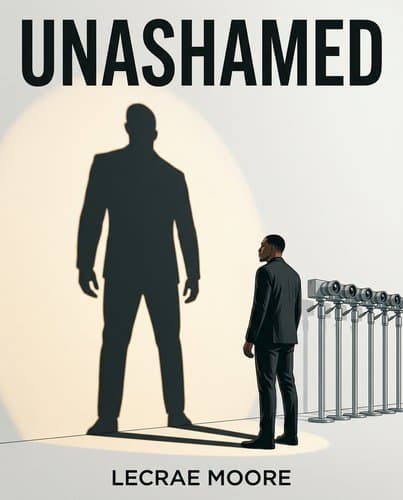
25802615_unashamed
by Lecrae Moore
Lecrae Moore traces five precise lines from his father's absence to five adult behaviors, revealing how chasing acceptance from fans, labels, and culture was…
In Brief
Lecrae Moore traces five precise lines from his father's absence to five adult behaviors, revealing how chasing acceptance from fans, labels, and culture was just the old wound wearing new clothes. Freedom comes not from finally belonging somewhere, but from needing it less.
Key Ideas
Name wounds specifically to heal
Name your wounds specifically — Lecrae traces five direct lines from his father's absence to five specific adult behaviors. Vague acknowledgment of pain doesn't produce healing; precise naming does.
Grace operates outside performance metrics
Distinguish contractual faith from covenantal faith. If you're performing for God's approval the way you performed for your father's, you've mapped an old wound onto a new relationship. Grace isn't a contract with stricter terms.
Human approval is borrowed currency
'If you live for people's acceptance, you'll die from their rejection.' Approval from a room is borrowed currency — it requires constant repayment and can be revoked without notice. The question isn't how to earn more of it but what you'd do if it stopped entirely.
Sacred secular divide is false
The sacred/secular divide is a thinking error. There is no Christian rap and secular rap — only people can become Christians. Whatever work you do, the question isn't whether it's religious enough but whether it tells the truth about the world.
Institutional resistance signals right direction
Gates don't attack — they keep people out. The resistance you face from the institution you're trying to serve is often the clearest signal that you're pointed in the right direction.
Rock bottom where denial ends
Rock bottom has a specific use: it's the moment you stop arguing with the evidence about your own life. Lecrae's crayon-and-Gideon-Bible moment in a psychiatric ward was productive precisely because every other option had been exhausted.
Who Should Read This
Readers interested in Memoir and Christianity, looking for practical insights they can apply to their own lives.
Unashamed
By Lecrae Moore
13 min read
Why does it matter? Because the approval you've been chasing your whole life might be the very thing keeping you from knowing who you are.
Forty-five minutes. That's how long Lecrae Moore stood waiting on the Grammy red carpet while security waved Iggy Azalea, Rick Ross, Taylor Swift, and Ziggy Marley past him. When he finally walked the backdrop in his tuxedo, thirty-five of forty photographers lowered their cameras. Most of us haven't stood on that carpet — but we know that feeling. The room that doesn't quite open. The introduction that lands wrong. The approval we've been quietly arranging our whole lives around, still just out of reach. Unashamed is the story of what happens when a man who grew up fatherless, abused, and perpetually mislabeled finally stops trying to earn his way into rooms that were never going to let him in. And that red carpet, those lowered cameras, that long wait in a tuxedo — turns out that's not the end of the story.
The Room That Reveals Everything About You
A security guard's arm keeps dropping in front of you. Iggy Azalea gets waved through. Then Rick Ross. Then Wiz Khalifa. Then Taylor Swift, Keith Urban, Ziggy Marley. Your wife, who came to watch this moment, eventually gives up and goes to find a seat. Forty-five minutes pass before the guard finally lets you through to the Grammy backdrop — where you are a legitimate nominee for Best Rap Performance, competing against Eminem and Kendrick Lamar — and when you walk up and flash your best smile, thirty-five of forty photographers lower their cameras. The remaining five probably felt sorry for you.
This is how Lecrae opens his memoir, and the details matter precisely because they're so specific and so small. No one was cruel to him. No one threw anything. The photographers just turned away. Somehow that's worse — the polite, distracted, nearly involuntary dismissal of someone who doesn't quite register.
What makes the scene cut deeper than a celebrity-status story is the internal split Lecrae admits to feeling. Part of him saw the whole spectacle for what it was — grown adults performing at being cool, a room full of humans pretending they weren't nervous — and found it ridiculous. But another part wanted in anyway. That wanting didn't disappear just because he recognized it as shallow. It sat there, uncomfortable and honest.
The red carpet turned out to be testing something older than fame: what do you do with the hunger to be seen? Lecrae's answer, hard-won across a lifetime of not quite fitting anywhere, is that if you feed it by chasing the room's approval, you hand the room the power to destroy you. The photographers lowered their cameras. He had to decide, in that moment, whether the room got to have that power. He kept walking.
When a Rapper Becomes Your Father
Fatherlessness isn't a wound you carry — it's a blueprint. Lecrae makes this distinction precise, and it changes how you read everything else about him. He doesn't describe his father's absence as a sad fact of his childhood. He traces five direct lines from that one absence to five specific adult behaviors, the way an engineer might trace cracks in a structure back to a single point of failure. Because his father chose drugs over him, he spent decades craving approval from everyone around him. Because the one person who should have found him easy to love apparently didn't, he questioned whether love was something he was capable of receiving at all. Because he wasn't reason enough for his father to stay, he carried a baseline conviction that he was perpetually disappointing the people in his life. Because the abandonment generated so much rage, his temper kept detonating in the direction of people who had nothing to do with the original injury. Because no man ever showed him consistently what a man does, he had no template to work from.
Three uncles tried to fill the space — one who shared his love of music and would spend hours playing reggae records, one who was stylish and affirming and would claim Lecrae as his own son when strangers made the mistake, one who radiated a kind of steel-spined toughness that Lecrae found stabilizing. Pieces of a composite father, he calls them. But they were scattered geographically, present inconsistently, and none of them could reach the place his father had hollowed out.
Hip-hop could. Tupac in particular became what Lecrae describes as a second parent — his mother's love of Black music and his uncle's street gravity fused into one voice that was always available. When Tupac was killed, Lecrae wept watching the funeral procession on television with a grief that surprised even him. It made sense when he examined it honestly: in every functional way, Tupac had been a father figure, and now he was gone too. The wound was the same wound.
What Happens to a Child When No One Is Watching
She was seventeen. He was six. She called him to her basement bedroom, closed the door, and the lock clicked behind him when he left.
What happened to Lecrae in that room is the actual load-bearing structure of everything the next decade of his life would become — and the mechanism is more specific than most people realize. It wasn't that abuse left him damaged in some vague, atmospheric way. His brain did something that six-year-old brains do when they have no other frame for an experience: it filed what happened under the nearest available category. He had wanted, desperately, to please people, to be good at something, to feel like he mattered to someone. And in that basement, he discovered he could produce an intense physical reaction in another person. That registered as power. As competence. As something close enough to love that a child couldn't tell the difference.
So his brain rewired around it. Not metaphorically — he describes a complete reorientation of behavior. While other kids his age were watching Saturday morning cartoons, he was finding closets, beds, anywhere private, pursuing sexual contact with girls from his neighborhood, his school, even distant relatives. He hadn't reached puberty. He wasn't acting from desire as adults understand it. He was mimicking the only script he'd been handed, because that's what children do with the scripts they're given. Then comes the detail that makes the abstraction land: at eight years old, he ran a race at a school field day, crossed the finish line, and buried his face in his teacher's crotch. She assumed it was an accident. It wasn't. He was replaying what he'd been taught.
Here is the thing about childhood trauma that Lecrae makes precise: it doesn't announce itself as damage. It announces itself as behavior, and the behavior feels like agency. The child doesn't experience themselves as broken — they experience themselves as someone who finally knows how something works. That reinterpretation is the wound: not what was done to him, but what his mind had to build in order to survive it.
Every Exit You Take When You Can't Find the Door
Lecrae spent his adolescence and early twenties running the same escape route over and over, just rebranded each time. He left Denver for Dallas looking for a fresh start. He left the arts magnet school to fit in with his friends, then watched his grades collapse at one of the worst-ranked schools in the state. He landed a full theater scholarship to the University of North Texas and dismantled it himself — first by dropping the program rather than kiss strangers in a class scene as a required exercise, then by cycling through weed, casual sex, and small-time drug dealing until the only thing his 3.5 GPA proved was how much energy he burned just staying afloat. He transferred to a music college in Tennessee seeking another reset and failed there too. Every move was genuinely motivated. Every move reproduced the same result.
The abortion sequence is where the compounding finally becomes impossible to ignore. His girlfriend — smart, musical, high as often as he was — tells him she's pregnant. His mind runs the math instantly: no degree, a telemarketing paycheck, no infrastructure for another person. He drives to her house and informs her this isn't a conversation. He borrows money, fills out her paperwork at a gray building in East Dallas squeezed between a liquor store and a check-cashing place, then circles the block while the procedure happens. When a nurse wheels her out blank-faced from the medication, he sneaks her past her mother, puts her to bed, and leaves. He breaks up with her not long after, offering something vague about them both needing to get right with God — a line he describes as the truest thing he'd ever said to her, even though he didn't believe it yet.
What makes this the representative moment isn't the moral weight of the choice, though that's real. It's the structure. He pressured someone he cared about into something she didn't want, in order to preserve a future he wasn't actually building. He protected options he wasn't using. The thing he sacrificed to stay free was the only thing that might have required him to grow into someone different. Every false exit works this way — it borrows against the future in exchange for relief right now, and the interest accrues until you're running the same escape from the escape.
The Night He Stopped Running and Hit a Wall Instead
Art Hooker pulled up in a beat-up Cutlass on a night when Lecrae had nowhere to be and nothing pulling him forward. Art mentioned a conference in Atlanta, and Lecrae barely heard the spiritual pitch — he heard Atlanta, the city he'd absorbed as a kind of promised land, Outkast and Freaknik and Morehouse and the idea that a person could be fully themselves there. He said yes before Art finished the sentence.
What happened at the Impact Conference on New Year's Eve 1998 was real. A pastor named James White described the crucifixion in terms Lecrae had never encountered — not stained-glass abstraction but physical particulars: the whip with sharpened bone, the splintering wood, the nails. Lecrae's image of Jesus had always been someone gentle to the point of uselessness, the kind of man who'd have gotten destroyed on the streets of Southeast San Diego. White's Jesus was something else — built for tenderness and built to survive a Roman execution squad. Then White read a single verse: you were bought at a price. Something in Lecrae broke open. Every stolen thing, every person he'd used, every moment of cruelty and cowardice flashed through his mind, and the sentence standing at the other end of all of it was that God had paid for him anyway. He collapsed to his knees and wept in a way he never had before.
He went home born again. He also went home as a man who had spent twenty years learning that love is something you earn, and now had a new relationship to perform in.
The conversion didn't rewire the hunger — it redirected it. When he stumbled, as he immediately did, he hid it, because he'd absorbed the message that Christians weren't supposed to stumble. Church face around believers, his old self everywhere else. The drinking accelerated, the cocaine started, he flipped his car drunk and walked away — and then one night he swallowed a cabinet full of pills hoping to die, woke up on the floor hours later, and kept going. The rage stored since childhood had nowhere left to go. He got in his car at eighty miles an hour headed toward his mother's gun, arguing with himself about whether his life was worth preserving. It wasn't, he decided. A voice broke through and told him to pull into the hospital parking lot instead. He walked to the emergency room desk and told the receptionist he was about to kill someone or himself.
At Timberlawn Psychiatric Center, they gave him a room with white walls and a metal door with a small glass window. They took his belt and his shoelaces. When his mother appeared at that window — the woman who had escaped the hood, pushed him into college, determined her children wouldn't end up here — and saw him in his patient uniform, she collapsed into the kind of crying he had almost never seen from her. He told her it wasn't her fault. He meant it.
Alone in that room, with nothing but a Gideon Bible and, when he asked for something to write with, a crayon — pencils were considered dangerous — he read through Romans and finally hit the thing no one had told him after Atlanta: grace isn't a performance to earn a father's approval. He had treated Jesus as a Savior while keeping himself in charge as lord, assuming God's forgiveness meant he could do whatever he wanted. Romans 6 broke that open. He'd been celebrating what he should have grieved and hiding what he should have owned. Surrendering wasn't weakness added to his existing weakness. It was the only thing that could actually help him walk.
You Can't Earn What's Already Been Given
Joe told him plainly: you struggle with acceptance. It wasn't an accusation. It was a diagnosis — and it named the wound that had been running the show long before anyone thought to look for it.
After Atlanta, Lecrae rebuilt his entire existence around earning God's continued approval. He stopped taking calls from non-Christian friends. He avoided parties, avoided women, avoided anything that might cost him points. He knew the theological language — grace, not works — but he was living the opposite. Because his father had abandoned him, he'd grown up assuming that love is something you perform for, and that failure means forfeiture. He mapped that blueprint straight onto God. Every day became an audition. The question underneath everything was whether his heavenly Father would leave him too if he misbehaved enough.
Which is why the double life makes sense once you see the architecture. When you believe love can be revoked, hiding your failures isn't weakness — it's survival. The problem wasn't that Lecrae was a hypocrite. It was that he'd written himself a contract: keep the rules, keep the relationship. Break the rules, lose everything. He was managing God the way you manage a creditor.
Romans 6 in the psychiatric ward broke that. He'd been celebrating the things worth grieving and hiding the things worth owning. The inversion was total. What Joe's diagnosis pointed to — the acceptance Lecrae couldn't receive — was the same gap the verse had cracked open: you can't earn what's already been given. That sentence isn't comfort. It's the thing that makes the contract obsolete.
The Gates Don't Attack — They Just Try to Keep You Out
Think about what a gate actually does. It doesn't chase you. It doesn't throw punches or lob accusations. It just stands there and refuses to open, betting that the refusal is enough to turn you around. Gates work on people who believe the wall defines the territory.
On a tour bus somewhere in the middle of his career, Lecrae was working through Matthew 16 when that image reorganized everything. Jesus delivers his famous line about the gates of hell not prevailing against the church — and Lecrae had always read it as a protection promise, God wrapping the faithful in a fortress, keeping the darkness outside. But he was sitting with the geography now. Caesarea Philippi, where Jesus said this, was one of the most aggressively pagan places in the ancient world. Not a hilltop retreat. A city full of temples to the wrong gods. And then the word 'gates' stopped him cold. Gates are defensive architecture. They don't attack — they exclude. Jesus wasn't promising to keep hell away from the church. He was promising that hell's walls couldn't keep the church out. Lecrae read it again and felt the whole thing shift. He'd been playing defense inside a wall that wasn't his to protect.
The distinction collapsed his entire operating model. He had been treating the Christian subculture as home base, making music for people already inside, measuring success by their approval. The gates logic reoriented everything: the wall was the problem to move through, not the address to protect.
So he made Church Clothes — stripped of theological jargon, written to people drowning in poverty and materialism and the particular loneliness of the hood — and gave it away free on DatPiff. A quarter million downloads in a month. The servers crashed. And then the people inside the wall responded: concert protests, YouTube condemnations, accusations of selling out, one contingent convinced he'd joined the Illuminati.
Lecrae locked himself in a closet with a biography of Francis Schaeffer — the philosopher and theologian who'd spent his career building a community for people the church had written off — and sat with the fury long enough to notice what it was actually telling him. Jesus had drawn the same anger from the same direction: religious communities who experienced outreach as betrayal. The resistance wasn't a setback to manage. It was confirmation that he'd finally found the door, and that the right people were waiting on the other side.
The Outsider Was Never a Phase — It Was the Answer
The belonging Lecrae spent decades chasing was always the wrong currency. Not because belonging doesn't matter, but because he was shopping in a store that had already decided his worth before he walked through the door.
The category problem was the tell. The Anomaly album came together when Lecrae finally stopped trying to solve it. Mainstream media wanted him to secularize. Christian critics wanted him behind the wall. Neither camp had a box that fit. What he eventually recognized — with something closer to relief than defeat — was that no box had ever fit, not once, all the way back to the beginning. The outsider status wasn't a wound to recover from. It was an accurate description of what he actually was.
The resolution arrives backstage at a sold-out Best Buy Theater in Times Square, April 9, 2015. Grammy-winning album. Good Morning America appearance that morning. A New York Times reporter in the audience. Lecrae stares into a mirror ringed by dressing-room bulbs and asks the question that had been running under his whole life: who is he, really? The rebel kid from Southeast San Diego? The lost college student? The man who swallowed a cabinet of pills and woke up on the floor? The husband, the father, the artist? All of those rings are inside the trunk, he decides. But the answer that settles everything is simpler and more durable than any of them: a child unconditionally loved by God. Not loved contingent on a Grammy, not loved pending approval from forty photographers on a red carpet, not loved if he could locate the right category to inhabit. Loved already. Loved first. Every dark chapter he'd survived — the abuse, the assault, the floor of that apartment — retroactively marked as a place where that presence had been, whether he could feel it or not. The Greek word in Ephesians 2:10 for 'workmanship' is poema. God's poem. The calling was never to make Christian art. It was to make art with your life.
What the Cameras Lowering Actually Meant
Here's what the Grammy backdrop was actually showing you: not that the room had decided against Lecrae, but that he'd finally stopped needing the room to decide for him. Thirty-five cameras lowering isn't a verdict — it's a mirror, and what it reflects is how much of your life you've organized around people who were always going to look away. The hunger to be seen doesn't dissolve when you understand this. It just loses its authority over you. Lecrae's word for that shift is unashamed — not triumphant, not finished, but no longer held hostage by approval that was always someone else's to grant. You already know which room you've been standing in. You already know what you've been performing for. The only question the book leaves you with is the one you'll have to answer yourself: what would you do if you stopped?
Notable Quotes
“What are you doing, man? Who cares about this dude?”
“I care. I can't just let someone threaten me with a gun. I can't just do nothing,”
“What do you think you're going to do that is going to change anything?”
Frequently Asked Questions
- What is Unashamed by Lecrae Moore about?
- Unashamed (2016) traces Christian rapper Lecrae Moore's journey through childhood abandonment, addiction, and crisis toward a faith-rooted identity no longer dependent on cultural approval. The book offers a framework for naming past wounds precisely, separating grace from performance, and building a life grounded in conviction rather than belonging. Through his own story, Lecrae demonstrates how specific healing comes from specific naming—he traces five direct lines from his father's absence to five specific adult behaviors. He also distinguishes contractual faith from covenantal faith, showing how recognizing grace as unconditional frees you from performing for divine approval. The work ultimately challenges readers to anchor their identity in truth rather than borrowed cultural currency.
- Why does Lecrae Moore emphasize naming your wounds specifically?
- Lecrae traces five direct lines from his father's absence to five specific adult behaviors, demonstrating that "vague acknowledgment of pain doesn't produce healing; precise naming does." Rather than accepting vague trauma narratives, he identifies exact consequences—how abandonment shaped specific patterns in relationships, decision-making, and self-image. This specificity matters because it breaks the automatic cycle; you can't heal what you haven't named clearly. Lecrae's diagnostic approach requires tracing the exact connection between past injury and present behavior. When you name precisely, you move from abstract acknowledgment to concrete understanding of how your history shapes present choices. This precision transforms healing from spiritual aspiration into actionable psychological work rooted in your own evidence.
- What does Lecrae Moore mean by separating contractual faith from covenantal faith?
- Contractual faith treats God like the demanding authority figures in your past—you must perform to earn approval and validation. "If you're performing for God's approval the way you performed for your father's, you've mapped an old wound onto a new relationship." Covenantal faith operates differently: "Grace isn't a contract with stricter terms." Covenant rests on unconditional acceptance that cannot be revoked by failure or weakness. This distinction matters because it reveals when you're repeating childhood trauma patterns in spiritual life. Lecrae's insight exposes how many people transfer their need for human approval directly onto their relationship with God, creating the same exhausting performance they hoped to escape. Covenantal faith interrupts this cycle.
- What does Lecrae mean by 'If you live for people's acceptance, you'll die from their rejection'?
- "If you live for people's acceptance, you'll die from their rejection." This statement captures a fundamental inversion: approval from a room is "borrowed currency — it requires constant repayment and can be revoked without notice." When you anchor your identity in external acceptance, you remain enslaved to forces beyond your control. The real question isn't how to earn more acceptance but what you'd do if it stopped entirely. Lecrae illustrates this through his own crisis—when he hit rock bottom in a psychiatric ward, external validation became irrelevant, forcing him to encounter his own life clearly. Freedom begins when you stop trading your identity for borrowed currency and instead ask what conviction actually demands.
Related Book Summaries
Read the full summary of 25802615_unashamed on InShort