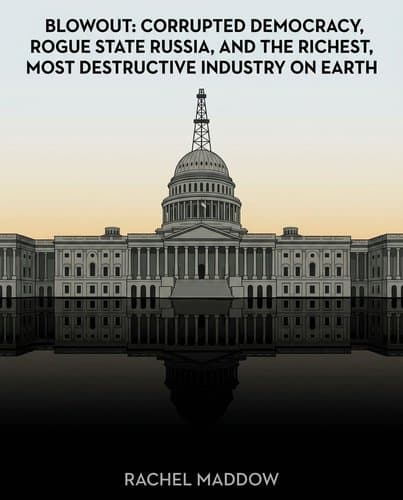
44767265_blowout
by Rachel Maddow
Oil doesn't just fuel cars—it fuels corruption, kleptocracy, and election interference. Rachel Maddow traces a single thread from Oklahoma statehouses to the…
In Brief
Oil doesn't just fuel cars—it fuels corruption, kleptocracy, and election interference. Rachel Maddow traces a single thread from Oklahoma statehouses to the Kremlin, revealing how petro-state economics made Russia's 2016 attack on democracy not a geopolitical mystery, but an inevitable consequence.
Key Ideas
Oil Concentration Institutionalizes Political Corruption
When oil revenues dominate a state's budget, corruption isn't a side effect — it's the operating system. The industry concentrates control over the commodity that controls everything else. This dynamic has run the same way from Rockefeller's Standard Oil in 1870 to Putin's Rosneft today: same traits, different hardware.
Fracking Accidentally Disrupted Petro-State Economies
The fracking revolution was geopolitically more consequential than any foreign policy decision of the era. George Mitchell's Barnett Shale experiments accidentally stranded Russia's petro-state economy, triggered Putin's financial desperation, and set the conditions for election interference — with no one planning any of it.
Western Finance Legitimizes Petro-State Theft
Western financial institutions — investment banks, law firms, stock exchanges — are not passive observers of petro-state corruption. They are essential infrastructure. The theft of Yukos required Morgan Stanley's roadshow, Goldman's coordination, and Skadden's 'independent' legal imprimatur to go global. Without that legitimacy, it couldn't have.
Pressure Replaces Bans in Science Suppression
Oil industry suppression of science is incremental and deniable: funded university budgets, board seats for administrators, calls from donors to deans, word-by-word edits to PowerPoint slides. You don't ban research — you make researchers' professional lives uncomfortable until they leave voluntarily, citing work-life balance.
Interference Exploits Existing Social Divisions
The 2016 Russian interference operation was cheap, analytically simple, and built on America's existing divisions. The IRA's stated goal was not to make Americans like Russia — it was to make Americans distrust each other. The proof of concept came from an unemployed Romanian who had nothing but time and a talent for guessing security questions.
Sustained Political Will Ensures Containment Success
Containment works when the constituency stays restless. Oklahoma teachers forced a tax reversal that produced a 125 percent revenue surge. Congress passed sanctions that held under a hostile president. Oklahoma earthquake counts dropped from 900 to 196 as injection wells were regulated. The tools are unglamorous and available — the only variable is sustained political will.
Who Should Read This
History readers interested in Geopolitics and Democracy who want a deeper understanding of how we got here.
Blowout: Corrupted Democracy, Rogue State Russia, and the Richest, Most Destructive Industry on Earth
By Rachel Maddow
12 min read
Why does it matter? Because Big Oil, Putin's Russia, and the 2016 election have always been the same story.
You've probably filed them in separate folders: the Russia problem, the oil industry problem, the democracy problem. Three crises, three explanations, three different Sunday morning panels. Rachel Maddow's argument is that this filing system is wrong. There's one story, and its engine has been visible since September 2003, when Vladimir Putin stood under a Lukoil canopy — Lukoil being, in case you missed it, a Russian state oil company — on Tenth Avenue in Manhattan, ate a glazed Krispy Kreme donut, and tried not to look rattled after an ExxonMobil CEO told him (more or less directly) that American companies expected to eventually own Russia's oil. What happened next connects Oklahoma earthquakes to Equatorial Guinea's starving children to a troll farm in St. Petersburg to the 2016 election. It's not a conspiracy. It's a single industry doing what it has always done: capture governments, corrupt institutions, externalize every cost — and getting away with it.
Standard Oil Never Died — It Just Replicated Its DNA Into Every Petro-State on Earth
The oil industry doesn't have a corruption problem. It has a corruption template, and it was written 150 years ago by a man counting barrel stoppers.
That's the central revelation of Rachel Maddow's Blowout: the grotesque behavior of modern oil (Putin's Kremlin absorbing companies through sham auctions, corporate executives testifying to Congress that fracking had never contaminated a single aquifer) isn't the product of particularly bad individuals happening to land in the same industry. It's the DNA Standard Oil encoded into the business at its founding, faithfully expressed by every successor since.
Here's the template: John D. Rockefeller, who built Standard Oil into what became the largest business enterprise in American history, was the kind of man who wrote letters to foremen about missing barrel stoppers. Not the occasional oversight memo — a formal inquiry about 750 bungs unaccounted for in a single month's inventory. The penny-pinching was tactical genius: compress costs enough and you can undercut every competitor, devour them at distress prices, and call yourself an angel of mercy for doing it. Standard eventually controlled 90 percent of America's crude oil flow. When the Supreme Court broke it up in 1911, Rockefeller kept stakes in all the spin-offs and grew richer anyway.
What the Court couldn't break up was the template. Maddow distills it into four traits: relentless cost-cutting, a drive to devour and expand, contempt for government regulation, and a conviction that the enterprise serves a higher purpose than profit. Rockefeller's view of trust investigators was that Congress had confused a public benefactor with a monopolist — the government punishing efficiency. The higher calling, for Rockefeller, was literal: he believed God gave him the gift of making money. ExxonMobil CEO Rex Tillerson's version, a century later, was Ayn Rand: the world runs on a handful of visionary operators, and anyone who hasn't spent thirty years at ExxonMobil simply lacks the knowledge to criticize it. Vladimir Putin's version was older: the divine right of the state. In each case, the higher calling meant the rules that applied to everyone else did not apply here.
The geography changes. The accent changes. The costume changes. The template doesn't.
An Oklahoma Wildcatter's Obsession Accidentally Stranded Russia's Entire Economy
In the summer of 1998, a Mitchell Energy engineer named Nick Steinsberger was trying to save his company money. The fracking gels the company pumped into the Barnett Shale (a tight rock formation five to eight thousand feet below the scrubland northwest of Fort Worth) were expensive, and Steinsberger had a cheap idea: replace most of the gel with water. His supervisors gave him the go-ahead on a handful of wells. One told him he'd eat his diploma if it actually worked.
George Mitchell, the company's founder, needed something to work. His stock had collapsed from $35 to near $10. Two waves of layoffs had cut the workforce from thirteen hundred to eight hundred. He was approaching eighty and worried the company might soon default on its decades-old contract to supply gas to Chicago. ExxonMobil and Chevron had already abandoned shale fracking as economically hopeless. Mitchell kept funding the experiments anyway, against his board, against the president he'd hired, against the consensus of the entire industry. His son said it wasn't persistence. It was obsession.
Steinsberger's "slickwater" formula — water, sand, a lubricant borrowed from face cream manufacturing, a touch of guar-bean gel — meant pumping 1.2 million gallons underground at high pressure to open hairline fractures in dense rock. The S.H. Griffin No. 4 well was still producing 1.5 million cubic feet of gas per day ninety days after the frack. One hundred twenty days later, still no decline. Conventional gel would have clogged the passages it opened; slickwater cleared them and left.
Devon Energy paid $3.5 billion for Mitchell's company in 2002, combined slickwater with horizontal drilling (straight down, ninety-degree turn, then miles of lateral tunnel), and expected over six thousand wells in the Barnett Shale alone. American gas production exploded. Prices fell. Russia sat on vast reserves in precisely the same kind of tight shale but needed Western drilling technology to unlock them — technology sanctions would deny it after 2014. Its state oil companies, insulated from the competitive pressure that had kept Mitchell drilling long after any rational board would have quit, never developed the horizontal-slickwater combination on their own. The fracking revolution was never meant to strand Russia's economy. It just did.
A $300 Shell Company Above a Vodka Bar Bought Russia's Premier Oil Firm — With Western Help
On December 19, 2004, the auction for Russia's most capable oil company lasted roughly six minutes. The winning bidder for Yuganskneftegaz — the production heart of Yukos, whose owner Mikhail Khodorkovsky was then Russia's richest man and already sitting in a prison cell on tax charges — was a company called Baikalfinansgrup. When reporters dug into its registration papers, they found a firm two weeks old, capitalized at three hundred dollars, with offices listed above a vodka bar in the medieval town of Tver, three hours from Moscow, at an address shared by 150 other shell companies with no apparent physical assets. A few days later, Rosneft stepped in and relieved the $300 company of its single purchase using state funds. A business that had been worth $36 billion was shoplifted in installments, with a liquor-adjacent shell corporation playing the role of legitimate purchaser.
Most accounts of Putin's Russia treat this as the end of the story: brazen kleptocracy, unfortunate for rule of law, moving on. Maddow's point is that the theft wasn't actually finished — because Rosneft still needed something the Kremlin couldn't manufacture: credibility with Western capital markets. And for that, it hired Morgan Stanley.
Morgan Stanley had kept its Moscow office open since 1994, staying put when every other major Western financial institution fled during Russia's 1998 collapse. It had hired a former Rosneft vice president to run the operation. When Rosneft began absorbing Yukos, Morgan Stanley ran the company's international roadshow through London and New York boardrooms, vouching for a business whose entire asset base had been assembled at that six-minute auction. George Soros published an op-ed arguing the IPO would legitimize the theft. Dick Cheney made the same case. When you've managed to unite George Soros and Dick Cheney in opposition and the deal closes anyway, you know what you're dealing with. The IPO raised over $10 billion — sixth-largest in world history at the time. Goldman Sachs and JPMorgan came on as coordinators. An international arbitration court later ruled the assets had been illegally seized. Morgan Stanley's estimated take over the decade: $360 million.
The West didn't watch from a distance. It provided the laundering infrastructure and sent an invoice.
The Most Profitable Industry in History Admits It Can't Clean Up After Itself — And Nobody Asks a Follow-Up
On June 15, 2010, Rex Tillerson sat before a Democratic House subcommittee and twirled a paper clip. He was still twirling it when Chairman Markey raised the walrus question. ExxonMobil's Gulf of Mexico spill response plan included walruses. Walruses haven't lived in the Gulf for three million years. Tillerson explained the plan incorporated broad marine mammal studies required by regulation. Markey cut him off: this was a regional plan. How did walruses end up in a regional Gulf response?
The walruses were bad. The dead expert was worse. Dr. Lutz, a marine mammal biologist, was listed in the plan as a key technical resource — someone to call during a spill. He had been dead for four years before the plan was filed. Tillerson's defense: a scientist's death doesn't invalidate his research. Markey's response: the plan included Dr. Lutz's phone number.
All of this unfolded two months after Deepwater Horizon, a BP-operated rig that exploded in April and would ultimately pour nearly five million barrels into the Gulf, the worst offshore spill in U.S. history. The best cleanup technology available was absorbent pads workers called "paper towels": diaper filling stuffed into sausage-casing booms, developed across the twenty years since the Exxon Valdez. Tillerson explained the situation with remarkable calm: the industry was not well equipped to handle major spills, had never claimed otherwise, and the solution was prevention. This was a Democratic majority subcommittee. Nobody followed up.
Ten days after the rig first exploded, while BP was still fighting to contain it, an ExxonMobil pipeline in Nigeria ruptured and went undetected for a full week, leaking nearly a million gallons into the Niger delta. Nobody in Congress raised it. This wasn't unusual: roughly 11 million gallons (one Exxon Valdez per year) had been leaking into the delta annually for fifty years, with no cleanup requirement at all. Tillerson walked out of the hearing still on record as a good corporate citizen "wherever we operate."
The 1 Percent That Killed Seventeen Cows
How toxic does a chemical have to be? Chesapeake Energy answered this, inadvertently, in a report filed seven weeks after seventeen cattle died within hours of drinking from puddles in a Louisiana pasture near one of the company's drill pads. Whatever had leaked, the report explained, was more than 99 percent freshwater, and therefore fell below the legal threshold for a "reportable" release. Think about what that arithmetic requires: if 99 percent of the substance was water, the remaining 1 percent had to be toxic enough to kill fifteen-hundred-pound animals within hours of ingestion. That's the 1 percent the company wasn't required to tell you about.
The cows had done what cattle do: drunk from puddles in their own pasture. Some were found foaming at the mouth, bleeding from the tongue. All seventeen were dead by evening. Deputies arrived in hazmat suits. Chesapeake said it had no evidence of a chemical release. Its formal report attributed any contamination to storm water runoff that had carried trace materials from the pad into the adjacent field. Convenient rain.
All of it was documented: a state DEP report, a filed corporate response, seventeen dead animals. Austin Holland was Oklahoma's sole state seismologist. When he started publishing peer-reviewed papers linking the state's earthquake explosion to wastewater injection — Oklahoma went from fewer than two magnitude-3.0 events a year before 2008 to 268 in the first six months of 2014 — Harold Hamm, the billionaire founder of Continental Resources, an Oklahoma oil company, met privately with the University of Oklahoma's president. Holland's PowerPoint slides were scrubbed of the words "disposal," "recovery," and "fracturing." Hamm wrote to the president that he was glad a trusted spokeswoman had been "put in charge" of public communications. The situation, he noted, could "spiral out of hand easily." A geologist at another institution who published corroborating findings received a legal threat from the same oil industry and decamped to Cornell. Same suppression, different campus. The science didn't stop being true. It just stopped being said out loud.
Putin Had $1.6 Trillion in Oil Revenue and Couldn't Build a Single Highway
Putin's oil empire was never a strategy. It was a trap he built carefully and then couldn't escape.
Here's how the trap works. Russia's state oil companies (Rosneft and Gazprom) grew not through competition but through devouring or intimidating every domestic rival that showed competence. Between 2000 and 2011, Russia collected $1.6 trillion in oil and gas revenues and built no interstate highway. Its economy is smaller than Italy's. By 2018, a fifteen-year-old boy in Russia had a shorter life expectancy than one in Haiti.
Russia isn't the only example. Equatorial Guinea produces enough oil per capita to rank among Africa's wealthiest nations, yet most of its children are malnourished and it has no functioning school system; the revenue flows to President Obiang Nguema's family and the American banks and lobbying firms in Washington helping them keep it. The oil didn't build the country — it replaced the country.
The reserves weren't exhausted, just increasingly hard to reach. Soviet-era fields were declining, and the remaining oil sat in Arctic waters and tight shale formations requiring exactly the drilling expertise Russia had spent twenty years destroying. That's why the Kara Sea deal with ExxonMobil mattered: without a capable Western partner, the oil stayed in the ground.
Then came Crimea. The 2014 annexation triggered sanctions cutting Russia off from Western Arctic-drilling technology. The day Rosneft completed its seizure of Bashneft, Russia's best-run private oil company, its chief announced the Kara Sea drill had struck a billion barrels of oil. He called the field Pobeda. Within six months, he was admitting Rosneft lacked the equipment to drill it without Western help. The return to the Arctic was pushed past 2021.
Pobeda is the whole story in miniature. Russia found its oil and immediately discovered it was unreachable — because the behavior that earned the sanctions was the same behavior that made Western technology necessary in the first place. German chancellor Angela Merkel put it plainly: "Russia has nothing, no successful politics or economy. All they have is this." When "this" stops working, the only remaining move is to corrupt everyone else's system until theirs looks as broken as yours.
The FBI Taped Russian Spies Dreaming of James Bond While an Unemployed Romanian Hacked the White House
In April 2013, Viktor Podobnyy, an SVR officer (Russian foreign intelligence) operating under cover as a UN attaché, sat in his mission's secure room and ate a cookie. The FBI had bugged it. "Not one point of what I thought then, not even close," he told his partner. He had imagined something like James Bond. Instead he was managing Carter Page, a 41-year-old Russophile adjunct professor who would surface years later as a Trump campaign advisor. Page rambled about Gazprom and handed over lecture notes. "I think he is an idiot and forgot who I am," Podobnyy concluded.
The Illegals were deep-cover Russian agents who'd spent years living as ordinary Americans before their 2010 exposure. Nearly two decades in American suburbs, and they never gathered anything unavailable in a newspaper. Their cars were GPS-tagged, their homes searched; one agent walked up to a stranger at Columbus Circle with a code phrase, another left his SVR password written in a notebook beside his computer. The genuinely dangerous operator in 2013 turned out to be a 42-year-old former paint salesman in Transylvania.
Marcel Lazar, known online as Guccifer, had no computer training. His method was guessing security question answers — pet names, childhood streets, mother's maiden name — using Wikipedia and obsessive Googling. Success rate under 10 percent, but he had nothing but time. Working through hacked address books like stepping stones, he breached accounts belonging to Colin Powell, the sitting head of the National Intelligence Council, a U.S. senator, and the acting director of the agency that secures America's nuclear stockpile. He stumbled into Sidney Blumenthal's inbox and accidentally exposed the existence of Hillary Clinton's private email server, buried in a throwaway line that almost nobody read.
What the Guccifer breaches proved — that American security was guessable, American institutions porous, American fractures real — was exactly the proof of concept that the Internet Research Agency took to work. The agency at 55 Savushkina Street, St. Petersburg ran two twelve-hour shifts, seven days a week. Workers binge-watched House of Cards and manufactured hundreds of fake-American posts daily about immigration, guns, and race. One former troll described the mission: "Our goal wasn't to turn Americans toward Russia. Our goal was to set Americans against their own government." The operation reached over a hundred million Americans. It worked not because Russia was strong but because the fractures were real and the trolls were cheap.
The Only Things That Have Actually Beaten This Industry Are Boring and Democratic
Think of every theory for breaking an industry's stranglehold on government, and they tend to require something extraordinary: a visionary politician, a disaster spectacular enough to generate lasting outrage, a billionaire willing to outspend the other billionaires. The boring answer — people showing up in enough numbers to make incumbents nervous — gets dismissed as naive. Maddow ends by noticing it's the only one in this story that has actually worked.
By 2018, what oil's political dominance had cost Oklahoma was past ignoring. Per-pupil school spending had dropped 24 percent in under a decade. Teachers bought classroom supplies with their own money and picked up second jobs. Dozens of districts cut to four-day school weeks. All of this while the industry's share of state GDP had more than doubled, and while its effective tax rate had been written, in a closed meeting at the governor's residence, by three oil executives who dictated terms to a budget director sitting quietly in the fourth chair.
Then teachers walked out. And walked out again. Parents came. Students came. They kept coming until the state legislature passed an energy production tax increase from 2 percent to 5 percent, the kind of move requiring a three-quarters supermajority in both chambers, the very threshold oil lobbyists had spent decades making unachievable. The industry's predictions of collapse didn't materialize. The November after the increase, gross production tax revenue came in 125 percent higher than the prior year. The projected deficit became a $612 million surplus.
Austin Holland, the Oklahoma state seismologist pressured to soften his findings linking injection wells to the earthquake swarm, published them anyway. The Corporation Commission gained real-time authority to shut down wells near active faults; the earthquake count fell from 900 in 2015 to 196 in 2018 without drilling stopping. In Washington, a bipartisan group of veterans sounded the alarm about Russia's energy leverage, and Congress passed sanctions 98-2 in the Senate and 419-3 in the House. Trump reportedly squeaked like an unoiled hinge, but signed under a veto-proof majority. The Kara Sea project remains frozen.
The playbook doesn't require a hero. It requires constituency pressure, applied long enough that even captured politicians calculate the risk to their own seats. The mechanisms exist, they've worked in exactly this story, and the only question is whether enough people will use them. The industry has spent decades betting they won't. Oklahoma's teachers proved that bet wrong.
The Lion Is Still Out There — But So Is the Fence
The industry will keep doing what it does. That's not pessimism — it's accurate. Oklahoma's earthquake count didn't fall because oil companies had a change of heart; it fell because someone regulated the injection wells and didn't stop watching. That's what Maddow keeps showing you, underneath all the shell companies and bought geologists and walrus-infested spill plans: the rules work when people show up to enforce them. Oklahoma teachers didn't discover a secret weapon. They just refused to go home until the math changed — and the math changed. The 98-2 Senate vote on sanctions held against a president who didn't want it to hold. These are unglamorous victories won by people who stayed annoyed past the point where annoyance was comfortable. The only question the book leaves you with is whether enough of you will.
Notable Quotes
“The trial court based its finding of Tymoshenko's guilt on factual determinations that had evidentiary support in the trial record,”
“Based on the record, Tymoshenko has not provided clear and specific evidence of political motivation that would be sufficient to overturn her conviction under American standards.”
“grateful…for this professional analysis that unconditionally lays out the facts of the matter.”
Frequently Asked Questions
- What is "Blowout" by Rachel Maddow about?
- "Blowout" argues that America's political decay, Russia's kleptocracy, and the 2016 election interference share a single cause: the oil and gas industry's structural power to capture governments. Rachel Maddow draws on cases from Oklahoma to the Kremlin to demonstrate how petro-state economics corrupts democracy and governance. The book traces this corrupting dynamic across time—from Rockefeller's Standard Oil in 1870 to Putin's Rosneft today—showing that when oil dominates a state's budget, corruption becomes the operating system itself. Maddow explores what sustained political resistance can achieve against this structural power.
- How does the oil and gas industry corrupt democracy according to "Blowout"?
- "When oil revenues dominate a state's budget, corruption isn't a side effect — it's the operating system." The industry concentrates control over the commodity that controls everything else, following the same pattern from Rockefeller's Standard Oil to Putin's Rosneft. Maddow reveals that Western financial institutions are not passive observers of corruption but essential infrastructure enabling it. The theft of Yukos required Morgan Stanley's roadshow, Goldman's coordination, and Skadden's 'independent' legal imprimatur to go global. Without Western financial legitimacy, such large-scale corruption couldn't have succeeded internationally.
- How did the fracking revolution affect Russia's economy and the 2016 election?
- "The fracking revolution was geopolitically more consequential than any foreign policy decision of the era." George Mitchell's Barnett Shale experiments accidentally stranded Russia's petro-state economy, triggered Putin's financial desperation, and set conditions for election interference. This technological shift created financial pressure on Putin's regime, forcing it to seek asymmetric responses. The 2016 Russian interference operation became possible because fracking had undermined Russia's traditional economic leverage, compelling Moscow to pursue information warfare as an alternative strategy against the United States.
- What solutions does "Blowout" suggest for resisting petro-state corruption?
- "Containment works when the constituency stays restless." Oklahoma teachers forced a tax reversal that produced a 125 percent revenue surge. Congress passed sanctions that held under a hostile president. Oklahoma earthquake counts dropped from 900 to 196 as injection wells were regulated. "The tools are unglamorous and available — the only variable is sustained political will." These examples demonstrate that coordinated political action can counter the oil industry's structural power and its corrupting influence on democratic institutions.
Related Book Summaries
Read the full summary of 44767265_blowout on InShort