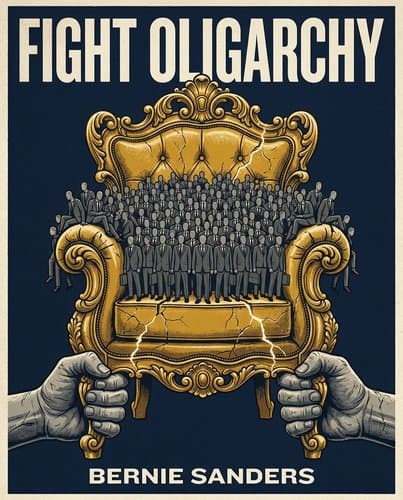
239925198_fight-oligarchy
by Bernie Sanders
Three asset managers now control 95% of S&P 500 companies, billionaires purchase elections with traceable precision, and $79 trillion has been quietly…
In Brief
Three asset managers now control 95% of S&P 500 companies, billionaires purchase elections with traceable precision, and $79 trillion has been quietly transferred from working Americans to the ultra-wealthy—but Sanders maps exactly how ordinary people have defeated unbeatable odds before, and how they can again.
Key Ideas
Three asset managers control America's corporations
The ownership architecture of the American economy is not just concentrated wealth — it's three asset managers (Vanguard, BlackRock, State Street) holding decisive influence over 95% of S&P 500 companies simultaneously, creating a system where no one can be held accountable because 'the owners' are always somewhere else.
Campaign spending converts directly into policy
Political capture has a measurable price: Musk's $290 million to elect Trump converted directly into DOGE and the death of a bipartisan bill within hours of a single tweet. The causal chain is now short enough to trace in real time.
Economic pain exploited with broken promises
Trump voters were responding to a real economic collapse — $79 trillion transferred from the bottom 90% to the top 1% over 50 years, wages lower in real terms than 1973 — but were handed a false target and then betrayed on every economic promise that mattered.
Manufactured defeatism contradicted by historical wins
The Establishment's most durable political weapon is manufacturing the belief that resistance is futile. Every historical precedent — labor rights, civil rights, women's suffrage, LGBTQ+ rights — was won against opponents who also looked unbeatable.
Quarter-million organize across party lines
Resistance is already happening at scale: 280,000 people across 24 rallies in 15 states, 60% not on existing progressive lists, 30% Independent or Republican, with 7,000 expressing interest in running for office.
Concrete policies targeting systemic economic inequality
The prescriptive agenda is specific: overturn Citizens United, wealth tax capped at $1 billion, Medicare for All ($650B annual savings per CBO), 32-hour workweek, $17 minimum wage, 4 million housing units, expand Social Security by lifting the income cap.
Who Should Read This
History readers interested in Democracy and Geopolitics who want a deeper understanding of how we got here.
Fight Oligarchy
By Bernie Sanders
11 min read
Why does it matter? Because the economy isn't broken — it's been captured, and there's a paper trail.
You already know the price of eggs went up. You know your rent is too high, your insurance denied something it shouldn't have, and the politician you voted for somehow never got around to fixing any of it. That feeling — that the game is arranged before you sit down — isn't paranoia. It's pattern recognition. What Bernie Sanders does in this book is hand you the org chart — and then show you what people who had less than this managed to build anyway. Three asset management firms. Six media conglomerates. A campaign finance system that converts billionaire money into legislation within the same news cycle. The mechanism is specific, it has names attached, and once you see how the ownership architecture actually works — who holds the shares, how that translates into what laws pass and which ones die — the vague sense of being cheated sharpens into something you can organize around. That's the move this book makes: from symptom to system, and then to the question of what people who had less than this managed to win anyway.
Three Asset Managers Own Nearly Everything — And That's Not a Metaphor
Wealth inequality, as most people understand it, means some people have vastly more than others — a gap you can measure in income charts and Gini coefficients. What Bernie Sanders is describing is something more precise and more unsettling: a specific ownership architecture in which three Wall Street firms exercise decisive influence over the entire American economy, including companies that are supposed to be competing with each other.
Here is the structure. Vanguard, BlackRock, and State Street are the three largest shareholders — in that exact order — of General Motors and Ford. They are also the three largest shareholders of ExxonMobil and Chevron. And of Pfizer, Merck, and Johnson & Johnson. These three firms hold major stakes in 95% of S&P 500 companies. Beef prices are high partly because four corporations control 80% of beef processing in America — but trace those corporations back far enough and you find the same three Wall Street firms at the top. Whatever competition exists downstream, the ownership is unified upstream.
The practical consequence is the disappearance of accountability. When Sanders was working on labor disputes as chair of the Senate HELP Committee — fighting for better wages and conditions for union workers — he repeatedly contacted corporate managers and got essentially the same answer: we're not the owners, that's someone else's decision. The actual decision-makers were invisible, buffered by layers of institutional ownership. The workers had grievances. Sanders had a committee. Nobody could locate the person responsible. When there's no face on the power, there's no consequence for how it's used.
Trace those three asset managers back and you find firms accountable to no senator, no regulator, no worker whose pension they quietly hold. The game was arranged long before anyone sat down to play.
A Billion-Dollar Donation Buys a Government Department: How Political Capture Actually Works
In December 2024, Bernie Sanders finished months of painstaking negotiations on a bipartisan federal spending package. As chair of the Senate HELP Committee, he had fought to get funding in for primary care clinics, dental services, mental health programs, nutrition support for elderly Americans, and apprenticeships for young workers. The bill wasn't everything he wanted — it never is — but it would have helped millions of struggling people. Congress was about to pass it. Then Elon Musk sent some tweets, threatening to fund primary challengers against anyone who voted yes. The bill collapsed. Musk spoke. The bill died.
That sequence is what political corruption looks like when it has fully matured. Not influence. Not access. Direct, same-day causation between a rich man's preferences and a legislative outcome affecting millions of people who never got a vote in any of it.
Citizens United is the mechanism. The Supreme Court's 2010 ruling, decided 5 to 4, let billionaires spend unlimited sums on elections. Since then, political spending has risen more than 1,600 percent. In the 2024 cycle alone, 100 billionaire families poured $2.6 billion into races — double what they spent four years earlier. Musk contributed $290 million to elect Trump and was rewarded with control of the Department of Government Efficiency, a newly created power center he used to dismantle federal agencies and fire tens of thousands of workers.
The transaction is explicit. The return on investment is measurable. And once politicians understand the terms, behavior adjusts — sometimes within hours. When Senator Thom Tillis announced he couldn't support Trump's 'Big Beautiful Bill' because it would strip more than 650,000 North Carolinians of their health insurance, Trump threatened to back a primary challenger. Tillis announced he wouldn't seek reelection before the day was out. The threat alone is sufficient. You don't even have to spend the money.
When you understand those terms, the vote on the 'Big Beautiful Bill' stops looking like a policy decision and starts looking like a self-preservation calculation.
The Inauguration Seating Chart Was an Org Chart
On January 20, 2025, as Trump took the oath of office, the three wealthiest people in America — Musk, Bezos, Zuckerberg — stood directly behind him. Behind them sat thirteen more billionaires Trump had nominated to run federal agencies.
Sanders found himself thinking of Lincoln's words at Gettysburg: government of, by, and for the people. That phrase, the whole argument of the speech, was what he watched being inverted in the seating arrangement in front of him.
The relationship between Trump and this class was transactional from the start, and the terms were not hidden. Zuckerberg paid $25 million to settle a lawsuit Trump had filed against Meta — a lawsuit legal observers considered weak. He got the settlement. Then Trump's legislative package included a $15 billion retroactive tax break for Meta. Six hundred times the investment, returned through statute. That same legislation handed the top one percent over a trillion dollars in tax relief while cutting health coverage for an estimated 15 million Americans on Medicaid. The estate tax provision alone — a break on inheritances over $30 million — was worth $211 billion.
The framing of Trump as a populist who lost his way once in office, captured eventually by the wealthy, misses what the inauguration made plain. The billionaire class was not waiting in the wings. They were on the stage. The government was organized around their interests before a single piece of legislation was written, because the people holding the offices and the people writing the checks were, in many cases, the same people. The transaction preceded the policy. The architecture was the point.
Trump Found the Real Wound and Poured Poison In It
How do you explain a working-class voter choosing a billionaire who openly planned to cut their health care? The easy answer — that they were duped, or that something darker was driving them — misses what the data actually shows: the economic abandonment was real, the rage was rational, and the Democratic Party handed Trump a vacuum it had spent decades creating.
Here is the number that frames everything else. According to RAND Corporation research, roughly $79 trillion moved from the bottom ninety percent of American earners to the top one percent over the past fifty years. Not through bad luck. Through policy choices — trade agreements that shuttered factories, tax structures that rewarded capital over labor, a political class that held fundraisers on the coasts while mill towns hollowed out. The average worker today, adjusted for inflation, earns less per week than their counterpart did in 1973. Sixty percent of Americans are living paycheck to paycheck in the wealthiest country that has ever existed. When those voters looked at the Democratic Party and felt unseen, they were not imagining it.
Trump walked into that wound with a move that demagogues have always known how to make: find the pain, confirm it, and redirect it toward a target that can't fight back. Starting in 2015 with the claim that Mexican migrants were rapists and criminals, he built a story in which the real authors of working-class suffering — the trade negotiators, the financiers, the politicians — remained offstage while undocumented laborers took the blame. Both liberal and libertarian researchers have reviewed the data and reached the same conclusion: undocumented immigrants are convicted of crimes at lower rates than native-born Americans. The menace was manufactured. The fear was real because the underlying economic pain was real.
Then Trump won, and governed as though the working class had never existed. He did not campaign on stripping health coverage from fifteen million people on Medicaid. He did not campaign on eliminating free school lunches for sixteen million low-income children. He did not campaign on firing more than seven thousand Social Security Administration employees while his allies called the program a fraud. Every one of those outcomes arrived in his signature legislative package — the same bill that delivered over a trillion dollars in tax relief to the wealthiest Americans. The voters who wanted the system blown up got exactly that. Just not the part of the system that had been crushing them.
The Establishment's Most Powerful Weapon Is Your Belief That Nothing Can Change
The Establishment's most powerful weapon isn't its money, its lawyers, or its politicians. It's the feeling it plants in you that the whole apparatus is simply too large to fight. Sanders is direct about this: manufacturing futility is the primary political tool of concentrated power, and it has always been wrong.
Consider what happened in Ludlow, Colorado in April 1914. Miners in the United Mine Workers had walked off the job demanding better pay and basic protections in one of the most dangerous industries in America. The coal company evicted them from company-owned housing, so they built a tent colony with their families. When National Guardsmen, acting in the company's interests, attacked the camp, they killed twenty-one people — eleven of them children. The message was unmistakable: this is what happens when workers make demands. Stand down.
They didn't stand down. The Ludlow Massacre focused national outrage so sharply on corporate brutality that it helped end child labor in the United States. The same movement that suffered that massacre ultimately produced the eight-hour workday, the minimum wage, and a standard of living that by midcentury had created a broad American middle class that was the envy of the industrialized world. The most violent suppression of the labor movement became one of its most productive turning points.
Frederick Douglass understood the mechanism over fifty years earlier: power concedes nothing without a demand, and the limits of any tyrant are set precisely by how much those he oppresses are willing to endure. The Establishment doesn't need to defeat every challenge. It only needs you to stop before you start. The tent colony at Ludlow looked defeated when the smoke cleared. The coal company won the day and lost the century.
Every generation has faced opponents who looked unbeatable. George Wallace stood before Alabama in 1963 and declared that segregation would last forever. One year later, President Johnson signed the Civil Rights Act. The confidence of entrenched power is not evidence of its invulnerability. It is the performance the powerful must maintain to keep resistance from organizing.
280,000 People Showed Up — 60% of Them Weren't on Anyone's List
In Warren, Michigan, four months after Trump held a presidential campaign rally and drew 4,000 people, Sanders and UAW president Shawn Fain brought out 9,000 — not as candidates for anything, just as organizers. That number is the simplest possible answer to the question of whether an anti-oligarchy movement has an audience beyond the progressive base.
By late July 2025, roughly 280,000 people had attended 24 rallies across 15 states. The list reads like a political consultant's nightmare: Nebraska, Iowa, Utah, Idaho, Oklahoma, Louisiana. Not strongholds. Not friendly territory. Sanders chose Republican-held districts deliberately, targeting representatives who had won by thin margins and were about to vote for legislation that would strip health coverage from millions while handing the wealthy a trillion-dollar tax break. The goal wasn't to preach to the converted. It was to show up where the pain was real and the party infrastructure had abandoned the field.
About 60 percent of attendees weren't in Sanders's campaign databases — meaning they hadn't shown up for his presidential runs, hadn't signed a petition, hadn't donated. They were new. And roughly 30 percent identified as Independents or Republicans. Whatever drove them to fill a high school football stadium in Tucson or stand in an arena in Tempe, it wasn't partisan loyalty. It was something more like recognition — the sense that the system is rigged in ways that don't stop at party lines.
Then came Tulsa. Sanders was finishing his remarks to a crowd of 5,500 when his campaign manager walked onstage and handed him a printed statement from Trump announcing that the United States had completed its attack on three nuclear sites in Iran. Sanders read it aloud. The boos were immediate and overwhelming, and the crowd settled into a chant — no more war, no more war — that was still going when someone filmed it and posted the clip online. Fifteen million people watched it. The moment worked because it wasn't staged. A crowd that had gathered to talk about Medicaid cuts and billionaire tax breaks had just been handed a war, in real time, and they knew exactly what to say.
After each rally, the organizing continued: full-time staff hired in four states, canvassing programs launched, and an open call for attendees to consider running for office. More than 7,000 people said yes, 40 percent of them indicating they'd run as Independents rather than Democrats. The resistance Sanders is describing isn't waiting to be built. It showed up before anyone sent the blueprints.
The Fix Is Specific, Not Inspirational
The closing argument here isn't a feeling — it's a numbered list with price tags. Sanders spends the final chapter doing something political books rarely attempt: writing an actual to-do list, in sequence, with dollar figures attached, so you leave knowing not just what's wrong but what would fix it and roughly what it costs.
The organizing anchor is a single, arresting number from the Congressional Budget Office: Medicare for All would save Americans $650 billion every year compared to the current system. That figure reframes the entire debate. The standard objection to universal health coverage is cost — how do we pay for it? The CBO answer is that the country is already paying more, just inefficiently, with the surplus flowing to insurance company profits instead of patient care. Add cutting prescription drug prices to European levels, and the math gets even cleaner. This is the template for the whole agenda: the wealth is already here, already being extracted from working people, just going to the wrong places. A wealth cap set at one billion dollars, a minimum wage of $17 an hour, Social Security expanded by lifting the payroll tax ceiling currently fixed at $176,100 — these aren't wishes. We already know exactly how to do them.
Then Sanders makes the move that separates this from a platform document: he hands you the infrastructure. His campaign has trained organizers in nearly two dozen states. Seven thousand people raised their hands at rallies to run for office. The Emergency Workplace Organizing Committee exists specifically to train workers who want to unionize and don't know how to start. These organizations are running now, not hypothetically. Zohran Mamdani's defeat of Andrew Cuomo is Sanders's proof of concept that the formula works outside Vermont.
The chapter's design is deliberate. Moral language — the Sermon on the Mount's question of when enough wealth is enough — sets the terms. But the chapter lands on specifics because Sanders understands that inspiration without a next step is just energy that dissipates. The to-do list is the point. Pick one item, find the existing organization working on it, and show up. That's not a call to hope. That's a call to Tuesday.
The Question the Seating Chart Already Answered
On January 20, 2025, three of the wealthiest men alive stood directly behind a president swearing an oath to serve you. No back room, no intermediary, no pretense of separation. They were on the stage because they paid for the stage, and everyone present understood the terms. What's worth sitting with is not the audacity of that arrangement but its openness — the oligarchy has stopped hiding because it has calculated, correctly, that it doesn't need to. The only question that remains is whether you accept that calculation. The policy agenda exists. The organizing infrastructure exists. Seven thousand people at rallies just like the one where a crowd learned about a war in real time have already said they want to run for office. The question has moved past whether change is possible. It's whether you show up for it.
Notable Quotes
“We're not the owners, it's somebody else.”
“Segregation now, segregation tomorrow, segregation forever.”
Frequently Asked Questions
- What is 'Fight Oligarchy' about?
- "Fight Oligarchy" argues that American democracy has been captured by a small class of billionaires and asset managers whose economic and political dominance is now traceable in precise, measurable terms. Sanders traces how $79 trillion in wealth transfer created conditions for authoritarian politics. The book demonstrates that political capture has immediate, observable consequences: Musk's $290 million campaign contribution converted directly into DOGE and killed a bipartisan bill via single tweet. Sanders then offers specific legislative solutions—from overturning Citizens United to Medicare for All—backed by evidence that large-scale resistance movements are already forming nationally.
- How does 'Fight Oligarchy' explain corporate ownership concentration?
- Three asset managers—Vanguard, BlackRock, State Street—hold decisive influence over 95% of S&P 500 companies simultaneously. According to "Fight Oligarchy," this creates "a system where no one can be held accountable because 'the owners' are always somewhere else." This ownership architecture represents far more than concentrated wealth; it's a structural accountability problem where decision-making power is so distributed that traditional oversight mechanisms fail entirely. The extreme concentration is deliberately obscured by the three-entity control structure, making it nearly impossible to identify or hold corporate America accountable.
- What are the key policy proposals in 'Fight Oligarchy'?
- Sanders proposes overturning Citizens United, implementing a wealth tax capped at $1 billion, and Medicare for All ($650B annual savings per CBO). Additional proposals include a 32-hour workweek, $17 minimum wage, 4 million housing units, and expanding Social Security by lifting the income cap. These policies directly address the $79 trillion wealth transfer from the bottom 90% to the top 1% over 50 years. Each targets measurable inequality and is backed by evidence of growing public support from resistance movements already organizing across the country.
- Does 'Fight Oligarchy' argue that resistance to oligarchy is possible?
- Yes. Sanders argues that "the Establishment's most durable political weapon is manufacturing the belief that resistance is futile," but every historical precedent—labor rights, civil rights, women's suffrage, LGBTQ+ rights—was won against opponents who also looked unbeatable. He presents concrete evidence: 280,000 people attended 24 rallies across 15 states, with 60% not on existing progressive lists and 30% Independent or Republican. 7,000 expressed interest in running for office, demonstrating that large-scale resistance movements are already forming and building momentum across previously unreachable demographic groups.
Related Book Summaries
Read the full summary of 239925198_fight-oligarchy on InShort