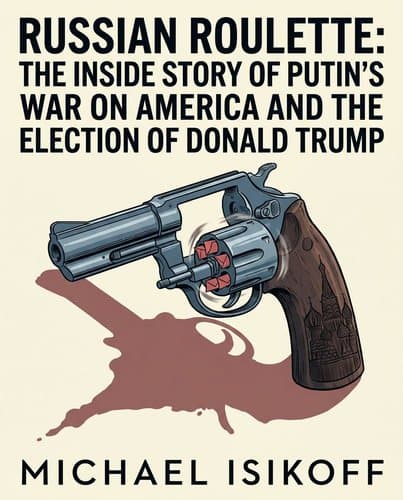
36222733_russian-roulette
by Michael Isikoff
Russia didn't manufacture America's political fractures—it just lit the kindling that was already there. The real story of 2016 is how the FBI, the White…
In Brief
Russia didn't manufacture America's political fractures—it just lit the kindling that was already there. The real story of 2016 is how the FBI, the White House, Congress, and Trump's own campaign each made one individually defensible choice that together handed Moscow the election.
Key Ideas
Foreign influence amplifies existing social fractures
A foreign influence operation doesn't manufacture fractures — it amplifies existing ones. Russia's most viral content in 2016 targeted real grievances: DNC favoritism toward Clinton, distrust of elites, economic anxiety. The attack worked because the kindling was already there.
Institutional silos prevent timely security warnings
Institutional compartmentalization can be as dangerous as ignorance. The FBI followed its case-management rules correctly — warning 'DNC leadership' for months through a low-level contractor — and never told the people who needed to know they were under active attack. Process compliance is not the same as mission success.
Financial ties create structural policy conflicts
Financial entanglements with foreign powers don't need to be corrupt to be disqualifying. Trump may have had no conscious intention to protect Russia's interests, but needing Putin's goodwill to close a $4M Moscow deal structurally prevented any serious criticism of the Kremlin during the campaign.
Fear of partisanship paralyzes defensive responses
The instinct to avoid appearing partisan — to 'wait until after the election,' to avoid 'boxing in the president' — proved crippling even in institutions with no partisan motive. The fear of looking political can make it impossible to respond to a political attack in real time.
Disclosure timing matters more than content
Disclosure timing can matter more than disclosure content. The U.S. government's October 7 attribution statement — months in the making, historically unprecedented — was functionally invisible within the hour. Truth needs clear air to land; an adversary who can control the information environment around a disclosure can neutralize it without ever touching it.
Active measures doctrine predates social media
The 'active measures' playbook predates social media by decades. Soviet-era fabricated FBI memos, planted AIDS-as-bioweapon stories, and forged documents prove the template is older than the platform. Shutting down the IRA's Facebook accounts addresses the distribution channel, not the doctrine.
Who Should Read This
History readers interested in Geopolitics and Democracy who want a deeper understanding of how we got here.
Russian Roulette: The Inside Story of Putin's War on America and the Election of Donald Trump
By Michael Isikoff & David Corn
10 min read
Why does it matter? Because the most shocking part of Russia's 2016 attack isn't what they did — it's what America saw and chose not to stop.
You already think you know what this book is. Russian hackers, troll farms, Kremlin cutouts slipping into campaign conversations — the spy story, the whodunit. But the journalists who wrote it spent years reconstructing something else entirely. The breach was detected. The operation was identified. Intercepted calls were being read at the highest levels of government. What Isikoff and Corn actually found is that from the Oval Office to the FBI's seventh floor to the Senate majority leader's office, there was a cascade of choices — each locally defensible, each made for reasons that felt legitimate in the moment — that added up to no one pulling the alarm. The mystery here isn't what Moscow did. It's why Washington watched. And once you understand that, the 2016 election stops looking like an aberration and starts looking like a systems test — one the system failed.
Trump Couldn't Criticize the Man Whose Permission He Needed to Build in Moscow
Late in the afternoon of November 9, 2013, Donald Trump kept asking the same question to everyone within reach at Crocus City Hall in Moscow: "Is Putin coming?" He'd brought his Miss Universe pageant to the Russian capital (his partners, the Agalarovs, were Putin-connected developers, and Sberbank co-sponsored the show) because he wanted to build there, and he understood that any significant deal in Russia required the Kremlin's approval. Putin's attendance would signal that the door was open.
When the answer came, Putin was stuck with visiting Dutch royalty. Trump immediately suggested to an associate they spread the word he'd dropped by anyway. "No one will know for sure if he came or not," he said. He needed Putin to think well of him because he needed something: permission to build.
In fall 2015, as Trump led Republican primary polls, he quietly signed a letter of intent to build Trump World Tower Moscow. His intermediary was Felix Sater, a former stockbroker who'd done prison time for racketeering with the Russian mob and Mafia families, now an FBI informant with a business card reading "Senior Advisor to Donald Trump." Sater emailed Trump's lawyer Michael Cohen with an extraordinary promise: get this deal moving, he wrote, and we can put Donald in the White House. The deal required Russian government permits. Potential financing came from VTB Bank, a Kremlin-linked institution under U.S. sanctions.
Trump kept all of this hidden while telling voters he'd stand up to Russia. He couldn't afford to push back on Putin without risking the deal. The conflict wasn't incidental — it was structural.
Russia Wasn't Improvising in 2016 — It Was Running a Playbook a Decade in the Making
The Russian assault on the 2016 election was years in the making — a program U.S. officials watched develop and largely declined to treat as a threat.
On September 11, 2014, a crisis spread across social media: a chemical plant in St. Mary Parish, Louisiana, had exploded. Hundreds of tweets carried images of flames and smoke. A fake CNN page showed breaking coverage. A Wikipedia entry documenting the disaster materialized. One account reached Republican strategist Karl Rove with a question: was ISIS responsible? None of it was real. No explosion had occurred. The operation traced to a web tool registered years earlier in St. Petersburg, linked to the executive director of the Internet Research Agency, a Kremlin-connected troll factory employing hundreds of Russians on twelve-hour shifts, manufacturing fake personas and planting false stories across American social media platforms.
The U.S. government already knew this was coming. A Kremlin-connected source whose identity U.S. officials kept classified had warned in spring 2014 that Moscow was building a sustained influence operation against Western democracies: cyberattacks, propaganda, social media manipulation. That intelligence reached more than a dozen senior officials in classified cables. Their attention went to Ukraine, the crisis of the moment. "Anybody who had any doubt about Putin's intentions," the official who filed those reports later said, "just wasn't reading what we reported."
The machinery was visible. America kept looking elsewhere.
The Most Consequential Hack in American Political History Succeeded Because of an Ignored Phone Call and a Typo
At 9:54 on the morning of March 19, 2016, a Clinton campaign IT staffer named Charles Delavan read a phishing email that had landed in the inbox of John Podesta, Clinton's campaign chairman, and typed his assessment: "This is a legitimate email. John needs to change his password immediately." The email was a Russian trap. Podesta clicked the fake link, and the GRU, Russia's military intelligence service, walked away with years of private correspondence from the top of the Clinton operation. Delavan later claimed he'd meant to type "not a legitimate email." One missing word. Russia had what it needed.
The DNC breach was a different kind of failure, spread across five months and a string of phone calls that went nowhere. In September 2015, FBI agent Adrian Hawkins rang DNC headquarters asking to speak with the technology team. He was routed to Yared Tamene, an IT contractor whose real job was setting up employee accounts, not a cybersecurity expert, and one who immediately suspected the call was a prank. Tamene ran a quick scan of the network logs, found nothing, and dropped it. Hawkins called back in October, twice. Tamene ignored the voicemails. He called again in November, January, and February, each time with a little more detail: the malware was tied to Russia, one DNC machine was beaconing to a foreign IP address. Each time: cursory search, nothing found, report to the direct supervisor, full stop. No one in DNC leadership knew anything. Russian intelligence had been inside the network since July 2015.
Two Russian teams, two organizational failures, neither requiring genius to exploit. The DNC fell because a skeptical contractor answered a call he couldn't escalate. The Clinton campaign fell because a staffer dropped a single word. You assume operations that altered an election demanded extraordinary tradecraft. They demanded an unanswered voicemail and a typo.
The Trump Campaign Kept Getting Told About Russian Help — and Kept Staying Quiet
On the morning of June 3, 2016, Donald Trump Jr. opened an email from Rob Goldstone, a British publicist who'd helped broker the family's Miss Universe deal in Moscow. The offer was explicit: Russian prosecutors had documents that would "incriminate Hillary," and Goldstone described them as "part of Russia and its government's support for Mr. Trump." Seventeen minutes later, Trump Jr. wrote back: "If it's what you say I love it." He forwarded the whole chain to Paul Manafort and Jared Kushner under the subject line "Russia — Clinton — private and confidential."
Six days later, all three showed up at Trump Tower to collect. The Russian emissary, attorney Natalia Veselnitskaya, had real Kremlin credentials: she'd once warned an anti-corruption activist, two of whose colleagues were later imprisoned, that she had friends in the FSB and the prosecutor's office. What she actually brought was a dense memo arguing that Bill Browder was a crook and that some Democratic donors might have funded Clinton. Trump Jr. pressed twice: could she show a direct link to Hillary? She couldn't. Manafort appeared to fall asleep. Kushner emailed an aide asking for an excuse to leave. After twenty minutes, he texted Manafort: "Waste of time."
No one called the FBI.
The White House Knew. Had Aggressive Options Ready. And Was Told to Stand Down.
You might assume the Obama administration failed to strike back at Russia because it couldn't figure out how: novel threats, no playbook, fog of an unprecedented attack. Here's what the record actually shows.
By late summer 2016, NSC cyber director Michael Daniel and Russia analyst Celeste Wallander had options. Specific ones. They proposed dismantling the Guccifer 2.0 and DCLeaks websites that had been leaking stolen Democratic emails online. They drafted denial-of-service attacks to knock Russian state news sites offline, and a cyberattack against Russian intelligence command-and-control infrastructure. Wallander went further: leak classified details of secret bank accounts held in Latvia for Putin's daughters, a direct poke at a man obsessive about his family's privacy. Dump corruption files on Kremlin officials. Put Russia on the receiving end of its own methods. The options existed. They were on paper.
Then Susan Rice called Daniel into her office. The White House wasn't prepared to endorse any of it. Don't get ahead of us. The order came back: stand down.
Daniel returned to his team and delivered the news flatly. His deputy, Daniel Prieto, needed a moment to process it. He asked Daniel to repeat what he'd just said, then told him it was like being in a street fight and refusing to swing. The stated reason was institutional caution: if the options leaked, Obama would be forced to move before he was ready. Rice and national security deputy Lisa Monaco didn't want his hand forced.
The White House had its own logic. A visible counter-operation could look partisan (Obama was actively campaigning for Clinton) and a public U.S.-Russia confrontation might fuel Trump's claim the election was rigged. So the administration settled on a private threat: Obama would warn Putin personally at the G20 in China, vow devastating economic consequences if Russia didn't stop, and leave the specifics vague so Putin's imagination would do the heavier work.
Whether Putin heard it as a credible threat was another question. At home, Obama found a wall of a different kind. When he assembled all four congressional leaders in the Oval Office and asked for a bipartisan public statement warning Americans about Russian interference, McConnell said no. His reasoning was stripped down: you're trying to help Hillary Clinton. Anything that damaged Trump would also damage Republican Senate candidates and, with them, McConnell's majority. Trump's refusal to acknowledge the Russian operation had given McConnell cover to block the one step that might have forced the issue into the open.
The failure wasn't a lack of options. It was a chain of choices — each defensible in isolation, collectively catastrophic.
The Day America Finally Named Russia's Attack, the News Cycle Moved On Within the Hour
Todd Breasseale, the senior DHS spokesman, was on the phone with a top network correspondent around 4 PM on October 7, and the conversation was going exactly as planned. The correspondent was locked in. The U.S. government had just done something it had never done before: formally accused Russia of directing the theft of Democratic Party emails, named Putin's most senior officials as the authorizing force, and flagged suspected Russian probing of state election infrastructure. The ODNI/DHS statement had dropped at 3 PM. NSC spokesman Ned Price had been fielding calls constantly since. The Russia attribution story looked like the day's defining news.
Then Breasseale heard the correspondent bark at someone off-camera to unmute the television. A moment later, the line went dead.
The correspondent had just seen the Access Hollywood tape.
At 4:02 PM, Washington Post reporter David Fahrenthold tweeted a heads-up. One minute later, his story went live: a 2005 recording of Trump on a hot mic, boasting to a television host about forcing himself on women, grabbing them without consent, doing anything he wanted because of his celebrity. Cable news looped it. Price's phone, ringing constantly since 3 PM, went quiet. He didn't understand why at first. Then he did.
At 4:32 — thirty minutes after the tape broke — WikiLeaks dropped the first tranche of John Podesta's stolen emails, announcing 50,000 more were coming. Clinton campaign aides believed the timing wasn't accidental. "They needed Fox News to have something to talk about," Podesta later said.
The campaign had spent months trying to put Russia at the center of the coverage. Joel Benenson, the campaign's chief strategist, read the 3 PM statement and felt certain: this was the thing that would reshape the rest of the campaign.
It didn't reshape anything. The first time the U.S. government publicly accused a foreign power of attacking an American presidential election held the news cycle for sixty-two minutes. October 7 was also Vladimir Putin's sixty-fourth birthday.
The FBI Director Who Refused to 'Appear Political' Made the Most Consequential Political Move of All
Think of a referee who won't call a foul in the first half because the cameras are on him, then blows his whistle on a disputed play in the final minutes. The restraint didn't make him neutral. It made him consequential in a different direction.
In the final principals meeting before the October 7 attribution statement, the document was ready: every intelligence agency's seal on a single page formally accusing Russia of the DNC hack. James Comey raised an objection. He didn't want the FBI's name on it. His reasoning: it would look like the Bureau was putting its thumb on the scale before an election, which one participant found jaw-dropping, since Comey had spent the summer publicly declaring Clinton "extremely careless" while announcing no charges. What he didn't tell the room: the FBI had already been running a counterintelligence probe into the Trump campaign's Russian contacts since July.
Twenty-one days later, a laptop belonging to Anthony Weiner, estranged husband of Clinton aide Huma Abedin, turned up in a sex crimes case carrying Clinton emails. Comey knew agents in the FBI's New York office harbored a grudge against the Clintons and feared they'd leak the discovery. So he notified eight Republican congressional committee chairmen. The letter went public within hours. Eleven days before the election, Clinton's email controversy was back. Podesta called it being "ratfucked."
The identical logic — protect the Bureau, avoid the appearance of interference — produced opposite outcomes. On Russia, caution meant silence. On Clinton, it meant disclosure. The asymmetry was structural, not conspiratorial: the Clinton investigation had a public paper trail Comey felt bound to correct; the Trump probe was classified by definition. One principle, two situations, two incompatible results. No malice required — only a system where the same instinct toward institutional self-protection meant entirely different things depending on what was already in the open.
The Conditions That Made the Attack Possible Are Still There
What the story leaves you with isn't a verdict — it's a blueprint. Russia didn't need a secret pact. It needed a candidate who couldn't afford to criticize the man whose permission he needed to build, institutions too rule-bound to speak across their own walls, party leaders who calculated that exposing the attack cost them more than absorbing it, and a news cycle short enough that sixty-two minutes counted as a full day's reckoning. None of those conditions required invention. Every one of them was already in place. The question that remains — deliberately, uncomfortably open — is whether anything structural has changed, or whether the fractures are still there, a little wider now, waiting for whoever comes next with a sharper eye for the gaps.
Notable Quotes
“If there were too many of women of color, he would make changes,”
“He often thought a woman was too ethnic or too dark-skinned. He had a particular type of woman he thought was a winner. Others were too ethnic. He liked a type. There was Olivia Culpo, Dayanara Torres [the 1993 winner], and, no surprise, East European women.”
“who had snubbed his advances.”
Frequently Asked Questions
- What is Russian Roulette about?
- Russian Roulette reconstructs Russia's interference campaign in the 2016 U.S. election through firsthand reporting. The book traces how the Kremlin exploited existing divisions, financial entanglements, and institutional failures to attack American democracy. Isikoff and Corn detail who knew what, when, and why no one stopped the operation. Their central finding: "A foreign influence operation doesn't manufacture fractures — it amplifies existing ones." Russia's most viral content in 2016 targeted real grievances—DNC favoritism toward Clinton, distrust of elites, and economic anxiety. The attack worked because existing political and social divisions provided the necessary conditions for the interference to take root and spread.
- How did institutional failures enable Russian interference?
- Institutional compartmentalization proved as dangerous as ignorance during the election interference. The FBI correctly followed case-management rules, warning DNC leadership for months through a low-level contractor about being under active attack—but never told the people who needed to know. "Process compliance is not the same as mission success." Beyond structural failures, institutional timidity crippled any response. Leaders chose to "wait until after the election" and avoid "boxing in the president" rather than respond to a political attack in real time. The instinct to avoid appearing partisan made it impossible to act decisively when action was needed most.
- What role did financial ties to Russia play in the 2016 campaign?
- "Financial entanglements with foreign powers don't need to be corrupt to be disqualifying." Trump may have had no conscious intention to protect Russia's interests, but needing Putin's goodwill to close a $4M Moscow deal structurally prevented any serious criticism of the Kremlin during the campaign. The book reveals how financial leverage creates conflicts of interest independent of criminal conspiracy. This structural constraint shaped Trump's public positions on Russia throughout the election, demonstrating how an adversary can exploit financial dependencies without requiring corruption or explicit collusion. The vulnerability lies in the incentive structure itself, not in conscious complicity.
- Why did the October 2016 attribution statement fail to impact the election narrative?
- The U.S. government's October 7 attribution statement was historically unprecedented—yet proved functionally invisible within an hour. The problem wasn't the disclosure content but its timing and information environment. "Truth needs clear air to land; an adversary who can control the information environment around a disclosure can neutralize it without ever touching it." When major revelations compete for attention during chaotic political news cycles, their impact evaporates. The book demonstrates that disclosure effectiveness depends less on what is revealed than when it is revealed and what narrative controls surround it. Strategic timing and information ecosystem control can neutralize even historically significant official statements.
Related Book Summaries
Read the full summary of 36222733_russian-roulette on InShort