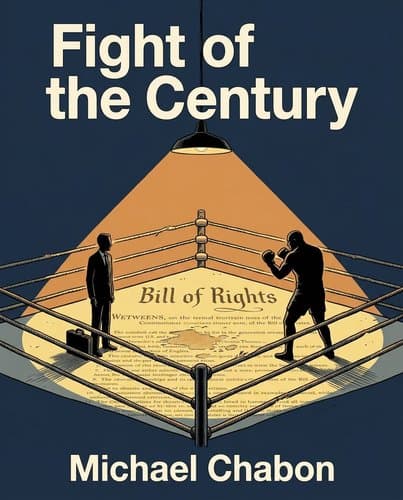
50092714_fight-of-the-century
by Michael Chabon
Rights that can be stripped from the despised will eventually be stripped from everyone—and that's the unsettling logic at the heart of American civil…
In Brief
Rights that can be stripped from the despised will eventually be stripped from everyone—and that's the unsettling logic at the heart of American civil liberties. Forty acclaimed writers trace how defending the indefensible built the legal armor that protects us all.
Key Ideas
True rights require protecting the despised
Rights that only protect popular causes aren't rights — they're permissions. The ACLU defending Nazis, KKK leaders, and anti-Semitic priests is the core logic of civil liberties, not a contradiction: protections that can be revoked from the despised will eventually be revoked from everyone.
Hate speech precedent protected civil rights
The Brandenburg precedent that let a KKK leader call for racial revenge also stopped the government from prosecuting NAACP boycott organizers, antiwar protesters, and Black civil rights marchers. The free speech weapon built on white supremacism's case was immediately turned against white supremacism — Rothman-Zecher calls it aikido.
Contingency not heroism shaped civil rights
Almost every landmark civil rights ruling was won by the wrong person for the wrong reason: Miranda just didn't show up when told to march; Korematsu stayed behind for his girlfriend; Morris Ernst had to beg customs agents to arrest a book they'd never bothered to seize. Contingency is the rule, not heroism.
Legal equality hasn't created lived equality
A Supreme Court ruling doesn't close the gap between legal equality and lived experience. Brown v. Board is over seventy years old: two schools eight miles apart in Huntsville, Alabama still split almost perfectly along racial lines, with graduation rates of 88% versus 31%.
Power redefines rights when it loses
Power rarely concedes when it loses a legal argument — it reclassifies the right. The school that lost on dress code simply moved 'dress how you choose' from the rights column to the responsibilities column. Every legal victory begins eroding the moment it's won.
Defending enemies tests belief in freedom
The test of whether you actually believe in civil liberties is not whether you'll defend people you agree with. Anyone will do that. The test is whether you extend the same protection to someone whose views repel you — because the atmosphere protecting you is made entirely of those acts.
Who Should Read This
History readers interested in Democracy and Policy who want a deeper understanding of how we got here.
Fight of the Century
By Michael Chabon & Ayelet Waldman & Ann Patchett & Brit Bennett & Steven Okazaki & David Handler & Geraldine Brooks & Yaa Gyasi & Sergio de la Pava & Dave Eggers & Timothy Egan & Li Yiyun & Meg Wolitzer & Héctor Tobar & Aleksandar Hemon & Elizabeth Strout & Rabih Alameddine & Moriel Rothman-Zecher & Jonathan Lethem & Salman Rushdie & Lauren Groff & Jennifer Egan & Scott Turow & Morgan Parker & Victor LaValle & Michael Cunningham & Neil Gaiman & Jesmyn Ward & George Saunders & Marlon James & William Finnegan & Anthony Doerr & C.J. Anders & Brenda J. Child & Andrew Sean Greer & Louise Erdrich & Adrian Nicole LeBlanc & David Cole & Viet Thanh Nguyen & Jacqueline Woodson
11 min read
Why does it matter? Because the rights protecting you were forged by defending people you'd never vote for.
Here's the comfortable version of what civil liberties are for: protecting the innocent. The wrongly accused. The dissenter the state wants silenced. The private citizen ground up by the machinery of majoritarian power. That version isn't wrong — it's just incomplete in a way that quietly undoes everything. Because the Constitution has never proved its strength by protecting the people everyone agreed deserved protecting. It has proved its strength by defending Nazis marching through a town of Holocaust survivors, a Klan leader in a Hamilton County field, Father Arthur Terminiello (an anti-Semitic priest whose 1949 Chicago speech triggered a riot and a Supreme Court ruling). This collection of essays by forty writers, including Viet Thanh Nguyen, Jesmyn Ward, and Andrew Sean Greer, is built on exactly that discomfort — and on something harder still: that every time someone decides a particular person doesn't deserve those protections, the protections themselves shrink just a little more, for everyone.
The Bill of Rights Only Matters When It Protects People You'd Prefer It Didn't
That discomfort is the thesis of Fight of the Century. Michael Chabon and Ayelet Waldman grew up unable to answer the question Skokie raises: how can the ACLU be simultaneously on the side of good (the First Amendment) and evil (Nazis)? The answer, which runs through every essay here, is that the paradox dissolves once you understand what the First Amendment actually is. You can't protect the speech you approve of without protecting the speech you hate. The Bill of Rights has worked, when it has worked at all, because it's been extended, often against enormous resistance, to the despised and the abhorrent. That's not a flaw in the design. It's the whole design.
Viet Thanh Nguyen makes this concrete. Vietnamese Americans fled a communist regime that suppressed dissent — and then built, in their California enclaves, something structurally similar: a social order where no one dared fly the red Vietnamese flag, where a footbath painted the wrong colors triggered mass protest. The impulse to silence, Nguyen observes, isn't ideological. It's human. Every community, given enough control over its own space, eventually finds something it would rather not allow.
Which is why the Bill of Rights can't be reserved for sympathetic cases. David Cole's foreword notes that as recently as 1920, it didn't apply to states at all — communists, anarchists, and union leaders were jailed for their politics, and the only constitutional right the Supreme Court reliably upheld was corporations' right to avoid worker-protection laws. The protections that now feel foundational were built case by case, out of the least popular causes anyone could find.
Defending a KKK Leader in 1969 Is the Reason Black Activists Couldn't Be Silenced in 1982
The courtroom exchange takes about six minutes to build. Ohio's attorney is arguing that Clarence Brandenburg's Klan rally speech, his declaration that Black Americans should be sent back to Africa and Jews returned to Israel, should remain criminal under the state's syndicalism law. To illustrate the danger, he poses a hypothetical: imagine running through Harlem shouting those words. Justice Thurgood Marshall, the first Black man to sit on the Supreme Court, cuts in: "He wouldn't last that long." Laughter breaks across the room.
Six minutes later, Allen Brown — a short, raspy-voiced Jewish civil liberties lawyer representing Brandenburg pro bono — rises and turns Marshall's quip into the argument's center of gravity. Marshall is safe here in Washington, Brown tells the court. But in Ohio, his remark about how a crowd might react to racial provocation could itself be charged under the very statute they're all gathered to challenge. To convict Brandenburg, Ohio needed a law broad enough to criminalize the anticipation of violence. A law that broad reaches Marshall's words just as easily as Brandenburg's.
Rothman-Zecher calls it aikido. He grew up in southwest Ohio, Jewish, and writes about Brandenburg v. Ohio partly to understand why the ACLU, represented by Brown and Eleanor Holmes Norton — a Black attorney fresh from serving as legal counsel to Freedom Summer, the 1964 Mississippi voter-registration campaign — chose to defend a Klan leader rather than stay quiet. Norton, when challenged by fellow activists, framed it simply: defending a leftist's right to dissent persuades no one who isn't already sympathetic. Defending a racist's rights is "the object lesson dramatically clear."
The answer is structural. Brandenburg's case gave the ACLU a chance to build the highest possible wall against the state's power to criminalize speech it dislikes, using the Klan's own ugliness as the lever. The unanimous ruling holds that speech loses First Amendment protection only when it directly and imminently incites lawless action. Abstract advocacy of violence, no matter how vile, isn't enough.
Within thirteen years, that standard was the reason Charles Evers, Medgar's brother, could stand in Port Gibson, Mississippi, and warn Black residents that people who broke the NAACP's boycott of segregationist merchants would get their necks broken, and remain free. The state argued his speech caused subsequent violence and should make him liable. The Supreme Court disagreed: heated rhetoric aimed at social pressure isn't a command to commit violence against a specific person tonight. Brandenburg said you need the latter. The state of Mississippi would have preferred otherwise, and it wasn't white supremacists they were most eager to silence.
The Man Who Named Your Miranda Rights Just Didn't Feel Like Showing Up That Day
In the spring of 1963, Ernesto Miranda was brought into a Phoenix police station on suspicion of kidnapping and rape. He was an ex-con with a record of prior sex crimes and a history of mental illness, not the person you'd want as the face of a constitutional reckoning. Detectives told him he'd failed a lineup. They suggested some charges might be dropped if he cooperated. They didn't mention his right to stay silent. He wrote out a confession. Prosecutors presented no other evidence at trial. Just that statement, and it was enough to convict him.
The case that followed, Hector Tobar shows, was a study in institutional accident. The Phoenix ACLU spotted in Miranda's appeal a chance to extend a recent ruling on interrogation rights. Arizona's best trial lawyer took the case for free. More than a hundred defendants had filed similar appeals; the Supreme Court chose four to hear, and Miranda's was among them. His attorney's argument before the Court in 1966 framed Miranda not as a principled resister but as someone who, given his limited education and probable mental illness, couldn't have understood what he was giving up. The 5-4 ruling extended Fifth Amendment protections from courtrooms into police stations. California's assistant attorney general drafted the warning language that summer; Harold Berliner, a Nevada County DA who also happened to run a print shop, produced hundreds of thousands of laminated cards and sold them to law enforcement nationwide. One found its way to Jack Webb, the Dragnet producer, who had Sergeant Joe Friday recite the warning twenty-five times across the show's inaugural season. From there it entered the ambient noise of American life. The warning is now recited roughly ten million times a year across the United States. The name on all of it belongs to a drifter who confessed because no one told him he could refuse.
Miranda's conviction was overturned — and immediately refiled. His common-law wife, estranged after a custody dispute, told police he'd confessed the crime to her during a jailhouse visit. He was convicted a second time. While still incarcerated, he and his fellow inmates watched a TV cop drama in which a detective read a car-theft suspect his Miranda rights. The cell block applauded. After his parole in 1972, he signed copies of the warning card for $1.50 each. In January 1976 he was stabbed to death in a Phoenix bar. His killer escaped. The accomplice was arrested and read his Miranda rights.
What the Law Declares and What People Actually Live Are Not the Same Country
In the mid-1980s, Yaa Gyasi walked to school most mornings along a mile of Huntsville, Alabama streets, past the Publix, past the gas station, past Aldridge Creek. The only other Black person she usually saw on that route was the crossing guard, who waved her through with a smile and knew who her brother was without being told. Her family was recognizable by sight in southeast Huntsville, the white part of town. A stranger once identified her directly: "You're that black professor's kid." She'd been there long enough to know how.
Her family had moved there deliberately, for the schools. When she later asked her parents whether being the only Black family for miles bothered them, they offered the simple answer: "The schools were better." Better, when examined, meant whiter, because nothing in America, including its schools, gets to stand outside of race. Her parents, African immigrants still learning the country's geometry of race, had made a choice unavailable to most African Americans. They shouldn't have been required to make it. And they had made it thirty years after Brown v. Board of Education declared that separate educational facilities are inherently unequal.
Huntsville's schools were still under a federal desegregation order when Gyasi was writing. To understand what that means in practice: drive eight miles from Virgil I. Grissom High — where Gyasi attended, where 8 percent of students were Black and 88 percent graduated — to Butler High, where 71 percent of students were Black and 31 percent graduated. Only 22 percent of Butler students read at grade level; at Grissom, 78 percent did. The school district's superintendent called Butler "barely a school." Eight miles. The same federal law. The same city.
"All deliberate speed" — the Court's chosen phrase for the pace of desegregation — turns out to contain its own escape hatch. Deliberate can mean slow, calculated, unhurried. In a state where a governor once declared "Segregation now, segregation tomorrow, segregation forever," the courts handed down the ruling and the state did the math.
Gyasi's counterfactual lands like a verdict: had her family lived eight miles up the road, she might never have read at grade level. The life she now has as a novelist might never have existed. Her graduating class sent students to Princeton, Harvard, and Yale. Butler was barely a school. The distance between those two facts is not geography. It's the gap between what Brown said and what America built.
Every Time Power Loses the Legal Argument, It Moves the Rights Column to Responsibilities
Daniel Handler — who writes fiction under the name Lemony Snicket — discovered this pattern in sixth grade. During a San Francisco heat wave, his school principal banned shorts. A friend produced the student handbook: right there in the rights column, "Students can dress how they choose." Handler organized a protest, everyone came in shorts, he was hauled before the principal, and held off crying until he reached the hallway. The argument was airtight. He won.
The following semester, the handbook was reprinted. The phrase about dressing as one chooses had been physically moved across the fold from rights to responsibilities, where it now read "dress appropriately." Handler and his short-pants comrades had no bare leg to stand on.
Handler calls this the lesson of middle school: power doesn't concede a lost argument. It changes the terms.
Every victory in this book lands inside that same structure. The Supreme Court establishes a right. The enforcement is grudging. The next administration files briefs arguing the right doesn't mean what everyone thought. The atmosphere protecting people is thinned so gradually that the thinning barely registers — until you reach for the protection and find the column it was in has been renamed.
The Atmosphere Is Built From Acts Nobody Asked You to Make
What actually holds the atmosphere together? Not the rulings. Rulings establish what's permitted; they don't make people show up for one another.
Andrew Sean Greer was overseas when United States v. Windsor struck down the Defense of Marriage Act in 2013, awake in a hotel room, watching friends take to the streets from a distance. Scalia's furious dissent admitted it: the ruling implied full marriage equality would follow. It felt like winning. Like handing the fight off.
Within four years, the Justice Department was arguing federal civil rights law doesn't cover sexual orientation, the transgender military ban had arrived, and the same machinery that granted the right was testing how much it could strip back without formally overturning it.
Greer found himself enraged — not at the administration, whose behavior he'd expected, but at himself for believing a Supreme Court decision could change the texture of daily life. Nobody's heart had been changed by the ruling. The hostility was still in parking lots, workplaces, and the slur keyed into the hood of his car.
The days that stayed with him weren't Windsor. They were the 1990 campus kiss-in — queer students, most of them single and new to dating, kissing in a university quad, as charged as a junior high dance. A 1991 antiwar march that ACT UP joined, a crowd that crashed at his mother's place and rode the Metro in with signs designed to provoke. The morning a straight male friend quietly buffed the slur off his car hood in Montana. Ordinary days when he wasn't afraid because the people around him were willing to take his side. None of those days required a ruling — they required people who showed up for someone they had no obligation to protect.
The Question the Book Refuses to Answer For You
The question the book never answers for you is whether you'll do the same — not for someone sympathetic, not for a cause you already hold, but for someone whose views genuinely repel you. The atmosphere doesn't get built in courtrooms. It gets built in parking lots, at campus protests nobody's parents approved of, on a cold morning when a friend drives across town to buff a slur off your hood because he heard about it and couldn't sit still. Those are Greer's beautiful days: ordinary days when someone who didn't have to show up showed up anyway. The legal victories matter, but they're downstream of that. That's what the atmosphere is made of. Every time someone suited up anyway. Every act you didn't have to make.
Notable Quotes
“God never meant to have one race,”
“God never meant for America to be a melting pot to rub out the line between the nations. That was not God's purpose.”
“I say it makes me sick!”
Frequently Asked Questions
- What is Fight of the Century about?
- Fight of the Century is a collection of essays and stories from forty leading American writers, each examining a different clause of the Bill of Rights. It shows how civil liberties have always been won and sustained by defending the least popular people in the room — and equips readers to understand why protecting rights for those they disagree with is the only way to protect their own. The anthology demonstrates that the philosophy of defending unpopular causes is central to how all civil liberties work.
- Why does the ACLU defend unpopular cases like white supremacists?
- The ACLU defending Nazis, KKK leaders, and anti-Semitic priests is "the core logic of civil liberties, not a contradiction: protections that can be revoked from the despised will eventually be revoked from everyone." The Brandenburg precedent that let a KKK leader call for racial revenge also stopped the government from prosecuting NAACP boycott organizers, antiwar protesters, and Black civil rights marchers. The free speech weapon built on white supremacism's case was immediately turned against white supremacism — Rothman-Zecher calls it aikido.
- How do major civil rights cases actually get decided?
- Almost every landmark civil rights ruling was won by the less-than-heroic circumstance. Miranda just didn't show up when told to march; Korematsu stayed behind for his girlfriend; Morris Ernst had to beg customs agents to arrest a book they'd never bothered to seize. "Contingency is the rule, not heroism." These cases show that transformative legal victories often result from mundane human failures rather than principled stands. The greatest civil liberties precedents emerged from circumstances far more complicated and less inspiring than the popular narrative suggests.
- Why does legal progress erode after big court victories?
- A Supreme Court ruling doesn't close the gap between legal equality and lived experience. Brown v. Board is over seventy years old: two schools eight miles apart in Huntsville, Alabama still split almost perfectly along racial lines, with graduation rates of 88% versus 31%. "Power rarely concedes when it loses a legal argument — it reclassifies the right." When a school lost on dress code, it simply moved 'dress how you choose' from the rights column to the responsibilities column. Legal victories begin eroding the moment they're won.
Related Book Summaries
Read the full summary of 50092714_fight-of-the-century on InShort