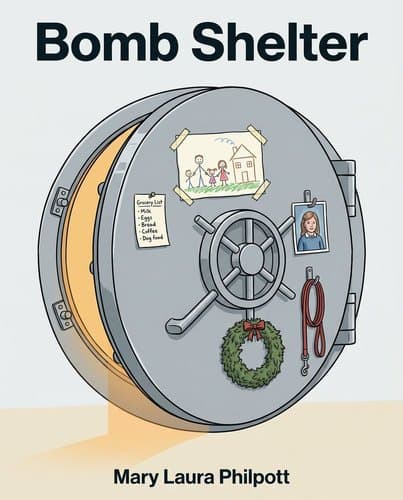
58438569_bomb-shelter
by Mary Laura Philpott
No amount of memorized facts or emergency plans can protect you from the real disaster: loving people who can be hurt. Philpott reveals that the only shelter…
In Brief
No amount of memorized facts or emergency plans can protect you from the real disaster: loving people who can be hurt. Philpott reveals that the only shelter isn't safety — it's the small, stubborn acts of care you keep doing anyway.
Key Ideas
Anxiety is love's unavoidable cost
The anxiety you feel about the people you love is not a flaw to treat — it is the direct cost of caring deeply, and it grows every time your life gets richer. Treating it as a symptom misidentifies both the problem and the source.
Preparation cannot guarantee true safety
Perfect preparation and perfect calm during a crisis give you something to do with the fear — but they do not create the safety you most want. The honest answer to 'I was ready' is always 'Was I? Is anyone?'
Vigilance creates its own blind spots
The anxious mind you built in childhood — always scanning for what you don't know, filing facts 'just in case' — is both your most protective instinct and your most reliable blind spot. It memorizes pamphlets and misses signals at the same time.
Others must trust themselves, not you
When crisis arrives, you can only throw your arms toward one falling person at a time. The people you are not watching in that moment need to know they can trust their own instincts — and that they do not owe you their stillness or silence.
Small acts of care compose a life
The answer to loving in a world of unlimited risk is not vigilance, not hardening, and not acceptance. It is the accumulation of small, specific acts of care done anyway — filling the turtle's dish, building the decorated box, sending the funny picture — which are both all you have and enough to call a life.
Who Should Read This
Readers who connect with first-person stories about Memoir and Mental Health and want to see the world through someone else's eyes.
Bomb Shelter
By Mary Laura Philpott
10 min read
Why does it matter? Because the thing you're most afraid of losing is also the only shelter you have.
Most books about anxiety promise a way out. This one doesn't bother with that promise, because Mary Laura Philpott has already worked out the math: the more you love, the more there is to lose, and the more there is to lose, the more your mind stays lit — a bunker with the generator running. That's not a malfunction. That's the system working exactly as designed. Bomb Shelter is a memoir about what it costs to pay close attention to the people you love most, written by someone who can describe assembling an epilepsy rescue kit and forgetting cornbread in the oven while her son was in the ER in the same register, and make both feel like the same act of devotion. The anxiety and the love aren't two problems sharing a body. They're one thing. And the question she's actually asking isn't how to put it down — it's what to do while you're still carrying it.
Every New Person You Love Adds Another Stick of Dynamite to a Vest You Can Never Take Off
At nine years old, Mary Laura Philpott was waist-deep in the Gulf of Mexico, choreographing a dance to an oldies song while a school of stingrays drifted past her ankles. She thought they were trash bags. She only found out the truth back on shore, pressed against her grandmother's shoulder — and cried so hard she could barely breathe. Not from pain. She hadn't been stung. From retroactive terror: the sudden knowledge of danger that had been there all along.
Three decades later, she's lying on the living room floor on a December evening, doing physical therapy stretches for herniated discs caused by years of hunching over a laptop. The teenagers are in bed. Her husband is upstairs brushing his teeth. She stares at the Christmas tree and lets twenty Decembers unspool: first-apartment ornaments collected at parties, nursing a newborn by the tree lights, her son asking Santa for rocks and a hammer, her daughter's polite letters to the North Pole always opening with an inquiry about the reindeer's health.
Then the wave hits. She is forty-four years old. Two Christmases left before the kids leave for college and holidays become visits. Grown-up curtains she chose and paid for herself. A tax spreadsheet.
She names what she's carrying: an explosive vest. Every person she loves, every purpose she holds is another stick of dynamite strapped to the bundle. The longer she lives and loves, the larger and more volatile it grows. She walks around awed by her luck and aware it could all vaporize in an instant.
Then she starts laughing. Not politely — full, unstoppable giggling at the absurdity that she, the person who forgot to plug in the slow cooker that very evening, has somehow kept all these boats afloat. The laughter doesn't dissolve the weight. The weight doesn't dissolve the laughter. They coexist.
That's what an explosive vest is. You don't remove it. You learn to walk around in it.
You Can Follow Every Step and Still Be Holding a Stranger
Four in the morning. Her son is on the bathroom floor, seizing.
Her mind does what minds do: runs through flash cards of explanation. The dog. A shampoo avalanche. The washing machine. Then John runs down the hall and she runs too, and whatever flash card her mind was reaching for next becomes irrelevant.
What follows is a performance of competence so precise it barely feels like panic. A twenty-year-old pamphlet surfaces without being summoned — the one she'd written as a hospital copywriter and memorized the same week, just in case. Seizure first aid, three bullet points. She executes each one without hesitation. She calls 911. The operator asks how fast the boy is breathing. John kneels over their son, and she relays each breath into the phone: "Now. Now. Now. Now." She breaks protocol exactly once, asking if the ambulance has already left: please, please hurry. Then she unlocks the front door and returns to being calm.
The ambulance comes. The seizing stops.
Her son wakes up in a kind of neurological no-man's-land. He reaches for the bathtub to pull himself upright. She puts her arm around his shoulders. He looks at her with wild eyes.
She asks the first question that surfaces: "Do you know who I am?"
He shakes his head.
She tells him her name. Mama. He shakes his head again. She tries another direction: "Do you know who you are?" He shakes his head a third time. The wailing starts back up.
So she offers a hug. He nods.
She wraps her arms around a teenage boy who doesn't know she is his mother, who doesn't know he has a mother at all, while he bows his head to her shoulder and sobs. Every instruction in the pamphlet had been followed. She had stayed calm enough to relay his breathing into a phone while her husband's hand bones cracked against the tile. None of it closed the distance. That was the discovery.
The diagnosis, when it comes, is almost funny in its offhandedness. Juvenile Myoclonic Epilepsy. JME. The new doctor slides past the name so smoothly she doesn't register it until he's already talking about the prescription, already past it — a nurse will come shortly, you can fill it on the way home. She manages one question aloud: should she put a gate at the top of the stairs tonight? Her real questions stay lodged in her throat. Who checks on us? How do we know the drugs are working? You just met me. How do you know I can handle this?
You can follow every step. You can demand the EEG, relay the breathing, stay calm through all of it. And still find yourself holding a stranger.
Your Anxious Mind Has Always Been Gathering Facts It Can't Use When It Counts
Think of every fact you've ever filed away just in case, every piece of knowledge collected against being caught off guard. Now imagine that the one piece of information you actually needed had been delivered to you, directly, a decade before you had any use for it.
Mary Laura Philpott started collecting at age eight. A ballet teacher asked a trick question about matches, called on her, and laughed when she answered honestly. The class chimed in the scripted correction. Standing in her pink slippers, Philpott walked out with a rule she kept forever: not knowing about dangerous things was the real danger. She began hoarding facts the way some people carry spare cash — compulsively, quietly, against the day she'd need them.
The habit expanded. She memorized the pyrokinesis chapters in Firestarter, then went into the backyard and stared at the swing set, waiting for sparks. Hospital pamphlets committed to memory.
She could not know how everything turned out.
Her son, at six years old, told her: I miss you when I blink. She spent ten years wondering what he meant. Then she read about absence seizures (brief lapses in consciousness, children misread as distracted or vague) and the sentence cracked open. When he blinked, he was absent. He had been telling her, in the only language a six-year-old has for an experience with no name yet.
The knowledge arrived. It arrived as ten years.
The same mind that memorized the seizure pamphlet, that relayed his breathing into a 911 call breath by breath, had been receiving his signal for a decade without a way to read it. That was ten years.
Getting Ready for the Bomb to Fall Doesn't Predict Whether It Will
Preparation feels like protection. That's why you do it twice, then a third time, just to be sure.
One morning, Philpott's teenage son was at school pushing a heavy table against a classroom door, watching the football players grab chairs to throw in case a gunman came through. She was at home watching an instructional video for the fourth time — attach needle to syringe, draw up medication, swap needle for nasal atomizer, spray half the dose up each nostril. Five minutes is the threshold: under that, a seizure resolves on its own; past it, you enter status epilepticus, the zone where permanent brain damage or death becomes possible. She needed to execute the steps with her brain in full panic. So she watched again.
Then she assembled three rescue kits: home, school, sports bag. She labeled them, unpacked them, repacked them. She put the home kit in the medicine cabinet. Took it back out. Labeled everything again, more clearly. When she looked at what she'd made, she asked herself: Was she ready? And then: Is anyone?
The ritual is real: the kits exist, the steps are correct, the five-minute threshold is documented fact. But the ritual does not determine whether the five minutes arrive. It doesn't make the gun less real, the seizure less electrical, or the bomb less likely to fall.
Her father spent part of the 1970s drilling at a classified bunker in the Pennsylvania mountains, rehearsing how fast he could open an underground hospital before the world above ended; he was never needed. Her mother sat home with a toddler and a baby while the sirens sounded, occasionally thinking: what were they, exactly — lunch meat?
She made the kits anyway. Her son pushed the table. Her father drove the ambulance. You do it because you need something to do with your hands when you cannot do anything that matters.
You Can Only Throw Your Arms Out Toward One Falling Person — The Other Is Already in the Dark
The morning her son seized on the bathroom floor, her daughter was almost thirteen and asleep three rooms away. Or so everyone assumed. She had been awake for all of it — the thuds, the running, the "Now. Now. Now. Now." relayed into a 911 phone, the paramedics stomping up the stairs. She sat in the dark and waited. When her father tiptoed in at 6:30 and found her cross-legged in the first gray light, he asked why she hadn't come out. She said: "I was waiting for someone to tell me I should come out."
She had been trained into this. From early childhood she'd absorbed the family's emotional grammar: hard things are normal, don't make a fuss. She sat through allergy shots twice a week pushing up her own sleeve, declining ice packs. She did twelve-minute nebulizer treatments at the kitchen table, coloring quietly while vapor filled a mask called Fishy Face. The lesson, delivered with smiles: it's only a problem if we tell you it's a problem.
Nobody was watching her. For years Philpott had kept her eye on the daughter — asthma, allergies, lungs that filled with every cold — certain she was the child most at risk. But the real danger had been quietly building in her son. When the crisis arrived, every instinct swung toward him. You can love two children with equal fierceness and still only reach the one who's falling. That leaves the other alone in the dark.
The daughter had understood something Philpott hadn't finished learning. She'd watched a seizure first-aid video a dozen times on her own — getting ready, in case it ever fell to her to help her brother in a crowd, because she knew she couldn't count on anyone telling her it was her job.
Philpott dreams of a dark vacuum pulling everyone she loves away. She screams at it — THEY ARE MINE — furious, then terrified, then stopped cold by something worse than the loss: the recognition that she has been living as though love were a contract. All the care, the preparation, the decades of keeping watch — built on an assumption the universe never agreed to. There was never an agreement. She wakes with nail crescents pressed into her palms. Her throat isn't raw. She only screams in her sleep, because she knows better than to say out loud what she's screaming: GIVE THEM BACK.
To Know You Can't Save Everyone and Try Anyway Is to Be Fully Alive
Christmas morning 2020, Nashville. A bomb has gone off downtown — an RV wired to detonate, its recorded warning voice repeating "evacuate" to a quiet street. The phone alerts are already blinking when Philpott and her husband wake up. Her city has been bombed. Her son has been accepted to college and will leave in months. And somewhere across town, a college senior named Ava is alone in a campus apartment, having posted to a neighborhood app asking where she might volunteer at a soup kitchen on Christmas Day so she wouldn't have to spend it by herself.
Philpott reads the post and shows it to her husband. He laughs. He already knows what she's going to do.
She cooks a full feast — butternut squash ravioli, stuffed potatoes, salad, rolls, dessert — and she and her daughter convert a shipping box into a delivery container whose lid opens to reveal a pop-up hearth: a cardboard fireplace, orange tissue paper for flames, tiny knit stockings hung in a row. When catastrophe is too large to fix, when your children are beginning to leave, when a bomb has leveled part of your city and the phone switching station downtown is rubble, you build what shelter you can for whoever is close enough to receive it. A decorated box of food. One afternoon. Two strangers on a porch with hot chocolate.
The book's answer is what Philpott calls barely the buzzing of a bee: the dish of fresh water filled for a turtle, the dogs walked, the seeds planted, the funny picture sent to children who are somewhere else now. Invisible from a distance. Entirely ablaze from inside. You cannot hold the planes in the air with your mind. You will not save everyone. Trying anyway, with full knowledge of this, in specific and daily acts of care, is what it looks like to be fully alive.
She ends the book with the line her mother taught her to say at every birthday party she attended as a child, required before she could leave: Thank you for having me. She says it to the earth and everyone on it. Not despite the stingrays at her ankles and the bomb on Christmas morning and the son who once didn't know her name. Because of them.
What "Thank You for Having Me" Actually Means
Here is what Philpott does not offer you: a technique for wearing the vest without noticing its weight. She offers something harder — evidence that the small acts are not consolation prizes. The dish of water filled for a turtle. A cardboard fireplace with orange tissue paper flames and tiny knit stockings hung in a row. A funny picture sent to a child who now lives somewhere else and responds on a small screen. These are not substitutes for safety. They are the actual life, the only one on offer. To say thank you for having me, to mean it while knowing exactly what "having" costs and how little time any of us are promised, is not acceptance. It is the most specific, daily, ablaze form of love a person can choose. You fill the dish. That is enough.
Notable Quotes
“anything and everything happen. I will laugh at the hubris of ever thinking I had such power. I may be awed by what I was able to do despite all I didn't know. I hope I will be proud that even though I could never find the answer to”
“All you need is love,”
“Oh yeah. It reminds me of when I worked there.”
Frequently Asked Questions
- What is Bomb Shelter about?
- Bomb Shelter is a memoir examining how anxiety emerges as the direct cost of loving people in a world of uncontrollable risk. Author Mary Laura Philpott reframes parental fear not as a disorder requiring treatment but as evidence of deep attachment. She explores how this anxiety grows every time your life becomes richer through meaningful connections. Rather than seeking to eliminate fear, Philpott examines how small, deliberate acts of care—done without guarantee of safety—create meaning and constitute both the only shelter available and enough to build a fulfilling life.
- Is parental anxiety a disorder that needs to be fixed?
- 'The anxiety you feel about the people you love is not a flaw to treat — it is the direct cost of caring deeply,' and it grows with every meaningful connection and richer life. Treating this anxiety as a symptom misidentifies both the problem and the source. Philpott argues that recognizing anxiety as the price of deep attachment—not a psychological disorder—fundamentally transforms our response. The goal shifts from elimination to meaningful coexistence. This reframing removes pathologizing language and instead honors anxiety as the natural, inevitable consequence of loving deeply.
- Does perfect preparation guarantee safety?
- 'Perfect preparation and perfect calm during a crisis give you something to do with the fear — but they do not create the safety you most want.' Philpott challenges the assumption that readiness ensures protection. The honest answer to 'I was ready' is always 'Was I? Is anyone?' The protective instinct from childhood—'always scanning for what you don't know, filing facts just in case'—is both your most protective instinct and your most reliable blind spot. Preparation provides agency during crises but cannot control all outcomes.
- How does Bomb Shelter suggest managing anxiety about loved ones?
- 'The answer to loving in a world of unlimited risk is not vigilance, not hardening, and not acceptance. It is the accumulation of small, specific acts of care done anyway — filling the turtle's dish, building the decorated box, sending the funny picture — which are both all you have and enough to call a life.' When crisis arrives, 'you can only throw your arms toward one falling person at a time,' so others must trust their own instincts. These acts of care matter because they represent commitment despite uncontrollable risk.
Related Book Summaries


Read the full summary of 58438569_bomb-shelter on InShort