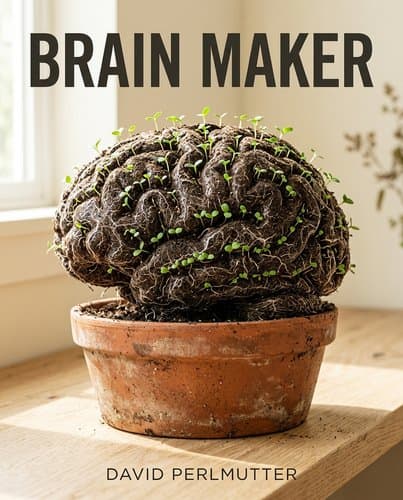
22875118_brain-maker
by David Perlmutter, Kristin Loberg
Your gut bacteria aren't just digesting food—they're controlling your brain's inflammation, mood, and memory, meaning Alzheimer's, depression, and anxiety are…
In Brief
Your gut bacteria aren't just digesting food—they're controlling your brain's inflammation, mood, and memory, meaning Alzheimer's, depression, and anxiety are microbial problems with dietary solutions. Perlmutter shows exactly how to rebuild your microbiome to protect your brain through fermented foods, prebiotic fiber, and cutting the hidden culprits reshaping your gut overnight.
Key Ideas
Daily fermented foods diversify gut bacteria
Eat fermented foods daily — kimchi, sauerkraut, kefir, yogurt — as your primary probiotic source; diversity matters more than quantity of any single strain
Twelve grams prebiotic fiber feeds bacteria
Hit 12 grams of prebiotic fiber daily from sources like jicama, raw Jerusalem artichoke, dandelion greens, and acacia powder — these feed the bacterial populations that produce BDNF and regulate mood
Eliminate fructose and artificial sweeteners
Cut fructose and artificial sweeteners: both restructure gut bacteria within days, with artificial sweeteners shown to cause glucose intolerance through microbial changes alone — not calories
Probiotics mid-antibiotic course preserve microbiome
Use antibiotics only when medically necessary; when you must take them, take high-potency probiotics at the halfway point between doses to maintain microbial population through the course
Maternal bacterial gauze restores newborn seeding
Avoid elective C-sections: if a C-section is unavoidable, ask about the gauze technique — swabbing the newborn with maternal vaginal bacteria — to partially replicate natural microbial seeding
High cholesterol supports cognitive performance
Treat dietary fat as brain fuel, not enemy: the Framingham Heart Study found higher cholesterol correlates with better cognitive performance; LDL is how the brain receives cholesterol it cannot make itself
High-fat low-carb shifts bacterial ratio
A high-fat, low-carb, gluten-free plate — two-thirds fibrous vegetables and 75–115g of protein — shifts the gut's bacterial ratio away from calorie-extracting Firmicutes toward protective Bacteroidetes
Vitamin D testing regulates gut bacteria
Get Vitamin D levels tested: Vitamin D functions as a hormone that regulates gut bacteria directly, and most people in northern climates are deficient at levels that impair microbial balance
Who Should Read This
Science-curious readers interested in Nutrition and Neuroscience who want to go beyond the headlines.
Brain Maker
By David Perlmutter & Kristin Loberg
12 min read
Why does it matter? Because the brain disease epidemic is being treated in the wrong organ.
You've spent decades assuming that what goes wrong in the brain gets fixed in the brain. That's where the drugs go, that's where the research money flows, that's where medicine points when it wants answers about Alzheimer's, depression, autism, ADHD. Reasonable assumption. Almost entirely wrong. The emerging science of the microbiome — the hundred trillion organisms already living inside your gut — suggests that the epidemic of neurological disease isn't primarily a brain problem at all. It's a gut problem. The inflammation destroying neurons, the neurotransmitters governing your mood, the immune signals accelerating cognitive decline: these are driven by organisms most doctors still treat as irrelevant. Brain Maker is the case that medicine has been looking in the wrong direction for decades — and that the most powerful levers for your brain's future are sitting, right now, in your intestines.
The Drugs Aren't Working — and Your Neurologist Probably Knows It
Here is a claim worth sitting with: neurology — one of the most resourced, most prestigious branches of medicine — is losing ground. Not slowly, and not quietly. Between 1979 and 2013, deaths from brain disease climbed 66 percent in American men and 92 percent in women. Autism diagnoses have multiplied seven- to eightfold in barely a decade and a half. The U.S. now spends $200 billion every year caring for dementia patients alone — triple what cancer care costs — and the number of people living with Alzheimer's is projected to double by 2030.
The money being spent on finding a solution is just as staggering, and just as discouraging. In 2014, a high-profile alliance of pharmaceutical companies, nonprofits, and government agencies committed $230 million to developing new Alzheimer's drugs. That same year, two of the field's most promising drug candidates were found to provide no meaningful benefit — including memantine, already FDA-approved and widely prescribed, which one major study found was associated with faster functional decline than a placebo.
Perlmutter makes this failure personal. His father was once a brilliant neurosurgeon. He now lives in assisted care across the parking lot from his son's office, unable to recognize him, still believing he is practicing medicine. Watching that deterioration while watching the pharmaceutical industry absorb billions in failed trials, Perlmutter reaches the uncomfortable conclusion that the drugs keep failing because they are aimed at the wrong organ. The brain is not where the trouble starts. Understanding where it does start is what the rest of the book is about.
The Hidden Organ Running Your Brain
Think of your gut as a long, hollow pipe — something food enters at the top and exits at the bottom, with some chemistry happening in between. That picture leaves out almost everything that matters.
The gut is actually a densely populated ecosystem. Right now, roughly a hundred trillion microbes are living inside you — bacteria, fungi, viruses — most of them concentrated in your intestines. They outnumber your own cells ten to one, and because each carries its own genetic material, their collective DNA dwarfs yours by a factor of 360. By the numbers, you are more microbe than human.
What those microbes are doing is the part that medicine has been slow to reckon with. They are not passive residents. The enteric nervous system — the mesh of neurons lining your digestive tract — contains hundreds of millions of nerve cells and manufactures somewhere between 80 and 90 percent of your body's serotonin. The chemical that antidepressants are designed to boost is being produced mostly in your gut, not your brain. The drugs are chasing a signal that originates one floor below where they're looking.
The immune system tells a similar story. The gut-associated lymphatic tissue accounts for 70 to 80 percent of your total immune activity, positioned at the intestinal wall because that wall — just one cell thick — is where the body first encounters nearly everything it ingests. Bacteria on one side of that wall signal immune cells on the other, calibrating whether the system stays calm or flares into inflammation. The vagus nerve, running from the brain stem all the way down into the abdomen, carries this conversation in both directions: a live wire between gut and brain that never goes quiet.
None of this is happening with your permission or awareness. Which raises an obvious question: how does a system this consequential get built in the first place?
Two Lives, One Variable: Why Birth Is a Microbial Event
On a Greek island called Ikaria, roughly thirty miles off the Turkish coast, a baby boy arrives the way babies have arrived for all of human history: through the birth canal, immediately bathed in his mother's microbial community. He is breastfed for two years, grows up on garden vegetables and olive oil. Nearly one in three people on Ikaria reach their nineties with their minds intact.
Now consider an American girl born on the same day, in a hospital, by elective C-section. She bypasses the birth canal entirely — and with it, the dense colony of Lactobacillus that would have coated her skin and seeded her gut in those first critical minutes. The microbes she picks up instead come from the operating room: skin bacteria from gloved hands, none of it shaped by millions of years of co-evolution between mother and child. She is also given formula rather than breast milk. By the time she is six, she is obese. By adolescence, she is on medication for anxiety and struggling to focus in school.
Perlmutter is not drawing a poetic contrast here — he is describing a biological mechanism. The passage through the vaginal canal is the first and most consequential microbial event of a person's life. Babies born surgically carry measurably different gut populations from the start, and that difference echoes forward for decades. The data is blunt: compared to vaginally born children, C-section babies face a fivefold higher risk of allergies, triple the risk of ADHD, double the risk of autism, and a 70 percent greater chance of developing type-1 diabetes. Type-1 diabetes, for its part, more than doubles the risk of dementia later on.
What makes this feel less like a medical curiosity and more like a quiet emergency is the trend line. A third of American babies are now born by C-section, a 50 percent increase since 1996. Almost half of those deliveries are not medically required. Ordinary choices, made in ordinary hospitals by ordinary parents and physicians, are collectively reshaping the microbial starting point for an entire generation — setting inflammatory thresholds and immune calibrations early in life. Later dietary improvements help, but they don't fully reset what was missed in the birth canal. The gut's microbial architecture, it turns out, is largely poured in the first hours. Everything after that is renovation work on a foundation you didn't get to choose.
The Molecule That Turns a Leaky Gut Into a Shrinking Brain
Here is the mechanism nobody described to you when you last read about Alzheimer's disease: a protein fragment produced by common gut bacteria quietly escapes through a damaged intestinal wall, enters the bloodstream, crosses into the brain, and deposits the exact plaques that define the disease. The gut is not a backdrop to this story. It is the origin.
Your intestinal lining is one cell thick — a single layer of epithelial cells separating your bloodstream from roughly a hundred trillion microbes. The cells are held together by tight junctions, gaps measuring somewhere between ten and fifteen angstroms — millions of times smaller than the head of a pin, too small for bacteria themselves to squeeze through. Under healthy conditions, those junctions regulate what passes: nutrients in, threats out. When they fail — from a poor diet, chronic stress, certain medications, or gluten sensitivity — the gates open. Particles that were never supposed to be inside you start circulating freely.
The most dangerous of these passengers is a molecule called lipopolysaccharide, or LPS. It makes up part of the outer membrane of a class of bacteria called Gram-negative — the majority of gut flora — that normally account for half to seventy percent of the intestinal microbiome. As long as LPS stays in the gut, that's fine. The trouble begins when a leaky lining lets it into the blood, where the immune system recognizes it as a foreign invader and responds with a full inflammatory cascade.
A study at Texas Christian University made the consequences of that cascade impossible to ignore. A graduate student named Marielle Suzanne Kahn injected LPS into the bodies — not the brains — of laboratory animals. The result was swift and severe: overwhelming learning deficits, and a measurable accumulation of beta-amyloid in the hippocampus, the brain's primary memory structure. Beta-amyloid is the exact protein that forms the plaques that are Alzheimer's disease. Inject a gut toxin into the abdomen, and a disease marker appears in the brain. The pathway is direct.
And LPS does not simply trigger inflammation from the outside — it suppresses BDNF, the brain's growth and repair protein, while simultaneously making the blood-brain barrier more permeable, allowing pro-inflammatory chemicals to reach tissue that would normally be insulated from them.
What you're looking at is a chain where every link is visible: disrupted gut bacteria weaken tight junctions, LPS leaks through, inflammation ignites, the brain's defenses dissolve, and plaques accumulate in the very structure responsible for memory. This is not a theory. Each step has been demonstrated. And in the plasma of Alzheimer's patients, LPS levels run three times higher than in healthy controls. That is not a subtle signal. That is the gut, showing its hand.
Obesity Is Not a Math Problem — It's a Microbial Condition
Your weight is not primarily a story about willpower. It is a story about microbes.
The most direct demonstration of this comes from a 2013 experiment at Washington University in St. Louis. Researchers took gut bacteria from one human twin — obese — and transplanted them into lean mice. The mice grew fat. Then they took bacteria from the svelte twin and transplanted them into a separate group of lean mice. Those mice stayed lean, eating the same food in the same amounts. Identical calories, different bacteria, different bodies. The mechanism sits in a ratio: obese individuals carry about 20 percent more of a bacterial group called Firmicutes and roughly 90 percent fewer Bacteroidetes than lean people. Firmicutes are exceptionally efficient at pulling calories out of food as it moves through the gut — and they go further, influencing the expression of metabolic genes in ways that signal the body to store energy rather than burn it. You could eat less and move more and still be fighting a microbial profile that is extracting maximum calories from every bite and instructing your DNA to hold on to them.
The brain consequences extend further than most people realize. Visceral fat — the kind packed around your internal organs — behaves like an active gland, continuously releasing pro-inflammatory molecules called cytokines into circulation. Researchers tracked waist-to-hip ratios in more than a hundred people and compared those measurements to brain scans taken as the participants aged. The finding was unambiguous: the larger the belly, the smaller the hippocampus, the brain's primary memory structure. And hippocampal function is directly tied to its size. What visceral fat is doing, in practical terms, is running a slow inflammatory campaign against the organ responsible for memory, driven by the same microbial imbalance that caused the fat to accumulate in the first place. The gut disruption and the brain shrinkage are not parallel problems. One produces the other — which raises an uncomfortable question: if the microbes came first, what does it take to change them?
Modern Life Is Systematically Destroying the Microbiome
The modern microbiome is not being nudged toward imbalance by occasional bad choices. It is being systematically dismantled — by ordinary foods and routine prescriptions — in ways that restructure the microbial community fast enough to measure in days.
Consider what happened when researchers gave mice the artificial sweeteners saccharin, sucralose, or aspartame in their drinking water. Within eleven weeks, those mice had developed measurable glucose intolerance — a sign that their metabolism was already misfiring. The obvious next question was whether gut bacteria were responsible. When the researchers wiped out the animals' microbiomes with antibiotics, the glucose intolerance disappeared entirely. Every mouse, sweetened or not, processed sugar equally well once the bacteria were gone. Then came the definitive test: scientists transplanted gut bacteria from the saccharin-exposed mice into germ-free animals that had never touched a sweetener. Within six days, the recipients had lost part of their ability to metabolize sugar. The intolerance wasn't stored in the body's chemistry — it lived in the microbiome, and it transferred with it. Artificial sweeteners carry zero calories precisely because the body cannot digest them, and for decades that was taken as proof of their neutrality. Passing undigested through the gut is not the same as passing through harmlessly.
Antibiotics tell the same story from the other side of the medicine cabinet. A New York University research team studying veterans who used antibiotics to eliminate H. pylori found that treated men gained an average of five percent of their body mass and saw ghrelin — the hormone that signals hunger — rise sixfold after meals. More ghrelin means the body keeps asking for food long after it should feel full. This is exactly the mechanism by which the agricultural industry uses antibiotics to fatten livestock quickly. The numbers suggest it is operating at population scale: 258 million antibiotic courses were prescribed in the United States in a single year, to a population of 309 million people.
A 12-Year-Old's Gut Held the Answer His Neurologists Missed
When Jason was twelve, his mother brought him to see a neurologist — not for the first time, and not with much hope left. His file told a familiar story of diminishing returns: EEG monitoring, MRI scans, occupational therapy, speech therapy, round after round of appointments producing the same shrug. What it also told, though nobody had read it this way before, was a microbial history. Jason's mother had taken daily antibiotics through her entire third trimester for recurring bladder infections. In his first year of life, Jason was on antibiotics for ear infections more often than not. Strep throat, tube surgeries, injectable courses when the pills weren't enough. By the time he was four, his gut had been scoured repeatedly — and it showed in the only way a gut can show it: a stool analysis came back with virtually no Lactobacillus species remaining.
The neurological picture followed that microbial destruction precisely. Jason could use sign language at three but barely string a spoken word together. He could not sit still, could not hold eye contact, could not stop wringing his hands. He had developed obsessive relationships with light switches.
The biochemical link connecting those gut bacteria to those behaviors runs through a molecule called propionic acid, or PPA. When antibiotic exposure allows Clostridia to crowd out competing species, PPA accumulates. Derrick MacFabe at Western Ontario University found that injecting PPA directly into rodents produced hyperactivity, social withdrawal, and repetitive circling behaviors within two minutes. The mechanism is layered: PPA weakens the tight junctions of the intestinal wall, enters the bloodstream, impairs mitochondrial energy production, and strips the brain of antioxidants and neurotransmitters it cannot function without. The brain does not have a separate problem. The brain is downstream.
Perlmutter started Jason on oral probiotics and vitamin D. Three weeks later, his anxiety had dropped enough that he tied his own shoes for the first time. He rode a roller coaster. He slept away from home overnight. His mother then pursued a fecal microbial transplant — using a healthy friend's daughter as donor — to rebuild the gut from the ground up. A month later, a video arrived on Perlmutter's phone. No caption needed: Jason, jumping on a trampoline, laughing, talking with his mother in full sentences. His teacher sent word that he was present in class, singing in church, initiating conversations nobody had ever been able to pull from him before.
What changed was not Jason's brain. What changed was what his gut was sending to it.
The Microbiome Is Rehabilitatable — and the Protocol Starts Tomorrow
How long does it actually take to rehabilitate a microbiome that has been decades in the making? Less time than you probably fear. Perlmutter cites research showing that significant changes in gut bacterial composition can occur within six days of changing what you eat. The organ you've been inadvertently damaging through antibiotics, processed carbohydrates, and chlorinated water can begin responding to better inputs almost immediately. That compressed timeline matters because it transforms the microbiome from a lifelong sentence into a target you can actually hit.
The protocol Perlmutter builds from this has five components, and the most counterintuitive comes second. Start with fermented foods — yogurt, kefir, kimchi, sauerkraut — consumed daily to flood the gut with living Lactobacillus and Bifidobacterium strains. Then shift to a high-fat, low-carbohydrate diet, which keeps blood sugar stable and stops feeding the bacterial species that thrive on sugar. Here Perlmutter makes a move that surprises most readers: cholesterol is not the enemy. A Boston University study tracking nearly 1,900 people for up to eighteen years found that those with the highest cholesterol performed best on tests of memory, concentration, and reasoning. LDL, the so-called bad cholesterol, turns out to be the protein the brain uses to transport cholesterol to its neurons — a delivery vehicle, not a threat. Polyphenols come next: coffee, dark chocolate, and a daily glass of red wine all boost beneficial bacterial populations and reduce C-reactive protein, a key inflammation marker. The fourth component is twelve grams of prebiotics daily — the insoluble fibers that feed those bacteria — from foods like raw garlic, dandelion greens, and jicama. Fifth, minimizing environmental toxins (chlorinated water, BPA-lined cans, Teflon-coated pans) stops the steady chemical pressure on gut ecology.
None of this requires a prescription. The microbiome's responsiveness is its most important property — dinner tonight is already a decision.
The Question Worth Carrying Forward
The organ medicine has spent the least time studying turns out to be the one running the show. Your gut bacteria are manufacturing your serotonin, calibrating your immune system, and deciding, every day, whether the inflammatory signals building in your intestines ever reach your brain. The epidemic of Alzheimer's, depression, autism, and ADHD did not arrive because the brain got weaker on its own. It arrived because the gut got emptier — and while that was happening, medicine kept sending patients back to the neurologist's office for a better prescription. But here is what makes this different from every other diagnosis delivered there: the microbiome responds in days. Not decades. The protocol is specific, the biology is documented, and dinner tonight is already a decision.
Notable Quotes
“The knowledge that signals are sent from the intestine to the brain and that they can be modulated by a dietary change is likely to lead to an expansion of research aimed at finding new strategies to prevent or treat digestive, mental and neurological disorders.”
“certain foods, especially processed foods and foods that had dyes.”
“his body had become more calm.”
Frequently Asked Questions
- What is Brain Maker about?
- Brain Maker argues that the gut microbiome directly controls brain inflammation, mood, and cognitive function, making most neurological conditions fundamentally a gut problem rather than a brain problem. The book draws on microbiome research to provide readers with a concrete dietary and lifestyle protocol designed to reshape gut bacteria and protect long-term brain health. Key interventions include fermented foods, prebiotic fiber, and reduced sugar consumption. By targeting the underlying microbial imbalances rather than treating symptoms in isolation, the book offers a comprehensive framework for preventing neurological decline.
- What are the key dietary recommendations in Brain Maker?
- Brain Maker recommends consuming fermented foods daily—kimchi, sauerkraut, kefir, and yogurt—as primary probiotic sources, emphasizing that diversity matters more than quantity of any single strain. The protocol calls for hitting 12 grams of prebiotic fiber daily from sources like jicama, raw Jerusalem artichoke, dandelion greens, and acacia powder, which feed bacterial populations that produce BDNF and regulate mood. The book also emphasizes cutting fructose and artificial sweeteners, which restructure gut bacteria within days, and treating dietary fat as brain fuel rather than an enemy, with recommendations for a high-fat, low-carb plate.
- What does Brain Maker say about the gut microbiome's role in brain health?
- Brain Maker establishes that the gut microbiome directly controls brain inflammation, mood, and cognitive function. The book argues that most neurological conditions are fundamentally gut problems that have been misaddressed as brain problems. Specific mechanisms discussed include how bacterial populations produce BDNF, a molecule critical for mood regulation and cognitive performance. The microbiome also influences how the gut processes nutrients necessary for brain function, including cholesterol. By restoring microbial balance through diet and lifestyle changes, the book suggests that patients can address the root cause of neurological dysfunction rather than merely managing symptoms.
- What non-dietary lifestyle changes does Brain Maker recommend?
- Brain Maker recommends limiting antibiotic use to medical necessity only; when antibiotics are required, taking high-potency probiotics at the halfway point between doses helps maintain microbial populations through treatment. For newborns, the book advocates avoiding elective C-sections, and when C-sections are unavoidable, requesting the gauze technique—swabbing the newborn with maternal vaginal bacteria—to partially replicate natural microbial seeding. Additionally, the book emphasizes getting Vitamin D levels tested, as Vitamin D functions as a hormone that regulates gut bacteria directly, and most people in northern climates are deficient at levels that impair microbial balance.
Related Book Summaries

Read the full summary of 22875118_brain-maker on InShort