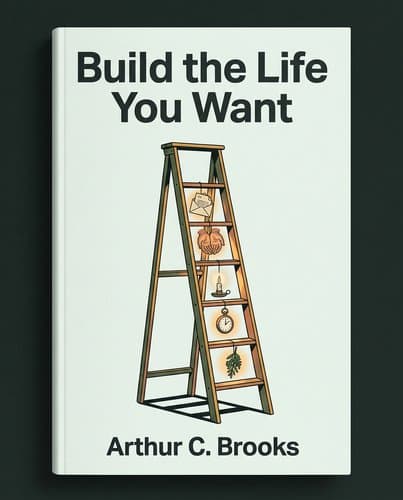
137978862_build-the-life-you-want
by Arthur C. Brooks, Oprah Winfrey
Happiness isn't something that happens to you—it's a skill you can master. Brooks and Winfrey reveal how managing your emotions and investing in four proven…
In Brief
Build the Life You Want (Sept) by Arthur C. Brooks and Oprah Winfrey argues that happiness is not a product of circumstances but a skill of emotional self-management. Drawing on psychology and philosophy, it gives you practical tools for regulating negative emotions and building lasting meaning through four pillars: family, friendship, work, and faith.
Key Ideas
Name physical sensations to regulate emotion
When you catch a negative emotion rising, try the Five-Minute Rule: don't act on it for five minutes. Name the physical sensations in your body — heart rate, chest tightness — to move the experience from your limbic system to your prefrontal cortex where you can decide what to do with it.
Hope is your power to act
Distinguish hope from optimism. Optimism assumes things will work out; hope is the conviction that you can act to improve things regardless of the odds. When facing a difficult situation, skip the prediction and ask: what is actually within my power to do here?
Invest in virtue-based friendships
Audit your friendships using Aristotle's ladder. How many of your relationships are 'deal friends' — useful, pleasant, but instrumental? Deliberately invest in at least one 'real' friendship defined by virtue rather than transaction, with someone who would notice when you're slightly off.
Choose work with intrinsic meaning
Stop identifying yourself by your job title. Ask whether your current work provides intrinsic rewards — earned success, service to others — or mainly extrinsic ones. If it mostly provides the latter, that's a diagnostic, not a verdict: the Spiral career model allows dramatic shifts that repurpose old skills.
Practice grateful-remembering of specific moments
Start a weekly gratitude list focused on specific people and moments rather than general circumstances. The research effect comes from 'grateful-remembering' — actively retrieving particular memories — not from generic acknowledgment of being fortunate.
Teaching others consolidates your growth
Give what you've learned away. Explain one idea from this book to someone in your life who is struggling. The act of teaching forces you to consolidate what you know, and it converts a personal project into something that compounds.
Who Should Read This
People working on personal growth in Happiness and Positive Psychology, especially those tired of generic motivational advice.
Build the Life You Want
By Arthur C. Brooks & Oprah Winfrey
11 min read
Why does it matter? Because chasing happiness is the surest way to miss it.
Most of us are running a quiet background program: once things settle down, I'll finally be happy. Once the relationship is right, the job is stable, the body cooperates. It's a reasonable assumption. It's also, the evidence now makes clear, wrong. Happiness isn't waiting at the end of the to-do list. It turns out to be a skill — specifically, the skill of managing your inner life rather than optimizing your outer one. Arthur Brooks and Oprah Winfrey spent years arriving at this uncomfortable conclusion from opposite directions: one through decades of neuroscience and behavioral economics, the other through a front-row seat to every variety of human suffering and grace. Part of what they found surprises people: your emotional baseline — the default mood you return to after good news and bad — is far more malleable than most of us assume, and far more under your control. The people who flourish aren't the ones whose circumstances finally cooperated. They're the ones who stopped waiting.
You've Been Misreading the Map — Happiness Isn't a Destination
Albina Quevedo is ninety-three years old, bedridden in her Barcelona apartment after a bad fall, surrounded by the same two things that have hung on her walls for decades — a photograph of the Canary Islands where she grew up, and a simple crucifix. She cannot walk without help. She spends nearly every hour in that bed. And when Arthur Brooks sits beside her and she begins talking about her younger years — the parties, the beach days, the friendships — she pauses, turns toward the window, and says something that stops him cold: she is much happier now than she was back then.
That claim deserves scrutiny, because her earlier life was not obviously worse. She was young, healthy, surrounded by people who are now gone. But Albina's story reveals why those details are almost beside the point. When she was in her forties, her husband had long since abandoned her and their three children, leaving her in poverty and isolation. For years she sat at the window of that same small apartment and cried — not because she lacked courage, but because she had a perfectly logical theory: her unhappiness came from her circumstances, so her circumstances would have to change first. She was waiting on the world to move.
At forty-five, the theory cracked. Nothing outside her life shifted — no windfall, no reconciliation, no improvement in her luck. What changed was a single question she started asking herself: what if the outside world wasn't actually in charge of how she felt? She rebuilt herself from scratch — college at forty-five, a teaching career in Barcelona's hardest neighborhoods. When her husband eventually came back fourteen years later, she welcomed him — not because she needed him, but because she had become someone who could choose. They stayed together until his death. Her summary of the whole arc is the most compressed proof in the book that circumstances and happiness run on separate tracks: sixty-eight years married, she said with a smile, minus the fourteen unhappy ones.
That gap — between the life outside and the life inside — is where the rest of this book lives.
Happiness and Unhappiness Aren't Opposites — You Can Have Both at Once
Happiness and unhappiness run on completely separate tracks. This sounds like wordplay until you follow the implication: you don't have to eliminate one to increase the other.
Positive and negative emotions are independent systems, not opposite ends of a single dial. People experience purely positive feelings roughly 41 percent of the time and purely negative ones about 16 percent — but a full third of waking life lands somewhere in between, both present at once. Grief at a funeral alongside gratitude for the person's life. Pride in finishing something hard alongside anxiety about whether it was good enough. These aren't confused emotional states; they're normal ones. Feeling less bad does not mean feeling more good.
Brooks frames happiness as three macronutrients that need to be present together: enjoyment (pleasure made meaningful through connection and full attention — a long dinner with people you love, not a scroll through your phone), satisfaction (the earned thrill of doing something difficult), and purpose (the why that makes suffering bearable rather than merely punishing). All three contain some unhappiness. Enjoyment requires passing up easy pleasures. Satisfaction demands sacrifice — cheating your way to the same outcome produces nothing. Purpose, Viktor Frankl spent a lifetime arguing, is often forged in suffering rather than around it.
The problem isn't that satisfaction is impossible — it's that the brain adapts to it almost immediately. This is the hedonic treadmill: you reach the goal, feel the rush, and then the baseline resets. Which is why chasing permanent contentment is the real problem, not the goal. Beethoven, progressively losing his hearing and locked in a miserable guardianship battle over his nephew, produced more major works in the years following each setback. A 37 percent rise in measurable sadness correlated with one additional major composition, on average. The discomfort wasn't incidental to the work. It was part of the fuel.
Your unhappiness isn't a malfunction. It's a system doing exactly what it was built to do — alerting, teaching, creating. The goal isn't to go quiet on that channel. It's to stop letting it drown out everything else.
Your Brain Generates Feelings Before You've Had a Chance to Think
Think of your emotional brain as a smoke detector. It doesn't pause to confirm whether the burning smell is toast or a house fire — it screams at full volume the instant anything resembles danger. That speed is the whole point. By the time your conscious mind catches up, your body has already acted.
The neuroscience is uncomfortably precise about this. Your amygdala — the part of your brain that hasn't changed since you were prey — fires in roughly 74 milliseconds, flooding your system with stress hormones before your thinking brain has registered anything at all. The car that cuts you off in traffic has already been survived before you consciously feel afraid. The reflex happens; the feeling follows; the thought arrives last. You are always, in a small but meaningful way, catching up to your own emotional life.
Viktor Frankl spent years in Nazi concentration camps watching this sequence play out under conditions designed to collapse it entirely. His conclusion — worked out not in a seminar room but in genuine extremity — was that between any stimulus and its response, there is a space. Small, often, but real. That space, he insisted, is the location of human freedom. Not the only freedom, but the most durable one: the freedom to choose what you do with what you feel.
Most of us quietly get the next part wrong. We treat our emotions as verdicts — as though feeling angry means the anger is correct, or feeling hopeless means the situation is hopeless. An emotion is a signal, not an instruction. It's your brain telling your conscious mind that something is happening that may need attention. What you do with that information is a separate question, and it belongs to you.
Oprah Winfrey, who has spent decades watching this dynamic in her work, describes the sequence as 'feel the feel, then take the wheel.' The feeling is real — you don't talk yourself out of it or pretend it isn't there. You let it land. And then you decide what to do next. That interval between signal and response is where every practical tool in this book lives. The first step toward widening it is simply knowing it exists.
You Can Choose a Better Emotion — But Not the Way You Think
Can you actually choose a different emotion, or does that just mean forcing a smile over something that genuinely hurts? The question matters, because most people's instinct about 'choosing better emotions' is wrong in a way that makes the whole project backfire.
The mistake is confusing hope with optimism. They feel similar from the inside, but they work in opposite directions under pressure. Admiral James Stockdale learned this distinction at a cost most of us will never pay. He was a prisoner of war in Hanoi for over seven years, surviving torture and isolation that broke men around him. The ones who broke fastest, he observed, were not the pessimists — they were the optimists. The prisoners who kept saying 'we'll be out by Christmas' would hold themselves together until Christmas passed, then fall apart. The next deadline would replace it, and when that one passed too, the accumulated disappointment killed something essential in them. Stockdale survived by doing the opposite: accepting that the situation was genuinely brutal and expecting nothing from the outside world, while acting relentlessly on the small things he could actually control. That combination — clear-eyed about circumstances, active within them — is what hope actually is. It isn't a feeling; it's a practice with two parts: believing a better outcome is possible, and identifying specific steps toward it. Optimism is passive and dependent on the world cooperating. Hope is something you do.
Gratitude works the same way, and for the same reason. Not gratitude as a sentiment you perform — as a deliberate act of noticing. People who actively recalled things they were grateful for experienced roughly five times more positive emotion than those who didn't, not because their circumstances changed, but because they changed what they were looking at. The situation stayed hard. The attention moved.
That's the mechanism all three tools share. They don't ask you to pretend the hard thing isn't there. They give you somewhere else to put your eyes while you figure out what to do next.
The Four Idols Are Keeping You Distracted From Building Anything Real
Most people trying to get happier spend their energy accumulating better routines — journaling more, sleeping eight hours, cutting sugar. But the research points at something more disorienting: the main obstacles to happiness aren't habits you're missing; they're distractions you're already running.
Think about the last time your flight was delayed and nothing could be done about it. Within minutes, you were scrolling your phone — not because it helped, but because the frustration needed somewhere to go. Now extend that reflex to the larger frustrations: a marriage that feels distant, a career that's going nowhere, a creeping sense that life lacks meaning. The same move gets made. Take money: not saving for anything in particular, just buying things because buying things feels like motion. Add social status, pleasure, the attention of others — what one medieval philosopher catalogued as the four false gods — and you have airport-delay scrolling applied to a life. None of it solves anything. It numbs the awareness that something needs solving. And because the consumer economy is structurally built to serve people who are emotionally stuck, the options for numbing are unlimited. Unhappy people make the most loyal customers.
Emotional self-management is what breaks that loop. Not the destination — the thing that makes the real destination reachable. Once you're no longer reflexively self-medicating with triviality, you suddenly have time and energy pointing nowhere. The research across thousands of studies is unusually consistent about where to aim it: four areas only — family, friendship, work, and faith. Not ten thousand habits. Not a subscription to someone's optimization framework. Just those four, pursued seriously, as the places where enjoyment, satisfaction, and purpose actually live. The next four sections take each one apart.
The difficulties inside those four areas — the ones you were previously scrolling to avoid — turn out to be the whole point.
The People Who Love You Most Are Also the Ones Most Likely to Derail You
Picture a monkey in the forests of South India, reaching into a hollowed-out coconut for a fistful of rice. The hole is just wide enough to insert an open hand. The monkey grabs the food, makes a fist, and is stuck — not by a cage, not by a chain, but entirely by its own refusal to let go. Hunters exploited this for centuries. The trap requires no force at all.
A grudge works the same way. Brooks describes forgiveness not as a gift to the person who hurt you but as the act of opening your fist. Carrying resentment toward a family member binds you to them in the most painful possible way — you think about them constantly, they live rent-free inside your head, and the original wound stays fresh because you keep visiting it. The person who wronged you has often moved on entirely. You haven't.
Forgiveness has a structure, and applying the wrong kind to a serious offense can leave wounds that look healed while remaining open. Minor slights can simply be minimized and moved past — the sarcastic comment at Thanksgiving, the forgotten birthday, the small slight that stings and then fades. Mid-level offenses, the kind that damaged trust without destroying it, usually call for an explicit acknowledgment: a real conversation, an apology, a named reconciliation where both people agree something went wrong. For the worst things, the ones that broke genuine trust, what's needed is something harder and slower — a series of structured conversations, or therapy with the other person present, or a formal reconciliation process where the damage is examined rather than plastered over. What never works is conditional forgiveness — "I'll forgive you when you prove you've changed" — which is leverage dressed up as generosity. Pseudo-forgiveness is no better: the kind performed for social appearance while the anger stays intact underneath.
The reason family is where forgiveness matters most is precisely because family is where the stakes are highest. The people who can hurt you worst are the ones you love most, because they're the ones you've actually let close. That vulnerability is not a design flaw in family life — it is the design. The conflict isn't the problem to be eliminated. It's the price of the only relationships deep enough to be worth fighting for.
Your Job Title Is Not Your Purpose — and Mistaking One for the Other Is Expensive
Stephanie reaches the corner office — CEO, finally, after decades of the right moves and the right sacrifices — and then one day she comes back to visit, just months after retiring, and discovers she has been completely erased. The new CEO is traveling her routes, meeting her clients, working from her desk. Nothing in the building marks that she was ever there. The career that consumed her marriage and swallowed her children's childhoods turns out to have been a role, not an identity. Anyone could play it. Someone already is.
That's not a cautionary tale about ambition gone too far. It's a story about confusing a job title with a purpose — and the research is precise about why the confusion happens so easily. Prestige and pay are extrinsic rewards, meaning they come from outside you. The psychological problem with extrinsic rewards is that the brain adapts to them almost immediately. Get the promotion, and within months it's just your normal life. The hedonic treadmill strips the reward back to baseline. You need the next one. And the one after that. Careers built around status feel like running without arriving because they are.
Intrinsic rewards behave differently. Earned success — the specific sense of mastering something hard through genuine effort — doesn't adapt away the same way, because it's generated inside the work itself, not attached to what someone else pays you for it. That distinction matters, and a 1973 Stanford study on children and drawing makes it concrete: kids who genuinely loved to draw were given gold-star certificates as external recognition for doing it. Afterward, they were roughly half as likely to draw on their own. The external reward didn't add to the intrinsic pleasure — it replaced it, then departed. That's the precise mechanism: cutting corners to reach the external reward faster doesn't just fail ethically. It crowds out the intrinsic satisfaction, leaving you dependent on applause that will eventually stop.
Your next move doesn't have to look like a step forward on someone else's ladder. The real question is simpler: does it produce earned success, or does it produce applause? One of those compounds. The other evaporates the moment people stop clapping.
Transcendence Isn't Religion — It's the Neurological Reset Your Brain Needs
Spiritual practice isn't theology — it's neurology. Whether or not you hold any religious belief, deliberately zooming out from the self produces measurable changes in how your brain operates, and fifteen minutes of it is an entry point available to everyone.
Lisa Miller scanned the brains of people while they recalled either a deeply spiritual experience or an intensely stressful one. The spiritual recall produced a distinct drop in activity across the brain regions most associated with overthinking and rumination — the same mental loop that keeps you awake at three in the morning relitigating an argument from two weeks ago. The stressed brain stayed trapped inside its own circuitry. The spiritually oriented brain, even just remembering a moment of transcendence, found a neurological exit from that loop. You don't have to believe anything in particular for that mechanism to work. The brain doesn't check your theology before it responds.
There is one genuine catch: the benefits only arrive when personal happiness isn't the goal. Buddhist teaching is specific about this — the practitioner who meditates to become more serene often achieves less peace than one who meditates to become more useful to others. Transcendence isn't a wellness tool you aim at yourself. It's a reorientation of attention away from yourself, toward something larger, call it what you want, and the neurological reset follows as a side effect.
For practical purposes, this means the practice matters more than the tradition. Meditation, prayer, time in nature approached with deliberate attention, even sitting quietly with a piece of music and listening as if the composer were trying to tell you something — any of these, done with the intention of connecting to something outside your own concerns, produces the shift. Pick one. Fifteen minutes. The goal isn't peace. Peace is what you find when you stop making it the goal.
The Best Way to Master What You've Learned Is to Give It Away
What's the real point of doing all this work to understand happiness — sitting with uncomfortable ideas, reorganizing your priorities, rethinking what you owe the people you love — if it just stays inside you?
The answer is that it probably won't stay inside you for long. Not because you'll forget the ideas, but because understanding fades precisely to the degree that you stop making it active. This is what researchers call the teaching effect — a principle sometimes illustrated with a deliberately absurd image: explain a concept coherently to a plastic platypus, a bowling ball, any inanimate object that will hold still, and you will retain it far better than if you simply reviewed your notes. The act of teaching forces your prefrontal cortex to do organizational work it skips entirely during passive re-reading. You locate the gaps, find the words, discover which parts you only thought you understood. The platypus teaches you more than you teach it.
That's the neuroscience. But teaching what you know to someone who needs it is not a kindness you add on top of the work. It is the work, completed. Every pillar this book addresses — the repair work in family life, the depth of real friendship, the intrinsic rewards of work done in genuine service, the spiritual reorientation toward something larger than yourself — runs back to that same source. Passing it on isn't the finishing move. It's how the whole thing holds together.
You are not waiting to arrive somewhere. The daily commitment — the fifteen-minute practice, the forgiveness you extend, the notice you take — is the point. Give it away and it compounds. Keep it and it quietly drains.
The Commitment That Doesn't Require a Perfect Day
The whole architecture — the macronutrients, the emotional substitution, the four pillars, the gratitude lists — eventually reduces to a single morning decision: pick up the hammer again. Not because yesterday went well. Not because you've solved the problem of yourself. Brooks and Winfrey's daily mantra isn't an affirmation; it's a posture toward a day you cannot predict, made before you know how the day will go — I will love others and allow myself to be loved — which is another way of saying: I will stay in the game. Bad days aren't evidence the project has failed. They're just data. The measure is whether you return.
And when you find someone struggling with what you've now understood a little better, you explain it to them — not to perform generosity, but because that act is both the deepest form of mastery and, quietly, the whole point. You started this trying to fix something in yourself. You end it with something to give someone else. That's not a coincidence. That's the mechanism.
Notable Quotes
“(I Can’t Get No) Satisfaction.”
“Let’s talk this through so I can let go of the hurt”
“I will forgive you when you do X and Y”
Frequently Asked Questions
- What is 'Build the Life You Want' about?
- Build the Life You Want by Arthur C. Brooks and Oprah Winfrey argues that happiness is not a product of circumstances but a skill of emotional self-management. The book draws on psychology and philosophy to provide practical tools for regulating negative emotions and building lasting meaning. It organizes wellbeing around four core pillars: family, friendship, work, and faith. Rather than treating happiness as something that happens to you, the authors present it as something you can develop through deliberate practices like the Five-Minute Rule, reframing hope, investing in genuine friendships, and practicing gratitude through specific memory retrieval.
- What is the Five-Minute Rule explained in 'Build the Life You Want'?
- The Five-Minute Rule is an emotional regulation technique for managing negative impulses. When you catch a negative emotion rising, try the Five-Minute Rule: don't act on it for five minutes. During this period, name the physical sensations in your body—heart rate, chest tightness—to move the experience from your limbic system to your prefrontal cortex where you can decide what to do with it. This practice creates space between an emotional impulse and your response, enabling more thoughtful decision-making rather than reactive behavior that you might regret.
- How does 'Build the Life You Want' distinguish between hope and optimism?
- The book makes a critical distinction between these two concepts. Optimism assumes things will work out; hope is the conviction that you can act to improve things regardless of the odds. When facing difficulty, the authors recommend skipping predictions and asking: what is actually within my power to do here? This reframing shifts you from passive hoping things resolve to active problem-solving. Hope becomes more reliable than optimism because it anchors in your agency and what you can control, rather than external outcomes and assumptions about the future.
- What does 'Build the Life You Want' say about finding meaning through work?
- Stop identifying yourself by your job title. Instead assess whether your work provides intrinsic rewards like earned success and service to others, or mainly extrinsic ones. If your work mostly provides extrinsic rewards, the authors present this as diagnostic information, not a verdict. They introduce the Spiral career model, which allows dramatic shifts that repurpose existing skills in new directions. This reframes career changes from failure into strategic repositioning for greater satisfaction and meaning, acknowledging that work is one of four pillars essential to building the life you want.
Related Book Summaries
Read the full summary of 137978862_build-the-life-you-want on InShort