43495368_building-a-life-worth-living
by Marsha M. Linehan
Once deemed the most hopeless patient her psychiatric ward had ever seen, Marsha Linehan turned her own suicidal suffering into DBT—the world's most effective…
In Brief
Once deemed the most hopeless patient her psychiatric ward had ever seen, Marsha Linehan turned her own suicidal suffering into DBT—the world's most effective therapy for people who want to die—proving that the deepest wounds can become the most powerful medicine.
Key Ideas
Effective Therapy Dances Between Acceptance and Change
When supporting someone in severe distress, pure validation ('this is terrible, you're right') and pure change-push ('you need to do X') both fail. The effective move is the constant alternation between the two — accepting fully, then gently pressing toward change, then accepting again. Neither pole works alone; the dance between them is the therapy.
Radical Acceptance Is Repeated Body Practice
Radical acceptance is not a one-time decision but a repeated practice of 'turning the mind' at each fork — choosing the acceptance road again and again, like practicing an instrument. Accepting with your mind is different from accepting with your body; the latter requires willing hands, half-smiling, and physical posture, not just cognitive reframing.
Action Rewires Thinking Faster Than Thought
You can't think yourself into new ways of acting — you can only act yourself into new ways of thinking. When emotion blocks action, body-first interventions (unclenching hands, twenty minutes of aerobic exercise, paced breathing with a longer exhale than inhale) change body chemistry faster than any thought-based technique.
Counterintuitive Withdrawal Breaks Harmful Reinforcement Loops
Reinforcement loops can maintain suicidal behavior unintentionally, even when everyone involved is acting in good faith. If intensified care, hospitalization, or increased attention follows self-harm, the behavior may be inadvertently reinforced. The response that breaks the loop is often the counterintuitive one — what O'Brien demonstrated when he emotionally withdrew.
Wise Mind Is Learned, Not Inherited
Wise mind — the synthesis of emotion mind and reasonable mind — is learnable, not innate. Even people in acute crisis can access it, as Linehan's client showed by announcing 'this is NOT wise mind!' while still walking out the door. The practice is learning to locate it, not acquire it; everyone has it.
Build Life Worth Living With Small Acts
'Building a life worth living' is a concrete behavioral goal, not a therapeutic metaphor. It means systematically adding positive elements to the life you have right now — not achieving an ideal life. Linehan's first version was a single self-imposed rule at age twenty-one: no drinking alcohol alone. It was enough to make the present livable while the future was still uncertain.
Who Should Read This
Curious readers interested in Memoir and Scientists and the science of how the mind actually works.
Building a Life Worth Living: A Memoir
By Marsha M. Linehan
10 min read
Why does it matter? Because the therapy that helped hundreds of thousands of suicidal people was built by the patient they couldn't save.
The assumption is that therapies come from researchers who study suffering at a careful distance. DBT dismantles that. Every technique in the most effective treatment for suicidal people — the radical acceptance, the dialectical balance, the skills for tolerating unbearable pain — was excavated from the wreckage of its creator's own two years in a locked psychiatric ward, where she was labeled the most incurable patient her doctors had ever seen.
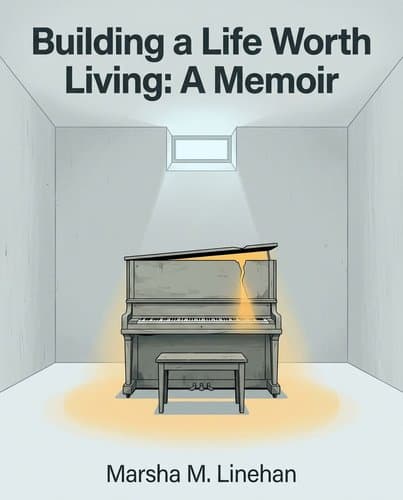
Marsha Linehan didn't study borderline personality disorder. She survived it. She sat at an upright piano on the worst unit of a Hartford psychiatric hospital and made a vow to God she had no standing to make. She would get out of hell herself, then go back in and get others out. What followed was thirty years of spiritual searching, scientific stubbornness, and clinical invention, all aimed at keeping that single promise.
This is what it looks like when suffering becomes method.
The Therapist Who Cracked the Code for Suicidal Patients Was Once the Patient No One Could Crack
At a psychiatric hospital in Hartford, Connecticut, in the early 1960s, staff wrote up a patient they'd spent two years trying to save. Every medication had been tried, alone and in combination. Multiple rounds of electroconvulsive therapy produced nothing. The girl burned herself, cut herself, slammed her head against walls, made repeated attempts on her life, and remained beyond reach, bitterly mistrustful of anyone trying to help. When the hospital finally discharged her, her record called her the most incurable patient they had ever seen.
Decades later, a psychiatrist named Allen Frances sat down to write the foreword for a book by Marsha Linehan. He opened with that patient (her two years in seclusion, her failed treatments, her discharge in failure) and named her a paragraph later: the founder of Dialectical Behavior Therapy, a treatment now used by ten thousand trained therapists to help hundreds of thousands of people considered otherwise unsaveable.
The reveal is disorienting by design. For decades, Linehan kept her history private. When she finally went public, it was in an afternoon session at the very institution where she'd been hospitalized at eighteen. The audience had gathered expecting a clinical lecture on DBT's development. Instead they heard a confession: the therapy was built by someone who had been the patient no treatment could reach, who had whispered "God, where are you?" in a hospital room and heard nothing back, and who made a vow before leaving: get out of hell, then figure out how to get others out.
That backstory made DBT structurally different from everything before it. Every choice in the therapy — why it balances acceptance against change rather than demanding change alone — came from someone who knew from the inside what it felt like to be told, implicitly, that you were the problem. DBT doesn't treat the urge to harm yourself as irrational or the desire to escape pain as pathological. It starts from the assumption that what you feel makes sense given everything that happened to you: what's missing isn't insight into your own wrongness but specific, learnable skills for surviving moments of crisis. The problem isn't you. The problem is your toolkit.
Everything the Hospital Did to Help Her Was Accidentally Making Her Worse — and She Filed That Away
Thompson Two smelled of urine and cigarette smoke and housed patients who fecal-smeared and fought and stripped naked. Marsha Linehan spent nearly two years there as the Institute of Living's most disturbed patient: cutting herself with broken window glass, burning herself with cigarettes, diving headfirst off furniture, spending an uninterrupted three months locked in a seclusion room with a bolted-down bed and an iron-barred window. She understood none of it.
Decades later, she did. And what she understood was that almost everything the hospital had done to help her was accidentally training her to stay.
In a ward with no effective treatment, the only available feedback was how hard the staff scrambled when she hurt herself. Suicidal crisis brought more observation, more sessions with her psychiatrist, more effort from every direction. The seclusion room was supposed to be aversive. For Linehan it felt like containment, relief from impulses she couldn't control on her own. She wasn't manufacturing crises deliberately. But the behavior was being reinforced all the same, and nobody saw the loop. The worse she got, the harder they tried. The harder they tried, the worse she got.
The loop broke when her psychiatrist, Dr. John O'Brien, walked in one day with a different tone. He told her calmly that he had accepted she might kill herself. If she did, he would have one Mass said for her. He was going out of town for two weeks and hoped she'd still be alive when he returned. Then he left. She became hysterical within minutes — screaming at nurses to restrain her, certain she'd be dead before he got back. And in the middle of that panic, something landed: she did not want to die.
The reason was a vow she'd made in the ward's day room, alone at the upright piano, talking to a God who wasn't answering. She had no working treatment, no plan, nothing except the promise: if she got herself out of hell, she would go back in and get others out. When O'Brien stopped reaching, what had looked like helplessness revealed itself as a choice.
He hadn't planned a clinical intervention. But Linehan filed it anyway. When she built DBT, one of its structural commitments was refusing to let suicidal crisis become the most reliable path to connection, not coldness but a refusal to make chaos the only lever that worked. She had watched clients follow the same loop she'd been caught in: hospital admission brings care and structure, which rewards crisis, which produces more hospitalization. She knew this not from research but from Thompson Two, where the staff's real, sustained, and genuinely insufficient compassion had, as she would later quote a French novelist, slipped through her soul like water through a sieve.
The Secret at the Center of DBT: A Golden Chapel in Chicago and a Zen Monastery in Germany
DBT's most distinctive features — mindfulness and radical acceptance — did not come from cognitive science. They came from a Catholic mystical experience and months of Zen practice in Germany, and Linehan spent years making sure the field that would validate her therapy never saw the seam.
January 1967, Chicago. Linehan was kneeling before a crucifix in a chapel on Fullerton Parkway, sunk into one of the worst stretches of despair she had ever known, when the room filled with golden light. She knew immediately that she was not alone: something divine ran through her, and she through it. She ran upstairs and said aloud: "I love myself." The word "myself" is the tell. Since her hospitalization she had thought of herself in the third person, a split she hadn't noticed until that pronoun collapsed it. She called her psychiatrist, couldn't reach him, and for the first time in years didn't care. At their next session, her atheist analyst told her she no longer needed therapy. She walked out onto Michigan Avenue and asked the empty street where the band was.
Sixteen years later, that experience sent her to a Zen monastery in northern California and then to a Benedictine monk named Willigis Jäger in Germany. She told her department chair she needed to learn acceptance firsthand to teach it. She never told him what she was actually doing: DBT's core was taking shape in chapel pews and Zen sesshins, extended silent retreats lasting days at a time. Jerry Davison, her mentor from Stony Brook, told her explicitly: don't mention Zen in behavior therapy circles. Behavioral science in the 1980s was hostile to anything that smelled like mysticism; a therapy traceable to a Zen master and a Catholic chapel would never survive peer review.
At Harborview Medical Center in Seattle, she tested Zen-derived exercises with patients who'd volunteered for skills training. She led the group in walking meditation down the hallway, glanced back, and found she was alone. Everyone had stayed in the room.
It took years of back-and-forth with Jäger — testing each adaptation with patients, getting his corrections, revising — before the translation held. The result appears in the DBT manual dressed in clinical language: meditative practices reframed as behavioral skills, origins unspecified. The seam is invisible. You have to know to look for it.
Neither 'Accept Yourself' Nor 'Change Your Behavior' Worked Alone — So She Built the Dance Between Them
Think of a surgeon who needs a patient to move — movement is essential to recovery — but the patient's skin is third-degree burned from collar to ankle. Any contact detonates the nervous system. The surgeon's options aren't "encourage movement" or "discourage movement." The surgeon needs a different frame entirely.
Linehan's federally funded study had a straightforward premise: run behavior therapy on highly suicidal patients and see whether it outperformed the psychodynamic treatments of the day. She came prepared with protocols. Each week she identified what the patient needed to change; the following week she laid out a plan. Standard practice. The response was chairs thrown, silence, walkouts, screaming: "You're not listening to me. You're trying to change me." These patients had experienced real tragedy (abandonment, abuse, lives of compounding loss), and any suggestion that they might need to change read as one more person telling them they were the problem. Linehan's image for it: no emotional skin. Third-degree burns, full body. The lightest contact was unbearable.
She switched poles entirely. She dropped change-focused work and moved to pure validation, the kind Carl Rogers called unconditional positive regard. Warmth, no pressure. The response was equally volcanic, opposite direction. "What? You're not going to help me? You're just going to leave me here in all this pain?" Pure acceptance read as abandonment. A therapist who'd given up.
What Linehan had discovered, without yet having a framework for it, was that her clients were caught between two equally unbearable things: being told to change (which implicated them as the problem) and being fully accepted (which meant the suffering would never end). Either pole collapsed the relationship. Not sometimes. Every time.
The solution her team stumbled toward (her students called it "blackmail therapy," with affection) was to hold both at once. She'd spend most of a session deep in validation, making room for the tragedy of a client's life, with almost no demand for change except one: stay alive until next week. Once the relationship felt solid, she'd start using it as a behavioral lever: more warmth when the client moved toward her life, some withdrawal when she didn't. Not punishment. A recalibration. It was improvised and incomplete. But it was working in a way neither pole alone had.
What she would later name dialectical is not a compromise between change and acceptance, not meeting both somewhere in the middle. It is holding them simultaneously in tension, and moving. Any position held too long collapsed. The therapy had to keep dancing between the poles, finding a synthesis that neither could reach on its own.
Radical Acceptance Is Not Resignation — It Is the Most Demanding Practice in the Therapy
What does accepting something actually require? The instinct is to picture release: the fist unclenching, the mind going quiet. Linehan spent years watching that assumption undermine her clients and, in a rented car in northern Israel in 1991, confirmed it had undermined her too.
She was driving alone near the Golan Heights while on sabbatical from Cambridge, where she'd been writing the DBT manual. A colleague had warned her: don't stop for anyone, not even police — kidnapping was a real risk in the area. Linehan drove out anyway, found a road that looked right, and took it. The pavement gave way to dirt, then to nothing. She turned back. Then stopped the car and told herself fear wasn't allowed to make decisions. She turned around and kept going. After hours of this, every road ending at a cliff or dead end, gas running low, her thoughts drifting toward prison and what her friends would think of her, she finally gave herself a rule: if a road was wrong once, she would not drive it again, because it would still be wrong. She made it home.
What she'd been doing before that rule arrived was the failure she'd been trying to teach against. Returning to wrong roads again and again, as though checking once more might change what was there. That's not passive suffering. It's active, exhausting refusal to accept. Radical acceptance, as Linehan defines it, isn't the feeling of release. It's the decision, made again and again, to stop going back. She calls this "turning the mind" — acceptance chosen again and again at each fork, not once but continuously.
The distinction between ordinary acceptance and the radical kind is the phrase "all the way." Recognizing that something is true is not the same as accepting it in your whole body. When Linehan built half-smiling and willing hands into the DBT distress-tolerance module, she was formalizing something she'd observed: unclenching your palms and turning them upward softens the mind when the mind won't soften itself. A teenage client once dissolved her anger at a disrespectful stranger simply by opening her hands. The body moves first; the mind follows. Radical acceptance is not passive. It has a technique.
She Returned to the Hospital That Had Locked Her Up — and Kept the Promise She Made There
In June 2011, Linehan stood in a small, flower-filled room at the Institute of Living facing roughly thirty former patients, some after suicide attempts, some after long hospitalizations. She had asked to meet them before her afternoon lecture, just them. She told them she had come to give a major talk on DBT. Then she told them something else: she had been a patient here herself. The lowest unit. The locked ward. Two years and one month. "I was where you are now," she said. "And here's where I am now. You, too, can get out of hell."
One woman later described the silence as electric. Nobody had considered the possibility. The woman who appeared on every DBT training video, the architect of the therapy they'd been taught — one of them. The patient the hospital had catalogued as most incurable had become the person who built the treatment they were now receiving, in that same building.
She had earned the right to say it. Two decades of clinical warfare had produced results the psychiatric establishment spent years trying to explain away. The first randomized trial showed DBT patients averaged 1.5 incidents of self-harm and near-lethal attempts (what researchers call parasuicide) per year, compared to nine for controls; inpatient hospitalization dropped from thirty-nine days to eight. The paper was rejected twice by the leading psychiatry journal (the editor called it "junk") before being accepted on the third try in 1991. Critics argued her results came from charisma, not therapy. She ran a study without her involvement: same results. They argued suicide was biological, so behavior therapy couldn't touch it. Her reply: DBT changes the biology. That is the biological intervention. Sixteen independent randomized trials, run in other labs and other countries, produced outcomes identical to her first.
The vow she had made at an upright piano on Thompson Two — get out of hell, then come back for the others — had earned its fulfillment in clinical trials, a publication fight, and a hundred academic skirmishes. But it closed in the same room where it began.
She ended the gathering with a circle dance: one step left, two steps right, moving slowly. Everyone was in tears by the end. Including her.
The Vow Made at the Piano — and What It Actually Costs to Keep One
Picture her in that ward — alone on Thompson Two, sitting at an upright piano in a ward that smelled of cigarettes and urine, talking to a God who said nothing back. Not asking for rescue. Making a deal: get out, then return for the others. She had no credentials, no therapy, no reason to believe she'd survive the week. The promise was made from exactly nothing.
Fifty years later, in that same building, she stood before a room of former patients and said: I was where you are. You can get out. The most incurable patient the Institute had ever seen closed the loop on her own origin story — not with triumph, but with a circle dance and the grace of a debt repaid.
The question she leaves you with isn't about DBT. It's about the worst thing you've lived through: what if it was already a vow?
Notable Quotes
“You may be wondering why I am here today,”
“I am here at the Institute of Living to give a major talk at one o'clock. You are invited to that talk, but I didn't want you to hear what I have to say at that talk. I wanted to tell you myself right now.”
“When I developed this treatment, it was to fulfill a vow I had made when I was very young,”
Frequently Asked Questions
- What is Building a Life Worth Living by Marsha Linehan about?
- Building a Life Worth Living is Marsha Linehan's memoir about her personal recovery from severe psychiatric distress and her development of Dialectical Behavior Therapy (DBT). The book tells how Linehan, herself a former psychiatric patient, created the most empirically validated treatment for suicidal behavior. DBT centers on the dialectic between validation and change, radical acceptance, and building a livable life from within. Linehan explains that effective support requires constant alternation between accepting fully and gently pressing for change — "the dance between them is the therapy." The memoir weaves her personal journey with the core principles of DBT, showing how acceptance, behavioral change, and mind-body integration work together to help people in severe distress.
- How should you practice radical acceptance according to Linehan?
- Radical acceptance, according to Linehan, is not a single decision but a repeated practice of "turning the mind" at each fork in the road. You must choose the acceptance path again and again, like practicing an instrument. Linehan distinguishes between accepting with your mind and accepting with your body; the latter requires "willing hands, half-smiling, and physical posture," not just cognitive reframing. This bodily practice is crucial because "you can't think yourself into new ways of acting — you can only act yourself into new ways of thinking." Body-first interventions like unclenching hands, aerobic exercise, or paced breathing change body chemistry faster than purely mental strategies, making acceptance an embodied behavioral skill.
- What does "building a life worth living" mean in Linehan's framework?
- "Building a life worth living" is a concrete behavioral goal, not a metaphor, according to Linehan. It means systematically adding positive elements to the life you have right now — not striving for an ideal life. Linehan's own first version was remarkably simple: at age twenty-one, she imposed a single rule on herself — "no drinking alcohol alone." She explains this modest constraint was enough to make her present life livable while her future remained uncertain. The concept emphasizes incremental, achievable improvements rather than transformative life overhauls. By focusing on what makes life worth living in its current state, rather than waiting for complete transformation, individuals can implement small, concrete behavioral changes immediately.
- Why is behavior change prioritized over thinking in Linehan's approach?
- Linehan prioritizes behavior change over thinking because she argues that thought alone cannot produce behavioral transformation. She states: "you can't think yourself into new ways of acting — you can only act yourself into new ways of thinking." When emotion blocks action, body-first interventions prove more effective than cognitive reframing. These include unclenching hands, twenty minutes of aerobic exercise, or paced breathing with a longer exhale than inhale — techniques that change body chemistry faster than thought-based methods. This body-first approach underpins DBT's effectiveness. Additionally, Linehan describes "wise mind" as the synthesis of emotion and reason, which is learnable. People can access wise mind even in acute crisis through practice, making behavioral skills foundational to emotional and cognitive change.
Related Book Summaries



Read the full summary of 43495368_building-a-life-worth-living on InShort