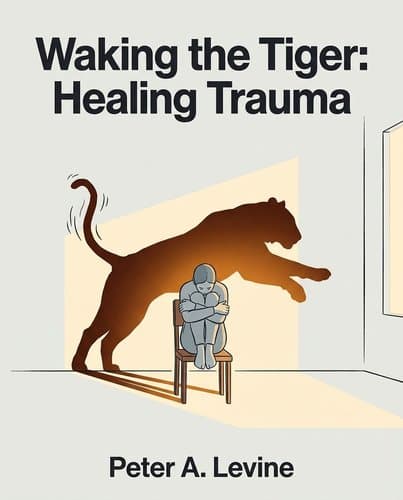
384924_waking-the-tiger
by Peter A. Levine
Your body holds the complete blueprint for healing trauma—trembling, shaking, and involuntary discharge aren't weakness, they're the cure.
In Brief
Your body holds the complete blueprint for healing trauma—trembling, shaking, and involuntary discharge aren't weakness, they're the cure. Discover why animals in the wild never develop PTSD, and how to stop interrupting the biological reset your nervous system is desperately trying to complete.
Key Ideas
Allow natural trembling after frightening events
When your body wants to tremble, shake, or cry after a frightening event, find somewhere safe and let it complete rather than suppressing it — that involuntary discharge is how the nervous system resets, and interrupting it is how trauma becomes chronic.
Discharge frozen activation through sensation and movement
Healing trauma does not require accurately remembering or reliving what happened. What heals is allowing the biological activation frozen in the body to discharge — through sensation and graduated movement, not through narration or emotional flooding.
Repetition signals incomplete nervous system responses
If you find yourself drawn into the same difficult situations, relationships, or conflicts repeatedly, consider that this may be the nervous system attempting to complete an interrupted survival response, not a character flaw or death wish to overcome.
Monitor body sensations for discharge signals
Track body sensations — warmth, expansion, tingling, trembling — rather than memories or emotions when processing traumatic material. A shift from constriction to ease or warmth is the signal that discharge is actually happening.
Establish felt resources before processing trauma
Before approaching difficult traumatic material (in therapy or self-work), identify a felt resource first — a body sensation, memory, or image that produces warmth or a sense of strength — and oscillate between that resource and the difficult material in small steps, never diving straight in.
Let children complete natural discharge cycles
When helping a child after a scary medical procedure or accident, resist the urge to immediately reassure or distract. Watch for natural trembling, crying, and reorientation; let those cycles complete; allow the child to control the pace; and only then invite storytelling.
Who Should Read This
Curious readers interested in Mental Health and Neuroscience and the science of how the mind actually works.
Waking the Tiger: Healing Trauma
By Peter A. Levine & Ann Frederick
8 min read
Why does it matter? Because your body already has everything it needs to heal trauma — and most of what we call treatment keeps interrupting it.
Picture the standard trauma recovery: years of talking, medication calibrated by trial and error, careful excavation of the past. That model assumes the mind is where the wound lives, so the mind is where healing must happen.
Then watch what an impala does in the three seconds after a cheetah releases it.
Peter Levine spent twenty-five years noticing what therapists weren't trained to notice — that wild animals recover from mortal threat automatically, completely, and without help, while humans stay frozen in place for decades. The mechanism isn't psychological. It's biological. And it's already inside you, waiting to complete what fear interrupted. This book won't teach you to revisit the past. It will show you why the body's trembling, shaking, and impulse to run aren't symptoms of damage — they're the cure, perpetually interrupted.
Traumatic Symptoms Aren't Psychological Wounds — They're Biological Energy Frozen Mid-Escape
A young impala is sprinting at sixty miles an hour when the cheetah's jaws close in. Then — nothing. The animal drops to the ground, completely motionless, apparently dead. But it isn't dead. And it isn't pretending.
Inside the impala's nervous system, everything is still running at sixty miles an hour. The body has stopped; the engine has not. Levine describes it with an analogy: floor the accelerator and stomp the brake at the same moment. The car goes nowhere, but the forces building between those two opposing commands are enormous: a tornado of energy with nowhere to discharge.
That tornado is trauma. Not the cheetah. Not the memory of the attack. The energy that mobilized for escape and then had nowhere to go.
To feel the scale of what's trapped, Levine offers a visceral measure: imagine the moment just before sexual climax, when an outside force stops everything cold. Now multiply that intensity by one hundred. That is the scale of what's trapped. The same charge is running through the impala's nervous system as it lies perfectly still on the ground, a real physiological state, measurable in the body.
Wild animals resolve this automatically. When the threat passes, the impala shakes, trembles, and moves through the immobility. The energy discharges. Within minutes, it has rejoined the herd. No lasting mark, because the process completed.
We don't complete the process. Our rational brains interrupt it. The body wants to shake; the mind reads that trembling as more danger and clamps down. The trapped energy then organizes itself into symptoms (anxiety, depression, hypervigilance, chronic pain), the organism's attempt to contain a biological force it never managed to release.
The reframe changes everything about how to think about healing. If trauma were a scar on the mind, healing would run through the mind: talking about the event, processing the narrative, re-examining the memory until it loses its charge. Many survivors have spent years doing exactly this and remained stuck. Talking addresses the story. It leaves untouched the biological energy still running at sixty miles an hour inside the nervous system.
The wound is in the body. And the body already knows how to heal; the impala demonstrates that every time it shakes off a near-death encounter and walks back to the herd. The same enormous energies that produce traumatic symptoms can, when properly engaged, produce something quite different: healing.
The Trembling You're Taught to Suppress Is Exactly What Would Cure You
The shaking, the uncontrollable crying, the way your body seems to fall apart after something terrible — that is the discharge mechanism. Every cultural instinct telling you to hold it together is suppressing the one process that would actually resolve what happened.
Levine describes a bird that flies into a window. The impact doesn't kill it. The animal collapses, stunned, into apparent motionlessness. Left in the warmth of a child's hands, it begins to tremble. The trembling moves through its whole body. It reorients, staggers slightly, looks around, and then flies away unharmed. But if the child, moved by concern, begins to stroke the bird during that trembling, something breaks apart. The bird drops back into shock. If that interruption happens repeatedly, each successive shock lasts longer. The bird can die of fright — not from the original collision, but from having its recovery repeatedly stopped.
The trembling was the recovery. The comfort was the harm.
Suppress those involuntary responses and you get the same result. Muscles that mobilized for running, for fighting, for escape are finally releasing energy that had nowhere to go. That discharge looks, from the outside, like falling apart. The social pressure (be strong, don't cause a scene, you should be over this by now) is the equivalent of petting the bird. It looks like care. It interrupts the cure.
What makes humans uniquely vulnerable is that we're the only animal with a nervous system capable of overriding its own discharge. A deer that narrowly escapes a predator shakes and twitches through its body within minutes and returns calmly to grazing. It doesn't decide to do this; it simply doesn't stop it. We stop it constantly, treating that restraint as composure. The body disagrees. The energy that didn't discharge doesn't disappear. It reorganizes into something chronic: anxiety, depression, hypervigilance, inexplicable pain. It stays there, sometimes for decades, waiting for the trembling that was never allowed to complete.
The nervous system never abandons the discharge. It just finds another route.
What Looks Like Self-Destruction Is Usually the Nervous System Trying to Finish the Job
Sometimes the biology writes the same scene for fifteen years.
Every July 5th at 6:30 in the morning, for fifteen years, the same man walked into a convenience store with his finger in his jacket pocket. He collected a few dollars in change from the register, walked back to his car, and waited. When the police arrived, he climbed out with his finger still in his pocket and told them he had a gun.
He didn't have a gun. He never hurt anyone. He just kept going back to prison.
After the seventh time — same date, same time, across fifteen years and multiple prison terms — the police noticed the pattern and brought him to psychiatrist Bessel van der Kolk. Van der Kolk asked him one direct question: what happened to you on July 5th at 6:30 in the morning?
The answer came without hesitation. His entire platoon had been ambushed in Vietnam on July 4th. He and his friend Jim survived through the night, hiding in a rice paddy surrounded by enemy soldiers. Jim was shot around 3:30 AM and died in his arms at 6:30 on the morning of July 5th. In one session, the man grieved Jim for the first time. The biology had somewhere to complete its arc. He never staged it again.
Levine reads this not as madness but as biology. After surviving a threat, wild animals go through a second phase: they rehearse what happened, playing out escape routes and counterattacks until the unfinished movement finds somewhere to go. Cheetah cubs that survive a predator will spend hours afterward replaying the scenario until the activation discharges. The veteran was doing exactly this: staging the confrontation again and again, hoping this time the story would end differently.
The story couldn't end differently because the first step had been skipped. The survival energy that flooded his nervous system in that rice paddy on July 4th had never discharged. Without that discharge, the biological drive to finish the story stayed live in his body, and his nervous system kept writing the same scene, year after year, dragging in convenience store cashiers and police officers as unwitting cast members in a drama it was trying to resolve.
This is what re-enactment actually is: not compulsion, not self-destruction, but a stuck biology looking for the exit it never found. For this man, that search took fifteen years.
You Don't Need to Remember What Happened Accurately to Heal — and Reliving It May Make Things Worse
Imagine trying to drain a flooded basement by reading the weather report that caused the flood. The report might be accurate — exactly when the storm arrived, what warnings were ignored. But the water doesn't care about the narrative. It needs a drain.
For decades, trauma therapy proceeded on the opposite assumption: that the story was the medicine. Find out what happened. Reconstruct it accurately. Relive it until the charge releases. What needs to discharge, Levine argues, is biological activation locked in the nervous system, and accurate memory is irrelevant to that. High emotional arousal during therapy makes things worse, not better: a nervous system under pressure plus a therapist's leading questions assembles "memories" from emotionally charged fragments that the person will then treat as absolute truth.
Margaret, a physician, had spent decades with neck pain and abdominal cramping that no test could explain. In a session with Levine, she tracked a tension in her neck (just that) and her head began slowly turning left on its own. Her legs trembled. Then an image: a man's face. What followed wasn't a linear narrative. Her organism alternated between scenes of childhood assault (a man, a tree, a knife) and vivid sensory counterweights: autumn leaves, a grandmother's arms, a child rolling and laughing. Those peaceful images weren't literal memories of breaks in the attack. They were resources the organism assembled from disparate moments to keep the process from tipping into overwhelm. Levine calls these poles the trauma vortex and the healing vortex: the first is the pull toward overwhelm and re-activation; the second is the pull toward resource and ground. Healing is the pulsation between them, not a plunge into either. Margaret's neck pain was gone after that session. She reported a new symptom: joy.
The reason accuracy doesn't matter is that memory was never a recording. Nobel-cited biologist Gerald Edelman describes it as "the re-membered present" — reconstructed each time, assembled from emotionally similar fragments drawn from multiple events and moments. Under high arousal, that assembly becomes especially pliable: a memory forged in an intense therapy session feels like revelation but is often a collage, shaped by whatever images carried similar emotional charge. Chasing it doesn't stabilize anything; it keeps the nervous system in exactly the arousal state that prevents discharge.
What heals is completion. The survival response that stalled needs to finish its arc in the body. Reading the report doesn't drain the water.
Give the Nervous System One Small Victory at a Time — That's All Healing Actually Requires
A hypothermic patient can't be saved with a hot bath. The thermal shock kills before the warmth helps. You give the body's own return mechanism something to work along: warmth administered gradually, the system regulating itself back. The capacity was never gone. It needed the right gradient.
Levine's deepest claim is that this logic extends to trauma at every scale, in every nervous system, at any age. The healing instinct is biological, not biographical: it predates any story you've told about what happened to you, and it doesn't wait for you to tell the right story before it activates. Small, graduated steps are what unlock it. The proof is a two-and-a-half-year-old named Sammy and a stuffed bear.
Sammy had been impossible for months: tyrannical, controlling, unable to sleep without thrashing. Six months earlier, he'd split his chin in a fall and been taken to the ER, where doctors strapped him to a Velcro restraint board (torso and legs immobilized) to suture the wound. His mother carefully validated his fear afterward, and nothing seemed to linger. Then the behavior started.
Levine introduced a game: place Pooh Bear on a chair, let it fall, announce it had to go to the hospital. Sammy bolted out the door, across a footbridge, down to a creek. Confirmation. His parents retrieved him. The next time, he ran only as far as a bedroom, a millimeter of new range. Levine placed Pooh under a blanket. Sammy watched, then ran to his mother: "Mommy, I'm scared." They waited and went again.
Pass by pass, something shifted. Fear-clinging gave way to excited jumping. Then came the real test: Sammy under the blanket himself. His eyes went wide — briefly — and then he grabbed the bear, shoved the blanket off, and flung himself into his mother's arms, screaming the exact words his father recognized from the ER: "Mommy, get me out of here. Mommy, get this thing off of me." More passes. More triumph each time. By the end, group celebration. The tyranny ended.
Each pass brought Sammy closer to the traumatic intensity while his capacity (support, familiarity, the group's encouragement) grew alongside it. The activation never outran the resources. Six months of waiting. The body needed a safe gradient, not a flood. At two and a half, Sammy already had everything required to get there.
The Wound and the Medicine Are in the Same Place
Every symptom that looks like damage — the nightmares, the flinching at nothing, the numbness, the way you keep ending up in the same impossible situations — was the nervous system doing something precise with energy that had nowhere else to go. That was never pathology. That was biology, working with the only tools available. The distinction matters because it changes what healing means: not correcting a broken mind, but completing something that was interrupted. And that capacity doesn't expire. Sammy got there at two and a half. The veteran got there after fifteen years. The body will use whatever safe gradient you give it — a pulsing shower, a child's game, a paper towel roll — to move energy that years of talking alone couldn't reach. The intelligence was always there. It just needed somewhere to go.
Notable Quotes
“You are being attacked by a large tiger. See the tiger as it comes at you. Run toward that tree; climb it and escape!”
“like she had herself again.”
“doesn't matter at all in terms of healing her traumatic symptoms. Did Margaret move through her traumatic symptoms because she returned to the past and”
Frequently Asked Questions
- What does Waking the Tiger argue about trauma recovery?
- The book argues that the body possesses an innate biological mechanism for recovering from trauma that modern culture systematically suppresses. Instead of requiring narrative or emotional reliving, healing involves completing interrupted nervous-system responses. When your body wants to tremble, shake, or cry after a frightening event, allowing this involuntary discharge in a safe space lets the nervous system reset. Interrupting these natural responses causes trauma to become chronic. The path to healing bypasses the need to relive or narrate the original event, focusing instead on completing the body's biological activation process through sensation and graduated movement.
- How does trauma healing work without reliving traumatic events?
- Healing trauma does not require accurately remembering or reliving what happened. Instead, the process focuses on allowing biological activation frozen in the body to discharge through sensation and graduated movement, rather than through narration or emotional flooding. By tracking body sensations like warmth, expansion, tingling, or trembling—rather than memories or emotions—you can identify when actual discharge is occurring. A shift from constriction to ease or warmth signals that the nervous system is resetting. This somatic approach bypasses the need to revisit the traumatic narrative, making healing accessible even when memories are fragmented or unavailable.
- What role do body sensations play in trauma healing?
- Track body sensations—warmth, expansion, tingling, trembling—rather than memories or emotions when processing traumatic material. A shift from constriction to ease or warmth is the signal that discharge is actually happening. This somatic tracking approach is central to healing because it helps you recognize when your nervous system is genuinely resetting versus when you're ruminating mentally. By focusing on physical sensations instead of trying to think through or emotionally process trauma, you activate the body's natural healing mechanisms. This sensory awareness allows you to work with trauma at a pace your body can genuinely complete.
- How should you help a child after a frightening experience?
- When helping a child after a scary medical procedure or accident, resist the urge to immediately reassure or distract. Instead, watch for natural trembling, crying, and reorientation; let those cycles complete; allow the child to control the pace; and only then invite storytelling. The book emphasizes that these involuntary responses are essential to the nervous system's natural recovery process. By allowing your child to discharge the activation in their body without interruption, you facilitate genuine healing. This approach prevents trauma from becoming frozen in the body and teaches children that their natural responses to fear are healthy and trustworthy.
Related Book Summaries



Read the full summary of 384924_waking-the-tiger on InShort