15802944_carry-on-warrior
by Glennon Doyle
Authenticity isn't something you achieve by fixing yourself first—Glennon Doyle reveals that the carefully hidden mess you're ashamed of is precisely what…
In Brief
Carry On, Warrior (Apri) argues that authenticity, not performance, is the foundation of meaningful connection, recovery, and faith. Drawing on her own experiences with addiction, marriage, and motherhood, Glennon Doyle shows readers how embracing brokenness rather than hiding it opens the door to genuine relationships, spiritual grounding, and lasting resilience.
Key Ideas
External order catalyzes internal change
When you hit bottom, the first act of restoration is physical and witnessed — clean one surface, let one person stand next to you while you do it; the internal shift follows the external order, not the other way around
Treasure sacred moments, not all minutes
Replace 'Carpe Diem' with 'Carpe a couple of Kairoses' — your job as a parent is not to be in ecstasy during every Chronos minute, only to notice the transcendent ones when they appear
Honest mess builds real connection
The secret self you protect from others is the only self capable of real connection — the mess, offered honestly, is the bridge; the performance is the wall
Movement precedes motivation and feeling
Recovery from anything requires acting before you feel like it: wash the sink, apply for the library card, make today someone else's lucky day — feelings are the caboose, not the engine
Peace is constructed through friction
Peace is not found in the right conditions; it is built through friction — Smelly Coughy Guy is the training, not the obstacle
One person must soften first
When a relationship is wound so tight you can't find the ends, someone has to pour the first glass of wine without waiting for an apology or a grand conversation
Fear speaks loudly; truth whispers
The voice that sounds most realistic — the one cataloguing your failures and predicting your unworthiness — is Fear, not truth; Love is the quieter voice that waits until you stop running
Miracles appear at the periphery
Distinguish between the dream you're building and the destiny being constructed around you — peripheral miracles require turning your head away from the specific thing you've been frantically working toward
Who Should Read This
Readers who connect with first-person stories about Memoir and Resilience and want to see the world through someone else's eyes.
Carry On, Warrior
By Glennon Doyle
14 min read
Why does it matter? Because the self you've been cleaning up before showing it to the world is the only one capable of real connection.
Picture your last birthday party — not a bad one, just a regular one. Someone hands you a slice of cake and you smile and say something like 'this is so fun' and you mean maybe forty percent of it. The assumption underneath that smile is that the mess is temporary, a waiting room, and that real life begins once you've cleaned yourself up enough to deserve it. Glennon Doyle spent two decades trying to outsource her unhappiness to alcohol, food, and whatever else promised to fill the gap — and what she found on the other side of all that wasn't a tidier self. It was the same self, just finally willing to be seen. She came back with tools: a word for holding beauty and brutal at the same time, a framework for which pain is worth walking toward and which to leave alone. This book makes the uncomfortable case that the chaos you're managing, the contradictions you're hiding, the ways you fall short of the person you meant to be — that's not the obstacle to connection. That's the door.
The Room That Looked Like Her Insides Had Spilled Out
She was a student government officer to a class of nearly a thousand, homecoming court nominee, athlete, Senior Superlative winner — 'Leading Leader,' the yearbook read — and she was also bingeing and purging several times a day, every day, for almost twenty years. Glennon Doyle spent decades performing competence so convincingly that nobody thought to ask what was happening underneath. That's the exhausting part: not the addiction itself, but the energy required to make everything look fine from the outside.
Rock bottom, when it finally came, didn't arrive with dramatic resolve. It came on a Mother's Day morning in 2002, sick and shaking on a bathroom floor, staring at a positive pregnancy test. The hole she'd been filling with food, alcohol, and cocaine had gotten so large that — as she puts it — God stepped in, the way you'd grab a wheel from someone who's fallen asleep. There was no triumphant decision to change her life. There was just a whispered prayer: help me. Weary surrender, not willpower.
What happened next is the part worth holding onto. After her first AA meeting, Doyle came home and sat on her bed staring at the floor — wine bottles, stilettos, ashtrays, tube tops, old magazines — a room that looked exactly like her insides felt. Her sister didn't make a speech. Didn't offer a framework or a plan. She just climbed off the bed, picked up a wine bottle, and threw it away. Then another. Doyle watched for a moment, then got up and joined her. They worked side by side in silence for two hours — folding clothes, wiping down surfaces, pouring every hidden bottle down the drain — until the room looked, for the first time, like somewhere a person might actually want to live.
Feeling Bad About Not Enjoying Every Moment Is the Double Failure No One Warns You About
The guilt is baked in from the start. Not the ordinary guilt of parenting — the guilt that you are failing to feel the right things while doing it. Glennon Doyle names this the double failure: the work itself is brutal, and then you're supposed to feel bad that you aren't savoring every brutal second of it.
Here's the scene she offers as evidence. She's standing in a Target checkout line. Her daughter Amma has helped herself to a bra from the cart and is sucking a lollipop she apparently found on the floor, with three shoplifted neon feathers stuck in her hair. One kid has vanished somewhere in the store; another is blocking the woman ahead of them from using the credit card reader. At this precise moment, a sweet older woman leans over and tells Doyle she loved every single second of raising her children. Every moment. Cherish this.
Doyle smiles and says thank you. What she actually wants to ask is: are you sure you loved parenting, or do you love having parented? It's the difference Dorothy Parker drew about writing — she didn't love writing, she loved having written. The experience and the memory are entirely different things, and the women handing out Carpe Diem advice in checkout lines may be reporting on the latter while prescribing it as a cure for the former. Nobody corners a software salesman in the break room and tells him to seize the day during a difficult fiscal quarter. Somehow mothers who admit exhaustion don't get the same pass.
To get out of the trap, Doyle draws a distinction between two kinds of time. Chronos is the clock — ten excruciating minutes in any checkout line, the long crawl toward bedtime. Kairos is something else: the sudden, still moment when time stops. She describes catching a glimpse of Amma's teeny elf mouth mid-chaos and feeling, briefly, like she was exactly where she was supposed to be. These moments can't be manufactured or scheduled. They just arrive. Her argument is that the real goal of parenting was never to seize every day. It was to catch a couple of those Kairos moments and recognize them when they come. Aim for that, and you can actually succeed. Miss one, and it's not a failure — it's just Chronos doing what Chronos does.
The Only Person Who Can't Hear Your Secret Self Is the One You're Protecting It From
Hi, I'm Glennon. I'm a recovering, well, everything, and lately I've been struggling with isolation and with being irrationally angry at my kids. Doyle rehearsed this introduction in her head at playgrounds and then ran it by her sister. Her sister's verdict was swift: do not do this. Society requires a filter, and the filter is, technically, lying — that's Doyle's own framing, and she more or less concedes the point.
But here's what she noticed underneath it. Every person she might say that to is also maintaining a filter — also performing fine — also carrying a secret self they've been told, since childhood, is too ugly and too afraid to be brought out in public. Which means two people are standing next to each other on the monkey bars, both lonely, both convinced they're uniquely broken, both protecting each other from the one piece of information that might actually help.
Doyle the preschool teacher understood this before Doyle the memoirist put it into words. When a child was feeling something enormous — furious, excluded, frightened — she didn't explain it away. She picked up a marker and wrote the feeling in big red letters with lightning bolts around it. Made it real. Made it visible. The child saw their own interior life treated as something worth naming, and the distance between them and the adult in the room collapsed.
The mess isn't what keeps people away. Hiding it is. Later in the book, Doyle describes finally letting herself dance — three hours, sweat stains, rat's nest hair, stilettos she refused to remove — and the liberation of it is the same thing: the secret self, offered instead of concealed, turns out to be the only bridge that actually reaches another person.
Recovery Isn't a Feeling You Wait For — It's a Sink You Clean
Imagine someone tells you they'll start swimming laps once they feel more energetic. You see the problem immediately: the energy comes from swimming the laps, not from waiting around feeling tired. Recovery works the same way — and Glennon Doyle is merciless about this. You will not feel better before you act. You will act, and then, eventually, feel better. The sequence is non-negotiable.
The frostbite metaphor is the clearest way she puts it. Numbing the soul with alcohol is like freezing it — no sensation, no pain, which feels like a reasonable deal until you try to stop. When sobriety starts, the thaw begins, and the thaw is excruciating. The feeling coming back doesn't feel like healing; it feels like daggers. Grief, fear, loss, anxiety — all the things the drinking had kept on ice — arrive at once. Doyle is honest: this part is horrific. But the only alternative to enduring the defrost is permanent amputation. There is no version where you skip the daggers and go straight to wholeness.
So what do you actually do while the daggers are coming? You wash the sink. You braid your daughter's hair. When you feel unloved, you find someone to offer love to. And you apply for a library card — Doyle recommends it specifically because librarians have low expectations, and when you're re-entering the world after a collapse, low expectations are a gift. Not because you feel like it. She is explicit: you will hate everything for a long while. Do it anyway. The action isn't the reward for getting your feelings in order. The action is how the feelings get ordered at all.
Mechanics first. Feelings follow.
Peace Isn't the Absence of Smelly Coughy Guy — It's Finding Stillness Next to Him
Every time Glennon Doyle unrolled her yoga mat in the corner of the gym — the one she'd chosen specifically for its distance from other humans — Smelly Coughy Guy walked in and set up right beside her. She'd try to create a perimeter: water bottle here, shoes there. Didn't matter. He moved whatever was in his way and planted himself close enough that when the instructor said to breathe deeply, Doyle quietly wondered whether breathing deeply was actually a good idea. She spent half the class with her hands pressed together in prayer pose, eyes half-closed, silently fuming at both the man and the instructor's patient smile that suggested this was, somehow, fine.
And that smile was the crack in her certainty. She'd been treating yoga as a refuge — an hour purchased at the cost of leaving her kids in the gym nursery, earned, protected. The lesson she slowly absorbed was that she'd been confused about what peace actually is. She'd been hunting for its conditions: the quiet room, the cooperative neighbor, the absence of coughing. But peace isn't an environment you find. It's a capacity you build. The friction isn't the obstacle — it's the training.
Real consequences followed. Not long after, her family was strapped into the van, running late for a birthday party, gifts in hand — and the garage door broke. They sat there for ten minutes: kids yelling, hands freezing, Craig unable to fix it. Old Glennon erupts in exactly this moment. New Glennon said to herself, quietly, this too shall pass. And it did. Craig described it as a miracle. What had actually happened was that Smelly Coughy Guy had done his job — all those class-long irritations had been reps, and this was the test. Peace, it turns out, is what you build next to the thing that annoys you most.
A Marriage Built on Too Much Wine and Too Few Precautions Can Still Become a Love Story
On a couch one night, after their kids were finally asleep, Glennon and Craig sat close together and looked at photos of their children on the mantle. Someone said: I love you more today than I did on our wedding day. A beat passed. Craig replied: me too, but honestly, we didn't love each other that much on our wedding day. They burst out laughing. She cried a little. It was the first time either of them had said it out loud — that the marriage had been arranged not by tradition but by too much wine and too few precautions, held together on the day itself by exactly two things: the baby growing inside her, and a shared, desperate belief that doing the next right thing would eventually be enough.
It was. But not automatically, and not because they got lucky in each other. What Doyle describes underneath the comedy of their chaotic origin story — she's told it before, it involves a bar crawl and Craig briefly forgetting she existed while someone handed him a beer — is a marriage that had to be built deliberately, piece by piece, out of material that kept arriving as a surprise. She didn't know, when she married him, that she would watch his face in the hospital and understand immediately that he was hooked on their family forever. She didn't know about the midnight newborn shifts, the singing, the way he would hold her on the nights their adoptions fell through and tell her they would never give up. None of that was available on the wedding day.
Love, Doyle suggests, is less like a discovery and more like something you build slowly — one midnight shift, one adoption night that didn't work, one moment of holding on anyway. But only if someone keeps choosing to stay in the room.
That choosing is the work. When the marriage goes cold and tangled — as hers did, as most do — her framework is almost offensively simple: somebody has to go first. Not with a speech. Not after the feelings return. Right now, before they do. You pour the glass of wine. You set the coffee maker. You let your arm brush his while you're making dinner. Feelings, she argues, are the last thing to arrive — the caboose, not the engine. You don't act because you feel it. You act, and then eventually — not immediately, not painlessly — you do.
The Betrayal You Already Knew About Is Still a Crucifixion
Some betrayals feel new when they're named, and some feel like confirmation of something you already knew in your body for years. Glennon Doyle's marriage had a long, quiet rupture before it had a loud one — she had been saving her real stories for her sister and a blank page, handing Craig nothing but the motions, because handing him the actual gifts felt like building sand castles the tide would erase by morning. When the formal betrayal arrived — what she describes as a major violation of their vows, not once but repeatedly, long ago — it hurt the way confirmation hurts: fully, and with nowhere to hide.
Her framework for surviving it comes from Easter, and it's worth taking seriously even if theology isn't your thing. Good Friday is the crucifixion. Easter Sunday is the resurrection. But the day nobody talks about is Saturday — the day in between, when the tomb is sealed and there's no evidence yet that anything will ever be different. Doyle argues that most people, when a marriage breaks, try to skip Saturday. They rush toward resolution or exit, because sitting in the wreckage with full awareness is almost unbearable. But resurrection is only real if you let the crucifixion happen first. Numbing it, fleeing it, performing your way through it — that's not Saturday. That's just refusing to let anything die, which means nothing can come back to life either.
So she steered into it. Her friend Adrianne had given her that phrase — steer into the fall, meaning stay present in the pain rather than managing it from a safe distance — and Doyle made it her strategy. What that looked like, concretely, was Craig sitting at their dinner table with a notebook, asking her where her parents worked before she was born. Starting over. Not because the feelings were good yet. Because they had decided to build something true this time.
The $140,000 They Brought to the Table Just to Walk Away
Craig came home from the bank one morning with a different look on his face. He'd been standing in line when he noticed the woman ahead of him — a single mother, crying, bargaining with the branch manager to save her house from foreclosure while her two small children hung off her legs looking like they'd been through something no kid should have to go through. He walked in the door and told Glennon: no short sale. They'd save that route for people with actual hardships. They had the money. They'd use it.
The Doyles were already $100,000 underwater on an interest-only mortgage — one that had never touched the principal, whose rate was about to climb another thousand dollars a month. A short sale would have been defensible. Craig's point wasn't that they didn't have an out. It was that an excuse and a hardship aren't the same thing, and the difference mattered.
So they brought $140,000 to the closing table. Their retirement accounts. Their entire savings. Their son Chase's college fund. Everything left on a big fancy brown table, and they walked out with nothing. Not as a loss they absorbed — as a choice they made.
For years, the mortgage company had been the real decision maker in their marriage. Where to live, whether to move, how much risk to take, what was even possible — all of it ran through a monthly payment they were hemorrhaging money to make. That's what makes this more than a cautionary story about adjustable-rate mortgages: firing that creditor required losing everything they'd built. It cost them everything to get the marriage back from an institution that had been running it.
They moved to a small town on the Chesapeake Bay. Chase sold nine shrimp to his grandfather for ninety cents. Tish took half an hour choosing wool tights for the beach. At church, an elderly woman in the choir held up a plain metal cereal spoon and asked if anyone had left it at her house. The whole congregation nodded with complete seriousness. Nobody checked their watch. Old ladies and lost spoons, Doyle concluded, are infinitely more important than time — and you can't learn that when a bank is running your life.
When the Dream Dies, Look for the Cathedral Being Built Around You
At 4:45 p.m. in a closet-sized Rwandan embassy, Glennon Doyle felt the tears coming. She and three other desperate families had been sitting there since morning — they'd brought lunch for themselves and for every embassy employee, because leaving felt like abandoning their children, and they could not leave. The staff had been polite, firm, and increasingly awkward about the whole situation for twelve hours. At 5:15, a Rwandan woman came downstairs and handed each family a piece of paper: you're grandfathered in. She said they came, so she'd done this for them. Two months later, Rwanda closed all adoptions indefinitely. The baby wasn't coming home. None of it had mattered.
Here's the distinction Doyle arrives at on the other side of that loss — after years of international rejections, a Guatemalan girl she'd already named in her head (a girl they'd been matched with before the process fell through), and an entire adoption fund she'd donated to save an orphanage for other children's futures: a dream is the altar you build. You hammer at it, stare at it, pour your savings and your identity into it, head down, furious, sweating. A destiny is the cathedral being constructed around you while you're doing that, and you can't see it because you won't lift your head.
What she found when she finally looked up: the couples from that embassy who did eventually get their babies — she learned this later, piece by piece, as their lives unfolded. The thousands of people who found their way to her blog because she'd been writing through the grief. A community that had gathered around her family so quietly she'd mistaken it for nothing. The altar she'd been building was small and broken. The thing going up around it was enormous.
This isn't a reframe designed to make failure hurt less. The failures hurt exactly as much as they should. It's something stranger and more useful: the understanding that what you were building and what was being built were never the same project.
Fear Screams Like an Infomercial. Love Waits Like a Redwood.
Think about the last time you talked yourself out of something good. The voice that did it probably sounded like the reasonable one — the cautious one, the one that had receipts. That's the setup Glennon Doyle identifies at the center of every addiction, every relapse, every quiet act of self-destruction: the loudest voice in your head is the one lying to you.
She names it Fear, and she transcribes its monologue with uncomfortable precision. It runs two tracks simultaneously, which is the tell. Track one: there's not enough for you — grab everything, hoard it, move fast. Track two, arriving seconds later: actually, take nothing, you don't deserve any of it, and if anyone really knew you they'd be horrified. Both tracks can't be true. They aren't trying to be. Fear isn't making an argument; it's generating static.
The other voice had always been there, Doyle says — it simply waited. Where Fear jumps and flails like someone hawking a midnight kitchen gadget, Love sits the way a redwood sits: not urgent, not competing, just present. When she finally got quiet enough to hear it, Love told her something Fear had been drowning out for twenty years: that at the moment of her birth, something indestructible had been placed inside her. A piece of the thing that made her — permanent, already there, not subject to her behavior or anyone else's opinion of it.
Here's what makes this more than affirmation-poster theology: she tested it. Cold turkey — alcohol, bulimia, drugs, all of it, gone — to see whether Love's promises would hold when Fear's crutches were removed. What she found wasn't immediate peace. It was the daggers she'd been warned about in early sobriety, then clearing. Skin that healed. Breaths that went all the way down. And underneath those, what she calls prizes: wisdom, dignity, the specific warmth of being actually present in her own life. The voice that promised abundance had been accurate the whole time. Fear was the wishful thinking. Love was the news.
Don't Stop Knitting
She opens the scene in a quiet bedroom, sitting on the edge of a four-poster bed, furious. God is across the room in a rocking chair, knitting — because apparently that's what God does — and Doyle is listing her grievances out loud, the way you do when the other person refuses to ask what's wrong. The Lyme disease. The empty arms. The marriage. She delivers her ultimatum: fix this or she's done. She'll quit being kind, quit writing, quit praying. She'll spend everything on fancy couches and surrender her evenings to Real Housewives of New Jersey. Atheism. She means it.
God keeps knitting.
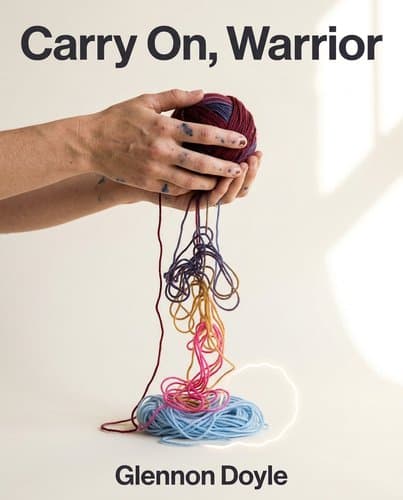
Then Doyle looks down at what's actually in God's lap, and the knitting stops her cold. The yarn is blue and green and hot pink and gold and silver — chaotic until it isn't. The shape emerging is her life: the whole swirl of it, the mess and the beauty, worked stitch by stitch by someone who hasn't dropped one yet.
She doesn't demand God stop. She says: keep going. I still trust you. And then, quietly, she makes a deal — you knit, I'll dance.
This is the ending the book earns. Not healing, not the baby, not a marriage restored to its original condition. Just a woman deciding that full presence in an unresolved life is the only honest answer available. Dancing while God knits is not giving up. It is what every hard thing in this book was building toward.
The Pattern in the Knitting
Here's what the book finally offers, underneath all the wreckage and the wine and the yoga mat drama: the wholeness she spent twenty years frantically assembling in secret was already there, woven into the design. The blue threads and the hot pink and the swirl that looked like nothing from close up were always the point. She just kept her eyes down too long to see it.
The question you carry out of this book isn't how to fix yourself. It's whether you can trust the thing doing the knitting enough to stop demanding it explain its work — and then, while the answer is still unresolved, put on something with a little room in it and dance anyway.
Not because the circumstances improved. Because she looked up, recognized herself in the pattern, and asked for it to continue.
That's the whole thing.
Notable Quotes
“Call my parents. I need to be hospitalized. I can’t handle anything. Someone needs to help me.”
“I don’t know if AA is going to be sufficient. We might need Triple A.”
“Sugar, I hope you are enjoying this. I loved every single second of parenting my two girls. Every single moment. These days go by so fast.”
Frequently Asked Questions
- What is Carry On, Warrior about?
- Carry On, Warrior argues that authenticity, not performance, is the foundation of meaningful connection, recovery, and faith. Drawing on her own experiences with addiction, marriage, and motherhood, Glennon Doyle explores how embracing brokenness opens doors to genuine relationships and lasting resilience. Rather than waiting to feel ready or recovered, Doyle emphasizes taking small, witnessed actions—like cleaning one surface or allowing someone to stand beside you—as the starting point for internal transformation. Her approach combines spiritual wisdom with practical life advice, making it relevant for anyone seeking deeper authenticity in their relationships and personal growth.
- What are the main lessons in Carry On, Warrior?
- Glennon Doyle offers several core lessons for living authentically. "When you hit bottom, the first act of restoration is physical and witnessed — clean one surface, let one person stand next to you while you do it; the internal shift follows the external order, not the other way around." Another key principle is reframing parenthood: instead of chasing ecstasy in every moment, "Carpe a couple of Kairoses"—notice the transcendent moments when they appear. Doyle emphasizes that "the secret self you protect from others is the only self capable of real connection — the mess, offered honestly, is the bridge; the performance is the wall." Recovery requires action before feeling ready, and peace comes through friction, not perfect conditions.
- Is Carry On, Warrior worth reading?
- Carry On, Warrior is worth reading if you're seeking practical guidance on living authentically and building genuine connections. The book combines Glennon Doyle's personal narrative with accessible wisdom, making complex ideas about recovery, spirituality, and resilience relatable. Her writing style is conversational and honest, avoiding preachy tone while addressing serious topics like addiction and marriage. Rather than offering quick fixes, Doyle emphasizes that "recovery from anything requires acting before you feel like it: wash the sink, apply for the library card, make today someone else's lucky day — feelings are the caboose, not the engine." The book resonates particularly with readers facing life transitions, struggles with perfectionism, or seeking deeper spiritual grounding. Its practical takeaways make abstract concepts actionable.
- What does Glennon Doyle say about authenticity in relationships?
- Authenticity is central to Glennon Doyle's message about relationships. She argues that "the secret self you protect from others is the only self capable of real connection — the mess, offered honestly, is the bridge; the performance is the wall." Genuine connection requires vulnerability and honesty, not the persona typically presented. In addressing relationship friction, Doyle shows that peace isn't found in perfect conditions but built through conflict and tension. She illustrates this through difficult relationships, noting that "someone has to pour the first glass of wine without waiting for an apology or a grand conversation." Additionally, she distinguishes between pursuing a specific dream versus recognizing destiny unfolding around you. True connection requires abandoning protective performances.
Related Book Summaries


Read the full summary of 15802944_carry-on-warrior on InShort