199798785_challenger
by Adam Higginbotham
Seven engineers knew the O-rings would fail in cold temperatures, yet Challenger launched anyway—revealing how bureaucratic pressure, inverted burden of proof…
In Brief
Seven engineers knew the O-rings would fail in cold temperatures, yet Challenger launched anyway—revealing how bureaucratic pressure, inverted burden of proof, and normalized near-misses can turn a safety culture into a disaster factory. Higginbotham's forensic account exposes the systemic logic that makes catastrophe not just possible, but inevitable.
Key Ideas
Near-misses must prove system understanding
When an organization survives an anomaly without understanding why, it doesn't learn that the system is safe — it learns that the anomaly is acceptable; treat every near-miss as a failure of understanding, not evidence of resilience
Safety burden of proof matters most
The burden of proof in safety decisions matters more than the evidence itself: requiring engineers to prove something is unsafe (rather than safe) fundamentally inverts the logic of risk management and will eventually produce a catastrophe
Hierarchical review legitimizes rather than surfaces
A safety review process that exists within a hierarchical organization will tend to drift toward legitimizing decisions already made by leadership rather than surfacing inconvenient technical realities — the structure of the review matters as much as its existence
Protected escalation paths replace cultural hope
Individual engineers raising alarms are not enough; the system must be designed so that a 'no' recommendation from a contractor cannot be overridden by a manager asking them to 'change hats' — escalation paths need to be structurally protected, not culturally hoped for
Risk estimate gaps reveal organizational danger
Richard Feynman's closing observation applies broadly: for any complex system, the gap between management's stated risk estimate and engineers' actual risk estimate is itself a leading indicator of organizational danger — when those numbers diverge dramatically, something is being suppressed
Who Should Read This
History readers interested in World History and Organizational Behavior who want a deeper understanding of how we got here.
Challenger: A True Story of Heroism and Disaster on the Edge of Space
By Adam Higginbotham
12 min read
Why does it matter? Because the warnings were heard — and launched anyway.
At T+73 seconds, Steve Nesbitt was still reading numbers — velocity, altitude, downrange distance — three seconds after Challenger had already come apart. The data on his screen hadn't caught up to reality yet. Neither had anyone else's. That gap, between what the instruments said and what was actually happening, turns out to be the whole story. Because the real question isn't why no one noticed the warning signs before launch — they did. Engineers wrote memos, ran tests, lost sleep, shouted in hallways. The question is how an organization can hear all of that, process it carefully, file it correctly, and then decide everything is fine. Challenger is the forensic record of exactly how that happens: the precise mechanisms by which close calls become evidence of safety, bureaucratic pressure quietly inverts the burden of proof, and the most dangerous knowledge is the kind that gets rationalized rather than acted on.
The Machine Was Compromised Before It Ever Flew
On the morning of April 1, 1969, twenty NASA engineers filed into a cluttered room in Houston's Building 36, most of them convinced they were the targets of an elaborate prank. Then Max Faget — the five-foot-six genius who had designed the Mercury capsule on drugstore graph paper — climbed onto a desk, pulled a three-foot balsa-wood model from a garment bag, and threw it across the room. It flew arrow-straight, like a normal aircraft. He retrieved it, tilted the nose sixty degrees toward the ceiling, and threw it again. This time it maintained that steep angle throughout its flight, belly-down, falling horizontally through the air — exactly how a spacecraft could present its broad underside to the plasma of reentry rather than burning up nose-first. 'We are going to build the next-generation spacecraft,' Faget announced. The design was elegant, lightweight, and aerodynamically sound.
What followed over the next three years was its systematic destruction.
To secure Pentagon funding — without which Nixon would never approve the project — NASA gave the Air Force effective design authority over the vehicle. The military needed the shuttle to glide up to a thousand miles sideways after reentry, enabling once-around spy missions that would be wheels-down before the Soviets could respond. Faget's straight-winged design couldn't do that. So the engineers replaced it with a heavy delta-wing configuration, roughly the size of a DC-3 airliner. The added weight forced further cuts: the jet engines that would have let the orbiter fly under its own power once back in the atmosphere were dropped. So was the launch escape system — the crew-survival mechanism standard on every American spacecraft since Mercury.
Then came the solid rocket boosters. Budget constraints had already killed the fully reusable booster stage Faget originally envisioned. Solid rockets were cheaper and simpler than liquid-fueled alternatives, but they carried a fundamental flaw: once ignited, they could not be throttled down or switched off. They burned until empty, no matter what. Wernher von Braun, the architect of the Saturn V, had argued they were too dangerous for crewed flight. He was overruled. Simple and cheap won.
'We've made a pact with the devil,' Faget told a friend in the astronaut corps — and by the time the Challenger crew strapped in sixteen years later, every clause of that bargain was already written.
Each Survived Anomaly Became Permission to Take the Next Risk
The Challenger disaster was not a sudden failure — it was a slow accumulation of evidence that the organization learned, mission by mission, to absorb without alarm. Every time the hardware nearly killed someone and didn't, the near-miss became a precedent. Every survived anomaly became permission to tolerate the next one.
The O-ring problem illustrates this with almost clinical precision. Engineers at Morton Thiokol, the Utah contractor building the shuttle's solid rocket boosters, understood by 1978 that the joints connecting the rocket's steel segments behaved in a way that directly contradicted the design. At ignition, when pressure inside the casing spiked to roughly a thousand pounds per square inch in under a second, engineers expected the force to compress the joint tighter — squeezing the rubber O-ring gaskets hard against the metal faces. Instead, the casing walls ballooned outward and the joint sprang apart. The O-rings, squeezed to tolerances finer than the thickness of a sheet of copy paper, suddenly had room to leak. Marshall Space Flight Center's own laboratory engineers called this unacceptable and said in writing that it required urgent correction to prevent catastrophic failure. Their memos went unanswered. The problem was given a blameless technical name — 'joint rotation' — and quietly accepted.
When boosters recovered after the second shuttle flight in 1981 revealed a primary O-ring partly vaporized by a six-thousand-degree jet of escaping gas, the response followed the same logic. Managers noted that the shuttle had made it to orbit anyway. They ran lab tests on deliberately mutilated seals and found the rings could withstand three times the stress of a normal launch. They declared the erosion 'self-limiting.' The joint was reclassified on the official safety register from a redundant system to a single-point failure — meaning its destruction alone could kill the crew — yet that reclassification was treated not as a red flag demanding resolution but as a bureaucratic update to a document. The flights continued.
The same rationalization distorted the program's sense of its own odds. An independent study in the early 1980s estimated the shuttle could expect a catastrophic failure once every eighteen to thirty missions. NASA officials found the number inconvenient and pressured the analysts to revise it. The final published figure was one failure per hundred thousand launches — a probability so remote it implied you could fly the shuttle every single day for nearly three centuries without losing a vehicle. No evidence supported this. The engineers who had watched a primary seal vaporize on flight two knew it didn't support it. But the number existed in a document, and documents became the basis for decisions, and decisions accumulated into institutional certainty.
The Safety Review Process Became the Mechanism for Suppressing Danger
A safety review exists to find danger before it kills someone. The Flight Readiness Review process at NASA was designed exactly that way — a four-tier hierarchy of increasingly adversarial meetings, rising from contractor conference rooms in Utah and Alabama all the way to Kennedy Space Center, where the agency's administrator himself would sometimes sit and hear the final risk assessment before signing off on a launch. Engineers were supposed to prove, under withering cross-examination, that their hardware was safe. The process was supposed to be the last line of defense.
By the mid-1980s, it had become a mechanism for ratifying decisions that had already been made.
In August 1985, Allan McDonald, the head of Morton Thiokol's shuttle rocket program, flew to Washington and delivered a three-hour briefing to more than a dozen of NASA's most senior managers. He laid out fifty slides documenting a pattern of seal erosion in the solid rocket joints and told the room plainly that the field joints had been officially classified as Criticality 1 components — the agency's own language for a failure mode that would produce loss of vehicle, mission, and crew. There was no redundancy. If the primary seal in a field joint failed, the secondary would almost certainly fail with it. McDonald said this with documentation, to the people at the top of the program.
The room absorbed this and concluded it was safe to keep flying.
NASA's deputy for technical matters, Mike Weeks, left the meeting uneasy. He did what the system encouraged: he found a trusted expert to tell him the problem wasn't as bad as it sounded. He called George Hardy at Marshall Space Flight Center — a veteran engineer who had overseen the booster program from the beginning — and asked him directly how serious the O-ring situation was. Hardy told him he wasn't worried. Weeks hung up satisfied. The alarm McDonald had spent three hours building was dissolved by one reassuring phone call, and no further action followed.
The Flight Readiness Review process, with its charts and oral presentations and panels of questioners, created the appearance of rigorous scrutiny while structurally favoring the answer everyone already wanted. Contractors needed NASA's continued business. Managers needed the schedule to hold. The reviews were adversarial in form, but the burden had quietly shifted: instead of proving hardware was safe, engineers were effectively being asked to prove that flying was more dangerous than the last time they flew. Survived anomalies were the evidence. Each one reset the baseline of acceptable risk slightly higher than before.
The Night Engineers Begged Them Not to Launch
At 8:00 p.m. on January 27, 1986, a group of engineers in a Utah conference room were racing to hand-letter presentation slides because the secretaries had already gone home. Bob Lund, Morton Thiokol's VP of Engineering, was printing each chart in careful block capitals himself — no time to rehearse, no time to review what his colleagues were drawing up at adjacent tables. The fax machine was already stuttering pages toward Cape Canaveral and Alabama. The argument those pages made was unanimous: all fourteen managers and engineers in the room agreed that launching Challenger the next morning, into temperatures forecast to reach 22 degrees Fahrenheit overnight, would very likely kill seven people. The final slide said it plainly: Do not launch.
What happened over the next two hours is the moment the book has been building toward — where every institutional compromise, every suppressed memo, every survived anomaly converged into a single act. On the teleconference linking Utah with Marshall Space Flight Center and the Cape, NASA's Larry Mulloy listened to Thiokol's presentation and then methodically dismantled it. He pointed out that some of the worst previous seal damage had occurred at room temperature, not cold. He noted that O-ring manufacturers rated the seals safe to use well below freezing. His conclusion: the data was inconclusive. And inconclusive data, Mulloy told the engineers, was not enough to stop a launch.
This was the inversion. In every prior Flight Readiness Review, inconclusive data meant you stayed on the ground — the contractor had to demonstrate safety before the vehicle flew. Mulloy had reversed the burden of proof. He was now asking the engineers to demonstrate, with numbers they didn't yet have, that it was categorically unsafe to fly. When Boisjoly said he knew the cold made things worse, that they were moving away from the direction of 'goodness,' Mulloy pressed for hard figures. Boisjoly had none. The institutional logic that had spent years processing warnings without changing course now had a name and a mechanism: prove the danger, or we launch.
Then came the caucus. Thiokol's senior executives went off-line, and Jerry Mason, the division's general manager, turned to his VP of Engineering. Lund had just represented the unanimous judgment of his technical staff. Mason told him to take off his engineering hat and put on his management hat. The implication was precise: engineering judgment and management judgment were different things, and this decision belonged to management. Lund, who would later describe himself as having been wishy-washy when he reversed course, sat silently for several seconds. Then he raised both hands and agreed to launch.
The engineers in the room had done everything the system asked of them. They had documented the risk, gathered the data, prepared the slides, and presented their case under pressure. The system's answer was to reclassify the question — to treat a decision about whether seven people would die as a business problem rather than an engineering one, and to reassign it accordingly.
On the Morning of the Launch, the Ice Team Recorded 8 Degrees — and Called It a Malfunction
Charlie Stevenson pressed the trigger of his infrared thermometer at the base of Challenger's right-hand booster and got a reading of 8 degrees Fahrenheit — 24 degrees below freezing, and 16 degrees colder than anything on record for a shuttle launch. He looked at the number, concluded the instrument was broken, noted it in his log, and moved on. The launch proceeded.
That gap — between what the thermometer actually measured and what the institution was prepared to accept — is the whole story of the morning in miniature. The data wasn't hidden. Stevenson took the reading. He just had no framework in which an 8-degree booster joint made sense, so the framework won. The number disappeared.
Rockwell's chief engineer in California, watching closed-circuit footage of icicles thick as organ pipes hanging from the gantry walkways, told his colleagues the situation was 'a bit of Russian roulette' — then added that five out of six times, Russian roulette works out fine. This was offered not as an argument against launching but as the grounds for proceeding. Rockwell formally told NASA it could not certify the launch as safe. NASA's launch director polled his own people and resumed the count.
The physical destruction took 73 seconds. At ignition, the O-rings at the base of the right-hand booster — stiffened by cold to the consistency of hard plastic — failed to close the gap that always opens momentarily when the rocket casing flexes under pressure. Superheated gas punched through both seals. A temporary reprieve came when burning aluminum oxide residue from the propellant plugged the breach like a cork. Then, at 58 seconds, the shuttle hit the worst wind shear ever recorded on a shuttle flight. The plug shattered. An orange flame appeared at the joint, grew, bent toward the external fuel tank, and cut through it. Seventy-two seconds after liftoff, 300,000 gallons of liquid hydrogen detonated at once.
Stevenson's thermometer had been right all along.
Richard Feynman Proved the Cause With a Cup of Ice Water
Think of an institution as a pair of glasses it has ground for itself over years of looking at the same problems. Whatever the lenses distort, the institution cannot see — not because the information is absent, but because the glass keeps bending it back into a familiar shape. That was the problem the Rogers Commission was actually trying to solve. The question was never purely technical. It was whether an organization could be forced to see what its own optics had been trained to filter out.
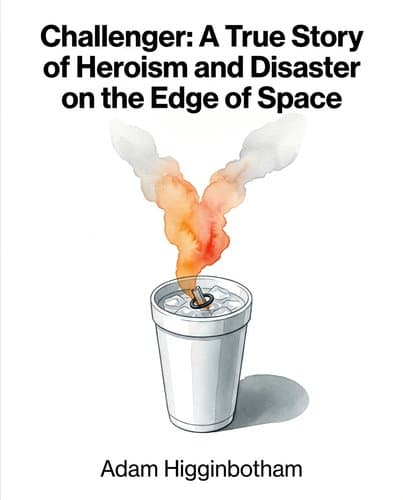
The answer arrived in the form of a dying physicist with a C-clamp in his jacket pocket. Richard Feynman, sixty-seven years old and already diminished by two rare cancers, joined the commission as its designated skeptic. He sat through days of testimony from NASA managers who spoke in the dense jargon of risk rationale and fault-tree analysis, and grew impatient with an institution that seemed constitutionally incapable of saying something true in plain language. So he borrowed a piece of O-ring rubber from a cutaway model being passed around during the hearings, folded it into a clamp, and dropped the assembly into a Styrofoam cup of ice water. On live television the next morning, he drew the clamp out, released the rubber — and it held its compressed shape, rigid and inert, refusing to spring back. 'I believe that has some significance for our problem,' he said. In thirty seconds, without a single slide or technical document, he had demonstrated what hundreds of pages of engineering analysis had failed to communicate: below freezing, the material supposed to seal a gap in milliseconds simply stopped working.
That experiment mattered not because it was technically sophisticated — it wasn't — but because it made visible something the institution had spent years not seeing. And Feynman's ice water cup belongs beside a second, equally stark moment: Allan McDonald walking to the end of a conference table after being ignored while waving his hand, and stating that Thiokol had formally recommended against launching below 53 degrees. The temperature at launch was 29 degrees. The room went silent.
Neither Feynman nor McDonald produced information NASA lacked. They produced the same information in a form the institution could no longer process away.
Someone Was Conscious During the Fall — and the Organization Had Known That Was Possible
The crew of Challenger did not die at 73 seconds. That is the central horror the evidence eventually forced NASA to confront, and the thing the agency was slowest to say plainly.
When Joe Kerwin's team at Houston's Life Sciences lab examined the Personal Egress Air Packs recovered from the ocean floor, they found that three of the seven had been activated after the orbiter broke apart — including the one assigned to pilot Mike Smith. The packs were compact emergency units, designed only for ground evacuations: if toxic fumes entered the cabin on the pad, a crew member could seal their helmet and breathe through the portable supply while escaping. At 65,000 feet, with the cabin tumbling in free fall, the pack had no survival purpose. But someone had switched Smith's on. Tests confirmed that the valve's position ruled out accidental activation, and ruled out Smith himself — the unit was mounted behind his seat, beyond his reach while strapped in. Either Judy Resnik or Ellison Onizuka, seated behind him on the flight deck, had been conscious, oriented, and deliberate enough to reach across and open the supply. The air remaining in Smith's pack indicated it had been breathed for roughly two and a half minutes — almost precisely the time the broken cabin took to fall from its apex to the Atlantic.
Jane Smith, the pilot's widow, went to the simulator in Houston and sat in Resnik's seat to work out the geometry. She concluded that Resnik couldn't have reached the valve — Onizuka must have done it. She then flew to Cape Canaveral and stood in the refrigerated hangar where the wreckage lay, pressing her hands against what remained of her husband's seat and harness. She learned from astronaut Sonny Carter that several of the spring-loaded switches on the pilot's console had been moved from their ascent positions. He had been working through procedures on the way down. He knew what was happening. He never stopped.
The Question Bob Ebeling Spent Thirty Years Asking
One of the Thiokol engineers who fought hardest to stop the launch, Bob Ebeling spent the next thirty years certain that God had chosen the wrong man — that if someone more persuasive, more credible had made the case, seven people would have grown old. What his colleagues finally gave him, weeks before he died, was the truth: he had done everything the system allowed. That's the part that should stay with you. Not that the warnings were absent, but that the system was specifically structured to receive them, process them, and continue. The O-ring erosion, the midnight teleconference, the ice on the gantry — none of it was hidden. It was absorbed. And seventeen years later, a piece of foam did the same thing to Columbia that cold did to Challenger, because the institution had simply reground its lenses. The question Ebeling carried isn't really his. It belongs to anyone who has ever survived a close call and called it safety. What are you currently managing that you've actually just been lucky with?
Notable Quotes
“Well, I have a dissenting opinion. And I’d like to tell you why.”
“When do you expect me to launch—next April?”
“It’s still a bit of Russian roulette,”
Frequently Asked Questions
- What is Challenger: A True Story of Heroism and Disaster about?
- Challenger reconstructs the 1986 Space Shuttle Challenger disaster by analyzing the institutional failures that made it inevitable. Adam Higginbotham draws on original reporting to show how normalized risk, inverted safety logic, and bureaucratic pressure silenced engineers' warnings. The book provides readers with a clear framework for recognizing organizational dynamics that transform manageable warnings into catastrophe, offering insights beyond this single historical event into how complex systems can systematically suppress crucial safety information.
- What are the main lessons from Challenger about organizational failure?
- Challenger teaches five crucial lessons about how organizations fail safety. First, organizations that survive an anomaly without understanding why learn that the anomaly is acceptable, not that the system is safe. Second, when engineers must prove something is unsafe rather than safe, safety logic inverts and catastrophe becomes inevitable. Third, hierarchical safety reviews tend to legitimize leadership decisions rather than surface technical realities. Fourth, individual engineers' alarms aren't enough—escalation paths must be structurally protected. Finally, large gaps between management and engineers' risk estimates signal organizational danger.
- What does Challenger teach about how organizations learn from near-misses?
- According to Challenger, when an organization survives an anomaly without understanding why, it doesn't learn the system is safe—it learns the anomaly is acceptable. This represents a critical failure of organizational learning. Higginbotham emphasizes that "treat every near-miss as a failure of understanding, not evidence of resilience." This shift in perspective is essential because treating near-misses as evidence of system robustness creates normalized risk, where dangerous conditions become routine and expected rather than warning signs requiring investigation and remediation.
- What does Challenger teach about the gap between management and engineer risk estimates?
- Challenger emphasizes Richard Feynman's observation that the gap between management's stated risk estimate and engineers' actual risk estimate serves as a leading indicator of organizational danger. When these estimates diverge, "something is being suppressed." The book demonstrates how this divergence played a critical role in the Challenger disaster, as managers and engineers had fundamentally different understandings of the shuttle's safety. This observation applies beyond Challenger to any complex system: monitoring alignment between management and engineering risk assessments reveals whether organizational communication is breaking down and safety information is being suppressed.
Related Book Summaries



Read the full summary of 199798785_challenger on InShort