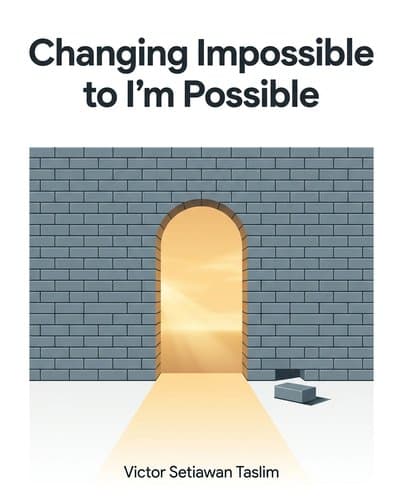
13014346_changing-impossible-to-i-m-possible
by Victor Setiawan Taslim
A man who once stood at the edge of ending his life dismantles the myth of impossibility using historical failures, Cartesian goal-breaking, and a brutal…
In Brief
A man who once stood at the edge of ending his life dismantles the myth of impossibility using historical failures, Cartesian goal-breaking, and a brutal 'Paper Tiger' test that forces you to distinguish real danger from self-imposed paralysis—and take one step forward anyway.
Key Ideas
Break Goals Into Daily Micro-Actions
Write your goal down in concrete terms, then apply the Descartes method: break it into the smallest possible unit of daily action. A 50lb weight loss becomes 1lb per week becomes a trivially small daily deficit — the intimidating goal dissolves into a manageable next step.
Success Includes Frequent Failures
Recalibrate your definition of an acceptable success rate. Babe Ruth 'failed' 70% of the time and is considered one of the greatest athletes in history. If you're waiting to act until you're confident you won't fail, you're holding yourself to a standard that no successful person has ever met.
Expert Consensus Often Gets It Wrong
When a critic or expert tells you something is impossible, ask: what is the historical track record of expert consensus on this question? Western Union, the New York Times, Walt Disney's own employer — the list of authoritative voices that were catastrophically wrong about what's possible is long enough to strip most criticism of its authority.
Distinguish Fear From Real Danger
Distinguish between the feeling of fear and the presence of actual danger. Taslim's 'Paper Tiger' test: if the fear is not protecting you from a physical threat, it is almost certainly a psychological construct — and the only way through it is one step forward, not more preparation.
Stop Treating Waiting as Neutral
Stop treating 'waiting for the right moment' as a neutral holding position. Every day spent waiting is a day in which external forces shape your life by default. The clay gets formed whether you're holding it or not.
Completion Matters More Than Credentials
Your authority to pursue your dream does not require credentials, elite education, or innate talent. Taslim spent four years on a two-year degree. What he finished was this book. The credential is the completion, not the institution.
Who Should Read This
Readers interested in Self-Improvement and Motivation, looking for practical insights they can apply to their own lives.
Changing Impossible to I'm Possible
By Victor Setiawan Taslim
10 min read
Why does it matter? Because the limits you believe in were probably put there by someone else.
Here's the paradox that opens this book like a door kicked off its hinges: the man writing it almost didn't survive long enough to write it — because he made the mistake of believing what people told him was possible. He took their ceiling and called it his sky. That nearly killed him. What saved him wasn't therapy or luck or some sudden private reckoning. It was evidence. Cold, historical, undeniable evidence that every limit he'd accepted as real had already been shattered by someone who simply refused to file it under impossible. Victor Taslim rebuilt himself on that evidence, and now he's handing it to you — not as encouragement, but as a record. Because the question this book keeps pressing on like a bruise is this: what if the thing standing between you and your dream isn't a wall at all, but just difficulty in a convincing costume?
The Author Almost Died Believing Other People's Ceilings Were His Own
A young man sits alone, convinced by the voices around him that he has no future worth building. Not one catastrophic event brought him there — a decade of absorbing other people's assessments of his worth did. Victor Taslim had spent years listening to the people in his life tell him he would never amount to anything, and at some point he stopped arguing. He believed them. That belief, held long enough, became a plan to end his life.
The only thing that stopped him was his best friend, Christopher Yuastella, who talked him off the ledge and pushed him to examine one question: what if the ceiling everyone kept pointing at wasn't actually there?
What Taslim found when he started looking is that the word "impossible" contains its own refutation. Rearrange the letters slightly and it reads "I'm possible." He's quick to say this isn't wordplay — it's a structural argument about perception. Accept that a dream is impossible before you've tried it and you never try. Never try and the dream doesn't happen. You've manufactured the very proof you were afraid of. The impossibility was never in the dream. It was in the decision not to move. (Section 2 develops this argument in full; what matters here is where it came from.)
Taslim's authority in this book doesn't come from a business school or a coaching certification. It comes from having lived inside that closed loop and following its logic nearly to a terminal conclusion — a cost Section 5 examines in detail.
That changes what kind of book this is. When someone who has genuinely been to the bottom tells you the floor isn't where you think it is, you listen differently than when a credentialed optimist tells you to believe in yourself. Taslim isn't offering encouragement from a podium. He's reporting back from a place most people don't survive with their dreams intact — and the first thing he wants you to know is that the voice telling you your dreams are impossible is borrowing its certainty from people who never tried either.
'Impossible' Has a Catastrophically Bad Track Record
The historical record of expert consensus on what's impossible is a graveyard of embarrassments. Know that before you let anyone's skepticism slow you down.
Consider the telephone. When Alexander Graham Bell tried to sell his invention to Western Union, the company's internal assessment was that the device was little more than a toy — amusing, perhaps, but commercially worthless. Western Union passed. That decision is now the canonical example of institutional blindness, cited in business schools as a cautionary tale. The people who made that call were not idiots. They were experienced, credentialed, operating on the best information available to them. They were simply wrong in a way that turned out to matter enormously. What's striking isn't just that they were wrong — it's that they were confident enough in their wrongness to reject something that would eventually become infrastructure for the entire modern world.
The pattern holds everywhere you look. The New York Times declared in 1936 that rockets could never escape Earth's atmosphere. Walt Disney was let go from a newspaper job because his editor decided he lacked imagination. Einstein's own teacher concluded he was too slow to amount to anything. The Wright Brothers were pursuing what the scientific consensus of their era considered a settled impossibility. These aren't cherry-picked oddities — they are the texture of how progress actually happens. The people who said it couldn't be done were consistently, almost reliably, wrong.
What this should do to your relationship with criticism is significant. The voices telling you your dream is impractical, unrealistic, or beyond your capabilities are drawing on the same reservoir of certainty that Western Union drew on. They feel authoritative. They may even be accomplished. But authority and accuracy are not the same thing, and the track record here is not on their side. The argument isn't that criticism is always wrong — it's that it has no special claim to being right, and you've been treating it like it does.
Fear Is Not a Warning Sign — It's a Paper Tiger You've Been Treating Like a Wall
Imagine you're driving at night on an empty highway and your headlights catch something in the road — a shape, hulking and still. Your foot goes to the brake before your brain has finished deciding what it is. That response is fear doing exactly what it was designed to do: buy you a second to assess a real threat. Now imagine you feel that same physiological lurch sitting at a desk, trying to start something you care about. Same sensation, same paralysis — but there's nothing in the road. Taslim calls what's stopping you a paper tiger, and the name is precise: it looks like a wall, it feels like a wall, but it collapses the moment you walk through it.
The cruel trick is that fear in a non-survival context doesn't just feel like caution — it manufactures evidence for itself. You hesitate because you're afraid of failing. The hesitation produces no motion. No motion produces no results. Now you have proof you were right to be afraid. You didn't fail at your dream; you failed at attempting it, and fear quietly takes credit for protecting you from the larger disaster it convinced you was waiting. Taslim's argument is blunt: the fear of failure doesn't shield you from failure. It engineers it in advance and charges you rent for the privilege.
Sometimes the fear isn't about failing at all. It's about what happens if everything goes right. The life you'd have to learn to inhabit, the person you'd have to become, the familiar discomfort you'd have to leave behind — that prospect can be more disorienting than a thousand critics. Taslim names this too: the fear of your own potential, the suspicion that you might be capable of more than you've allowed yourself to be. That fear doesn't announce itself as fear. It shows up as vague unreadiness, as waiting for better timing, as a hundred reasonable-sounding reasons why now isn't quite right. Steven Pressfield spent a decade like this — calling it writer's block, calling it preparation, calling it anything but fear — before he finally sat down and wrote the book. The tiger is still made of paper.
The only move that dissolves it is the move forward. Not because the fear disappears, but because the wall was never structural — it was always just a picture of a wall. You take the step and discover that the thing guarding the door wasn't guarding anything. Just paper. Just air.
A 30% Success Rate Made Babe Ruth a Legend — What Does That Say About Your Standards?
What if the difference between a legend and a quitter is just a willingness to keep swinging after a miss?
Babe Ruth struck out 1,330 times over his career. He hit 714 home runs. Run the math and his success rate lands around 30 percent — a grade that would get a student held back, a grade that looks, by any academic standard, like failure. And yet nobody calls Babe Ruth a failure. Nobody remembers the strikeouts. The home runs are what survive, and they survived precisely because he kept stepping up to the plate after each one of those 1,330 swings that caught nothing but air.
Here's what that number actually means for you: the people you admire failed more often than you have, not less. That's not consolation — it's arithmetic. If you're treating each mistake as evidence you're on the wrong path, you're reading the data backwards. The strikeout record isn't an embarrassment hiding behind the home run record. It's the mechanism that produced it. Ruth himself said that every strike brought him closer to the next home run. He wasn't being poetic. He was describing how repeated attempts work mathematically — each failed swing narrows the distribution of what's left.
Edison didn't stumble onto the working lightbulb after a handful of educated guesses. He worked through 1,000 configurations that didn't work before finding one that did. What that number reveals is this: most people never make a first attempt because they're afraid of the outcome. Edison made a thousand. That gap — between zero attempts and a thousand — is the only variable that determined the outcome. Not genius. Not perfect conditions. Just the refusal to let a failed attempt be the last one.
So the question isn't whether you'll make mistakes. You will. The question is whether you'll treat each one as a verdict or as a data point. Verdicts close things down. Data points tell you to try again. Ruth knew the difference. Edison lived it. Your standards for what counts as failure have probably been set by people who never stepped up to bat — throw that standard out.
Living Someone Else's Dream Isn't Safe — It's Quietly Lethal
Living someone else's dream isn't a safe compromise. It's a slow demolition of the person you actually are.
Taslim knows this because it nearly finished him. Not poverty. Not failure. Not some catastrophic event anyone could point to and understand. What brought him to the edge of suicide was a decade of becoming the version of himself that the people around him approved of — burying the things he loved, abandoning the directions he wanted to move in, shrinking himself down until he fit the shape others had cut out for him. He calls this psychological warfare against your own potential, and the phrase is precise. It doesn't feel like violence while it's happening. It feels like responsibility, like maturity, like not being selfish. It feels, for a long time, like the reasonable thing to do.
The cost doesn't arrive all at once. It accumulates. He writes about becoming ashamed of the things he actually wanted — the artistic work, the automotive passion, the paths that didn't come with a prestigious title. He'd absorbed so many other people's assessments of what counted as worthwhile that he started hiding his desires even from himself. That's the end state of long-term conformity: you don't just stop pursuing what you want, you stop knowing what you want. And that hollowness, he says, is worse than any external failure could be.
The moment that changed was the moment he stopped treating other people's approval as the benchmark. Not defiantly, not dramatically — but as an act of survival. Because the alternative, as he discovered, wasn't safety. It was the quiet extinction of the self. Every stone the critics threw, every expectation he absorbed, every dream he quietly retired to please someone else — those were building the wrong mountain. His insight is that if you keep climbing anyway, keep moving toward what you actually care about, those same stones become the steps you stand on. But only if you stop treating other people's ceilings as your own architecture.
The reader who thinks shelving personal ambition for a stable, approved path is a neutral act — maybe even a generous one — is making the same calculation Taslim made for a decade. He ran the numbers himself. The answer nearly wasn't survivable.
Waiting for the Right Moment Is Just Inaction with Better Branding
When is the right moment to start going after something you actually want? The honest answer, once you trace the logic far enough, is that there isn't one — and waiting for it is not a neutral act. It's a decision, compounding quietly against you every day you make it.
Taslim offers a simple observation that cuts through the procrastination story most of us tell ourselves: we only ever exist in the present. The future moment when conditions will finally be perfect — more money, more time, more confidence, better circumstances — will not arrive as the future. It will arrive as another present moment, indistinguishable in structure from the one you're sitting in right now. Which means the person who waits for the right moment is practicing waiting, not preparing. When the moment comes, they'll still be waiting, because waiting is the habit they've been building.
The clay metaphor Taslim uses is worth sitting with. Life is a ball of clay. It either gets shaped by your hands or it gets shaped by whatever external forces happen to press on it — other people's expectations, economic drift, the slow accumulation of defaults. There is no third option where the clay holds its shape on its own. Choosing not to act is not a pause. It's a vote for whatever happens next by accident.
Planning can become procrastination wearing a productivity costume. The blueprint is not the building. The outline is not the life. The gap between a well-structured plan and actual movement is where most people stay, because planning feels like progress while carrying none of the risk of action.
The only guaranteed failure is never starting. An imperfect first step produces data — something to correct, something to learn from. Waiting produces nothing except a longer distance between you and where you want to be. Waiting doesn't change the conditions. There is no functional difference between now and then. Start now.
The Only Guaranteed Failure Is the One You Never Attempt
Henry Ford went broke five times. Not once, not twice — five separate instances of financial collapse, plus two dissolved companies before the one that worked. At any point along that timeline, a reasonable person would have looked at the evidence and concluded the verdict was in. The evidence would have been wrong.
That's the thing about quitting: it looks like reading the situation clearly. It feels like maturity, like knowing when to stop throwing good effort after bad. But Taslim's argument cuts straight through that framing. Ford's first two automotive ventures didn't fail because he lacked the ability to build cars — they failed because the specific attempt hadn't worked yet. The difference between those collapsed companies and the one that revolutionized an industry was a single variable: he didn't stop. Every instance of going broke was a data point, not a verdict. Verdicts only arrive when you hand them to yourself by walking away.
Quitting doesn't protect you from failure — it guarantees it, in the one way that can't be corrected. A wrong decision can be revised. A mistake can be learned from. A business that collapses can be rebuilt. But stopping permanently closes every one of those doors at once, and all the effort that came before it evaporates. You don't escape failure by quitting; you make it final.
The inverse is what matters: as long as you're still moving, failure is technically impossible. You might be wrong, slow, broke, embarrassed, exhausted — but those conditions are all recoverable. The only unrecoverable condition is the one you choose. Taslim's authority on this point isn't academic. He spent four years on a two-year degree, dropped out of senior math, and wrote a book anyway — not because circumstances aligned, but because the will to finish was the only credential that actually counted. He didn't wait until he was qualified. He just refused to stop, and the book is what that looks like in practice.
Ford's fifth bankruptcy wasn't the end of the story. It was just the fifth chapter.
The Question You'll Regret Not Asking Sooner
Edison put it plainly: the regrets that hollow you out aren't the swings you took and missed — they're the ones you never took at all. Every person in this book who got fired, rejected, laughed at, or told to stop kept moving anyway. They weren't extraordinary. They were just still going when everyone else had sat down. The ceiling you've been staring at was built by people who quit, and they handed you their unfinished business as though it were a law of nature. It isn't. History has already settled the question of whether your dream is possible — the answer, repeated across every century and every field, is yes. The only question left is whether you'll still be moving toward it tomorrow. The ones who made it didn't start better than you. They just didn't stop. The only outcome that can't be reversed is the one you choose by never beginning.
Notable Quotes
“The greatest revolution of our generation is the discovery that human beings, by changing the inner attitudes of their minds can change the outer aspects of their lives.”
“Men are not prisoners of fate, but only prisoners of their own minds.”
“prior planning prevents poor performance,”
Frequently Asked Questions
- What is Changing Impossible to I'm Possible about?
- Changing Impossible to I'm Possible challenges the belief that difficulty equals impossibility. Published in 2011 by Victor Setiawan Taslim, the book draws on historical examples of expert consensus proven catastrophically wrong—from Western Union to the New York Times—and the author's own near-fatal struggle with self-doubt. It equips readers with practical tools to transform ambitions into action, showing how to break intimidating goals into manageable daily steps and reframe fear as a psychological construct rather than a barrier to success. The central message: stop waiting for ideal conditions and start pursuing your dreams now.
- What are the key takeaways from Changing Impossible to I'm Possible?
- The book teaches specific, actionable methods. Use the Descartes method: break your goal into the smallest possible unit of daily action—a 50lb weight loss becomes a 1lb per week goal, then a trivially small daily deficit. Recalibrate your success threshold: Babe Ruth failed 70% of the time yet is considered one of the greatest athletes. When experts say something is impossible, examine history's record of expert consensus being wrong. Distinguish psychological fear from actual danger using the "Paper Tiger" test: if fear doesn't protect you from physical threat, one step forward is the answer, not more preparation.
- Why is Changing Impossible to I'm Possible relevant to overcoming self-doubt?
- Taslim's personal struggle with near-fatal self-doubt anchors the entire book's philosophy: doubt is often the real obstacle, not external barriers. The author demonstrates that waiting for the right moment is not neutral—every day spent waiting allows external forces to shape your life by default. His central argument destroys perfectionism: successful people never had confidence they wouldn't fail; they acted despite uncertainty. By distinguishing between genuine danger and psychological constructs, readers learn that self-doubt is typically a Paper Tiger. The book argues your authority to pursue dreams needs no credentials, elite education, or innate talent—only action.
- Is Changing Impossible to I'm Possible worth reading?
- Yes, particularly if you struggle with perfectionism or use fear as a reason to delay action. The book's strength lies in debunking the myth that successful people possess special confidence or wait for ideal conditions. Taslim's approach combines rigorous historical analysis—proving expert consensus has been spectacularly wrong—with immediately applicable tools. The Descartes method for goal-breaking alone justifies reading. His example of completing this book despite a challenging degree timeline models his philosophy concretely. If you're held back by self-doubt, fear of failure, or waiting for permission, this book directly challenges those barriers with both evidence and methodology.
Related Book Summaries
Read the full summary of 13014346_changing-impossible-to-i-m-possible on InShort