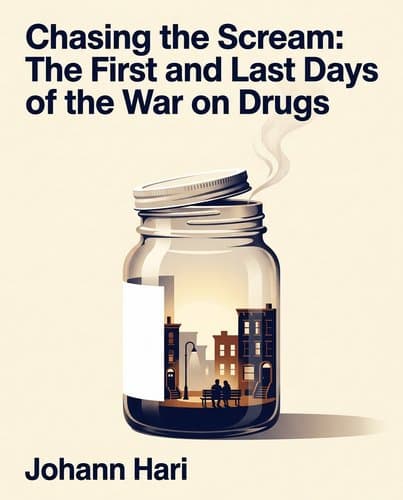
22245552_chasing-the-scream
by Johann Hari
The drug war's violence, crime, and despair aren't caused by drugs—they're caused by prohibition itself. Johann Hari travels across nine countries to prove…
In Brief
The drug war's violence, crime, and despair aren't caused by drugs—they're caused by prohibition itself. Johann Hari travels across nine countries to prove that addiction is driven by trauma and disconnection, and that every nation embracing treatment over criminalization has seen overdoses, crime, and drug use collapse.
Key Ideas
Anslinger created drug war for budget survival
The drug war was not created to solve a public health crisis — it was created by Harry Anslinger to save his bureau's budget after Prohibition ended, and expanded globally through economic coercion, not evidence
Illegal markets cause violence, not drug chemistry
Drug-related violence (turf wars, cartel killings, gang shootings) is not caused by the pharmacological effects of drugs. Professor Paul Goldstein found 75% of 'drug-related' killings in New York were caused by the structural requirements of operating an illegal market — the same violence that disappeared when alcohol prohibition ended
Environment and trauma drive addiction more than chemistry
The 'chemical hijacking' theory of addiction is contradicted by the evidence: post-surgical patients given opiates for months rarely become addicts; rats with rich social environments ignore freely available morphine; the nicotine patch has only a 17.7% success rate, suggesting 82% of addiction is driven by factors other than the chemical
Childhood trauma predicts addiction as strongly as genetics
Childhood trauma is as strong a predictor of drug addiction as obesity is of heart disease. Nearly two-thirds of injection drug use is linked to adverse childhood experiences — which means the drug war is, structurally, a war on victims of child abuse
Decriminalization reduces crime, overdose, and incarceration rates
Every country that has moved toward decriminalization or legal prescription has seen the same results: crime drops, overdose deaths fall, drug use does not increase and often decreases. Portugal halved its addict population. Merseyside saw a 93% drop in theft among patients. Vancouver's InSite saw an 80% drop in drug-related fatalities
Human connection heals addiction better than abstinence
The opposite of addiction is not sobriety — it is connection. What heals addiction, at every scale from a one-on-one relationship to a national policy, is giving people something to belong to and something to lose
Who Should Read This
History readers interested in Social Issues and Policy who want a deeper understanding of how we got here.
Chasing the Scream: The First and Last Days of the War on Drugs
By Johann Hari
10 min read
Why does it matter? Because everything you believe about addicts was designed to make you believe it.
Johann Hari spent years on television arguing that shaming addicts only makes things worse — and then went home and screamed "idiot" and "shameful" inside his own head at the people he loved most. That gap, between the position you'll defend in public and the instincts that run you in private, is exactly where this book begins. Because it turns out the punitive script most of us carry — the one that says addicts are weak, criminal, hijacked by chemicals — wasn't assembled from evidence. It was built by a single bureaucrat named Harry Anslinger in the 1930s who needed a budget justification, and it has been running on autopilot ever since. Chasing the Scream is what Hari found when he finally went looking for the machine underneath the script: a hundred years of war waged not on drugs but on people — and a completely different story about what addiction actually is and what can end it.
The Drug War Was Invented to Solve a Budget Problem — Not a Drug Problem
In 1904, a twelve-year-old boy named Harry Anslinger was sent racing on a horse and cart to fetch medicine for his neighbor's wife, whose screaming had frightened him badly enough that he never forgot the sound. She was in morphine withdrawal. He brought back the drugs, her screaming stopped, and something calcified inside him: the belief that chemicals could reduce any human being to an animal. That fear would eventually become federal policy.
Thirty years later, Harry ran a government bureau that was nearly extinct. Prohibition had just been repealed, his department's budget had been slashed by $700,000, and the Supreme Court had recently ruled that doctors — not men like Harry — should handle drug addiction. He needed a new enemy fast. He had previously dismissed marijuana as a nuisance, barely worth his time. Then he reversed himself almost overnight, warning Congress that the drug turned users into raving beasts and that if Frankenstein's monster ever encountered marijuana, the monster would run in terror.
To make the threat feel real, Harry needed a story. He found one in Victor Lacata, a young Florida man who killed his entire family with an axe. Harry broadcast this case nationally as proof that cannabis was driving ordinary people to murder. What he didn't mention — because he apparently never checked, or didn't want to know — was what psychiatrists had actually written in Lacata's medical files: that he had suffered from severe, chronic mental illness for years before the killings, that three of his relatives had been committed to asylums, and that local police had tried to have him institutionalized twelve months before the murders. His cannabis use struck the examining doctors as so beside the point that they didn't bother recording it.
Harry had his monster. The public had their fear. And the Bureau of Narcotics had its reason to exist.
The costs of that manufactured fear were immediate and concrete. Before Harry's crackdown took hold, morphine cost two or three cents per grain at any pharmacy. After his bureau crushed the clinics and imprisoned the doctors who treated addicts, criminal gangs charged a dollar — a price increase of over a thousand percent. The black market, the addict-as-criminal, the violent scramble for a fix: none of that existed before prohibition created it. It was manufactured, then handed to organized crime as a permanent revenue stream.
The instinct to recoil from drug users — to see them as dangerous, deviant, beyond sympathy — feels like a natural moral response. It isn't. A bureaucrat facing a $700,000 budget cut built it from scratch, and a Florida family's grief was his advertisement.
The Drug War Didn't Fight Organized Crime — It Created It
Arnold Rothstein understood the Harrison Act the way he understood a fixed horse race: as a system tilted toward whoever controlled the supply. The son of a beloved Jewish patriarch known for scrupulous fairness, Rothstein inherited his father's mathematical mind and none of his ethics. When Congress criminalized opiates, he saw immediately that the demand hadn't gone anywhere. So he moved the supply chain to Europe, where heroin was still manufactured legally, and shipped it in bulk. For every thousand dollars spent acquiring and moving the product, the people at the top collected six thousand or more. The profit margin was so grotesque that buying off individual police officers and judges cost less than a rounding error. He didn't fight the law. He absorbed it.
But Rothstein also understood what the architects of prohibition didn't seem to grasp: once you move a trade outside the law, the only way to protect it is terror. You can't call the police if someone steals your shipment. You can't sue a rival who undercuts your corner. Every dispute has a single available resolution. So you don't just use violence when necessary — you perform it, loudly and memorably, until the performance itself becomes the deterrent. A stolen stickpin is returned overnight, anonymous, with a note: the thief didn't know who you were. That's the system working exactly as prohibition designed it to work.
Paul Goldstein, a criminologist at the University of Illinois, ran this logic against actual numbers. Examining every killing categorized as drug-related in New York City during 1986, his team found that less than ten percent involved someone who had taken drugs and acted violently as a result. The overwhelming majority — more than three quarters — were murders committed to establish turf, punish informants, or signal that crossing this crew would be catastrophic. The drugs weren't the cause. The illegality was the cause. Al Capone's murders weren't caused by alcohol. They were caused by Prohibition.
We call it the drug problem. It's closer to the prohibition problem, wearing drugs as a mask.
Billie Holiday Was Hunted Because She Refused to Bow Her Head
Billie Holiday had been on stage singing 'Strange Fruit' — a spare, devastating account of Black men lynched in the American South — for exactly one day before Harry Anslinger's Federal Bureau of Narcotics began following her. The song, which her friend called the beginning of the civil rights movement, had done what Harry couldn't tolerate: a Black woman had expressed grief and fury in public, without apology, without softening the message for a white audience. The harassment started the next morning.
What followed stretched across two decades. Harry assigned an agent to track her every movement. He watched as she struggled with heroin, and rather than treating that as a medical problem — the approach he quietly extended to white women with influence and connections — he treated it as an opportunity. When Judy Garland, also addicted to heroin, came to his attention, Harry invited her in for a pleasant conversation and then wrote to her studio assuring them she had no drug problem whatsoever. A Washington socialite he knew personally who was illegally obtaining narcotics received his private assistance in weaning herself off them, no arrest, no charges, her family's reputation intact. Billie got George White. White had strangled a man he wasn't sure was even guilty and kept the photograph as a trophy. Harry sent him to San Francisco to plant evidence and end her career.
By the time she was dying in a New York hospital, her body wrecked by cirrhosis and exhaustion, federal agents were stationed at her door. They told the staff she was no longer on the critical list — reclassifying her condition so they could legally post a guard — and denied entry to her friends. They confiscated her flowers, her radio, her comic books. The heroin they claimed as evidence had supposedly been found on a nail six feet above the bed of a woman who could not lift herself upright. The case never mattered. The point was the cage around her, not what was inside it.
She died handcuffed to the bed with fifteen fifty-dollar bills strapped to her leg — money she'd set aside for the nurses who'd been kind to her.
Billie Holiday's crime wasn't the heroin. It was the song she wouldn't stop singing.
Addiction Is Not What Happens When You Take a Drug — It's What Happens When You Have Nothing Else
Hannah came first.
She had been starved in a locked room for four years as a child, beaten through most of her adult life, and was now dying of AIDS in a Vancouver hospital with heroin on her bedside table. Gabor Maté watched nurse Liz Evans hold her and found himself asking the only question that mattered: what was the drug actually doing? It was the only thing that made the pain stop. The addiction wasn't the wound. It was the bandage.
That observation led Maté — and eventually the research — to a question that unravels the standard story: what if everything we believe about addiction is backwards?
For decades, the standard answer has been: chemicals do it. Take a powerful enough drug often enough, and it seizes your brain. You become a slave to the molecule. This theory has a certain logic — it explains why we wage war on the substances themselves. But a psychologist named Bruce Alexander noticed a flaw in the experiments that supposedly proved it. Those famous studies where rats choose cocaine until they die? The rats were alone in empty cages. There was nothing else to do.
So Alexander built Rat Park: a plywood enclosure with wheels, tunnels, good food, and other rats. Both groups — isolated animals and those in the social paradise — had access to plain water and morphine-laced water. The isolated rats consumed up to 25 milligrams of morphine daily and kept going until they collapsed. The Rat Park rats drank less than 5 milligrams and mostly ignored the drug. Then Alexander pushed further: he forced rats to drink morphine for 57 consecutive days — enough, by any conventional measure, to hijack their brains permanently — then moved them into Rat Park. They showed brief tremors of withdrawal. Then they stopped. A decent environment dissolved what looked like addiction. The drug hadn't taken them over. They'd been adapting to an unbearable situation, and when the situation changed, the adaptation became unnecessary.
The Adverse Childhood Experiences Study confirmed what Hannah's story already suggested. Run in the 1990s by Kaiser Permanente and the CDC across more than seventeen thousand patients, it remains one of the largest investigations of childhood trauma ever conducted. Researchers tracked what happened to people who experienced abuse, neglect, violence, or abandonment as children and found that each additional trauma doubled to quadrupled the likelihood of becoming an addicted adult. Nearly two-thirds of injection drug use traces back to childhood trauma — a correlation the researchers described as nearly unprecedented in public health data.
This flips the logic of the entire war on drugs. If addiction is an adaptation to suffering, then punishment — arrest, imprisonment, humiliation, forced withdrawal — doesn't treat the underlying condition. It deepens it. Every crackdown increases the isolation and pain that drove people toward the drug in the first place. You cannot threaten someone out of a need they developed in order to survive.
The Merseyside Experiment Proved the Alternative Works — So They Shut It Down
Dr. John Marks was a Welsh psychiatrist who inherited a small clinic in Merseyside where local doctors had quietly been writing prescriptions for pharmaceutical heroin since before Harry Anslinger was born. Marks was skeptical at first, but a researcher studying his patients found something that surprised him: none of them had HIV, none had the rotting abscesses that marked street addicts, and most held jobs. The reason turned out to be simple. Pure heroin, injected through clean needles, causes almost none of the damage we associate with heroin addiction — the damage comes from brick dust and bleach crystals cut into black-market drugs, from sharing needles, from injecting into collapsed veins in desperate circumstances. His patients looked like nurses or receptionists. You couldn't tell them apart from the staff.
So Marks expanded the program to over four hundred people. A local police inspector tracked 142 of them and found something almost absurd in its clarity: in the eighteen months before their prescriptions, these patients averaged nearly seven criminal convictions each. In the eighteen months after, that figure fell to less than half a conviction. A 93 percent drop in theft and burglary, because people who had been robbing to buy drugs no longer needed to rob. The neighboring borough of Bootle, similar in every other way but without a clinic, had twelve times the rate of drug use. Drug dealing on the streets diminished because Marks had stripped out the economics. Under prohibition, addicts have to sell to fund their habit, so they recruit new users — a pyramid scheme driven by desperation. Remove the desperation, and the pyramid collapses.
The clinic was closed in 1995 after American diplomatic pressure on the British government. Within two years, 41 of Marks's 450 patients were dead. Julia Scott was one of them. She had quit working as a prostitute, found waitressing work, and was raising her daughter. She had told a television interviewer, plainly, that she would be dead without her prescription. After the clinic closed, she lost access to it. She was right.
These aren't utopian projections. They're documented outcomes from real places, measured by people who had no stake in the result. The experiments weren't closed because they failed. They were closed because the people running the drug war couldn't afford for them to succeed.
The Opposite of Addiction Is Not Sobriety — It's Having Something to Lose
What actually pulls people back from addiction turns out to be the same thing at every scale: stakes. Something to lose. A reason to stay present in the world rather than escape it.
Bud Osborn was a homeless heroin addict who became a poet and then an organizer. In the late 1990s, he filled Oppenheimer Park in Vancouver's Downtown Eastside with a thousand wooden crosses — one for every drug user who had died in the neighborhood over four years. He sealed off the streets, hung a banner declaring the area a killing field, and forced the city to look at what it had been comfortable not seeing. Traffic stopped. A conservative mayor named Philip Owen, who had previously wanted to round addicts up and ship them to a military base, walked the neighborhood incognito, sat with people, and listened. He came away genuinely stunned. These weren't moral failures. They were people in unbearable pain with no way out. Owen defied his own party to champion InSite, the first legal supervised injection site in North America. Within a decade, life expectancy in that neighborhood had risen by ten years and drug fatalities had fallen by 80 percent.
What Portugal understood, and what Owen learned by walking those streets, is that the question was never how to punish people away from drugs. It was how to give them something worth staying sober for. The Portuguese government offered recovering addicts tax-subsidized employment, therapeutic communities, and treatment built around a single question: what made everyday life so unbearable that chemicals were the rational answer? The Lisbon Drugs Squad chief who had predicted catastrophe from decriminalization eventually summarized the transformation in the plainest possible terms: addicts are no longer on the other side of the line. They're regular citizens with a problem.
Harry Anslinger died in 1975 with his veins full of legal morphine, prescribed for the angina of old age. The man who spent four decades denying that same mercy to everyone he could reach ended exactly where the evidence always pointed: that when it's someone you care about — even if that someone is yourself — punishment stops making sense and relief becomes the only humane response. The opposite of addiction isn't sobriety. It's connection. It's having enough of a life that the escape stops being worth the cost.
What the Architect of the Drug War Knew at the End
Harry Anslinger spent his career building a machine designed to crush people who used drugs. Then, quietly, in his final years, he used that machine's blind spots to protect a powerful senator — a friend, a man who mattered — ensuring he had a steady, uninterrupted supply of morphine. No arrest. No cage. Just compassion, extended privately to someone worth protecting. He understood, when it counted, exactly what he'd been denying everyone else.
Portugal decriminalized everything in 2001 and watched drug-related deaths and HIV infections fall. Vancouver opened a supervised injection site, Insite, and overdose deaths in the surrounding blocks dropped by 35 percent. Merseyside, in the 1990s, ran a heroin prescription program and saw crime collapse. Different outcomes aren't waiting to be invented; they've already happened, in real places, with real numbers attached.
What remains is a simpler question, and a harder one: are you willing to extend to a stranger what Anslinger quietly gave his friend? Johann Hari's answer involves a spare bedroom — his friend in it, sick and frightened, and Hari sitting with him. Not arranging treatment or calling a hotline. Just being there, in the same room, present. That, the evidence keeps insisting, is the only thing that has ever actually worked.
Notable Quotes
“Parents beware! Your children . . . are being introduced to a new danger in the form of a drugged cigarette, marijuana. Young [people] are slaves to this narcotic, continuing addiction until they deteriorate mentally, become insane, [and] turn to violent crime and murder.”
“it would destroy . . . the unblemished reputation of one of the nation’s most honored families.”
“There were maggots and the smell of death and all these bones—we were going through the bones trying to find one piece of her. Trying to find one piece of her,”
Frequently Asked Questions
- What is Chasing the Scream about?
- Chasing the Scream traces the origins of drug prohibition to political self-interest rather than public health, revealing that the drug war was created by Harry Anslinger to save his bureau's budget after Prohibition ended. The book dismantles the standard model of addiction using decades of suppressed research from around the world. Drawing on evidence from Portugal to Vancouver, it demonstrates that decriminalization reduces crime, overdose deaths, and drug use. Hari argues that the opposite of addiction is not sobriety — it is connection, and that giving people something to belong to is what actually heals addiction rather than punishment.
- What does the book reveal about the origins of the drug war?
- The drug war was not created to solve a public health crisis — it was created by Harry Anslinger to save his bureau's budget after Prohibition ended, and was expanded globally through economic coercion, not evidence. Rather than addressing actual public health concerns, drug prohibition was driven by institutional self-interest. The expansion across countries was not based on scientific evidence or public health benefits, but on economic pressures and political decisions. This revelation challenges the common narrative that drug prohibition emerged from genuine public health concerns, showing instead that it stemmed from bureaucratic necessity and was perpetuated through coercion.
- What does research show about drug-related violence?
- Drug-related violence is not caused by the pharmacological effects of drugs themselves. Professor Paul Goldstein found that 75% of 'drug-related' killings in New York were caused by the structural requirements of operating an illegal market — turf wars, cartel killings, and gang shootings all stem from the prohibited market structure. Notably, this same violence disappeared when alcohol prohibition ended, demonstrating that the violence isn't inherent to the substance but rather to its illegality and the criminal market it creates. This fundamentally contradicts the common assumption that drugs themselves cause violence.
- What does the book say about what actually heals addiction?
- The opposite of addiction is not sobriety — it is connection. Research shows that childhood trauma is as strong a predictor of drug addiction as obesity is of heart disease, with nearly two-thirds of injection drug use linked to adverse childhood experiences. The book demonstrates that decriminalization policies work globally: Portugal halved its addict population, Merseyside saw a 93% drop in theft among patients, and Vancouver's InSite saw an 80% drop in drug-related fatalities. What heals addiction at every scale is giving people something to belong to and something to lose — connection and community, not punishment.
Related Book Summaries

Read the full summary of 22245552_chasing-the-scream on InShort