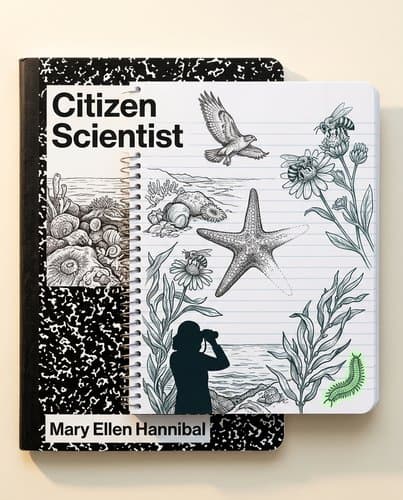
22580997_citizen-scientist
by Mary Ellen Hannibal
Counting birds and mapping tide pools turns out to be one of the most radical acts available to ordinary people—Hannibal shows how citizen science creates…
In Brief
Counting birds and mapping tide pools turns out to be one of the most radical acts available to ordinary people—Hannibal shows how citizen science creates irreplaceable historical baselines, generates real political leverage, and transforms personal attention into a moral response to mass extinction.
Key Ideas
Current observations become tomorrow's baselines
Historical baselines are irreplaceable: an observation made today in a specific place becomes the comparison point for every future study at that location—start recording what you see, even informally, because future scientists will need it.
Minor species, major ecosystem consequences
Trophic cascades mean that losing a 'minor' species can restructure an entire ecosystem—when evaluating conservation priorities, ask what role a species plays structurally, not just whether it's charismatic or endangered.
Precise data defeats vague concern
Citizen data becomes political leverage only when it is precise and verifiable: vague concern loses to a four-hundred-page logging plan, but documented acreage figures and species counts can overturn one.
Committed cores beat mass participation
The best citizen science projects are driven by a small core of committed individuals, not mass participation—find the project and the community where your specific observations fill a genuine gap, rather than contributing to an already well-covered dataset.
Traditional practices embody ecological knowledge
Indigenous land management practices (fire, seasonal harvesting, habitat rotation) were not pre-scientific superstition—they were accumulated ecological knowledge that maintained ecosystems modern conservation is still trying to reverse-engineer; seek out projects that integrate traditional ecological knowledge alongside technological tools.
Witnessing loss is moral necessity
Grief and ecological loss demand the same response: witness rather than avoidance. The courage to count what is disappearing—to name it, record it, show up for it—is both scientifically necessary and, the book argues, the only honest moral position available in the Anthropocene.
Who Should Read This
Science-curious readers interested in Ecology and Sustainability who want to go beyond the headlines.
Citizen Scientist
By Mary Ellen Hannibal
9 min read
Why does it matter? Because the world is ending in slow motion, and the only witnesses we have are you.
Most people picture citizen science as a pleasant weekend activity—retirees with binoculars, families releasing tagged butterflies. The reality is grimmer and more urgent: professional science simply cannot move fast enough, broadly enough, or cheaply enough to document what's disappearing before it's gone. The instruments that could tell us where a species was fifty years ago, what the tide pool looked like before the die-off, which ridge the hawks stopped crossing—those instruments are human beings with notebooks, and the only credential that matters is showing up, consistently, to the same place. Mary Ellen Hannibal spent years embedded with the researchers, the data architects, and the quietly obsessive volunteers trying to hold a baseline together while the baseline erodes. What she found is that paying close attention to the natural world—really paying attention, with rigor and repetition—isn't a hobby. It's the closest thing we have to a defense.
The World Doesn't End All at Once—It Unravels Species by Species
At four in the morning in June 2012, Mary Ellen Hannibal drove down a dark San Francisco street toward a beach in Half Moon Bay, chasing the lowest tide of the year. She was there to count sea stars. Two years later, the same transects that had turned up seventy-plus of the creatures turned up five. Or none.
The word for what happened carries its own eulogy. "Disaster" comes from the Latin dis—apart—and aster—star. Sea stars, when infected with the wasting syndrome that swept from Alaska to Baja beginning in 2013, don't simply die. They dissolve. Their bodies develop lesions, their arms detach and walk away from their own torsos, and within days the animal has liquefied. Twelve species. Millions of animals. The most extensive marine die-off in recorded history. When Hannibal pressed marine ecologist Pete Raimondi for his honest read on the situation—a scientist who had spent decades tracking abalone collapses and population crashes—his answer was: "It's really, really creepy."
What Raimondi understood, and what makes this more than a sad wildlife story, is that sea stars are what ecologists call a keystone predator. Remove them and you don't lose one creature—you lose the system they were holding together. Urchins multiply unchecked and devour the kelp forests. Ecosystems that took thousands of years to assemble can restructure in a season.
Ecological collapse doesn't announce itself. It shows up as a beach that looks exactly like a beach, minus the things that were supposed to be there. You have to already know what you're looking at—or rather, what's missing—to understand that the world has already changed. Citizen science, at its most urgent, is the practice of learning to see what isn't there anymore.
Everything Is Eating Everything Else—and That's the Point
In the 1960s, ecologist Robert Paine ran a simple experiment on a stretch of Washington coastline. He systematically removed sea stars from one plot while leaving a neighboring plot untouched. The result was not a beach with fewer sea stars. It was a beach in collapse. Without sea stars eating mussels, mussel beds expanded until they crowded out everything else. The kelp vanished. The dozens of species that lived in and around that kelp—fish, invertebrates, the whole layered complexity of intertidal life—disappeared with it. One predator removed. One ecosystem reorganized into something far simpler and far poorer.
Ecosystems are not collections of species. They are networks of dependencies, and the removal of a single node doesn't leave a gap—it sends a shock through the entire structure.
Paine called this a trophic cascade: a domino effect initiated at the top of the food chain and felt all the way to the bottom. What makes the concept so unsettling is how counterintuitive it is. We tend to think about species loss as subtraction—one fewer creature in the world. What trophic biology shows is that it's more like pulling a structural beam. The wall doesn't just have a hole in it. Parts of it can come down.
This plays out at every scale. California grizzlies, now surviving only as an emblem on the state flag, once scattered salmon carcasses across riverbanks while foraging, cycling ocean nutrients deep into terrestrial soil, aerating the ground while digging for tubers, spreading seeds across vast distances. They were a bridge between aquatic and terrestrial nutrient systems. Their absence didn't just mean fewer bears. It meant a quieter, less fertile, more impoverished landscape that has been reorganizing itself around their absence for over a century—which we now mistake for normal.
The stakes compound. Whales, whose populations were reduced by roughly 85 percent during the commercial hunting era, were moving nutrient systems: their excrement fertilizing the krill that anchors the entire ocean food chain, their bodies at death falling to the seafloor and sustaining up to 350 coevolved species in the otherwise barren deep. Restoring whale populations to historical levels, scientists have calculated, would sequester carbon at a scale comparable to deliberate geoengineering—naturally, and with cascading benefits still being mapped.
The pattern is the same everywhere you look: the connections go deeper than the visible losses.
The Landscape You're Standing In Was Built by People You've Forgotten
What does a natural landscape actually look like—before people got involved? The assumption buried in that question is almost certainly wrong.
Rob Cuthrell, an archaeologist working with the Amah Mutsun tribal nation in the Santa Cruz Mountains, stands in a valley that looks, by any reasonable measure, like wilderness. Rolling hills, native oaks, the smell of pine on warm air. He knows better. The place is dense with invasive plants, many of them descendants of seeds that arrived in the soil turned by Spanish colonizers 250 years ago—followed by ranchers, dairy farmers, and the slow biological aftermath of all of them. The valley cannot even be safely burned until native species are partially restored, because fire applied now would help the invasives spread, not clear them.
That single fact reframes everything. The reason you cannot simply light a match and begin again is that what you'd be restoring was never untouched nature—it was a managed system, maintained over thousands of years by California's indigenous peoples through intentional, carefully calibrated burns. Low-intensity fires kept grasslands open, triggered native wildflowers to germinate, cycled nutrients, held wetlands healthy, and prevented the catastrophic fire conditions now threatening the state's drought-stricken forests. The Amah Mutsun and collaborating archaeologists at Quiroste Valley have documented evidence of this fire management stretching back more than a thousand years before the Spanish arrived and outlawed the practice. The pre-contact landscape was, in the most precise sense, a garden—one whose gardeners were forcibly removed.
When the burns stopped, the garden didn't return to wilderness. It reorganized around the absence of the people who had been tending it, filling in with invasives and Douglas fir, losing the grassland species whose seeds are still waiting in the soil today. The Amah Mutsun aren't trying to leave the land alone. They're trying to get back to work.
A Specific Observation in a Specific Place Is Irreplaceable—No Satellite Can Do What You Can
Here is the bold assertion: a specific observation, made by a specific person, in a specific place, at a specific moment in time, cannot be reconstructed. No satellite pass, no expert expedition scheduled for next year, can go back and record what was there on a Tuesday in October in 1952. The moment passes. Either someone was watching, or it is gone.
Sam Droege, the USGS biologist who invented the bioblitz, makes this point by pointing away from the famous names of science. Edison, Darwin, Newton—if they hadn't existed, Droege argues, someone else would eventually have arrived at the same discoveries. The laws of electricity and natural selection were waiting to be found. But when Jane Whittaker, a volunteer on Droege's native bee survey, walks uninvited into a West Virginia farmer's field and chats him into letting her look around, then goes home and washes, dries, and pins what she's found—she is producing something no other method can replicate. Whittaker has personally inventoried a significant portion of her state's native bee population, accumulating more than twenty records of species never previously documented there. Those records are not approximations or models. They are facts about what was alive in a particular field, in a particular season, observed by a particular person who knew what she was looking at. The farmer would not have noticed. A satellite would have seen a field.
Terry Root proved the same thing from a different direction. She repurposed decades of Audubon Christmas Bird Count data—observations made by thousands of amateur birders, written down because they loved birds, not because anyone was funding a study—and found that North American bird distributions had shifted measurably northward, arriving on average ten days earlier than historical records indicated. That dataset existed only because ordinary people had been paying attention, consistently, across a continent, for generations. It became some of the earliest biological evidence that warming was already reshaping life on earth. The insight was hiding in the hobby.
Droege puts it plainly: what a citizen contributes to science is a data point from a time and place that will never come again. That specificity is not a limitation. It is the entire point.
The Data Doesn't Mean Anything Until Someone Connects It to Power
Think of a petition versus a lawsuit. Both express opposition. Only one wins. The difference isn't conviction—it's evidence precise enough to bind someone legally to a different outcome.
When the San Jose Water Company announced plans to log more than a thousand acres of steep Santa Cruz Mountain terrain by helicopter, they filed a 400-page plan thick with bureaucratic euphemism. Their language for ancient redwoods was "defective trees"; their language for old-growth clearing was "sustaining forest health." The company had filed under a category reserved for small landowners: nonindustrial timber operations, which require holdings below 2,500 acres. They claimed to own 2,002. Rebecca Moore and her neighbors could see that something was wrong. But feeling that wasn't enough.
What turned the corner was a conservation biologist named Adelia Barber working through more than 700 aerial photographs, hand-circling individual redwoods and Douglas firs, measuring their footprints with software. When she finished, the math was unambiguous: the company controlled 2,800 acres—300 more than the legal threshold. That single number reclassified the entire operation from a minor nonindustrial project into a commercial logging venture subject to far more demanding regulatory requirements. The California Department of Forestry denied the plan. The redwoods are still standing.
What Barber produced wasn't an argument. It was a fact embedded in evidence dense enough to be legally binding.
Citizen science at its most powerful works this way. Terry Root didn't just care about birds migrating earlier; she proved it, from decades of Audubon observations, in terms climate scientists could import directly into their own models. The Surui, an indigenous nation in the Brazilian Amazon, didn't petition against illegal logging; tribal members documented it with smartphones, in real time, at GPS coordinates, forcing enforcement responses that previously took months. The data doesn't just describe the problem. Precise enough, it becomes the mechanism that converts concern into leverage.
Grief and Extinction Are the Same Confrontation—Just at Different Scales
At Pillar Point on a spring dawn in 2015, the monitoring team came across a stretch of beach littered with polychaete worms—four inches wide, a foot long, fringed and beached in the receding tide. Several lay in puddles of neon-green goo. Biologist Rebecca Johnson explained what they were looking at: the worms spawn at high tide, and when the moment comes, their gametes explode outward into the water. The explosion kills the worm. Fertilization happens in the ocean. The creature dies so that more creatures can begin.
Hannibal had read Hemingway's 'Big Two-Hearted River' aloud to her dying father just months before. She had also, the same season, helped document sea stars dissolving in their transects. Two kinds of unraveling, held simultaneously, without resolution. What she arrived at on that beach—watching something ancient and Cambrian-era blow itself apart in service of continuance—was not consolation exactly, but a recognition. Campbell called this the essential logic of the hero's journey: one life ends to nourish what follows.
But the question Hannibal presses is whether that logic still holds. In a generational death—her father's, the worm's—something passes forward. The individual ends; the lineage continues. Extinction is different. When a species goes, there is no next generation carrying the pattern onward. The worm's gametes reach the water. The sea star's juveniles, documented with cautious hope in those same tide pools, remain susceptible to the same disease that took their parents.
Hannibal doesn't resolve this. After the worm observation, she dreams of her father young and grinning in a neon-green suit—the exact color of the gametes. He isn't speaking, but she understands him anyway: tell the double story. She wakes with it. The story of what is dying. The story of what is still being born. Both at once, because looking away from either one is how you end up, as she puts it, seeing but not saying. Witness is not a metaphor for grief management. It is what grief, practiced honestly, turns into.
Showing Up to Count Is an Ethical Act, Not a Hobby
What do you do when the scale of the problem exceeds anything you could personally affect? That question, posed honestly, is where most people stop—and where citizen science begins.
In 1906, after the San Francisco earthquake cracked the California Academy of Sciences down to its foundation, Alice Eastwood was explicitly forbidden from entering the building. She went in anyway. The marble staircase had collapsed, so she climbed to the sixth floor by gripping the exposed iron railings in her long skirts. The case holding the herbarium's type specimens—the single definitive physical example of each species, irreplaceable by definition—was too damaged to lower as planned. So she piled specimens into a work apron and ferried them down in relays, 1,497 of them, before the fire arrived. Then she wrote that she did not grieve her own destroyed work, because the doing of it had been joy enough, and she could begin again.
Eastwood's remark is usually read as a display of character. It is also a description of method. She understood that the specimens mattered not as her possessions but as data points belonging to the ongoing project of understanding life on earth. Her role was to be the person who showed up, reliably, for decades—weekly collecting trips up Mount Tamalpais, educational flower shows in the lobby, correspondence with every botanist who wrote her—not because any single act was decisive, but because the cumulative record was. The type specimens she saved became the anchor around which the academy rebuilt. The plants she pressed became the baseline against which, a century later, citizen scientists re-surveying Mount Tam could document what had shifted and what had been lost.
That continuity is the structure citizen science provides. Knowing what's there before it disappears requires, in verifiable detail, the kind of inventory no expedition can produce on demand. It can only be built the way Eastwood built it: one observation, one specimen, one recorded date and location at a time, by people who show up. Witness is not the consolation prize for those who can't do real science. It is the precondition for any science at all.
The Day Is Already Here
There is a hawk in this book that closes its talons around Hannibal's fingers, and she doesn't pull away. That's the whole instruction manual, really. You don't have to save the watershed. You have to show up for it—this Tuesday, at this beach, with this notebook. The polychaete worm doesn't deliberate about whether its gesture is sufficient before it detonates into the water. Alice Eastwood didn't wait for permission to climb the railing. The specimen in your hand is the one that matters, because it's the one that exists, right now, before the fire gets here. Campbell's line, which Hannibal saves for the end, isn't optimism: live as though the day were here. It's a directive. The day is already here. What you observe today becomes the baseline some future scientist will need. Start counting.
Notable Quotes
“Most people living in that realm of what might be called occasional concerns have the capacity that is waiting to be awakened to move to this other field.”
“A boy would come to me and ask, ‘Do you think I can do this? Do you think I can do that? Do you think I can be a writer?’”
“‘Professor Campbell,’ she said, ‘I understand it. I get what you are saying and I know how to attain wisdom.’ ‘Terrific,’ I replied, ‘all you’ve missed out on is your life.’”
Frequently Asked Questions
- What is Citizen Scientist about?
- Citizen Scientist makes the case that ordinary people observing and recording the natural world produce irreplaceable scientific data during a period of rapid ecological loss. The book draws on history, ecology, and hands-on fieldwork to demonstrate how readers can find meaningful citizen science projects, understand what their observations contribute, and engage with environmental decline as informed, effective witnesses. Hannibal argues that individual observations create historical baselines essential for future environmental studies and that citizen-generated data can become political leverage when precise and verifiable.
- How can ordinary people make their citizen science contributions count?
- Citizen data becomes political leverage only when it is precise and verifiable—vague concern loses to comprehensive documentation, but documented acreage figures and species counts can overturn conservation decisions. Rather than seeking mass participation, find the project and community where your specific observations fill a genuine gap. Starting today matters because an observation made in a specific place becomes the comparison point for every future study at that location. This targeted approach transforms individual witnessing into effective environmental advocacy.
- Why does indigenous ecological knowledge matter in citizen science?
- Indigenous land management practices like fire, seasonal harvesting, and habitat rotation were not pre-scientific superstition—they were accumulated ecological knowledge that maintained ecosystems modern conservation is still trying to reverse-engineer. Citizen science projects that integrate traditional ecological knowledge alongside technological tools prove most effective at understanding complex ecological relationships. By seeking out projects bridging indigenous practices with contemporary observation methods, citizen scientists honor accumulated wisdom while advancing environmental understanding and recognizing that scientific rigor and traditional knowledge are complementary.
- Why should I start recording observations even informally?
- Historical baselines are irreplaceable for future environmental science. An observation made today in a specific place becomes the comparison point for every future study at that location. Future scientists will need this data to understand ecological change and measure conservation progress. Additionally, trophic cascades mean losing a 'minor' species can restructure entire ecosystems, so documenting even seemingly insignificant species matters. Starting now—informally or formally—creates a personal record and contributes to the broader scientific understanding required for informed conservation decisions.
Related Book Summaries
Read the full summary of 22580997_citizen-scientist on InShort