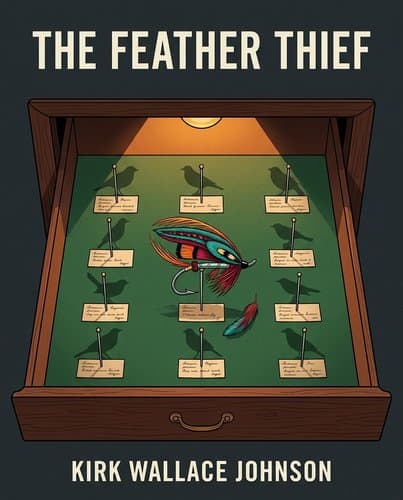
35901186_the-feather-thief
by Kirk Wallace Johnson
A concert flautist stole 299 priceless Victorian bird specimens from London's Natural History Museum to feed an underground fly-tying black market—nearly…
In Brief
A concert flautist stole 299 priceless Victorian bird specimens from London's Natural History Museum to feed an underground fly-tying black market—nearly erasing irreplaceable scientific data forever. A riveting true-crime unraveling of humanity's centuries-long compulsion to possess natural beauty, even at the cost of destroying it.
Key Ideas
Museum Specimens as Living Scientific Instruments
Museum specimens are not dead artifacts but active scientific instruments — feather samples have documented oceanic mercury rises, eggshells proved DDT's harm, and ancient bone DNA now aids endangered species recovery. When specimens are lost, so are answers to questions that haven't been asked yet.
Bans Concentrate Demand, Drive Illegal Market Growth
Conservation laws that ban possession of rare species don't suppress demand — they concentrate it, drive prices up, and attract exactly the obsessives most likely to circumvent them. The CITES-era feather black market is more organized and more expensive than the Victorian hat trade it replaced.
Crime Driven by Both Planning and Passion
Premeditation and obsession are not mutually exclusive. Edwin Rist planned his heist for 15 months, built a commercial sales operation, and registered a retail website 15 days after the theft — while simultaneously inhabiting a genuine passion that felt to him like artistic necessity. Motive is rarely just one thing.
Clustered Institutional Gaps Enable Major Theft
Institutional gaps tend to cluster: the museum had no annual inventory, CCTV retention was 28 days, investigators didn't know the fly-tying world well enough to recognize publicly searchable evidence, and the law was bound by a 2000 cemetery-desecration case. Each gap was individually reasonable; together they nearly let 299 stolen birds disappear entirely.
Legal System Struggles with Hybrid Crime Motives
Legal categories built for one type of crime (premeditated theft vs. compulsive disorder) struggle when the crime is both. The Asperger's defense worked not because it was clearly true or clearly false, but because the Gibson precedent made the judge's outcome predetermined once the diagnosis was on the table.
Underground Feather Trade Persists Despite Conservation Laws
The feather underground that made Edwin's crime possible and profitable is still operating — at fly-tying symposiums, on eBay under Latin species names, in private drawers. Enforcement shifted to rhinos and elephants. The compulsion that drove the Victorian slaughter of 200 million birds a year didn't end with conservation law; it went underground and waited.
Who Should Read This
History readers interested in Ecology and Biology who want a deeper understanding of how we got here.
The Feather Thief
By Kirk Wallace Johnson
10 min read
Why does it matter? Because humanity's compulsion to own rare beauty keeps destroying the very things it covets — and always has.
A music conservatory student walked out of a Victorian natural history museum with a rolling suitcase stuffed with 299 priceless bird skins — stolen so he could tie fishing flies that nobody fishes with. That is genuinely the premise, and it sounds like a punchline. It isn't. What Kirk Wallace Johnson uncovered while chasing this story across half a decade, a streetlamp in Oslo, and one memorably tense hotel room in Düsseldorf is that the absurdity reaches all the way back — through Victorian slaughter, colonial extraction, and a 150-year pattern of obsessive possession that has always found a way to dress itself up as art, passion, science, or mental illness. The irreplaceable things keep disappearing. The justifications keep getting better. And the distance between loving something and destroying it turns out to be almost none at all.
The Rarest Feathers in the World Are Effectively Priceless — Which Is Why They're Illegal to Own
At a fly-tying competition in Massachusetts, a thirteen-year-old named Edwin Rist — oval glasses, spiked hair, a prodigy who'd already won his division at the national level — wandered away from the junior category where he'd just tied sixty-eight trout flies in an hour and stopped cold. On display were sixty Victorian salmon flies. Edwin had never seen anything like them: hooks four inches long, feathers from a dozen countries layered into turquoise and gold and crimson, each one ten or more hours of work.
Here's the thing that makes this whole story possible. Trout flies imitate nature: tied to resemble hatching insects, built from cheap drab materials, requiring deep knowledge of river ecology. Salmon flies don't imitate anything. Salmon returning to spawn stop eating entirely, but they'll attack foreign objects near their eggs. So a salmon fly is a provocation, not a replica. You could theoretically catch one with dog fur knotted to a hook. The entire Victorian architecture of exotic plumage was never about fooling the fish; it was about status and the thrill of owning materials nobody else could obtain.
The thrill only gets worse once you learn those materials are now illegal. Most of the birds called for in George Kelson's 1895 bible The Salmon Fly — Blue Chatterer, Indian Crow, Resplendent Quetzal, Birds of Paradise — are protected under international treaties, and the Migratory Bird Treaty Act of 1918 made it a federal offense to possess even a Blue Jay feather found dead on the sidewalk. The legal wall didn't kill the desire. It created a market. A retired Detroit detective named John McLain sold Argus Pheasant quills at $6.95 per inch (a single quill, over $200). On ClassicFlyTying.com, a Cajun shrimp boater named Bud Guidry put it plainly: rare feathers are "like a drug, nothing else matters, nothing else compares. When it touches my fingers I feel the history." Members pooled money on eBay, outbidding each other for Victorian hats from grandmothers' attics just to razor out the plumes.
Edwin spent his teenage years splitting firewood for neighbors to scrape together feather money. The only place most tiers could see Kelson's birds in any real quantity was behind museum glass.
A Museum Bird Skin Isn't a Dead Animal — It's a Time Capsule Holding Answers to Questions We Haven't Asked Yet
In 1852, Alfred Russel Wallace stood on the deck of a burning ship seven hundred miles from Bermuda and watched four years of fieldwork die. The hold of the Helen carried nearly ten thousand bird skins from the Amazon — each skinned, tagged with location and date, treated with arsenical soap to keep insects out. In his final dazed moments aboard, Wallace grabbed a watch and some fish drawings and forgot his notebooks. His grip slipped on the escape rope, flaying his palms. The parrots he'd nursed through the jungle flew into the flames.
What burned wasn't decoration. It was data — records of species distribution and variation that no living bird could replace, because every living bird is alive now, not then.
That distinction is everything. When Tring's curator Dr. Robert Prys-Jones hands you a seabird skin from 1870, you're holding a chemical sample of the North Atlantic from that specific moment in time. In the late twentieth century, scientists pulled feathers from 150 years of seabird specimens and documented a steady rise in oceanic mercury since industrialization, a finding that changed marine policy and public health guidelines about eating fish. They called the plumage "the memory of the ocean." No living seabird can tell you what the ocean contained in 1870. Only the dead ones can.
Prys-Jones puts it plainly: these specimens hold answers to questions that hadn't yet been asked when they were collected. The researcher peering at a feather through a hand lens in 1820 couldn't have imagined nuclear magnetic resonance. DDT wasn't banned until museum eggshells documented shell thinning you couldn't measure any other way. Eggs from the 1930s sat in the same drawers as eggs from the 1960s; researchers compared them by caliper and watched the shells get thinner.
Each generation inherits the same birds and finds them newly useful. That's why, a century and a half ago, Wallace begged the British government to stockpile as many specimens as possible, warning that future generations would judge harshly anyone who let them be destroyed.
A 20-Year-Old Flute Prodigy Planned a Museum Heist for 15 Months and Called It the Greatest Day of His Life
Edwin Rist didn't stumble into the Tring on a whim. He planned the break-in for fifteen months, and you can tell because he named the Word document on his laptop "PLAN FOR MUSEUM INVASION," which sounds like a joke until you read the contents: grappling hooks, a glass cutter, latex gloves he'd pocketed from a doctor's waiting room.
The reconnaissance came first. In February 2008, nine months before his first visit to the vault, Edwin emailed the museum claiming an Oxford friend needed photographs for a dissertation on Birds of Paradise. The museum asked for the Oxford student's email address to verify his identity. Edwin created a fake account under his friend's name, intercepted the verification email himself, and was waved in. During two unsupervised hours inside the Tring, he photographed cabinet locations, not specimens.
He went home to New York for summer, returned to the Royal Academy in fall, and spent months tightening the plan: ordering an 8mm glass cutter through his eBay account (username: "Fluteplayer1988"), buying fifty mothballs to protect the birds from insects, and studying the town map until he found Public Footpath 37, a narrow alley behind restaurants that bypassed the Tring police station and deposited him directly behind the Ornithology Building. On June 23, 2009, he performed at a Royal Academy concert, swapped his flute for a suitcase in the locker room, and boarded an evening train north.
He spent nearly three hours inside. By the time he surfaced and walked two miles to the train station in the dark, he'd missed the last three trains home. He sat alone on the Tring platform until 3:54 AM with what he estimated was a million dollars in stolen birds, flinching at every footstep on the bridge overhead, convinced bloodhounds were already fanning outward from the museum.
He got home at dawn and spread 299 specimens across his bed — turquoise and crimson, indigo and emerald, hundreds of cotton eyes — and declared it the greatest day of his life. Then he got to work. He photographed each skin on gray fabric, carefully angling the camera to hide the "MUS. BRIT." stamps on the leg tags. He harvested orange breastplate feathers from the Indian Crow skins with tweezers: six feathers, no bigger than a pinkie nail, a hundred dollars a bag. The black-plumed carcasses, worthless to fly-tiers, he threw into a cardboard box by his closet. He calculated his margins (wholesale full skins to wealthy collectors, or retail packets to the forum), ordered thousands of Ziploc bags, and locked the rest away with mothballs before flying home. Edwin now had 47 Indian Crow skins and a business plan.
Nobody at the Tring knew anything was gone.
The Crime Was Solved Not by Police Procedure but by an Undercover Cop Who Recognized a Museum Specimen at a Dutch Fly Fair on His Day Off
How do you catch someone selling stolen museum specimens to a global network of obsessives who already didn't want to know where the birds came from?
The conventional answer is forensics, surveillance, careful police work. Detective Sergeant Adele Hopkin tried all of it. She found evidence her colleagues had missed — a latex glove fragment, a glass cutter, a drop of blood on a shard beneath the broken window — and sent everything to the national lab. She checked the visitor logbook; both previous major Tring thefts had been inside jobs, so she looked for patterns. She contacted the National Wildlife Crime Unit and asked border agents at Heathrow to flag any exotic birds crossing customs. She waited.
The forensics came back cold. The border agents found nothing. Meanwhile Edwin was posting Indian Crow feathers on fly-tying forums using the exact Latin binomials stamped on the Tring's empty cabinets, and forum members were publicly connecting the username "Fluteplayer1988" to "Edwin Rist, who sold Indian Crow to buy a flute." The investigation was six months old. The answer was a web search away. Nobody looked.
What finally broke it was a man who had spent two decades undercover in Northern Ireland, surviving bombings and shootings during the Troubles. At a festival in the Netherlands in May 2010, he wandered to a Dutch tier's booth and was shown a Blue Chatterer skin the Dutchman had recently bought. Something trained in him registered immediately: eye sockets packed with old cotton, wings pinned tight to the body. Not a bird pried from a Victorian hat. Museum-grade. He asked casually where it came from. A young American in London, a kid named Edwin Rist. He called Hertfordshire Constabulary the next day.
Adele petitioned eBay for the account behind "Fluteplayer1988." Edwin Rist. Royal Academy of Music student. Name in the Tring logbook from six months before the theft. She dialed the school. Fourteen days too late: he'd flown home to America. Her department couldn't fund a transatlantic flight. She would have to wait. Months passed, the file going nowhere, while somewhere in New York Edwin Rist practiced flute.
Edwin Rist May Have Performed His Own Asperger's Diagnosis — and the World's Leading Autism Expert Didn't Notice
Three hidden recorders, a 250-pound bodyguard named Klaus stationed in the hallway, and 284 prepared questions. Kirk Wallace Johnson has flown to Düsseldorf with all of it, and the most important one resolves itself without prompting. When Johnson ventures that Edwin doesn't seem to have Asperger's — he's maintaining eye contact, reading questions before they're finished, adapting mid-sentence — Edwin shifts in his chair and explains what he actually did. Before his arrest, eye contact had never been an issue. But as his sentencing approached, he started thinking: Eyes! I can't look there! He demonstrates: bulging his eyes, rocking in the chair, making a strange panting noise. "Before you know it," he says with a slight grin, "you're sitting in a chair rocking back and forth, not making eye contact... because those are symptoms." He calls the diagnosis a gift. Without it, he says, he'd have spent two or more years in prison.
The expert who examined him was Dr. Simon Baron-Cohen (director of the Autism Research Centre at Cambridge, Britain's pre-eminent authority on autism spectrum disorders, and Sacha Baron-Cohen's cousin). His four-page report argued Edwin wasn't motivated by money but by obsessional tunnel vision so complete that stealing the birds had simply made sense to him. The report even reproduced the feather recipe for one of Edwin's flies — Indian Crow, Blue and Yellow Macaw, Bustard — apparently without noticing that several are protected by international treaty. The world's top autism expert, serving as character witness, missed the conservation violations embedded in his own evidence.
At the sentencing hearing, all of it becomes almost irrelevant. The defense cites a single case: Crown v. Gibson, 2000. Simon Gibson, 21, had broken into a Bristol cemetery three times with friends — stealing a skull, fashioning vertebrae into a necklace, posing drunk with the skull like Hamlet's Yorick on a third visit. He had Asperger's. His sentence was overturned on appeal. Judge Gullick reads five paragraphs of the Gibson ruling aloud into the record, not because he disputes the prosecution — he calls the Tring theft "a natural history disaster of world proportions" — but to explain publicly why his hands are tied. Sentence: twelve months, suspended. Edwin Rist never spends a night in prison.
Whether he performed the diagnosis or genuinely has the disorder remains unresolved — he hedges, "well, maybe I do." The law couldn't tell the difference, and by the time it tried, it was already bound by a man who stole bones from graves in Bristol.
By the Time Anyone Came Looking, the Birds Had Already Dissolved Into the Underground
The court had finished. Johnson hadn't.
Under a streetlamp in the Oslo suburb of Asker, Johnson opened a small stamp album with a translucent gray cover. Inside, feathers were arranged like philatelic specimens — five rows to a page, each plume in a plastic sleeve — glittering in orange, sapphire, and turquoise against the dark page. The first page alone held more than fifty Indian Crow and Blue Chatterer feathers.
The man who handed it over, Long Nguyen, had needed three days of interrogation to get here. A Vietnamese refugee's son raised in a Norwegian boys' home after his mother died of cancer, Long taught himself to tie flies to reconstruct the memory of his father's tackle box. Edwin Rist had been his idol. When Edwin asked for help moving materials to fund a new flute, Long felt honored.
What Long admitted, across two days of evasion and one of reluctant admission: Edwin had shipped him between ten and twenty skins, plus hundreds of loose feathers, to sell and forward the proceeds. The stamp album had been sitting in a box in his apartment the whole time. When he finally showed it to Johnson under the streetlamp, Long said he hadn't felt that low since his mother died.
The album represented almost nothing in the larger accounting. The Tring had recovered 102 intact skins with labels and 91 more without, leaving 106 birds still missing, worth over $400,000 wholesale, more if plucked feather by feather. Nobody was looking. The police had closed the case.
The feather underground absorbed what Edwin stole and kept moving. The annual fly-tying symposium ran under the theme "Never Enough," with no federal agents in sight. Forum members posted photos of museum birds in Philadelphia under the subject line "Paging: Secret Agent Edwin Rist." Indian Crow and Blue Chatterer reappeared on ClassicFlyTying.com within months of the sentencing.
The Thump of the Cabinet Door
The quiet thump of that cabinet drawer is the sound the book ends on. It isn't justice — sixty-four skins are still out there, scattered into private drawers and symposiums where the annual theme, the year Edwin Rist walked free, was "Never Enough." John McLain put it best, while actively selling feathers: it's bizarre, really, how grown men go weak in the knees over a handful of stupid little feathers. He was right, and he was also one of the people selling them. That's how 299 specimens — each a frozen moment in oceanic time, holding data we haven't yet thought to ask for — got turned into materials. Somewhere, a Bird of Paradise is rolled in tissue paper in a collector's tackle box, waiting to become a salmon fly. The cabinet just closes.
Notable Quotes
“It's been a question in my mind for a very long time. Because I have a diagnosis, apparently, by this renowned, knowledgeable individual, great professor and specialist in this stuff. . . .”
“He told me that before the arrest, he'd never had any problems maintaining eye contact. And now, years later, he said,”
“But in the lead-up to his sentencing hearing,”
Frequently Asked Questions
- What is The Feather Thief about?
- The Feather Thief chronicles the theft of 299 priceless Victorian bird specimens from a London natural history museum and the investigation that followed. Written by Kirk Wallace Johnson, the book reveals how a hidden feather black market sustains obsessive collectors and why museum specimens are irreplaceable scientific tools. The narrative exposes institutional security gaps that nearly allowed stolen birds to disappear entirely, while examining the tension between conservation laws and their unintended consequences in driving up demand among obsessive collectors willing to break the law.
- Why are museum bird specimens important?
- Museum specimens are not dead artifacts but active scientific instruments — feather samples have documented oceanic mercury rises, eggshells proved DDT's harm, and ancient bone DNA now aids endangered species recovery. When specimens are lost, so are answers to questions that haven't been asked yet. This perspective challenges the common notion that museum collections are merely historical curiosities. Instead, they represent irreplaceable scientific resources that researchers continually draw upon to solve modern environmental problems, track historical changes, and understand the natural world's complex past.
- What are the unintended consequences of conservation laws?
- Conservation laws that ban possession of rare species don't suppress demand — they concentrate it, drive prices up, and attract exactly the obsessives most likely to circumvent them. The CITES-era feather black market is more organized and more expensive than the Victorian hat trade it replaced. Rather than eliminating the market, prohibition has transformed it into a lucrative underground operation attracting dedicated collectors willing to risk legal consequences. This dynamic reveals how well-intentioned environmental regulations can paradoxically incentivize the very behavior they aim to prevent when enforcement remains inconsistent across different endangered species.
- Who is Edwin Rist and what was his role in the theft?
- Edwin Rist planned the theft of the 299 bird specimens, investing 15 months in premeditation and building a commercial sales operation that included registering a retail website just 15 days after the theft. His case exemplifies how premeditation and obsession are not mutually exclusive — Rist simultaneously inhabited a genuine passion for fly-tying that felt to him like artistic necessity. Rather than simple theft motivated by greed alone, the crime emerged from a complex intersection of deliberate planning and genuine artistic compulsion, illustrating that motive is rarely just one thing.
Related Book Summaries


Read the full summary of 35901186_the-feather-thief on InShort