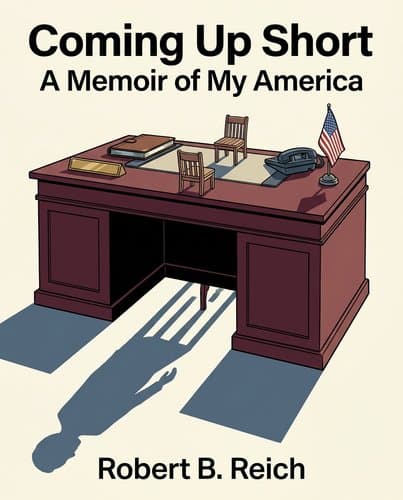
221754271_coming-up-short
by Robert B. Reich
Robert Reich connects a lifetime of being physically small—bullied, underestimated, vulnerable—to America's defining failure: societies that don't stop bullies…
In Brief
Coming Up Short: A Memoir of My America (2025) uses Robert Reich's lifetime in politics and policy to trace how concentrated corporate power systematically hollowed out American democracy — and how both parties enabled it.
Key Ideas
Corporate Seizure of Political Power
The 'Powell Memo' of 1971 is the most important document most Americans have never read — a specific blueprint for corporations to seize political power that produced measurable results within a decade and explains most of what has gone wrong since.
Democratic Economic Failure Enabled Trump
Democratic failures — NAFTA, Glass-Steagall repeal, the CEO pay loophole, welfare reform without investment — did as much to create Trump voters as Republican culture war strategy did. Assigning all blame to the right is a way of avoiding the harder reckoning.
Neutrality Framing Aids Democratic Dismantling
'Both-sidesism' is not neutrality — when one side is actively dismantling democratic institutions and the other is trying to preserve them, treating them as equally culpable is a political act that favors the dismantlers.
Coalition Building Stops Concentrated Power
The same dynamic that makes a bully unstoppable on a playground — bystander silence, the failure to recruit collective protection — makes concentrated wealth unstoppable in a democracy. The solution in both cases is the same: build coalitions before the bully takes everything.
Structural Extraction from Service Workers
The family leave problem is a structural one, not a personal one — the system is designed to extract maximum output from the people who care most about public service while offering no protection in return. This is not an accident; it's a feature of a system that has successfully privatized the upside and socialized the downside.
Reclaim Economic Populism for Workers
Economic populism — attacking concentrated power directly, as FDR did in 1936 — was abandoned by Democrats in the 1950s and has never been fully reclaimed. The working class did not drift to cultural resentment naturally; they were driven there by the absence of an economic alternative.
Who Should Read This
Readers who connect with first-person stories about Memoir and Political Figures and want to see the world through someone else's eyes.
Coming Up Short: A Memoir of My America
By Robert B. Reich
14 min read
Why does it matter? Because the bullies in your childhood and the billionaires destroying democracy are running the same play.
Most people assume the rot in American democracy crept in quietly — some vague cultural shift, the internet, maybe just human nature. Robert Reich doesn't buy that. He's spent seventy-eight years watching the same dynamic he first encountered on a playground in 1952: the strong take what they want, the bystanders look away, and everyone pretends it was inevitable. Reich was the shortest kid in school, perpetually in need of protection, which turned out to be the perfect education for a career spent studying power. In this memoir, he traces every major fracture in American life — the hollowing of the middle class, the corruption of both parties — back to specific rooms, specific choices, specific silences. Including his own. This isn't a book about what went wrong from a distance. It's a confession from someone who was in the rooms where the decisions were made and is finally telling you what actually happened.
The Shortest Kid in the Room Figured Out the Only Rule That Matters
Robert Reich at Lewisboro Elementary in South Salem, New York, age five: dragged behind a tree by older kids who've convened a mock tribunal, proposed sentence a baseball bat to the head for the crime of being too short to attend school. It is not a detour into childhood nostalgia. It is the book's operating theory, stated in miniature.
Reich grew up the smallest child in every room he entered, and the logic of that position is relentless. The boys' bathroom became so dangerous — second-graders threatening to dunk him headfirst in the toilet — that he stopped eating and drinking after breakfast to avoid needing it. He held out until he couldn't, suffered a humiliating accident in the principal's office, and was finally forced to explain the situation to his mother. The solution they arranged reveals something essential about how Reich would eventually understand the whole of American political life: he couldn't make the bullies smaller, so he recruited protectors. One after another, older boys were enlisted to walk him to the bathroom. It was mortifying. It was also the only thing that worked.
Then, in September 1964, a freshman at Dartmouth, Reich learned that the gentle teenager in the sailor's cap who had kept him safe during summer vacations in the Adirondacks — a boy named Mickey — was Michael Schwerner. That summer, Schwerner had traveled to Mississippi to help register Black voters. A county deputy sheriff pulled him over, held him, and that night handed him to Klan members, who beat him with chains and buried him in an earthen dam. The same dynamic Reich had survived on the playground — powerful actors using physical terror to keep the vulnerable in line — had simply scaled up. The bullies were now carrying badges and burning crosses; the goal was the same: ensure that certain people stay where they're put.
The $50 Trillion Question: How Did America Steal From Itself?
Here is the claim: American inequality was not an accident of markets or a natural byproduct of globalization. It was a coordinated political project with a start date, a document, and architects who signed their names to it.
In August 1971, Lewis Powell — a Richmond, Virginia, corporate attorney weeks away from being nominated to the Supreme Court — sent a confidential memo to the U.S. Chamber of Commerce. Its message was blunt: business was under attack from consumer, labor, and environmental groups, and the only answer was to fight politics with political power, systematically, with organized money. Powell urged corporations to treat political influence the way they treated market share — as something to be won, funded, and defended without apology.
The memo worked. Corporate political action committees numbered fewer than 300 in 1976. By 1980 they had multiplied to over 1,200. When Reich returned to Washington as labor secretary in 1993, some 61,000 people were on corporate payrolls as lobbyists and legal representatives — more than a hundred for every member of Congress. The physical city had transformed to match. In 1974, Reich had bought secondhand furniture from Fred Litwin, who ran a cramped, cheerful shop just off Pennsylvania Avenue. By 1993, Litwin's shop was gone — replaced, like block after block of the old Washington, by five-star hotels, gleaming office towers, and expense-account restaurants catering to the lobbyists who now outnumbered the lawmakers they had come to manage.
What those lobbyists purchased is visible in the ledger of dismantled protections: monopoly laws defanged, union rights diluted, Wall Street's gambling restrictions repealed, bankruptcy law rewritten to protect lenders rather than struggling homeowners and students. By 2016, corporations and Wall Street were outspending labor unions in elections by 34 to 1. The cumulative price tag, measured in the wealth that migrated upward over the following decades, is the figure Reich keeps returning to: roughly $50 trillion shifted from the bottom ninety percent of Americans to the top one percent. That is not a drift. That is a decision.
The Meeting Where CEO Pay Was Turbo-Charged — By Democrats
The meeting happened without Bill Clinton in the room. That detail matters. It was early 1993, and a handful of his most senior economic advisers had gathered to resolve a campaign promise: Clinton had pledged to stop letting corporations deduct executive pay above one million dollars from their taxable income. Reich was there. So were Treasury Secretary Lloyd Bentsen, budget director Leon Panetta, and Bob Rubin, who ran the National Economic Council. The president was elsewhere.
Rubin opened by framing it as a budget question. Bentsen, a former Texas senator who had spent his career around corporate money, dismissed the underlying premise: circumstances had changed since the campaign, he said, and besides, a talented CEO was worth every penny if he raised the value of the company's shares. Reich pushed back — the proposal wasn't a pay cap, he explained. Companies could pay executives whatever they liked. The question was whether taxpayers should subsidize it. Panetta floated the escape hatch and Rubin seized it: what if pay above a million dollars was still deductible, just only when it came in the form of stock or stock options tied to performance? That way it was linked to shareholder value. Panetta called it consistent with what the president had promised. Bentsen called Reich's objections social engineering and class warfare, and the meeting moved on.
What the room had just done, dressed up as a compromise, was create a massive federal incentive for corporations to pay their executives in stock. In 1992, the year Clinton ran on this issue, CEOs at major companies were already earning roughly 109 times what a typical worker made — up from 35 times in 1980. By the time Clinton left office, that ratio had more than tripled again. The tax tweak hadn't limited anything. It had turbocharged the very dynamic it was supposed to curb, by making stock-based pay the default currency and giving executives every reason to obsess over share price at the expense of everything else: wages, job security, long-term investment.
Reich was in the room. He argued. He lost. Then he stayed. That's the gut-punch the story delivers — not that cynical Republicans blocked Clinton's populist instincts, but that the people blocking them were Democrats who had just helped win an election on a different platform, making a decision they understood perfectly well, in a meeting the president didn't attend. The first betrayal of the working-class voters who put Clinton in office happened before Clinton had been in office a month, and it was concluded with the words: 'Now to a few other items on the agenda.'
The Hardhat Riot Was Organized in the Oval Office
On May 5, 1970, three days before a group of New York construction workers attacked anti-war students with steel rebar and steel-toed boots, Nixon operative Chuck Colson was on a White House telephone organizing exactly that outcome. The tape exists. When the riot came — 400 hardhats from World Trade Center construction sites chasing students through Lower Manhattan while a cop shouted encouragement — newspapers called it a spontaneous eruption of patriotic working-class fury. Nixon's chief of staff H.R. Haldeman recorded the real lesson in his diary: the blue-collar backlash was something the president could mobilize. Patrick Buchanan put it more bluntly in a memo: blue-collar Americans were now 'our people.' Nixon cemented the deal by inviting union leader Peter Brennan to the White House, accepting a ceremonial hard hat, and eventually handing Brennan the labor secretary post — in exchange for which Brennan blocked federal corruption investigations into a union that had delivered Nixon votes.
The reason this gambit worked is the part Reich finds hardest to admit. He was on the other side of it. In the 1960s, he threw himself into the New Left — a movement built almost entirely by and for college-educated people who took economic security for granted. The Port Huron Statement, his generation's manifesto, was written by comfortable University of Michigan students fretting about conformity and materialism. Fewer than ten percent of Americans had a four-year diploma in the mid-1960s. The New Left was designing a politics for the other ten percent.
What the construction workers who rioted in 1970 felt was a real grievance pointed in a manufactured direction. They had watched university enrollment shield clever kids from Vietnam while their own sons shipped out. They had absorbed the costs of integration in their neighborhoods while professionals fled to the suburbs. Split those two facts into the open and you see the problem clearly: the Democratic Party had spent a decade building a coalition that didn't include the people carrying those grievances. Nixon didn't create the resentment. He found it sitting there, untended. The culture war that has structured American politics ever since wasn't a natural divide. It was a vacuum that someone decided to fill with rage.
Roy Cohn Connects McCarthy to Trump — and Reich's Father Saw It Coming
Think of a family curse — some transmitted defect that skips no generation and keeps announcing itself in the same symptoms, decades apart. Reich grew up watching his father explode at the television whenever Roy Cohn appeared on screen. The word his father used isn't printable here, but the recognition behind it was precise: here was a man who had discovered that power, wielded without scruple, compounds like interest.
Cohn made his name as the young Justice Department attorney who helped send Julius and Ethel Rosenberg to the electric chair — Julius a genuine spy, Ethel, evidence later showed, mostly guilty of knowing about it. That prosecutorial ferocity caught J. Edgar Hoover's eye, and Cohn landed as chief counsel to Senator Joe McCarthy, where he perfected the technique of destroying careers through accusation alone. When a lawyer named Joseph Welch finally turned to McCarthy during the Army hearings in 1954 and asked, with the cameras running, whether he had any sense of decency, the spell broke. McCarthy drank himself to death within three years. Cohn, apparently immune to consequence, simply reinvented himself as a New York fixer.
That reinvention is where the story turns chilling. In 1973, the Justice Department charged the Trump family's real estate company with systematically steering Black rental applicants away from white-majority buildings. Employees had marked applications with a 'C' — for colored. Cohn, representing the Trumps, countersued the government for $100 million and called the charges baseless. The case settled. Three years later, when the Trumps were back in court for violating the settlement terms, Cohn called that a rehash too. The pattern held: accusation, denial, delay, survival.
In his memoir, Trump would later praise Cohn in terms his father would have found revolting. What Trump admired was not competence or honesty but precisely the absence of integrity — the willingness to choose loyalty over principle and ride that choice wherever it led. Ed Reich, sitting on that couch in South Salem watching the McCarthy hearings, was watching the rehearsal. The performance that followed lasted another seven decades and eventually moved into the White House.
The Oakland Induction Center and the Class Division That Explains Everything
An Army sergeant at the Oakland Induction Center in the summer of 1969 looked up from his desk, saw Reich walking toward him, and practically leapt with joy. At four feet eleven inches, Reich was exactly what the military needed: a perfect tunnel rat, small enough to crawl through the flooded passages beneath Vietnamese rice paddies with a grenade in each hand. The sergeant stripped Reich down to his underwear, walked him to a measuring platform, and slid the metal bar down to his scalp. Then he paused. A long pause. Army regulations allowed examiners to round measurements up or down by half an inch — and Reich, one inch below the five-foot minimum, stood there unable to see the reading, able only to hear his own heartbeat. When the sergeant finally said 'I'm sorry, son,' Reich had to perform disappointment convincing enough that the man wouldn't round upward out of sympathy. A moment later they were both laughing. Then Reich walked outside feeling sick.
The nausea wasn't relief souring. It was recognition. Reich had slipped free of the Vietnam War without a single act of courage or sacrifice — his escape purchased entirely by a physical accident of birth. Around him, the exit routes from the draft sorted almost perfectly by class. His Oxford colleague Frank Aller had agonized his way into exile in England, unable to claim conscientious objector status because he couldn't honestly swear off all wars, hoping his resistance would prick the national conscience. It didn't, and the exile ground him down until he took his own life. Bill Clinton had worked his own path out through an ROTC deferment he never intended to use. Every path out required either physical luck, institutional connections, or a college enrollment that kept you in the deferment queue.
The men who lacked all three went. Most of them didn't have college degrees. Reich understood, standing outside that induction center, that the rest of his life was borrowed time — and that the least he could do with it was figure out why that sorting had happened, and what it cost the country when it did.
The Family Leave Act's Author Couldn't Take Family Leave
Late in Reich's four years as Labor Secretary, he calls home to tell his sons he'll miss bedtime — again. His younger son Sam says that's fine, don't worry about it. Then, after a pause: 'But will you wake me up when you come in, Dad? I just want to know you're here with us.' Reich resigns the next day.
The man who spent four years implementing the Family and Medical Leave Act — the law giving American workers the right to twelve weeks off for a family emergency or a newborn — could not manage to be home for bedtime on a Tuesday. The irony isn't incidental. It's the whole argument. The system he was trying to reform extracted maximum output from the people who cared most about reforming it, while offering nothing back. He worked fourteen-hour days to secure protections for other people's families. His own sons were asking, at midnight, for proof he still lived there.
He had tried to tell himself it was a scheduling problem. It wasn't. He loved his work and he loved his family and he wanted more of both — which meant, as he finally understood it, that he was in a zero-sum game with no winning move. When he told Clinton he was leaving, Clinton said he understood completely. He was in the same bind. He just couldn't leave for another four years.
The system can't tell the difference between the people running it and the people it was built for. It just keeps pulling.
Reich stepped back. The question was whether anyone still in the room had learned anything from watching him — and, soon enough, it became clear they hadn't.
The 1994 Warning That Nobody Wanted to Hear
In October 1994, Reich sent Clinton a memo with a stark first line: we are in danger of losing Congress. He spelled out why with precision. Four million jobs had been added, but the richest five percent of Americans had captured nearly half the national income in 1993 — the largest recorded share in thirty years. The voters most alienated from the administration were adults without college degrees, the people whose wages had dropped furthest, the Reagan Democrats who had voted for change in 1992 and were now watching deficit reduction and free trade benefit the well-educated at their expense. Reich proposed a five-point rescue: profit-sharing incentives for corporations, labor law reform to rebuild union power, a minimum wage increase, pressure on the Fed, and at minimum an acknowledgment from Clinton that this was happening. The memo went unanswered.
Then the midterms arrived and delivered exactly what Reich had predicted. He got up at the Democratic Leadership Council afterward and said it plainly: the country was becoming a two-tiered society, a few winners and a growing remainder whose resentment was already being aimed at immigrants, welfare recipients, and gay people, and that as the middle class kept eroding, the targets would multiply. He knew the White House wouldn't approve that speech, so he sent them a dull substitute draft and delivered the real one. It made headlines. Panetta, Rubin, and Stephanopoulos summoned him and told him he'd violated the rules, that he wasn't a team player. He told them he didn't work for them. He was right on the procedural point and probably wrong on the political one, and he knew both things simultaneously.
What he named in that speech — globalization hollowing out manufacturing wages, corporations abandoning workers for share price, money flooding into politics — was already well underway. The alarm was documented. The response from the people who could have acted on it was silence, then fury at the person who said it out loud. Ignoring the warning wasn't confusion. It was a preference.
The System Isn't Broken — It's Working Exactly as the Billionaires Designed It
In June 2024, the Supreme Court ruled six to three in Snyder v. United States that 'gratuities' — payments delivered to a public official after the official has done what you wanted — are not bribes, and therefore not illegal. Bribes, the Court explained, are only payments made before the desired act. Pay a congressman in advance: crime. Take him to dinner, give him a yacht trip, wire money to his family after he votes your way: legal gift. The decision didn't expose a loophole in the law. It turned the loophole into the law.
The system isn't broken. That ruling is the system working correctly — and by now the design has been legally ratified at every level, from who can give how much to what 'bribery' means. Each successive court hasn't just permitted money in politics; it has progressively redefined corruption out of existence. What used to be called influence-buying is now called speech. What used to be called a bribe is now called a gratuity. The machinery is still running; they just keep changing the name on the door.
The 2008 financial crisis was the dress rehearsal for understanding where this ends. The crisis wasn't a natural disaster. It was the direct consequence of decades of deregulation that let the big banks make bets they couldn't cover. When it hit, Timothy Geithner — who as head of the New York Fed had been the designated watchdog over the very banks that caused it — was installed as Treasury Secretary to manage the response. His mortgage modification program, which was supposed to help homeowners, turned out to serve a different purpose entirely. Geithner described it himself: not to keep people in their houses, but to 'foam the runway' for the banks, spreading foreclosures out slowly enough that the banks could absorb them without destabilizing their balance sheets. Ten million families lost their homes. The banks received $700 billion in taxpayer backing and paid out nearly $20 billion in bonuses the same year. No senior banker was charged with anything.
The system produced that outcome not because it malfunctioned but because it was responding, correctly, to who held power inside it. The same people who deregulated the banks designed the bailout. The gains were private; the losses were nationalized. What looks from the outside like failure is, from the inside, a perfect result. That's the shift — not that money influences the system, but that the system has been rebuilt, ruling by ruling, so that the influence is the system.
Trump Is the Symptom. The Disease Started in 1970.
Picture someone standing in what Arlie Hochschild calls the line — the line toward the American Dream, where you believe the rules, work the hours, and wait your turn. Then the line stops moving. The first response, Hochschild found in her years in Louisiana and Kentucky, isn't anger. It's shame. You assume the failure is yours. And when shame becomes unbearable, you reach for something else to stand on: race, religion, region, the nation. Reich's argument is that this isn't an alternative to the economic explanation — it's what comes after it. The sequence is everything.
Trump didn't create that reservoir of wounded pride. He showed up when no one else was speaking to it directly, and he offered a trade. He paired a lie — the election was stolen from me — with something his followers felt in their bones: something was stolen from us. Then he fused the two by making his indictments into their indictments, his enemies into their enemies, his humiliation into proof that the same forces holding him down had been holding them down for decades. When he posted in capital letters that he was being arrested for them, millions of people believed it — not because they were credulous, but because the underlying grievance was real even if the specific claim wasn't.
What gave that move its force, Reich insists, is that it could only have worked after the Democratic Party spent forty years declining to make a different one. The party had the diagnosis — Reich sent the memo in 1994, Obey delivered the warning on the Labor Day parade route, Sanders nearly won a primary on it in 2016 — and chose, repeatedly, to tend to the investors instead of the workers. The fuel had been accumulating for forty years: trade deals that gutted factory towns, bailouts for banks that foreclosed on their customers, a single tax provision that tripled CEO pay while wages flatlined. The same playground logic applies: if the protectors won't protect you, eventually you'll take whatever protection is offered. The disease is four decades old. He is what it looks like when it finally gets a name.
What Mickey Schwerner's Death Actually Requires of Us
Here is what Reich leaves you with, once you close the book and sit with it: not a solution, not an apology, but a ledger. He was in the rooms where the damage was done, and he knows it. He passed the family leave law and couldn't take family leave. He argued against the CEO pay loophole and lost, then stayed anyway. That is not hypocrisy exactly — it is the trap that catches everyone who tries to change something from the inside. The question he refuses to answer for you is whether the trying was worth it. What he offers instead is the evidence: his Berkeley students organizing, Wertheimer still litigating campaign finance after fifty years, and somewhere right now a twenty-four-year-old with a stack of disclosure filings and a FOIA request, trying to finish what Reich's generation started and couldn't. The fight didn't end. It just became yours.
Notable Quotes
“Short People (Got No Reason to Live),”
“one of the most blatant and forgiven prejudices in our society.”
“Short People Are Furious with Reich”
Frequently Asked Questions
- What does Robert Reich argue about corporate power hollowing out American democracy?
- Robert Reich argues that concentrated corporate power systematically hollowed out American democracy through a calculated strategy outlined in the Powell Memo. This 1971 document is "the most important document most Americans have never read — a specific blueprint for corporations to seize political power that produced measurable results within a decade and explains most of what has gone wrong since." The memo represents a turning point where corporations pursued coordinated political dominance. Reich traces how this consolidated power became entrenched over decades through both Republican and Democratic policies, creating structural inequalities that now characterize American politics.
- How did Democratic Party policies contribute to the rise of Trump voters?
- Reich argues that Democratic failures created conditions for Trump's rise as much as Republican strategies did. He specifically identifies "NAFTA, Glass-Steagall repeal, the CEO pay loophole, welfare reform without investment" as Democratic policies that hollowed out working-class economic security. "Assigning all blame to the right is a way of avoiding the harder reckoning" about Democratic complicity in dismantling worker protections. Rather than embracing economic populism like FDR, Democrats abandoned this approach in the 1950s, leaving working-class Americans without economic alternatives and driving them toward political resentment.
- What structural factors drove working-class Americans toward cultural resentment?
- The working class did not naturally drift toward cultural resentment; they were systematically driven there by policy failures. Reich states: "the working class did not drift to cultural resentment naturally; they were driven there by the absence of an economic alternative." Both parties abandoned FDR's economic populism approach of attacking concentrated power directly. Democratic policies like NAFTA and Glass-Steagall repeal devastated communities without offering genuine economic solutions. When neither major party offered working families structural economic security, they turned to cultural grievances as a political option.
- What solution does Robert Reich propose for stopping concentrated wealth?
- Reich uses the playground bully analogy to explain how concentrated wealth operates. "The same dynamic that makes a bully unstoppable on a playground — bystander silence, the failure to recruit collective protection — makes concentrated wealth unstoppable in a democracy. The solution in both cases is the same: build coalitions before the bully takes everything." Reich argues that concentrated wealth becomes powerful through inaction and fragmentation. His solution requires collective action and broad coalition-building to counterbalance economic power before it becomes irreversible.
Related Book Summaries
Read the full summary of 221754271_coming-up-short on InShort