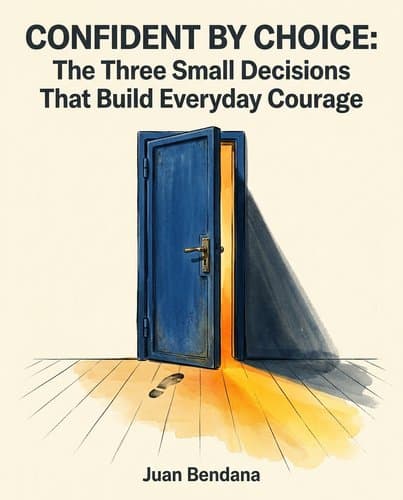
220239039_confident-by-choice
by Juan Bendana
Confidence isn't a feeling you wait for—it's a mechanical cycle you can start spinning today with three small decisions. Learn how to engineer energy before…
In Brief
Confidence isn't a feeling you wait for—it's a mechanical cycle you can start spinning today with three small decisions. Learn how to engineer energy before every attempt, find your Goldilocks Step, and collect proof from your actions rather than outcomes.
Key Ideas
Engineer energy scaffolding for difficult tasks
Before attempting anything difficult, engineer energy into the attempt: schedule a reward tied to the action (Ethan's wine bottles), involve someone you care about, or attach a 'guilty pleasure' to the preparation — courage deployed without energy scaffolding burns out.
Environment design beats willpower alone
Audit your environment before auditing your willpower. Identify one physical space, one habitual thought pattern, or one person who is draining your energy, and make a structural change — move the charger, change the workspace, control the Zoom topic — rather than trying to feel more motivated inside a broken environment.
Focus energy on the influenceable 80%
Use the 10/10/80 rule when fear of rejection stops you: 10% will support you regardless, 10% won't no matter what you do. Stop spending energy on the bottom 10% and direct your micro-actions toward the 80% you can actually influence.
Right-sized action produces progress signals
Define your Goldilocks Step: the action must be small enough to be achievable today but large enough to produce mild discomfort. Scott walking to the gym doors and turning back is not a failure — it's the exact right step. The discomfort is the signal you found it.
Own your actions, not just outcomes
Reframe what counts as proof. The proof that you can make new friends isn't whether the person says yes to dinner — it's that you asked. The output (what you did) belongs to you regardless of the outcome (what happened). Write down what you actually did, not just whether it worked.
Impersonate who you want to become
When you hit an identity ceiling — the inner voice that says 'I'm just not that kind of person' — try the Batman Effect: refer to yourself in the third person using a powerful identity ('Is [your name] working hard?') or impersonate a version of yourself that already is who you want to become. The research says perseverance increases because you identify with the features of the character, not with your current limitations.
Who Should Read This
Readers interested in Confidence and Self-Improvement, looking for practical insights they can apply to their own lives.
Confident by Choice: The Three Small Decisions That Build Everyday Courage
By Juan Bendana
11 min read
Why does it matter? Because the confidence you're waiting to feel is already being manufactured by the actions you're avoiding.
Here's the uncomfortable truth about confidence: you've been treating it like a reward. Get the promotion, land the date, nail the presentation — then you earn the right to feel confident. Except that's not how it works, and somewhere under all the waiting, you already know it. Because you've had wins. Real ones. And the feeling lasted maybe a week before the old doubt crept back in like it owned the place. Juan Bendaña spent years getting this backwards too — badly enough that the stories are genuinely mortifying. What he figured out is that the mechanism runs in reverse: action first, feeling second, and the starting action can be so small it barely counts. That's not motivational fluff. It's closer to a manufacturing process — one that needs a specific kind of fuel before it can run. And once you understand how the machine actually works, you can start it from almost anywhere.
The Confidence Myth That Keeps You Stuck
Picture a scrawny, red-haired teenager in Halifax, England — lazy eye, a stutter, a habit of crying every morning before school. No family connections in the music industry, no obvious stage presence, and industry insiders telling him to drop the loop pedal and stop rapping. By every measure we use to predict who becomes a confident performer, Ed Sheeran shouldn't have made it past open mic night. And yet his first year in London, he performed three hundred shows. Not three hundred in his career — three hundred in twelve months.
Here's the question that makes his story worth sitting with: where did that confidence come from? Because it clearly wasn't his circumstances handing it to him.
Most of us carry one of two models of confidence, and they feel different but function identically. The first is the genetic lottery version — some people are just born with it, wired for boldness the way others are wired for blue eyes. The second is the scoreboard version — confidence rises when things go your way and collapses when they don't. Good date: plus one. Fired from your job: minus one. The tally feels more democratic than the genetic model, but it leaves you in the same position: a passenger waiting on external events to hand you the feeling before you act.
Sheeran's three hundred shows punch a hole through both. He wasn't born with the conventional advantages. And his ledger was loaded against him — the stutter, the rejection, the couch-surfing between gigs. What he did instead was act before the feeling arrived. He treated the stage not as a reward for having confidence already, but as the place where confidence gets built. The shows created the proof, and the proof created the next show. He didn't wait to feel ready; the stage was where ready got built.
The trap isn't a shortage of confidence. It's waiting for it to show up on its own.
Energy Comes Before Courage — and Almost Nobody Talks About That
Courage alone is a terrible engine. It burns hot, it burns fast, and it burns out — usually taking your motivation and your relationships with it.
Take two people — Catherine and Ethan — both terrified of public speaking, both signed up for the same four-month program requiring two classes a week plus homework. Catherine attacks it with pure grit. She cancels date nights, absorbs extra projects at work, shows up every week no matter what. By any measure of raw determination, she's doing everything right. And yet by month two, the burnout has seeped into her friendships, her relationship, her job. She finishes, technically, but she arrives hollowed out.
Ethan is, by his own admission, the less bold of the two. So he rigs the game before it starts. He tells his workplace he won't be absorbing extra projects for the next four months. He invites his fiancée to watch him speak on Thursday nights, turning the scariest part of the week into something that ends with both of them opening a bottle of wine — pre-purchased and already waiting at home. He bribes himself with a guilty-pleasure café drink every morning he shows up to do homework he hates. By the end of all this arranging, Ethan almost looks forward to speech night.
Same program. Same fear at the start. Completely different structural setup.
Catherine depleted her energy before the hard moments even arrived. Ethan manufactured small pockets of anticipation — the drink, the wine, the fiancée in the audience — so his courage wasn't doing all the heavy lifting alone. He had scaffolding.
Confidence isn't something you summon by being brave enough. It's something you build by being smart enough — about what you build around yourself — so that courage has somewhere to land when you actually need it.
Your Environment Is Either Building Confidence or Draining It — There Is No Neutral
Here's what Ethan figured out — and what Bendaña keeps returning to throughout the book — is that the scaffolding isn't accidental. It's chosen. Which brings us to Michael Phelps.
Put Phelps on dry land and start walking. You win. Not because he forgot how to swim, but because you changed the container the competition happens in. Bendaña uses this thought experiment to make a point that sounds obvious until you notice how rarely we act on it: your surroundings aren't a neutral backdrop. They're actively working for you or against you, and the gap between those two conditions is enormous.
That reframe matters most when we talk about energy — the fuel that has to exist before courage can do anything. Most people treat their confidence problems as personal failures: not disciplined enough, not positive enough, not brave enough. Bendaña's argument is architectural. The drain usually isn't a character flaw. It's a leaky structure.
Two drains in particular yield to design rather than willpower. The first is negative self-talk — and not just in the obvious emotional sense. The internal critic running commentary on your failures all day isn't just demoralizing, it's drawing down the same limited fuel you need to try hard things. Your brain is 2% of your body weight and burns through 20% of your energy. Rumination isn't free. The second drain is the people around you. For relationships you can exit, the math is simple. For the ones you can't — the exhausting family member, the colleague who leaves every conversation feeling like a loss — the move isn't to fix the person. It's to control the conditions: the setting, the topic, the duration. Jeremy, one of Bendaña's clients, managed a toxic family relationship entirely through Zoom read-alongs — structured, time-limited, with a shared activity that made the interaction manageable. An engineering decision, not an emotional one.
Once you stop treating energy management as a character test and start treating it as a design problem, the whole question shifts from 'why can't I just push through?' to 'what am I building that pushes back?'
Courageous People Aren't Fearless — They're Just More Acquainted With Fear
Juan Bendaña was nineteen and hopelessly infatuated with a girl named Brittany. He had already frozen up once at a coffee shop drive-through in her presence, so he did what any self-respecting awkward teenager would do: he got a job at that exact coffee shop. His first weekend shift, he managed to trigger what can only be described as a smoothie volcano — a catastrophic malfunction that drenched Brittany and an innocent bystander in whatever fruit-and-ice disaster he'd set in motion. When he eventually worked up the courage to ask her out anyway, she handed him the four words nobody wants to hear: we should be friends. He'd risked everything, failed publicly, and ended up exactly where he started.
Here's the thing: that story isn't a cautionary tale about confidence going wrong. It's what confidence actually looks like from the inside — messy, embarrassing, and shot through with fear the whole way.
Research confirms what the smoothie disaster already showed: fear and courage don't cancel each other out — they coexist. Which means every assumption we make about people who seem fearless — the speaker who commands a room, the entrepreneur who bets everything — is probably wrong. We watch someone act boldly and conclude they must not be feeling what we're feeling. But the fear is there. The difference is just practice.
Bendaña compares it to skydiving. The altitude that could kill you is also what forces the parachute open. A skilled skydiver doesn't eliminate the danger — they get comfortable enough with it to work inside it, even rely on it. Courageous people aren't wired differently. They're simply more familiar with the feeling; they've been in the room with it enough times that it no longer paralyzes them.
Roger Federer won around 80% of his matches over his career but only about 54% of the individual points he played. Which means even at the peak of his dominance, nearly half of every single exchange went against him. The mastery wasn't in losing less. It was in releasing each lost point fast enough to play the next one clean — and it turns out that same instinct, acting before the fear has time to calcify, is exactly where small actions start to compound.
Fear is the constant. The variable is how many times you've acted alongside it.
The Smallest Possible Action Is the Right Action
What if the thing blocking you isn't a lack of motivation or skill or the right plan — but the size of the step you're imagining?
Scott had never set foot in a gym in his life. The idea of walking in, not knowing how any of the machines worked, surrounded by people who clearly did — it was enough to keep him on the couch indefinitely. So he did something that sounds almost too small to be useful: he walked to the gym doors and turned around. That was it. He drove home. The next day, he did the same thing. Then again. Until one afternoon he happened to bump into someone on the way in, struck up a conversation, and was through the doors before he'd had time to feel afraid. A few weeks later, Scott was a regular.
None of that would have worked if he'd started with a full workout plan. The plan would have required the confidence he didn't have yet. Walking to the doors required nothing except showing up — and showing up was exactly the thing that built the confidence. The step wasn't a warmup to the process. It was the process.
This is the part people get wrong. They think the step needs to be big enough to feel like progress. It doesn't. It needs to be small enough that you can't talk yourself out of it, and just large enough to create a little discomfort. Embarrassingly small, if you're doing it right. The embarrassment is actually the signal — it means you've found the edge of what feels safe, which is exactly where the useful work happens.
There's a version of this in running. Coaches call it the side stitch that disappears at yard 200. You feel it around yard 150, and your body votes to stop. Almost everyone stops. But the people who push through to yard 200 discover the stitch is gone — not because they powered through pain, but because the pain was a temporary response to the transition, not a signal that something was wrong. The quitting point and the breakthrough point are 50 yards apart. The only way to find out is to keep going.
David knew something like this before he ever walked out to face Goliath. When Saul pushed back — you're a kid, he's a soldier, this is insane — David didn't say he was brave or that God would protect him. He gave Saul a credential speech. He'd killed a lion that attacked his flock. Then a bear. He hadn't gone looking for lions and bears. They came to him, and he handled them, and now he had evidence. Goliath wasn't the first test. He was the proof that a progression had already happened.
The Goldilocks step works the same way. Not so small it changes nothing, not so large it triggers the full alarm system. Just past comfortable, just short of overwhelming. You're not waiting to feel ready. You're collecting the evidence — one door, one yard, one bear — that makes the next step imaginable.
Failure Isn't an Interruption of the Cycle — It IS the Cycle
The act of attempting something difficult is itself the proof. Not the win. Not the deal closed or the applause or the number on the scale — the attempt.
Bendaña tells the story of Carter, an Apple Store employee whose job is to deliver product presentations every hour to customers who are actively, visibly not listening. They're on their phones. They're whispering to each other. They're physically turning away. By any reasonable definition of success, Carter is failing continuously, for eight hours a day. And yet Carter delivers each presentation with the same intensity he'd bring to a packed auditorium. The signal the crowd sends him is: nobody cares. The misread version of that signal would be: I'm bad at this. The accurate version is something else entirely — that he shows up and delivers regardless of the room's response. That's the output. And output is what confidence actually runs on.
Most people get this backwards. We treat failure as evidence that the cycle broke down — as though confidence builds only when things go the way we wanted. But that's the scoreboard model again, just wearing different clothes. If your proof of capability requires a good outcome, you've handed the scoreboard to everyone in the room except yourself.
Kellogg School of Management researchers found that early professional failure is a statistically significant predictor of long-term success. They tracked this pattern across venture capitalists and — because failure follows the same structure everywhere — across data from 170,000 terrorist attacks. Failure isn't the interruption of eventual success. It's woven into the structure of it.
If you only count attempts that land, you'll stop attempting. The risk-reward calculation doesn't work. But if the attempt itself generates proof — proof that you can tolerate the fear, survive the awkward moment, stay in the room when things go sideways — then every swing, regardless of outcome, adds to the stack. Carter isn't building confidence waiting for a customer to finally pay attention. He's building it every single hour he shows up and performs anyway.
This doesn't mean failure is fun, or that outcomes are irrelevant. The cycle doesn't require success to keep moving — it just requires that you don't quit. You went. You tried. You're still here. That's enough data for the next step.
The Cycle Ends When Your Identity Changes — Not When Your Habits Do
What's the actual finish line here? If you've been doing the work — showing up, taking the small action, surviving the failure, logging the proof — when do you get to call it done?
Bendaña's answer is that habits and actions are the vehicle. The destination is a different label for yourself. And the cycle keeps running until that label changes.
The Batman group lasted longest. That's the punchline of a study where kids were given a boring task and told they could bail at any time to play on an iPad. One group checked in with first-person self-talk: 'Am I working hard?' A second group used their own name in the third person. The third group pretended to be Batman: 'Is Batman working hard?' The Batman kids outlasted everyone — not because anything about them changed, but because their perception of themselves did. They stepped outside their current self-image and borrowed a better one. That's not a trick for children. It's the whole mechanism. Identity shapes behavior more reliably than discipline does, because identity operates before the moment of decision.
This is why the cycle has to be repeated until it stops feeling like effort. You're dismantling an old label and replacing it with one that fits what you've actually been doing. Bendaña calls this crossing the Identity Threshold — the invisible wall where the old story about yourself finally loses its grip. Until you cross it, every win is provisional. You file it as an exception: 'I got lucky,' 'that was a good day,' 'it doesn't count because...' The proof slides off because the container you're pouring it into is still the old one.
His friend Matt shows what it looks like when the threshold breaks. Matt used to faint at the sight of needles — the kind of person who had to look away at checkups, who scheduled appointments around his fear. Then he learned his blood type was CMV-negative, rare enough that it's considered safe for premature infants whose immune systems can't handle standard donations. The moment Matt understood that his blood specifically could keep babies alive, the fear of needles stopped being relevant. He didn't push through it with repetition or exposure therapy. The fear simply had nowhere to stand once his identity reorganized around being someone who saves infants. The obstacle didn't shrink. The self got bigger.
That's what you're building toward. Not a streak of good habits, not a calendar full of brave decisions — a self-concept that makes the old hesitation irrelevant. The cycle delivers you there, one ounce of proof at a time. But the proof only lands when you've got a new container to pour it into.
The Door Was Already Unlocked
Bendaña pinned a photo of a stadium to the wall of his parents' spare bedroom before a single publisher had agreed to print his name on a cover. Twenty of them said no. Then, in the same week, one said yes — and the stadium called on the same day. He didn't have to choose between proof and outcome. The cycle completed because he kept feeding it while both were still in the air.
That's the whole thing. The label you carry right now — the one that says you're not quite that kind of person yet — doesn't update through inspiration. It updates through logged attempts, survived embarrassments, and steps small enough to actually take today. Not ten steps. One. Picture Scott standing in the parking lot outside the gym doors — not inside, not on the treadmill, just there. That's the step. Embarrassingly small. The discomfort you feel looking at it is how you know you found the right one.
You already have a photo on the wall somewhere. The cycle is waiting to be started, not perfected.
Notable Quotes
“Pain is bad, failure is evil, and if I lose, I’m a loser.”
“No wonder they acted so heroically; they’re courageous.”
“I could never speak up like that. I’m not bold.”
Frequently Asked Questions
- What is Confident by Choice about?
- Confident by Choice reframes confidence as a repeatable mechanical cycle rather than an innate trait or feeling. The 2025 book by Juan Bendana provides concrete tools for building courage through small, deliberate actions without depending on outcomes or waiting for motivation to arrive. Readers learn practical systems for generating proof of capability. The book introduces specific concepts including the Goldilocks Steps, energy scaffolding, and the Batman Effect. These tools help you audit your environment, make strategic micro-actions, and overcome identity ceilings. The focus is on making three small decisions that build everyday courage through deliberate practice and structural changes.
- What are the key takeaways from Confident by Choice?
- Key takeaways include: engineer energy into difficult attempts through rewards or involvement of others; audit your environment before your willpower; use the 10/10/80 rule to direct energy toward people you can influence; define your Goldilocks Step as an action small enough to achieve today but large enough for mild discomfort; reframe proof by focusing on what you did rather than outcomes; and use the Batman Effect to overcome identity ceilings by referring to yourself in third person or impersonating your desired identity. These practical strategies build confidence through repeatable mechanical actions.
- What practical tools does Confident by Choice provide?
- Confident by Choice provides several practical tools: Goldilocks Steps guide you to find the right-sized action that's achievable but slightly uncomfortable. Energy scaffolding techniques—like scheduling rewards tied to actions, involving someone you care about, or attaching a guilty pleasure to preparation—prevent courage from burning out. The 10/10/80 rule helps redirect energy toward people you can actually influence rather than wasting effort on those resistant to you. The Batman Effect uses third-person reference or identity impersonation to overcome limiting beliefs. The book also teaches environmental auditing, focusing on structural changes rather than willpower alone.
- How does the Goldilocks Step work in building confidence?
- The Goldilocks Step is an action small enough to be achievable today but large enough to produce mild discomfort—that discomfort signals you found the right step. For example, Scott walking to the gym doors and turning back is not a failure; it's the exact right step. The output (what you did) belongs to you regardless of the outcome (what happened). So proving you can make new friends isn't whether the person says yes to dinner—it's that you asked. By tracking outputs rather than outcomes, you build proof of capability through repeatable small actions.
Related Book Summaries
Read the full summary of 220239039_confident-by-choice on InShort