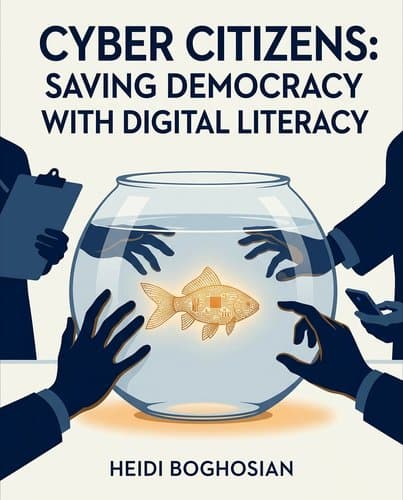
219522000_cyber-citizens
by Heidi Boghosian
The U.S. surveillance apparatus monitors bicycle advocates and farmworkers while financial fraudsters go unchecked—and corporations profit from keeping it that…
In Brief
The U.S. surveillance apparatus monitors bicycle advocates and farmworkers while financial fraudsters go unchecked—and corporations profit from keeping it that way. Boghosian reveals how government-corporate surveillance systematically criminalizes democracy itself, and how targeted local resistance can dismantle it piece by piece.
Key Ideas
Surveillance targets activists, not financial criminals
When you want to understand who a surveillance system is actually protecting, look at who gets monitored and who gets left alone — the documented targets of U.S. domestic surveillance are bicycle advocates, farmworker organizers, environmental lawyers, and journalists, not financial fraudsters
Private companies bypass legal surveillance restrictions
The First Amendment doesn't bind private corporations, which is why the government increasingly outsources surveillance to them — buying commercial data, hiring private contractors, and partnering with companies like Microsoft and JPMorgan Chase sidesteps legal restrictions on direct government collection
Crises enable surveillance expansion cycles
Every post-WWII expansion of the surveillance apparatus followed the same pattern: a national emergency (Cold War, 9/11) provides cover, new capabilities are built, civil liberties organizations claw back some protections through litigation and legislation, and the next administration quietly dismantles the limits — understanding the cycle is the first step to breaking it
Counterterrorism focus enabled financial crime epidemic
The FBI's counterterrorism focus between 2001 and 2007 directly caused a collapse in white-collar crime prosecution — financial fraud cases fell by roughly half — which means the surveillance state's expansion made the 2008 financial crisis more likely, not less
Specific campaigns defeat targeted surveillance programs
Documented resistance works at the local level: Seattle killed its drone program, a Texas teenager won a preliminary injunction against RFID school IDs, and the 1971 Media break-in forced the Church Committee — but these wins require specific, organized campaigns against specific programs, not general opposition to surveillance
Who Should Read This
Readers interested in Democracy and Social Issues, looking for practical insights they can apply to their own lives.
Cyber Citizens: Saving Democracy with Digital Literacy
By Heidi Boghosian
11 min read
Why does it matter? Because the surveillance state isn't protecting you — it's protecting the people who profit from watching you.
Most Americans assume the surveillance apparatus built after 9/11 is pointed outward — toward bomb plots, toward foreign threats, toward the genuinely dangerous. Then you look at who it's actually aimed at: a college student on a bicycle, a farmworker asking for a living wage, an attorney who issued a press release. The machinery is real, the targeting is documented, and the pattern is impossible to explain by accident. What the documents show isn't government overreach in the service of safety — it's something more specific and more troubling. The corporations funding police foundations, the private contractors billing by the suspect, the intelligence firms monitoring activists for Burger King — they all have one thing in common. They profit when dissent costs more than it's worth. This book follows the money, and the money leads somewhere the official terrorism narrative was never meant to take you.
The Targets Tell You Everything You Need to Know
The state's surveillance apparatus tells you exactly what it fears — and the targets are stranger than you'd expect. In New York City, the NYPD deployed infrared-equipped helicopters, undercover infiltrators, organized crime consultants, and a fleet of vans to monitor a monthly bicycle ride. Not a weapons cache. Not a bombing plot. A bicycle ride.
The Critical Mass events drew hundreds of cyclists through Manhattan — people who showed up to advocate for cleaner streets and fewer cars. By the time New York was preparing to host the 2004 Republican National Convention, Police Commissioner Raymond Kelly had already persuaded a judge to lift court-imposed restrictions on surveilling political groups, clearing the way for his Intelligence Division to find, watch, and penetrate them. What followed was a surveillance operation scaled to match a terrorist threat: undercover officers embedded themselves in the rides and the networks around them. Officers arrested nearly three hundred cyclists at a single pre-convention ride, then declared hundreds of parked bicycles 'abandoned property' and hauled them away with bolt cutters. The city eventually paid $965,000 to settle claims from 83 riders.
What made cyclists worth that investment? Heidi Boghosian's answer cuts to the core of the book. People on bicycles are harder to track than people in cars. They don't generate the registration fees, insurance premiums, fuel taxes, and parking revenue that car culture produces. They interact with each other in open public space, outside the data-generating infrastructure that corporations and governments mine for intelligence. The bicycle wasn't just a vehicle — it was a refusal to participate in systems built around surveillance and profit.
That refusal, it turns out, is what triggers the machinery. If this is how the state responds to cyclists, 'dangerous' doesn't mean what most people think it means.
This Machinery Has Been Built and Dismantled Before — and the Dismantling Never Lasts
On the night of March 8, 1971, while most of America was watching Muhammad Ali and Joe Frazier trade punches in what the press called the Fight of the Century, a small group of activists broke into an FBI field office in Media, Pennsylvania. They left with roughly a thousand classified documents — and what those pages revealed changed everything. The files showed that FBI agents had been provoking ordinary citizens into illegal acts to justify harsh police responses, breaking into homes and offices, and planting informants to stoke internal feuds. J. Edgar Hoover, confronted with the leak, shut down the counterintelligence program fifty days later. His memo called it 'successful over the years' but concluded it should end 'for security reasons because of their sensitivity.' He wasn't admitting wrongdoing. He was protecting the apparatus.
What followed looked like victory. A Senate investigation confirmed that the FBI had waged covert war against civil rights supporters and peace advocates for fifteen years, with, in the committee's own words, 'no conceivable rational relationship to either national security or violent activity.' In 1976, the attorney general established guidelines requiring 'specific and articulable facts' of criminal activity before any surveillance could begin. For the first time, the government needed a real reason to watch you.
It lasted five years. Reagan's Executive Order 12333, signed in 1981, quietly reauthorized techniques the Levi guidelines had banned. The next attorney general loosened the standard from 'specific and articulable facts' to 'reasonable indication' — a phrase elastic enough to justify almost anything. After 9/11, the Patriot Act handed investigators roving wiretaps, secret search warrants, and the authority to subpoena personal records without a court order. Each rollback followed the same pattern: a period of genuine reform, then a new emergency, real or amplified, and then the quiet legislative or executive reversal that most people never noticed.
The surveillance infrastructure that fills the rest of this book — infiltrators at bicycle rides, threat-assessment firms tracking environmental activists — didn't spring into existence after the Twin Towers fell. It descended from the same machinery that drugged Fred Hampton before Chicago police shot him in his bed, that manufactured gossip to destroy French New Wave actress Jean Seberg, that compiled political dossiers on millions of Americans who had done nothing more than hold unpopular opinions. Every reform has come with an expiration date, and the people doing the dismantling have always been careful to do it quietly.
When Government and Corporate Power Merge, the Constitution Stops Applying
The boundary between government surveillance and corporate data collection isn't blurring — it's gone. That's not a side effect of the system. It's the design.
Consider what JPMorgan Chase purchased with a $4.6 million donation to the New York Police Foundation: a thousand computers distributed across the department, two thousand laptops installed in patrol cars, network cabling across seventy-six locations and twenty-nine precincts. The bank didn't donate to a charity. It donated to an armed police force's operational infrastructure — the devices officers use to file reports, run plates, coordinate arrests. Then, when Occupy Wall Street demonstrators took to the streets to protest the financial industry's behavior, that same NYPD was deployed to clear them out. The bank had equipped the force that evicted the people protesting the bank. You don't need to allege a conspiracy to find that disturbing. The financial allegiance was already baked in.
The arrangement is also constitutionally convenient. Richard Helferich, CEO of Strategic Security Corporation — hired to help manage security at the 2004 Republican National Convention — stated the logic directly: law enforcement agencies are constrained by the First Amendment, but as a private firm, his company faced no such limits and could maintain databases on individuals that police departments legally could not. That's the mechanism. Government agencies, bound by constitutional restrictions, hand off the surveillance work to private entities that aren't. The corporation gets a paying client. The state gets intelligence it couldn't have gathered itself. Nobody violated the letter of the law.
The NYPD's partnership with Microsoft to build the Domain Awareness System — a platform that aggregates camera feeds, license plate readers, and crime data in real time — added a further twist: the city negotiated a thirty percent cut of future sales when Microsoft markets the system to other governments. A police department is now a software vendor with a direct financial stake in how many cities buy into the surveillance grid. The incentive no longer points toward public safety. It points toward moving units.
The FBI Was Monitoring the Stock Exchange a Month Before Occupy Existed
What does it mean when the FBI is already coordinating with Wall Street before a protest movement exists? The documents answer that question precisely. Through Freedom of Information Act requests, the Partnership for Civil Justice Fund obtained records showing that as early as August 2011 — a full month before anyone pitched a tent in Zuccotti Park — federal agents were meeting with the New York Stock Exchange and deploying counterterrorism resources against Occupy Wall Street. The FBI's own files noted, in writing, that organizers were calling explicitly for peaceful protest. The surveillance apparatus was in motion anyway.
This wasn't reactive policing — the kind that floods the streets after violence breaks out. It was positioning: deciding in advance whose interests the state would protect and against whom. By September, the FBI was already alerting private businesses that they might face protest activity. That December, the FBI's Jackson, Mississippi office attended a Bank Security Group meeting alongside multiple private banks and local police to discuss a planned sit-in at financial institutions. Throughout this period, Joint Terrorism Task Forces coordinated with university campus police to report on faculty and students affiliated with Occupy encampments. Briefing reports labeled the movement under the heading 'Domestic Terrorism.'
The organizational vehicle for this coordination was the Domestic Security Alliance Council, which the federal government describes as a strategic partnership between the FBI, the Department of Homeland Security, and the private sector. The council issued intelligence reports on civil unrest — defined as anything from small organized rallies to large demonstrations — and stamped them for use within the corporate security community only, explicitly barring release to the media or the general public. One advisory told corporate clients to avoid large gatherings 'related to civil issues.' The government was producing proprietary intelligence on American citizens and delivering it to banks.
Attorney Mara Verheyden-Hilliard, reviewing the documents, put it plainly: at the moment when ordinary people rose up in response to an economic crisis caused by financial institutions, the U.S. government was functioning as the private intelligence arm of those same institutions. Against those people. The priorities written into those files weren't incidental. They were the policy.
The Government Can't Legally Collect Your Data, So It Just Buys It
Think of it like a fence. The government builds one around your personal records — the Privacy Act of 1974 says federal agencies can't collect information for one purpose and secretly use it for another. Then a corporation builds an identical replica of everything inside the fence and sells access to anyone willing to pay. The fence is still there. The government just walks around it.
Acxiom is a data broker that knows your age, race, weight, marital status, health concerns, political leanings, and what kind of vacation you fantasize about. The New York Times once noted that it sees deeper into American life than the FBI or the IRS. But the FBI doesn't need to compete with Acxiom — it's a paying client. By purchasing what it's prohibited from collecting, the Justice Department and the Bureau access detailed profiles on millions of citizens without triggering a single Privacy Act restriction. The law bars direct government collection. It says nothing about shopping.
The error rate alone should stop this cold. A study of Acxiom's records found that every single report contained at least one error, and biographical mistakes appeared in two-thirds of files. So the government is buying unreliable data on its own citizens and using that data to drive investigations. The obvious response would be stricter accuracy standards. Instead, in 2003 the FBI successfully lobbied to exempt its own criminal database — nearly forty million records — from the Privacy Act's requirements for accuracy and timeliness.
The bureau exempted its own records from the accuracy standards that might have caught the damage when bad data sent investigators after the wrong person. This isn't bureaucratic drift. It's a system that got exactly what it was designed to produce: maximum information, minimum accountability, and no legal remedy for the person whose life gets upended by a database entry that was wrong from the start.
The Violence Was Manufactured by the People Prosecuting It
Eric McDavid was twenty-eight years old when he was arrested for buying household cleaning supplies and Pyrex cookware. Those were the 'bomb-making materials' that earned him a sentence of nearly twenty years in federal prison.
The person who put those items in his hands was a woman he knew as Anna, an FBI informant who had spent over a year building a romantic relationship with him — close enough that his attorney said the two argued like a couple. Anna didn't stumble onto a plot already in motion. She flew McDavid to planning sessions, paid for housing, handed him literature on how to construct explosive devices, and provided the money to purchase supplies. When his defense attorney described her as 'the glue' holding the conspiracy together, he wasn't reaching for a metaphor. He meant it structurally: take Anna away, and there's no plan, no materials, no crime. There's just a young man with an attraction to someone who didn't exist.
One of the jurors who convicted McDavid submitted a declaration afterward saying she believed the FBI was out of control and that Anna lacked any meaningful oversight. The juror voted to convict anyway, because the law as written didn't leave her much room. That's the point. The entrapment doctrine sets a high bar — defendants must prove they had no predisposition toward the crime — and prosecutors get to define predisposition using the informant's own account of what she witnessed.
The Animal Enterprise Terrorism Act, drafted by the American Legislative Exchange Council, a corporate-funded bill-writing organization, and signed in 2006, completed the architecture. Under that law, causing 'loss of profits' to a factory farm qualifies as terrorism — no violence required, no threat to human life required. When the federal government needs to show results in the War on Terror, it can point to prosecutions like McDavid's: a terrorism conviction, a twenty-year sentence, a press release. The FBI built the crime from scratch. That part doesn't make the press release. The system manufactures violence because the people running it need the numbers.
While Activists Were Surveilled, the Bankers Who Crashed the Economy Walked Free
The surveillance state didn't just fail to make Americans safer — it made them poorer, and the accounting is precise. Between 2000 and 2007, as FBI resources flooded into counterterrorism, white-collar crime staffing collapsed to 26 percent of its 2001 levels. The prosecution numbers show what that meant: financial institution fraud cases fell 48 percent, insurance fraud cases 75 percent, securities fraud cases 117 percent (the figure comes from the source's own framing — cases fell so steeply that the drop exceeded the proportional baseline). Those weren't background statistics. They were the unmeasured runway on which the mortgage crisis accelerated. Journalist Tim Weiner, writing about the bureau's counterterrorism fixation, concluded that the collapse of white-collar enforcement was a direct gift to the Wall Street behavior that produced the worst economic collapse since the Depression.
Here's the exchange that actually happened: the FBI stopped watching bankers and started watching activists. The same years that financial institution fraud prosecutions fell by nearly half were the years the bureau was infiltrating environmental groups, embedding informants in bicycle rides, and building terrorism cases against animal rights advocates. When the mortgage crisis finally detonated — wiping out savings, triggering mass foreclosures, concentrating economic pain most heavily among people with the least cushion — not a single banker was arrested. Thousands of Americans who took to the streets demanding that someone be held accountable were jailed instead.
The priority order wasn't accidental. It reflects who the system was actually built to protect. When you know that JPMorgan Chase donated millions to equip the police force that later cleared Occupy encampments, and that FBI counterterrorism agents were coordinating with the New York Stock Exchange a month before anyone arrived at Zuccotti Park, the math becomes legible. The state didn't stumble into protecting financial power over ordinary people. That was the design.
Small Victories Are Real, but the Structural Imbalance Is Enormous
Can organized resistance actually win? The answer, documented and specific, is yes — and no, not in any way that lets you stop.
In 2013, the Seattle Police Department had already received FAA approval for two small camera-equipped drones acquired through a federal grant. Officers had demonstrated the devices publicly. The program was functionally underway. Then residents showed up at a city council meeting and objected, loudly enough that Mayor Mike McGinn ordered the drones returned to the vendor. The machines went back. The program died. A city of ordinary people who showed up to a meeting beat a federally funded police surveillance initiative.
That win is real. So is what surrounds it. The same year Seattle scrapped its drones, at least eleven other states were moving to restrict drone surveillance — which means at least eleven other states still had it. The Supreme Court's unanimous 2012 ruling in United States v. Jones that police need a warrant to attach a GPS tracker to your car was a genuine legal victory. It left aerial surveillance, cell phone location tracking, and the government's practice of simply buying commercial data profiles completely untouched. Every rollback is real and partial and requires defending again next year.
Boghosian closes the book with a gallery of people doing that defending. The teenage girl who refused her RFID school ID on principle sued the district, and a federal court granted her a preliminary injunction — a high school sophomore forcing an institutional rollback through litigation. The father who got a biometric palm-scanner program canceled simply by asking the school board to make it opt-in instead of opt-out. The nonprofit lawyers who keep filing cases the government keeps trying to get dismissed. She calls them custodians of democracy, and the phrase isn't sentimental — it's precise. Custodians maintain things that would otherwise decay. The victories are real. So is the apparatus with a financial stake in its own expansion, funded and patient, still there the morning after every win.
The Question the Data Forces You to Ask
The documents don't lie, even when the press releases do. The FBI was already in the room with stock exchange officials before a single tent went up in Zuccotti Park. The report stamped not for public release went straight to the banks. Fraud prosecutions fell by half while the FBI was building terrorism cases from Pyrex cookware. You can read all of that as bureaucratic drift, as coincidence, as the messy overlap of institutions that grew too large to coordinate cleanly. Or you can read it as a priority order — written in meeting minutes and budget allocations and settlement checks — that tells you exactly whose disorder the system was built to manage, and whose was left to compound quietly until it detonated everyone's savings. The custodians fighting back are real, and their wins matter. But the apparatus has a financial stake in its own expansion, and it will be there tomorrow — and that, more than any individual case or settlement figure, is what you're left holding when you close the book.
Notable Quotes
“a strategic partnership between the FBI, the Department of Homeland Security and the private sector,”
“meant for use primarily within the corporate security community. Such messages shall not be released in either written or oral form to the media, the general public or other personnel.”
“small, organized rallies to large-scale demonstrations and rioting.”
Frequently Asked Questions
- Who does U.S. domestic surveillance actually target?
- U.S. domestic surveillance systems prioritize targeting democratic participation rather than financial crime. The documented targets of surveillance are bicycle advocates, farmworker organizers, environmental lawyers, and journalists — not financial fraudsters or corporate malfeasance. To understand what a surveillance system actually protects, examine who gets monitored and who gets left alone. This evidence reveals the system's true purpose. The U.S. government and private corporations have built a mutually profitable surveillance infrastructure focused on suppressing activism, journalism, and advocacy rather than investigating white-collar financial crime that threatens the economy.
- Why does the government use private corporations for surveillance instead of doing it directly?
- The First Amendment doesn't bind private corporations, which is why the government increasingly outsources surveillance to them. By buying commercial data, hiring private contractors, and partnering with companies like Microsoft and JPMorgan Chase, the government sidesteps legal restrictions on direct collection. This public-private arrangement allows both the government and corporations to profit from surveillance while evading accountability mechanisms designed to protect citizens from governmental overreach. The constitutional protections that limit direct state action don't constrain corporate data collection, making privatized surveillance a mechanism for avoiding democratic oversight.
- What is the repeating pattern of how surveillance systems expand over time?
- Every post-WWII expansion of the surveillance apparatus followed the same pattern: a national emergency (Cold War, 9/11) provides cover, new capabilities are built, civil liberties organizations claw back some protections through litigation and legislation, and the next administration quietly dismantles the limits. Understanding this repeating cycle is crucial because it reveals how surveillance infrastructure persists despite periodic legal victories. Breaking the cycle requires recognizing when each phase occurs and intervening strategically. Rather than mounting general opposition to surveillance, organized movements must target the specific moments when limitations are dismantled to prevent the next expansion.
- What are examples of successful local resistance to surveillance programs?
- Documented resistance works at the local level through specific, organized campaigns targeting particular programs. Seattle killed its drone program, a Texas teenager won a preliminary injunction against RFID school IDs, and the 1971 Media break-in forced the Church Committee investigations. These examples demonstrate that targeted opposition to specific surveillance initiatives succeeds where general anti-surveillance sentiment does not. Organized communities focusing on particular programs — rather than broad resistance to surveillance generally — have achieved measurable victories protecting constitutional rights and democratic participation in their communities.
Related Book Summaries
Read the full summary of 219522000_cyber-citizens on InShort