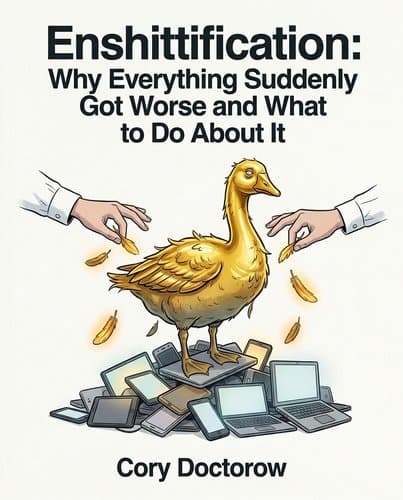
222376640_enshittification
by Cory Doctorow
Platforms don't rot randomly—they follow a predictable decay cycle where companies first betray users, then partners, then everyone.
In Brief
Platforms don't rot randomly—they follow a predictable decay cycle where companies first betray users, then partners, then everyone. Doctorow names the exact legal, economic, and regulatory weapons used to lock you in, and the four levers ordinary people can pull to fight back.
Key Ideas
Platform degradation follows predictable abuse patterns
When a platform starts degrading, name the stage: is it abusing users to help business customers, or abusing business customers to claw back everything for itself? The lifecycle is predictable and diagnosable.
DMCA weaponization criminalizes your own device
'It's not a crime if we do it with an app' is a deliberate legal strategy, not a gray area. Tech companies embed copyrighted code in products specifically to make your use of your own property a federal felony under DMCA Section 1201.
Lock-in is feature, not side effect
High switching costs are a design choice, not a side effect. When a platform makes leaving painful — stripping data portability, killing API access, banning forwarding addresses — that's the product working as intended.
App store thirty percent is monopoly rent
The 30% App Store tax is not a payment processing fee (which runs 2–5%). It is rent extracted because Apple and Google control the land you must build on. Every app price increase you've seen is this tax passed to you.
Algorithms find minimum wage workers accept
Algorithmic 'personalization' on gig platforms isn't about matching you to good jobs — it's about finding the minimum pay you'll accept before quitting. Drivers who accept every job signal they're easy pickings and get wages cut.
Competition enables effective regulatory oversight
Effective regulation requires competition. When five firms run an industry, they stop competing and start coordinating their stories to regulators. The adversarial truth-telling that makes regulation work only happens when companies are fighting each other.
Interoperability rights require delegable implementation
Interoperability rights are useless if they can't be delegated. A law that lets you individually jailbreak your device but makes it illegal to tell anyone how, or to use a tool someone else built, is a decorative ornament, not a right.
Antitrust enforcement reverses platform monopoly power
The antitrust lever can be pushed back. Concrete wins — the EU's Digital Markets Act, South Korea cracking the App Store monopoly, Colorado's wheelchair repair law, Apple's capitulation on RCS — prove the rot is reversible.
Who Should Read This
Readers interested in Policy and Artificial Intelligence, looking for practical insights they can apply to their own lives.
Enshittification: Why Everything Suddenly Got Worse and What to Do About It
By Cory Doctorow
15 min read
Why does it matter? Because the platform decay you're experiencing isn't a bug — it's the product.
You probably think Facebook got worse because Zuckerberg made some bad calls. A few misguided pivots, a culture that lost the plot, maybe the inevitable entropy of a big company that forgot what made it good. Understandable assumption. Also completely wrong. The deterioration wasn't drift — it was clockwork. Every major platform has run the same three-stage lifecycle: seduce users, then squeeze them to attract business customers, then squeeze those customers to claw everything back for shareholders. Cory Doctorow calls this enshittification. Same mechanism, same sequence, same terminus, every time. What kept it from happening sooner wasn't better leadership or nobler intentions. It was four specific protections — competition, regulation, interoperability, and worker power — that held the lever stuck. This book is the story of how each was methodically dismantled, who did it, and exactly what it would take to jam the lever again. Along the way you'll meet the reverse-centaurs working under algorithmic supervision (humans completing the tasks machines can't quite finish, not the other way around), the chickenized sellers trapped in Amazon's supply chain the way contract poultry farmers are trapped by Tyson, and the legal doctrine of felony contempt of business model, which explains why your repair shop can't fix your own tractor.
The Three-Stage Lifecycle That Explains Why Every Platform You Loved Eventually Betrayed You
Platform decay feels like betrayal because we keep explaining it the wrong way. We blame bad leadership, a culture shift, the wrong CEO — as if Facebook got worse because Mark Zuckerberg had a bad decade. The rot follows a script, the same script, every time, across every platform you've watched curdle. The decay isn't a malfunction. It's the business model running exactly as designed.
Cory Doctorow calls this lifecycle enshittification, and it moves in three predictable stages. First, a platform lavishes value on ordinary users to get them in the door. Then it quietly withdraws that value to court advertisers and business partners. Finally, it squeezes those business partners too, extracting everything it can while users stay trapped.
Facebook's rise illustrates the trap with uncomfortable clarity. When the platform opened to the public in 2006, it made an explicit privacy promise: unlike MySpace — then owned by Rupert Murdoch and widely understood as a surveillance machine — Facebook would show you only what the people you chose to follow actually posted. That was a real offer, funded by investor cash, the surplus a young platform burns to buy loyalty before it figures out how to extract value. (To sweeten the migration, Facebook even built a bot that would scrape your MySpace messages and deposit them in your Facebook inbox, so you didn't have to choose between a cleaner experience and the friends you were leaving behind.)
Then the bridge burned — and that's where the trap reveals itself. The reason users couldn't leave later had nothing to do with product quality. It's a math problem. To exit Facebook, you don't just quit Facebook; you have to convince every person you care about to quit simultaneously and reassemble somewhere else. Each of those people has their own web of connections: a rare-disease support group, a Little League carpool, a lifeline to family abroad. Everyone's hostage to everyone else. The network effects that made the platform worth joining are the same force that makes it nearly impossible to leave.
Once Facebook sensed that critical mass was locked in, it moved to stage two: it told advertisers it had been surveilling users all along and offered that data for targeting. It told publishers it would push their content into strangers' feeds as a free traffic funnel. Then came stage three, the squeeze: ad prices rose while targeting accuracy fell, and publishers were gradually corralled into posting full articles on Facebook, then forced to pay to reach the followers they'd already earned.
What looks like a series of bad decisions is one decision, made at the beginning, paying out in stages. The platform you loved was the lure. The platform you're stuck with is the point.
Amazon's Search Engine Is Actually a Bribery Registry
When you type a query into Amazon's search bar, you're not using a search engine. You're browsing a bribery registry. Amazon generates $38 billion a year selling top placement to merchants — meaning the results you see first aren't the best matches for what you need, they're the ones that paid the highest fee to appear there. The first item in a typical Amazon search costs, on average, 29 percent more than the best match for your query. That best match is buried roughly seventeen positions down the page.
What makes this genuinely maddening: Amazon can still truthfully claim it has the lowest prices on the internet, because the lowest-priced item technically exists in the results — you just can't find it. Sorting by price doesn't help either, because savvy merchants game the display by offering, say, a four-pack at a per-unit cost that looks cheap until you compare it to a larger bundle buried three pages back. The deal is there. It's been systematically hidden behind everyone who paid not to be hidden.
The merchants doing the hiding didn't get rich building that maze. Amazon takes between 45 and 51 cents of every dollar a seller earns on the platform, once you add up Prime eligibility fees, fulfillment charges, and advertising spend. No legitimate margin survives that extraction, so sellers raise prices — everywhere, not just on Amazon. Amazon's contracts require merchants to match whatever price they charge on the platform across all their other channels. The result is that Amazon's fees are a hidden inflation tax on prices at Target, local hardware stores, and the manufacturer's own website. You pay the Amazon toll even when you never visit Amazon.
The fraud that fills the remaining space is the logical endpoint. Sellers who can't afford to cheat get buried. Sellers who can afford fake review campaigns — which run $10,000 or more and account for roughly 42 percent of Amazon reviews flagged by third-party audits — stay visible but need to charge more to cover the cost. Amazon profits either way, from satisfied customers and furious ones alike, so the incentive to clean any of it up is precisely zero.
Apple's Privacy Brand Was a Clearing Operation, Not a Promise
What if the whole 'Apple charges money so it respects you' argument was just the setup for a longer con?
For years, the cleanest story in tech was this: Google harvests your attention and sells it to advertisers, while Apple sells you hardware and therefore wants you happy. The logic seemed airtight. A company paid in dollars has every reason to make a product worth buying. A company paid in eyeballs has every reason to keep you agitated and scrolling. Apple even proved the theory in 2021, when it introduced a single toggle — flip it, and every third-party app on your phone was blocked from tracking you. Ninety-six percent of iPhone users flipped it immediately. Facebook alone estimated it would lose $10 billion in the first year.
That looked like a company putting its money where its mouth was. It was a demolition crew clearing a construction site. Right around the time Apple was running global ad campaigns about privacy, it was quietly building its own data collection infrastructure — gathering the same behavioral information it had just blocked Facebook from gathering, for the same purpose: selling targeted advertising. The premium price tag was never a privacy rebate. It was the entrance fee to a walled garden Apple was planning to monetize on its own schedule.
The same logic consumed app developers. Apple's original pitch to small software makers was generous: sell through the App Store, pay a modest initial fee, keep your revenue. Developers flooded in. Each new app made iPhones more valuable; each new iPhone meant more potential customers. The network locked tight — then Apple changed the terms. The take rate doubled to 30 percent of every dollar, forever. Telling your own customers they could pay through a website and save money became grounds for removal from the store. An indie audiobook retailer selling a $25 title now owes Apple $7.50 in fees on a margin that only ever had $5 in it. Apple's own competing app pays none of that.
The privacy brand didn't describe Apple's values. It described its timing.
People Stay on Twitter Because They Love Each Other, Not the Service — and That's the Trap
Picture Tevye from Fiddler on the Roof watching his village scatter. The shtetl of Anatevka is freezing, poor, and regularly trampled by the czar's soldiers — nobody with options would choose to stay. But in the final scene, as the purge order forces everyone out, the villagers realize the horror isn't leaving Anatevka. It's losing each other. The community is the thing, and they're about to lose it.
That's why hundreds of millions of people are still on Twitter, wading through feeds packed with scam ads, shock images, and content moderation gutted when Elon Musk fired most of the team responsible for it. They're not there because they like the service. They're there because they like each other — and the cruelest irony lands on the people who most need to leave. Marginalized communities, activists, organizers: the ones who built networks on Twitter precisely because those networks kept them safe are now the ones who can least afford to abandon them. Leaving during a democratic emergency means losing the community that helps you survive one.
Musk understood this. The moves he made after the acquisition weren't neglect — they were architecture. He blocked users from listing rival platforms like Mastodon or Bluesky in their profiles, then killed the API tools that let people find their Twitter contacts on whichever alternative they migrated to. Before the ban, a migration tool could pull your full following list and rebuild it on Mastodon in minutes. After the ban, leaving meant starting over from zero — invisible, alone, shouting into an empty room. He stripped readable headlines from link previews, making the platform worse for publishers, then offered to let them post full articles on Twitter instead, knowing that surrendering your own site's traffic is a trap most of them had already learned to avoid from Facebook.
Every one of these moves had the same point: not to improve anything, but to raise the price of departure. A platform doesn't need to be good. It just needs to make leaving cost more than staying.
The Enshittification Lever Was Always There — Four Things Kept It Stuck
Think of a pressure valve. The valve itself doesn't create pressure — the pressure was always there, built into the system. What the valve does is prevent the pressure from destroying everything. Remove the valve, and the outcome isn't a mystery; it's physics.
Doctorow identifies four parts to that valve: the threat of competition, the threat of regulation, the capacity of workers to organize, and the ability of users to leave. Take competition alone — in 1980, the U.S. airline industry had a dozen major carriers; by 2015, four airlines controlled 80 percent of domestic seats. His argument is not that tech executives got worse. It's that all four were systematically removed, and what you're watching now is the pressure doing what pressure does.
The competition piece came off first. Starting in the late 1970s, every U.S. administration quietly stopped enforcing antitrust law as written. Companies figured out fast they were pushing on an open door. The merger wave that followed was so total that most industries shrank to five firms or fewer — eyeglasses, sea freight, beer, payment processing. And once an industry shrinks to five players, something specific happens: the collective action problem that keeps hundreds of competitors from coordinating disappears overnight. Five executives who've worked at each other's companies, whose kids go to the same schools, whose bonuses depend on the same market conditions — five is a cartel, not a market.
Google's internal history shows exactly what happens when a company absorbs the lesson that it cannot lose. For years, Ben Gomes, who had spent two decades helping build Google Search into something genuinely useful, ran the product with a mandate to make it better. Then Prabhakar Raghavan, the company's head of advertising, pushed through a different logic: deliberately degrade search results so users need multiple queries to find anything, generating more ad impressions per question asked. Gomes was sidelined. The internal memos documenting this fight later surfaced during the Department of Justice's antitrust lawsuit, where they read like a slow-motion record of a company deciding that the fear of being beaten had vanished, so the only remaining question was how fast to extract value from people who had nowhere else to go.
The same engineers were there. The same search index existed. What changed was that the valve — the possibility that a genuinely better search engine could take Google's place — had been removed by tens of billions of dollars in annual payments to own every default search box on every device. Once the valve was gone, the pressure found its natural outlet.
'It's Not a Crime If We Do It With an App' — How Tech Escapes the Law
Tech companies occupying some fuzzy frontier of law, outpacing regulators who can't keep up with innovation — that's the flattering story. The accurate one is simpler and uglier: they chose a legal architecture that makes their own lawbreaking invisible and anyone else's attempt to fix it a felony.
The HP ink cartridge is the cleanest example. Your printer is, technically, your property — which would seem to settle the question of whose business it is whether you refill your cartridge with cheap generic ink. HP would like you to believe it's theirs.
Here's the mechanism. HP embeds a chip inside each cartridge. That chip runs a small authentication program, and that program counts as a copyrighted work. When your printer and cartridge do their recognition handshake, they're technically 'accessing' that copyrighted work. DMCA Section 1201 — an anti-circumvention law signed in 1998 — makes it a federal crime to bypass any digital lock protecting a copyrighted work. So when you refill a cartridge, you're not committing fraud or theft. You're triggering a federal statute that carries a five-year prison sentence and a $500,000 fine. HP didn't lobby Congress to ban refilling ink cartridges. It just designed the cartridge so that refilling one touches a copyright law that already existed, then pointed at the result and called it a product feature.
This is what 'felony contempt of business model' looks like in practice — a phrase coined by Jay Freeman, who built the app store that iPhone users used to escape Apple's ecosystem before Apple made escape illegal. It's also why companies push so hard to move every interaction into an app rather than a website. A website is relatively open; anyone can build a tool that makes it work better for you. An app is a website wrapped in enough IP law that building such a tool — an ad-blocker, a price tracker, anything that tilts the experience toward you instead of the company — risks prosecution under the DMCA, the Computer Fraud and Abuse Act, patent law, and trademark law simultaneously. The app doesn't just deliver the service. It converts the legal ground beneath the service into private property that only the company can defend — and your attempt to fix it into a crime.
The Algorithm Isn't Watching You to Serve You — It's Watching You to Find Your Breaking Point
An Uber driver named Sarah has figured out the trick. She declines rides that don't pay well, waits for surge pricing, treats the app like a negotiation. And it works. Her hourly earnings climb. So she starts accepting more rides, because why wouldn't you? Things are going well. Within a few weeks she's taking almost every offer that comes in, working longer hours, making roughly the same money she made before she learned the trick. She assumes she's hit a plateau. The algorithm assumed something else entirely: that she'd found her floor.
Legal scholar Veena Dubal spent years doing fieldwork with rideshare drivers and identified the mechanism behind what felt like coincidence. Uber's algorithm recalculates each driver's pay rate every time a job is offered — not one rate for all drivers nearby, but individual rates based on behavioral history. Drivers who decline jobs regularly, the 'pickers,' get baited with higher rates on the next offer. Drivers who accept everything, the 'ants,' get their rates walked down in small, randomly timed increments so the erosion is hard to detect. The cruel irony Dubal documented: the drivers who considered themselves best at the job — the ones who showed up reliably, accepted every request, tried hardest to please the platform — were precisely the ones getting paid least. Their diligence was the signal the algorithm was looking for. It meant they'd found their breaking point already.
The wage cuts aren't dramatic. That's the point. If your rate dropped by half overnight, you'd notice and quit. Randomized small reductions, spread over weeks, feel like normal variability. Dubal found driver forums full of people confidently comparing notes on peak hours and acceptance rates while their actual take-home drifted steadily downward. Some drove until they couldn't stay awake, slept in their cars, got back on the road, and blamed themselves for the shortfall.
Doctorow is careful to say the algorithm isn't doing anything exotic. It's a simple game — test, measure, adjust — run continuously and without fatigue. A human manager capable of repricing each worker's labor in real time, based on their latest behavioral signals, would need to be everywhere at once. An app is everywhere at once. Doctorow calls this obfuscation rather than innovation: the underlying idea is ancient (exploit workers' desperation), the app just dissolves the practical barriers that made it unfeasible at scale. The workers in this arrangement are reverse-centaurs — not humans augmented by machines, but humans whose judgment has been subordinated to an algorithm that decides, moment to moment, what their labor is worth.
This is what the algorithm is actually for. Not to match you with what you want, not to optimize some mutual outcome — to locate the minimum you'll accept before you stop, and then offer you precisely that. Every adjustment is a question: will you still be here if we give you a little less? The answer, for a driver who's already refinanced her car for a platform that classifies her as a contractor and owes her nothing, is almost always yes.
Google Spent $70 Billion to Make Its Own Shares More Expensive — Then Fired 12,000 People the Same Year
The 2023 tech layoffs were not a response to financial distress. They were a bill that companies paid gladly to break the last internal check on enshittification.
Consider what Google actually did in the span of a few months. The company spent $70 billion buying back its own shares — a maneuver that makes share prices rise not by creating anything valuable, but by reducing the number of shares in circulation so each remaining one is worth more. Google didn't announce a new product. It didn't find new customers. It deleted $70 billion from its own balance sheet and watched its stock climb 13 percent within hours. Then, weeks later, it announced layoffs of 12,000 workers. That buyback would have paid every one of those workers for 27 years. The firings weren't a fiscal emergency. They were a purchase — specifically, the purchase of the right to enshittify without internal resistance.
For years, Google's engineering staff had been the one force management actually feared. Workers had forced the cancellation of a censored search engine for China. They had killed a military drone contract worth almost nothing in revenue. They had walked out en masse over a $90 million payout to an executive credibly accused of sexual abuse. Every time Google management tried to trade mission for margin, workers made the cost of that trade visible and embarrassing. The 'Don't be evil' ethos wasn't a corporate value — it was a labor relations problem.
Mass layoffs solved it. When you fire 12,000 people from a company posting record profits, the survivors get the message without anyone having to send a memo. A venture capitalist texting Elon Musk during the Twitter takeover put the logic with unusual candor: a two-day office requirement would drive out 20 percent of workers voluntarily. 'Sharpen your blades boys.' The blade isn't metaphorical. It's the gap between your mortgage and your next job offer.
The Cure Exists: Every Time Someone Pushed Back, the Platform Actually Blinked
James Gill was a teenager with time on his hands and a copy of Apple's iMessage running on his workbench. What he wanted was simple: a way for iPhone and Android users to send each other encrypted messages instead of the ancient, utterly defenseless SMS protocol that Apple silently substituted whenever two people on different devices tried to 'text.' Apple had refused to build one. So Gill reverse-engineered iMessage himself, cracked it open, and handed the result to a company called Beeper. They shipped an Android app. Apple assigned engineers to kill it. Each time Beeper found a new route in, Apple patched it. The arms race ran for weeks before Beeper stepped back — and then Apple, stung by the PR wreckage and staring down an EU mandate requiring open messaging, quietly added RCS support to iPhones. The thing Apple had insisted was technically or philosophically impossible turned out to be a weekend's work once the shame and the regulatory deadline arrived in the same month.
That's the rebuttal to TINA — There Is No Alternative. There is always an alternative. The question is whether the cost has been made artificially high by law, by market power, or by corporate inertia, and whether someone is willing to pay it anyway.
Sometimes that someone is a state legislature. Colorado passed a law in 2024 protecting the right to repair powered wheelchairs — the kinds of chairs that strand people in their homes for weeks when a private-equity-gutted repair monopoly can't get a technician out. The law banned parts-pairing and DRM in wheelchairs sold in the state. Colorado can't rewrite the federal law that lets manufacturers invoke copyright against repairers. But it can refuse to let those manufacturers sell in Colorado if they use the mechanisms that federal law protects. Manufacturers who screamed about impossible supply-chain complexity discovered that making a single repairable product for every market was cheaper than maintaining two.
The UAW found the same lever inside its own rulebook. Reform candidates who'd memorized the rulebook forced a fair leadership election in 2023. Shawn Fain won, then led a simultaneous strike against all three major American automakers — Ford, GM, and Stellantis settled, and for the first time in a generation, autoworkers got cost-of-living adjustments written back into their contracts. Fain has since aligned every UAW contract to expire on May 1, 2028, a date that sits in the middle of a presidential election and that he'd like every other union in the country to match.
The platform blinks. The law moves. The lever pushes back. None of this is easy, and none of it is finished. But the last section of Doctorow's argument is the shortest, because the evidence is already there: every time someone pushed, something gave way.
The Lever Was Never Inevitable
The people who built the good internet didn't become different people. They were always capable of this — the extraction, the lock-in, the algorithmic patience-testing — and in a few cases they were already doing it, quietly, while the brakes still held. Competition made it costly. Regulation made it visible. Workers made it embarrassing. Users could leave. Remove those four things and you don't get a different kind of person; you get the same person with nothing in the way.
That's the uncomfortable reframe Doctorow leaves you with. The internet isn't the most important fight right now — climate is, or democracy is, or the slow economic strangulation of everyone who doesn't own assets. But those fights will be organized, funded, and coordinated on this infrastructure, through these platforms. Won or lost by communities that can either reach each other or can't. You already know what it feels like when they can't — when the Facebook algorithm stopped showing you the local mutual aid group, when the search results buried the independent clinic three pages under sponsored links. The enshittified internet isn't a distraction from the serious work. It's the terrain.
Notable Quotes
“Please show our ads to eighteen-to-thirty-four-year-old man-children in the five boroughs of New York who own Xboxes and have searched for gonorrhea-related information in the past three weeks”
“I just got a click from a boomer in rural West Virginia who is signed up to a Medicare Advantage plan and recently searched for information on reverse mortgages”
“Work for a big, lumbering company for a few years, then strike out on your own and do a ‘startup’ with the intention of being rehired by your old employer or one of the other giant tech firms.”
Frequently Asked Questions
- What is enshittification according to Doctorow?
- Enshittification is the predictable degradation of digital platforms caused by systematically dismantling four structural protections: competition, regulation, interoperability, and labor power. Doctorow traces a diagnosable lifecycle where platforms first abuse users to help business customers, then abuse business customers to extract maximum value for themselves. This isn't accidental decay but results from deliberate legal and technical choices embedded in platform design from inception. The book provides frameworks for diagnosing each stage and identifying concrete policy levers to reverse the degradation.
- Why are switching costs deliberately engineered into digital platforms?
- High switching costs are intentionally designed features, not accidental side effects. When platforms strip data portability, kill API access, and ban forwarding addresses—making leaving painful—'that's the product working as intended,' according to Doctorow. The 30% App Store tax provides another example: it isn't payment processing (2–5% cost) but rent extracted because Apple and Google control the distribution channel. Users ultimately bear this tax as price increases. These design choices create vendor lock-in, forcing users to remain despite platform degradation.
- How do gig platforms use algorithms to suppress worker wages?
- Algorithmic 'personalization' on gig platforms isn't designed to match workers with good jobs—it identifies and exploits desperation. Doctorow reveals the system works by 'finding the minimum pay you'll accept before quitting.' Workers who accept every job signal vulnerability; platforms respond by cutting wages. This isn't neutral matching but systematic wage suppression, treating labor as a resource to squeeze. It exemplifies how platforms abuse business customers (gig workers) in the enshittification cycle, progressively degrading work conditions to extract maximum value while workers have minimal power to resist or exit.
- What concrete examples show enshittification can be reversed?
- Platform degradation can be reversed through antitrust action and regulatory intervention. Doctorow provides concrete examples: the EU's Digital Markets Act, South Korea cracking the App Store monopoly, Colorado's wheelchair repair law, and Apple's capitulation on RCS. However, effective regulation requires competition—when few firms control an industry, they coordinate stories to regulators rather than engaging in adversarial truth-telling. Interoperability rights must be delegable; if a law permits individual action but prohibits sharing knowledge, it becomes decorative rather than functional.
Related Book Summaries
Read the full summary of 222376640_enshittification on InShort