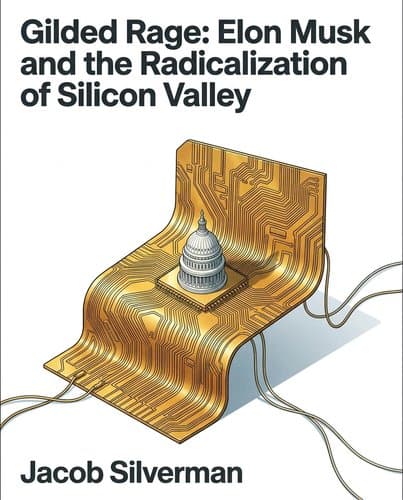
222377033_gilded-rage
by Jacob Silverman
How a decade of cheap money, social media capture, and interlocking billionaire networks transformed Silicon Valley's disruption mythology into actual state…
In Brief
How a decade of cheap money, social media capture, and interlocking billionaire networks transformed Silicon Valley's disruption mythology into actual state power—and why Elon Musk's purchase of Twitter was less a free-speech crusade than the opening move in an oligarchic takeover hiding in plain sight.
Key Ideas
Shareholders, not manifestos, define platform reality
Follow the shareholder list, not the manifesto: the unsealed X ownership roster — Qatari sovereign wealth fund, Binance, Saudi prince — tells you more about what Musk's platform actually is than anything he's said about free speech.
ZIRP concentrated wealth among resentful elites
ZIRP created the preconditions: a decade of near-zero interest rates generated a class of extraordinarily wealthy men whose fortunes were decoupled from productive output, making them simultaneously powerful and resentful — the specific combination that drove radicalization.
San Francisco recall playbook scales nationally
The San Francisco recalls were a proof of concept: the mechanics refined there — funded recalls, interlocking nonprofits, controlled local media, billionaire-backed candidates — were explicitly described by David Sacks as a 'playbook to be replicated across the country,' and they were.
Thiel's infrastructure survives beyond personal involvement
Thiel's influence is structural, not personal: by investing in people (Vance, Sacks), institutions (Project 2025 architects), and ideas (The Sovereign Individual, Network State), Thiel built an infrastructure that continues to operate whether or not he writes a check this cycle.
Donor meetings now set presidential policy
When a president's stated policy flips after a single donor meeting, that's not lobbying — it's purchase: Trump's reversal on TikTok after meeting Jeffrey Yass, and his 'strategic Bitcoin stockpile' promise after crypto PACs spent $204 million, are the clearest illustrations of how policy is now set.
Twitter takeover rehearsed federal governance tactics
The DOGE playbook was already published: Musk's Twitter takeover — the subpoenaed transition team, the mass firings, the 2 a.m. engineering orders, the elimination of trust-and-safety infrastructure — was a rehearsal for federal governance, and anyone paying attention had the script in advance.
Who Should Read This
Readers interested in Geopolitics and Policy, looking for practical insights they can apply to their own lives.
Gilded Rage: Elon Musk and the Radicalization of Silicon Valley
By Jacob Silverman
10 min read
Why does it matter? Because what looked like a political surprise was a decades-long rehearsal for oligarchy.
The easy story is cultural drift — a few billionaires got annoyed about pronouns and mask mandates and drifted rightward. Satisfying, a little smug, and almost entirely wrong. The actual story runs through a subpoenaed shareholder list with ninety-five entries, a Saudi prince's rolled-over billion-dollar stake, and fifty Tesla autopilot engineers quietly redirected to gut a social media company's trust and safety team at two in the morning. It runs through a $510 million lawsuit filed against farmers for texting their neighbors, and a crypto PAC that spent $135 million buying Senate seats before the ink dried on a fraud conviction. What Jacob Silverman documents isn't a mood shift — it's a mechanism. Once you see how the specific pieces actually fit together, the chaos stops looking like chaos.
The Myth of the Liberal Tech Utopia Cracked the First Time It Was Tested
In December 2016, weeks after backing Hillary Clinton, the CEOs of Apple, Google, Microsoft, Amazon, and a dozen other tech giants rode elevators to the Trump Tower conference room and sat down smiling across from the man they had spent months hoping to defeat. The scene was convivial, almost theatrical — executives introducing themselves for cameras while Trump, hands on the table, told the assembled billionaires there was nobody like them in the world. They nodded. The transaction was complete before anyone had ordered lunch.
The person who arranged that room was Peter Thiel, the venture capitalist and PayPal co-founder who had spent years cultivating Silicon Valley's contrarian chair. The most revealing detail of the summit wasn't who was there — it was who Thiel brought with him. Alex Karp, CEO of Palantir, was seated among the leaders of companies worth hundreds of billions of dollars, even though Palantir was still private, still unprofitable, and had no business at that table by any measure except one: Thiel had co-founded it, invested in it, and needed a Trump administration friendly to government surveillance contracts. Within four years, Palantir went public and rewarded its insiders handsomely. The summit looked like Silicon Valley making peace with a new president. It was Thiel spending political capital he had personally accumulated.
The story most people tell about Silicon Valley's rightward shift begins with resentment, or with Trump's election forcing a reckoning. Thiel's calendar tells a different story. The alliance was constructed before Trump won, by someone with concrete financial reasons to want it built.
Cheap Money Created a Class of Men Who Felt the Rules Didn't Apply to Them
The rightward turn of Silicon Valley's billionaire class gets framed, constantly, as a story about ideas — men driven to the edge by 'woke' excesses, campus protests, and pronouns in email signatures. That framing flatters everyone involved. The more accurate account starts with money: a decade of near-zero interest rates that the Federal Reserve maintained from 2008 through 2021. When borrowing costs are effectively zero, capital flows to whoever has the best pitch, not the best product. That policy minted a generation of billionaires who had learned, at a structural level, that the rules governing ordinary economic risk didn't apply to them. When those rules began reasserting themselves, the response looked like ideology. It was closer to panic.
The clearest illustration is the SVB crisis of March 2023. Silicon Valley Bank, the primary lender to tech startups, collapsed after poor interest-rate bets wiped out its capital cushion — a self-inflicted wound from the very rising rates that ended the cheap-money era. Among its depositors were some of the most vocal free-market evangelists in the country. David Sacks, a venture capitalist who had spent years railing against government overreach and progressive politics as the root of San Francisco's decay, erupted on social media in capital letters demanding an immediate federal rescue. His argument wasn't that SVB was too important to fail in some abstract systemic sense; it was that his portfolio companies kept their money there and he wanted it back. Within days, the FDIC stepped in and guaranteed deposits well beyond the standard insured limit of $250,000, meaning wealthy tech investors were made whole at public expense. Sacks's response to this extraordinary intervention was to complain that it had taken too long and that there had ever been any doubt. The man who had loudest proclaimed his contempt for the administrative state had just organized, successfully, to extract a bailout from it. The ideology was real enough, but it dissolved the moment it became expensive.
Peter Thiel Spent Thirty Years Building the Infrastructure for This Moment
Peter Thiel has been running venture logic in the political sphere since the early 1990s — not betting on any single candidate, but building a portfolio over decades, counting on the winning bet to pay off everything that came before it. By 2024, the portfolio had vested.
The clearest ledger entry is JD Vance. In 2011, Vance was a Marine veteran navigating Yale Law School — a place that existed, he later admitted, to produce federal clerks and white-shoe law partners — when Thiel came to give a talk about escaping the credential treadmill. For Vance, whose beliefs were still taking shape, it was a formative rupture. He reached out afterward. Thiel responded. From that moment forward, Vance's career was less a meritocratic climb than a managed ascent: a job at Thiel's Mithril Capital, then backing from Thiel to launch his own venture firm, Narya — named after a Tolkien artifact — then fifteen million dollars to fund his 2022 Ohio Senate run. An insider who watched the campaign told the New York Times, plainly, that the backing was 'a favor for Peter.' When Vance was selected as Trump's running mate in 2024, he became the first millennial on a presidential ticket and the presumptive heir to the MAGA movement. He owed the entire arc to one afternoon talk in New Haven.
Thiel's 2023 public statement — that his 2016 Trump support had been 'an experiment gone haywire' — was widely read as a man stepping back from the political project he'd built. That reading requires ignoring what the project actually looks like. Vance was embedded in the White House. David Sacks, Thiel's co-author from their mid-nineties culture-war handbook at Stanford, was installed as the administration's artificial intelligence and crypto czar. Calling it an experiment suggests contingency, accident, something that could have gone otherwise. The infrastructure says the opposite: three decades of patient construction, and by 2025, every door Thiel had unlocked was standing open.
X Is Not a Public Square — It's a Political Weapon With an Algorithmic Trigger
The Sunday after Super Bowl LVII, President Biden tweeted that he was rooting for the Philadelphia Eagles. So did Elon Musk. Biden's tweet pulled roughly three times the views. Musk deleted his tweet, flew to California, and summoned engineers to fix the problem. At 2:36 in the morning, one of his cousins posted an all-hands message on Slack: high urgency, anyone who could write code or build dashboards, please help. Eighty engineers assembled in the middle of the night to manually retune the platform's algorithm, boosting Musk's posts by a factor of one thousand. Within days, users who had never chosen to follow him found his content colonizing the feed they thought belonged to their own choices. A platform serving hundreds of millions of people had been rewired, overnight, because its owner lost a vanity metric to a sitting president.
That's the mechanism. But the machine needed fuel, and tracing where the money came from dissolves any remaining notion that X is a private eccentricity. When a lawsuit forced the unsealing of X's shareholder list, what emerged was a roster of about 95 entities — venture capitalists, yes, but also the Qatari sovereign wealth fund operating through a shell called Q Tetris Holding LLC, and Binance, the crypto exchange that had just paid the Justice Department $4.3 billion to settle money-laundering charges. Most telling was Saudi Prince Alwaleed bin Talal, whose $1.89 billion stake rolled directly from the old Twitter into the new X without interruption. That continuity matters because the Saudi relationship with Twitter predates Musk by years: in 2015, the FBI warned Twitter that an engineer named Ali Alzabarah had been siphoning data from thousands of accounts and routing it to Saudi handlers who used it to track dissidents. When Twitter moved to confront him, Saudi officials helped him flee the country. Nearly a decade later, he remained on the FBI's most-wanted list and still had an account on X.
Musk inherited that relationship and deepened it. The platform's largest outside shareholder represents a government that murders journalists and imprisons satirists, and Musk has shown no interest in that tension because there is no tension — authoritarian capital and a personal amplification machine are not in conflict. They are the product.
The Billionaires Who Hate Government Used San Francisco as a Laboratory for Capturing It
What does it look like when billionaires stop complaining about government and start building a machine to replace it? In San Francisco, you can date the transition almost to the week.
In early 2022, a coalition of tech-backed donors poured more than $1.9 million into the campaign to remove three San Francisco school board members — extraordinary money for a low-turnout municipal race. David Sacks alone contributed around $75,000. Nearly 70 percent of voters chose removal, and the lesson the donor class took away had nothing to do with school policy. It was operational: elite anger, expressed in dollars and directed at a low-visibility target, could flip an election. Sacks then scaled the experiment. He pivoted to the campaign against district attorney Chesa Boudin, funding what he branded a war on 'The Killer DA' and contributing so heavily that at one point he accounted for nearly a third of all anti-Boudin donations. When Boudin was removed in June 2022, Sacks went on Tucker Carlson's show the following morning and said, without ambiguity, that 'this sort of playbook is going to have to be replicated across the country.' The recalls were never really about San Francisco. They were prototypes.
The infrastructure behind these campaigns was deliberately obscure. A web of interlocking nonprofits — GrowSF, TogetherSF, Neighbors for a Better San Francisco, and others — shared funding sources, personnel, and agendas while presenting themselves as unrelated grassroots groups. The Phoenix Project, a research outfit tracking dark money in San Francisco, counted more than $33 million flowing through this network between 2020 and early 2024, with roughly three-quarters of traceable donations originating from just 23 ultra-wealthy individuals. One of Boudin's successors, district attorney Brooke Jenkins, turned out to have been paid $153,000 by a nonprofit that had also bankrolled the recall that put her in office. The machine didn't just remove officials. It installed replacements.
The Private City in Honduras Explains What These Men Actually Want
The clearest way to understand what Silicon Valley's most powerful men actually want is to watch what they do when a democratic government tries to take something back from them. In 2022, Honduras's newly elected president, Xiomara Castro, moved to repeal a law that had allowed private operators to carve out semi-autonomous corporate city-states on Honduran soil. The response from one of those operators — a venture-backed enclave called Próspera, on the island of Roatan, funded by Sam Altman, Marc Andreessen, Peter Thiel, and others — was to sue the Honduran government for $10.7 billion in damages. That figure wasn't an accident. It exceeded Honduras's capacity to pay. The lawsuit wasn't a legal argument; it was a hostage situation.
Honduras had passed legislation in 2013, after years of lobbying by US tech figures and anti-tax ideologues, creating what were called Zones for Employment and Economic Development. A ZEDE wasn't a factory or a tax haven — it was a governance platform. Corporate operators got fifty-year control of Honduran land, with latitude to run it under their own rules. Medical experiments illegal in the United States were explicitly among the permitted activities. Próspera accumulated around $120 million in venture backing and began construction. When the democratic government that succeeded the one that had sold this arrangement decided it was a bad deal, Próspera didn't accept the verdict of Honduran voters. It reached for international trade law.
Then came the part that strips away any remaining libertarian framing. Two US senators — one Republican, one Democrat — wrote to the Secretary of State warning that repealing the ZEDE arrangement would constitute an assault on treaty obligations and devastate investor confidence. The men who built Próspera, who had spent careers arguing that government should step aside for innovation, were now mobilizing the full apparatus of American diplomatic and legal power to protect their private fiefdom from a sovereign nation's electorate. That's not an exit from government. That's government, redirected to serve owners rather than citizens.
Crypto Didn't Just Buy Politicians — It Completed a Merger Between Finance and the State
In Nashville in the summer of 2024, Donald Trump took the stage at the country's largest annual Bitcoin conference and promised to build a 'strategic national Bitcoin stockpile' — effectively pledging to use public money to prop up the holdings of the people sitting in the arena watching him. A few months earlier, Trump had met with Jeffrey Yass, a billionaire with a $40 billion stake in ByteDance, TikTok's parent company, who had spent years as one of the crypto industry's biggest political backers. Shortly after that meeting, Trump reversed his stated position on banning TikTok. The mechanism was naked: a single private financial position had flipped a president's policy in the open, with no pretense of public interest as cover.
The industry that produced this moment had been building toward it since the collapse of Sam Bankman-Fried's FTX in late 2022. Bankman-Fried had stolen roughly $8 billion in customer funds and pumped it into a political influence operation that reached about one-third of Congress, buying access and goodwill on both sides of the aisle. The government eventually dropped the most serious foreign corruption charges — involving an alleged $150 million bribe routed through Chinese intermediaries — to speed sentencing, a decision that meant even the prosecution of the fraud was shaped by political calculations. The presiding judge described what remained as the largest political financial crime in American history. Bankman-Fried went to prison. His rivals in the crypto industry looked at the wreckage and drew a lesson: not that the strategy was wrong, but that it had been run by the wrong person with stolen money. The Fairshake PAC — funded by Coinbase, Andreessen Horowitz, and other industry titans — raised $204 million and spent it methodically on congressional races, scoring wins for 48 crypto-aligned candidates in 2024. The man who had pioneered this exact playbook watched it succeed from a federal cell.
What had started as lobbying had become something structurally different: an industry converting its capital into a constitutional project, aiming to dismantle the regulatory agencies — the SEC, the CFTC — that stood between crypto and the banking system. The donors didn't just want friendly politicians. They wanted the architecture of financial oversight rebuilt around their product.
DOGE Was Just the Twitter Takeover, Replayed on the Federal Government
When Musk took over Twitter in October 2022, he sent in a strike team — Boring Company executive Steve Davis sleeping on an office couch, investor Antonio Gracias working the phones — and ran a brutal, improvisational purge: mass layoffs via late-night email, AI tools scanning employee output for ideological deviance, whole departments eliminated before anyone had a legal memo explaining whether they could do it. The lawyers figured it out afterward, or didn't. What looked like chaos was a methodology. Two years later, the same personnel, the same sequence of moves, and the same studied indifference to procedural obligation were redirected at the federal government. DOGE wasn't an experiment. It was a rerun.
Davis and Gracias, Musk's Twitter lieutenants, turned up as core figures in the DOGE operation — and so did the playbook. Federal employees were asked to submit weekly accomplishment lists to be evaluated by AI, a direct replication of the performance-review mechanism Musk had used to thin Twitter's workforce. Government websites were scrubbed of anything that read as ideologically suspect. Probationary workers — newly hired or recently promoted — were terminated in waves because their civil service protections were weakest, a legal seam Musk had learned to exploit on private payrolls and simply applied at public scale. Courts pushed back; some workers were reinstated; the disruption to essential services was documented and undeniable. It didn't matter. By the time the legal challenges caught up, the architecture of multiple agencies had already been hollowed out.
Joe Biden, in his farewell address, explicitly reached for Eisenhower's 1961 warning about the military-industrial complex and updated it for the present moment. Then, within days, he welcomed Trump to the White House with the words 'Welcome home.' Silverman treats that greeting as the book's most compressed irony: the man who had named the threat held the door open for it — cheerfully, in front of cameras. The guardrails everyone assumed would hold — institutional inertia, congressional oversight, the sheer complexity of the federal bureaucracy — turned out to be optional. The men who had rehearsed on Twitter knew that already. The rest of us were still learning.
The Guardrails Didn't Hold — Now What?
Here is what you are left holding after all of it: these men are not hypocrites in the way that word usually lands — implying a gap between what they say and what they believe. The more unsettling truth is that the financial interest and the ideological conviction are fused, indistinguishable even to them. That fusion is what made the project so difficult to interrupt. You cannot negotiate with a true believer, and you cannot shame a mercenary. When the same person is both, every guardrail assumes the wrong opponent. The courts found procedural violations; the agencies were gutted anyway. The press documented the seizures; the platforms that might have amplified the alarm were already captured. And the human cost of that capture is not abstract: a federal worker terminated at 2am by automated email, no explanation, no supervisor to call, health insurance gone by morning. Twitter was the rehearsal, the federal government was the performance — which means the question you should be carrying right now is simple and clarifying: what is the rehearsal that is happening today?
Notable Quotes
“Peter’s talk remains the most significant moment of my time at Yale Law School,”
“He was possibly the smartest person I’d ever met, but he was also a Christian,”
“He defied the social template I had constructed—that dumb people were Christians and smart ones atheists.”
Frequently Asked Questions
- What is Gilded Rage about?
- Gilded Rage traces how a decade of cheap money produced a class of billionaires who converted personal wealth into political infrastructure — and then into state power. Drawing on the Twitter acquisition, the DOGE playbook, and Peter Thiel's ideological network, it gives readers a structural account of how Silicon Valley's disruption ethos became a vehicle for oligarchy. The book examines the specific mechanisms through which technology wealth concentrated into political power and governance.
- How did near-zero interest rates lead to billionaire radicalization?
- A decade of near-zero interest rates (ZIRP) created the preconditions for billionaire radicalization by generating a class of extraordinarily wealthy men whose fortunes were decoupled from productive output. This combination of power and resentment—of having wealth without corresponding productive contribution—drove the specific radicalization that Silicon Valley experienced. The book argues that this economic condition was foundational to understanding how billionaires became willing to invest in political infrastructure and radical transformation.
- What is Peter Thiel's influence in Silicon Valley?
- Thiel's influence is structural, not personal. By investing in people (Vance, Sacks), institutions (Project 2025 architects), and ideas (The Sovereign Individual, Network State), Thiel built an infrastructure that continues to operate whether or not he writes a check this cycle. His network of funded individuals, think tanks, and ideological touchstones creates a self-perpetuating system of power and influence. This structural approach means his impact extends far beyond any single donor relationship or political cycle.
- What does the book mean by policy purchase?
- When a president's stated policy flips after a single donor meeting, that's not lobbying — it's purchase. The book cites Trump's reversal on TikTok after meeting Jeffrey Yass and his 'strategic Bitcoin stockpile' promise after crypto PACs spent $204 million as the clearest illustrations of how policy is now set. These examples demonstrate direct quid pro quo arrangements where billionaires explicitly purchase policy outcomes, rather than engaging in traditional influence or lobbying activities.
Related Book Summaries
Read the full summary of 222377033_gilded-rage on InShort